




Category: Clinical Insights
Core Research Direction: Modeled out-of-pocket costs to Medicare-insured US men of guideline-recommended erectile dysfunction treatments, and the access-barrier implications of high cost for lower-recommended modalities
Search Intent: For US men with fee-for-service Medicare and erectile dysfunction, what annual out-of-pocket costs are modeled for each AUA-guideline-recommended ED treatment, and how does Medicare coverage track those costs?
Platform: SANYUN Science Center
Evidence reviewed through: 2026-11-12
Executive Summary
A cost-modeling analysis in International Journal of Impotence Research set out to estimate annual out-of-pocket costs for men with erectile dysfunction covered by Fee-for-Service Medicare across treatments recommended by the 2018 American Urological Association guideline. Coverage policy was taken from the Medicare Coverage Database, out-of-pocket prices from the 2023 Centers for Medicare & Medicaid Services Final Rule where coverage existed, and from GoodRx or published literature otherwise, with those figures inflated to 2022 dollars.[1]
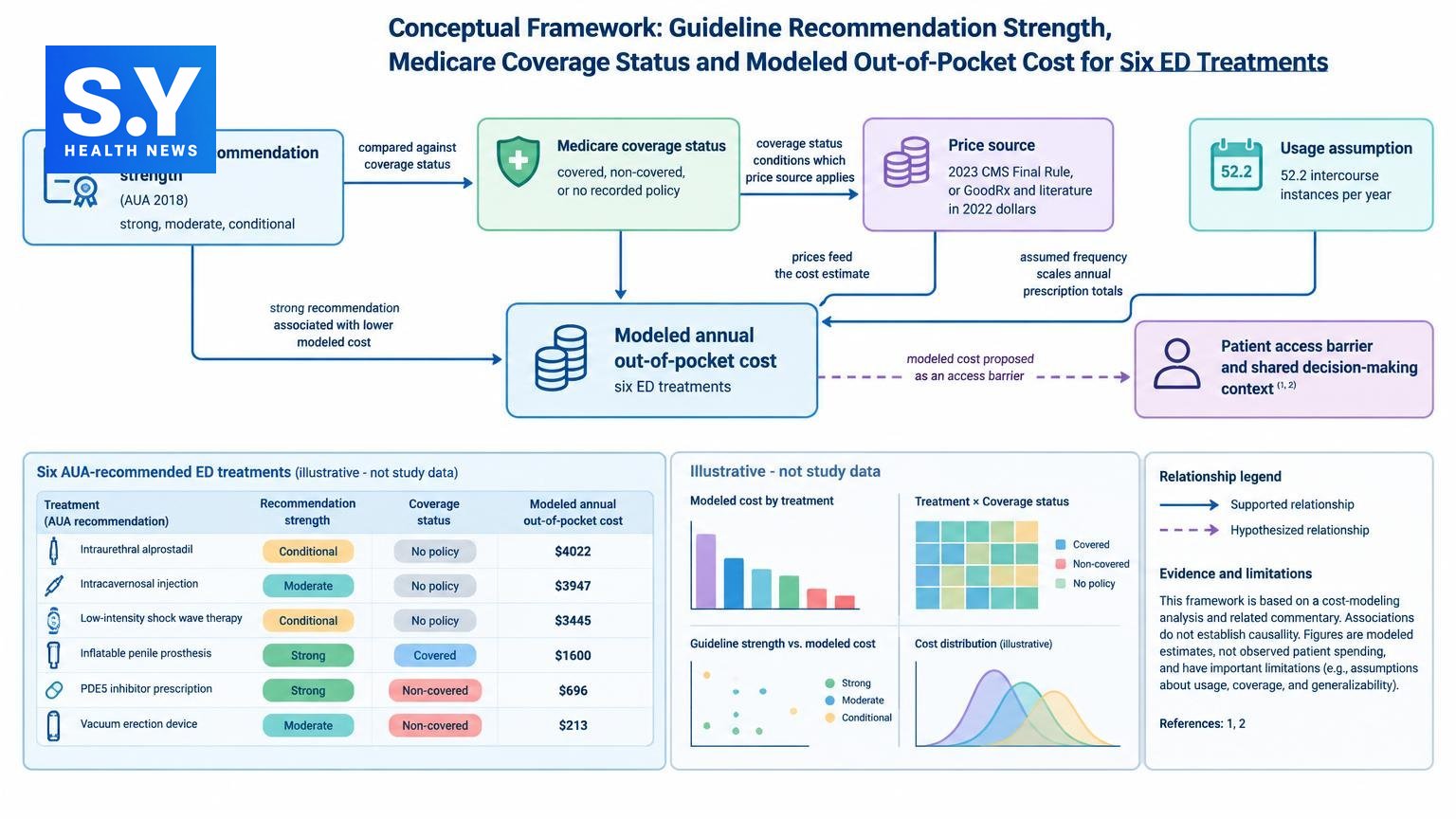
The modeled annual figures were $4022 for intraurethral alprostadil, $3947 for intracavernosal injection, $3445 for one low-intensity extracorporeal shock wave therapy course, $1600 for an inflatable penile prosthesis, $696 for a phosphodiesterase type-5 inhibitor prescription, and $213 for one vacuum erection device. Because these are modeled dollar amounts from a fixed usage assumption, they describe relative financial burden under stated conditions rather than observed spending by any individual patient.
The striking feature is the mismatch between guideline strength and cost. The two treatments carrying strong AUA recommendations — PDE5 inhibitors and inflatable penile prostheses — sat at the cheaper end of the modeled range, while the most expensive modalities carried moderate or conditional recommendations. Coverage did not consistently track cost either: Medicare covered the prosthesis but not PDE5 inhibitors, and had no policy recorded for injections, intraurethral alprostadil, or shock wave therapy.
Why Medicare Cost Modeling for ED Matters
Erectile dysfunction is common and, in the words of a published commentary on this analysis, chronically undertreated. The same commentary reports that only 10% of men living with ED undergo treatment, an estimate it attributes to an earlier epidemiological reference rather than to data generated in the cost analysis itself. That figure should therefore be read as secondary context: the denominator, setting, and era of the underlying study are not supplied in the available text, and it should not be generalized without checking the original source.[2]
Cost matters because it sits inside the decision, not outside it. The commentary argues that when coverage is not universal, as in the United States, potential financial burden takes on an emphasized role in most patients' treatment decisions. It further notes that physicians are generally unable to predict patients' out-of-pocket costs accurately even when given insurance plan details. Both statements are framed as commentary interpretation and secondary citation rather than as measurements in the modeling study, so they orient the question rather than settle it.
There is also a clinical stake. Untreated ED is associated in the commentary with psychosocial problems that can meaningfully impair quality of life, which is why the authors argue that barriers to treatment should be minimized. A cost model cannot demonstrate that a given price prevents a given man from seeking care, but it can quantify how wide the financial gap between options is — and that gap is what makes cost a legitimate part of shared decision-making.
How the Cost Model Was Constructed
This is a modeling analysis, not a claims-based cohort or a survey of patients' actual spending. The population frame was men with ED covered by Fee-for-Service Medicare. Treatments were selected by reference to the 2018 AUA guideline, and each treatment's Medicare coverage status was looked up in the Medicare Coverage Database. Where the Centers for Medicare & Medicaid Services Final Rule for 2023 supplied a price, that figure was used; where Medicare did not cover the treatment, out-of-pocket cost was drawn from GoodRx or the literature and inflated to 2022 dollars.
The annualization step is the assumption that shapes every drug-related total. Annual prescription costs were calculated using a published estimate of 52.2 instances of sexual intercourse per year. That is a fixed modeling input, not a measured consumption rate for the men in question. A patient who uses treatment less often would spend less; one who uses it more often, or who requires multiple doses per attempt, would spend more. The model produces a comparable annual benchmark across modalities; it does not predict an individual's bill.
Coverage status was also categorical rather than graded. Medicare coverage was recorded for inflatable penile prostheses, non-coverage for vacuum erection devices and PDE5 inhibitors, and no policy was identified for intracavernosal injections, intraurethral alprostadil, or low-intensity extracorporeal shock wave therapy. "No policy" is not the same as "covered" or "explicitly excluded," and it does not capture Medicare Advantage variation, supplemental plans, prior authorization, or step therapy — all of which can change what a patient actually pays.
What the Evidence Shows: Modeled Annual Costs
| Treatment (AUA recommendation) | Medicare coverage status | Modeled annual out-of-pocket cost | Interpretive note |
|---|---|---|---|
| Intraurethral alprostadil (conditional) | No policy identified | $4022 | Most expensive modeled option; uncovered price source inflated to 2022 dollars |
| Intracavernosal injection (moderate) | No policy identified | $3947 | Second most expensive; annual cost driven by the 52.2-use assumption |
| Low-intensity extracorporeal shock wave therapy (conditional) | No policy identified | $3445 | One course rather than an annual prescription; not directly equivalent to drug totals |
| Inflatable penile prosthesis (strong) | Covered | $1600 | Strong recommendation with the lowest modeled cost among procedural options |
| PDE5 inhibitor prescription (strong) | Non-covered | $696 | Strong recommendation, non-covered, yet among the lowest modeled annual costs |
| Vacuum erection device (moderate) | Non-covered | $213 | One device; lowest modeled cost overall |
Reading the table requires care about what is being compared. The drug and intraurethral figures are annual prescription totals built on 52.2 uses; the shock wave figure is one treatment course; the prosthesis figure is a device cost; the vacuum device figure is a single device. These are not equivalent units of care, and the model does not adjust for durability, retreatment, or the number of years a device remains in use. The $1600 prosthesis total and the $696 annual PDE5 inhibitor total are therefore comparable as annual out-of-pocket benchmarks only in the limited sense the authors intended — a common yardstick applied to different treatment types.
Within that framing, the analysis reports a clear pattern: PDE5 inhibitors and inflatable penile prostheses, the two treatments the AUA strongly recommends, were associated with lower out-of-pocket cost than the other assessed options. The word "associated" is doing real work here. The model shows co-occurrence of strong recommendation and lower modeled cost across the six treatments examined; it does not show that recommendation strength caused the price, nor does it test whether cost influenced which treatment men received.
Interpretation and Limitations
The central interpretive claim is modest and worth stating plainly: out-of-pocket cost may be a substantial access barrier, and the treatments with the weakest guideline backing were not the cheapest in this model. The commentary extends this to a practical point — that clinicians cannot reliably estimate these costs for patients, so the burden of financial navigation often falls on patients themselves. That claim rests on a cited study of physician cost-estimation accuracy that is not reproduced in the available text, so it is best treated as a plausible, externally sourced concern rather than a finding of this analysis.
Several limitations constrain how far the numbers travel. First, this is a cost model: every dollar figure is an estimate assembled from administrative pricing and retail or literature sources, not an observed expenditure by a defined cohort. Second, the 52.2-instance assumption standardizes annual drug costs but may misrepresent both low-frequency and high-frequency users, and it has no obvious analogue for a prosthesis or a single vacuum device. Third, the coverage snapshot comes from the Medicare Coverage Database at the time of analysis and will not capture every Medicare Advantage plan, supplemental policy, prior-authorization requirement, or subsequent coverage change. Fourth, the guideline anchor is the 2018 AUA guideline, so treatments recommended since then are outside the model's scope.
There is also a scope limitation that matters for equity: the analysis addresses Fee-for-Service Medicare specifically. Men covered through other arrangements, uninsured men, and men whose care is shaped by state Medicaid rules are not represented. Extrapolating these modeled figures to the general US population with ED would therefore overreach. The model answers a narrow, well-defined question — what would a Fee-for-Service Medicare beneficiary be modeled to pay out of pocket for each of these six treatments under stated assumptions — and it answers that question without claiming to describe real-world spending distributions.
Finally, cost is one axis of a multi-axis decision. The commentary lists efficacy, duration and convenience of treatment, personal values, and financial burden as factors patients weigh in shared decision-making. A cheaper option is not automatically the right option: a man who does not respond to or cannot tolerate oral therapy may need an injection, intraurethral therapy, or a device regardless of modeled price. The value of this analysis is that it makes the financial axis visible and quantifiable, not that it ranks treatments clinically.
Research and Policy Outlook
The analysis points toward several natural next questions rather than settled answers. One is validation: comparing modeled out-of-pocket estimates with observed spending in claims or patient-reported data would test whether the 52.2-use assumption and the retail price sources approximate real experience. Another is coverage design — whether the observed mismatch between guideline strength and coverage status, and between guideline strength and modeled cost, persists under current policy and across plan types. A third is communication: if physicians cannot reliably estimate out-of-pocket costs, then tools that surface plan-specific pricing at the point of prescribing become a testable intervention rather than an aspiration.
For readers, the practical takeaway is procedural rather than prescriptive. Modeled annual costs ranged from $213 to $4022 depending on modality, which means the choice among guideline-recommended options can carry a several-thousand-dollar difference in modeled annual out-of-pocket exposure. Patients navigating this should ask for plan-specific cost estimates, confirm whether a given treatment is covered, non-covered, or simply lacks a recorded policy, and discuss how often they expect to use a treatment, since usage frequency is the largest single driver of the modeled drug totals. None of this substitutes for individualized clinical advice.
Key Takeaways
- The analysis modeled annual out-of-pocket costs for six 2018 AUA guideline-recommended ED treatments in men covered by Fee-for-Service Medicare, using coverage data from the Medicare Coverage Database and prices from the 2023 CMS Final Rule or, where uncovered, GoodRx and literature inflated to 2022 dollars.
- Modeled annual costs were $4022 for intraurethral alprostadil, $3947 for intracavernosal injection, $3445 for one shock wave therapy course, $1600 for an inflatable penile prosthesis, $696 for a PDE5 inhibitor prescription, and $213 for a vacuum erection device.
- The two strongly recommended treatments — PDE5 inhibitors and inflatable penile prostheses — were associated with lower modeled out-of-pocket cost than the other assessed options, an associational pattern rather than evidence of a causal relationship.
- Medicare covered the inflatable penile prosthesis, did not cover vacuum erection devices or PDE5 inhibitors, and had no recorded policy for intracavernosal injections, intraurethral alprostadil, or shock wave therapy.
- Annual prescription totals rest on an assumed 52.2 instances of intercourse per year; because this is a fixed input, the drug figures are benchmarks rather than predictions of individual spending.
- All figures are modeled estimates from administrative and retail price sources; they are not observed patient expenditures, and coverage snapshots may not reflect Medicare Advantage variation or later policy changes.
Questions and Answers
What does the Medicare erectile dysfunction cost analysis measure?
It models annual out-of-pocket costs for men with erectile dysfunction covered by Fee-for-Service Medicare across six treatments recommended by the 2018 AUA guideline. Coverage policy came from the Medicare Coverage Database and prices from the 2023 CMS Final Rule or, for uncovered treatments, from GoodRx and literature inflated to 2022 dollars. It is an estimate, not observed patient spending.
Which erectile dysfunction treatments had the highest modeled Medicare out-of-pocket costs?
Intraurethral alprostadil was highest at $4022 per year, followed by intracavernosal injection at $3947 and one low-intensity shock wave therapy course at $3445. The inflatable penile prosthesis was $1600, a PDE5 inhibitor prescription $696, and one vacuum erection device $213. Drug totals assume 52.2 intercourse instances yearly.
Why were PDE5 inhibitors and penile prostheses the cheaper Medicare options despite strong guideline recommendations?
The analysis reports that PDE5 inhibitors and inflatable penile prostheses, both strongly recommended by the AUA, were associated with lower modeled out-of-pocket cost than the other assessed options. This is an associational pattern across six treatments under a specific pricing model, not evidence that guideline strength caused the price difference or that these options are clinically superior for every patient.
Does Medicare cover erectile dysfunction treatments included in this cost model?
Coverage was mixed. Medicare covered inflatable penile prostheses, did not cover vacuum erection devices or PDE5 inhibitors, and had no recorded policy for intracavernosal injections, intraurethral alprostadil, or shock wave therapy. Absence of a recorded policy is not the same as explicit exclusion, and the snapshot may not capture Medicare Advantage or supplemental plan variation.
What are the main limitations of the Medicare ED out-of-pocket cost study?
It is a model built from administrative and retail price sources rather than observed expenditures. Annual drug costs assume 52.2 intercourse instances per year, units differ across modalities (course, device, annual prescription), coverage reflects a single database snapshot, and the analysis is limited to Fee-for-Service Medicare and the 2018 guideline. Results should not be generalized to all US men with ED.
How should patients use modeled erectile dysfunction cost estimates in care decisions?
Treat them as benchmarks showing that modeled annual out-of-pocket exposure can differ by several thousand dollars between modalities, not as a personal quote. Ask for plan-specific estimates, confirm coverage status, and discuss expected usage frequency, since the 52.2-use assumption drives the drug totals. Cost is one factor alongside efficacy, tolerability, convenience and personal values in shared decision-making.
Conceptual framework: Conceptual framework – not a tested causal model. It organizes the six AUA-recommended ED treatments studied in a Fee-for-Service Medicare cost-modeling analysis by recommendation strength and coverage status, and shows how price sources and an assumed 52.2 annual intercourse frequency feed modeled annual out-of-pocket costs. The link from modeled cost to patient access is proposed, not demonstrated.
Academic References & Evidence
- V. Nguyen; A. M. McGovern; S. Rojanasarot; D. P. Patel; S. Bhattacharyya; L. M. Hargens; T. C. Hsieh. Patient out-of-pocket costs for guideline-recommended treatments for erectile dysfunction: a medicare cost modeling analysis. International Journal of Impotence Research. 2025 37(1):45-50 DOI: 10.1038/s41443-024-00903-9.
- Rosemary Iwuala; Omer A. Raheem. Comment on: Patient out-of-pocket costs for guideline-recommended treatments for erectile dysfunction: a medicare cost modeling analysis. International Journal of Impotence Research. 2024 DOI: 10.1038/s41443-024-00899-2.
SANYUN Science Center explains published research on men's reproductive and sexual health, connecting scientific evidence with everyday questions while making sources and limitations clear.
Disclaimer: This article is for scientific education and research communication only. It does not provide medical advice, diagnosis, or individualized treatment recommendations, and does not endorse any medication, supplement, device, penile enlargement procedure, or other intervention. Decisions about sexual and reproductive health should be made in consultation with a qualified healthcare professional. Do not delay seeking professional care because of information in this article.
Original Content & Copyright Notice
- This article is prepared for SANYUN Science Center, drawing on published research and publicly available academic literature on men’s sexual and reproductive health. Its editorial explanations and presentation are developed for this platform.
- Copyright in the original editorial content, selection, and arrangement is reserved by SANYUN Science Center to the extent protected by applicable law. Referenced research, quotations, and third-party materials remain subject to the rights of their respective owners. This notice does not claim ownership of scientific facts or third-party research.
- Except where permitted by applicable law or an applicable license, prior written permission is required to reproduce, republish, translate, adapt, redistribute, or commercially reuse protected content. Attribution alone does not grant permission for such reuse.
- For permitted quotation or authorized reuse, clearly identify the source and retain a link to the original article.
- Source: SANYUN Science Center
- Original URL: Retain the original article URL on science.san-yun.com.
- Copyright Holder: SANYUN Science Center, for its own protected editorial content.
- Quotation, excerpts, or authorized reuse must not distort the scientific meaning, omit material limitations or disclaimers, or imply unverified medical claims, product efficacy, or endorsement by SANYUN Science Center.



