




Category: Clinical Insights
Core Research Direction: Medication-associated sexual dysfunction in men: distinguishing drug effects from underlying disease, with emphasis on antidepressants (SSRIs/SNRIs) versus antihypertensive classes and practical management (PDE5 inhibitor co-use, no self-discontinuation)
Search Intent: When a man notices lower libido, weaker erections, or delayed/absent ejaculation after starting an antidepressant or blood-pressure medication, how much is attributable to the drug versus the underlying condition, and what does the available trial and meta-analytic evidence support for management without stopping the original medication?
Platform: SANYUN Science Center
Evidence reviewed through: 2026-11-06
Why This Matters
Sexual side effects are among the most common reasons men quietly stop psychiatric and cardiovascular medications, yet the assumption that a new symptom is the drug's fault is often only partly correct. Depressed and hypertensive men are already more likely to report low libido, erectile difficulty, and delayed ejaculation before treatment begins. The clinical question is not whether a drug can do this, but how likely it is in a given patient, what other causes are active, and which adjustments can address the sexual problem without abandoning effective treatment.[1]
This review pools the published evidence described in the source material: a 2026 European urology guideline's etiologic tables, meta-analyses of serotonergic antidepressants and antipsychotics, the long-term TOMHS hypertension trial, a 2022 network meta-analysis of antihypertensives, a small expectation trial, and a Cochrane review of PDE5 inhibitors for antidepressant-associated erectile dysfunction. It distinguishes statistical signals from clinical certainty and separates drug effects from disease effects wherever the design allows.[2][3]
The Biological and Clinical Rationale
The most coherent mechanistic account concerns the serotonergic antidepressants. SSRIs and SNRIs raise synaptic serotonin and are proposed to suppress dopaminergic outflow, which fits with the three-part symptomatic pattern: reduced desire, weaker or less reliable erections, and notably delayed or absent ejaculation. The ejaculatory delay is consistent enough that the same class is used off-label as a premature-ejaculation treatment, and the guideline lists serotonergic antidepressants among medication causes of delayed ejaculation.
The antihypertensive story is less straightforward than the pill-bottle label suggests. Beta-blockers have been proposed to blunt sympathetic drive and reduce penile vascular dilation, thiazides to lower blood volume and perhaps zinc-dependent testosterone synthesis, and centrally acting agents such as clonidine and methyldopa carry more documented negative reports but few controlled trials. These proposals are biologically plausible but unevenly supported; the strongest antihypertensive evidence, notably a large network meta-analysis, points to broadly neutral erectile effects across major classes.[4]
An often-overlooked third pathway is psychological expectation. In a small trial of 96 men with new cardiovascular disease and no prior erectile problems, all took the same beta-blocker (atenolol) for three months, but erectile problems occurred in 3.1% of men unaware of which drug they received, 15.6% of those told the drug name but not its side effects, and 31.2% of those told it might affect erections. This gradient argues that at least some of what patients experience as a drug effect is a nocebo response, and that counseling is itself part of the intervention.
What the Antidepressant Evidence Shows
The baseline burden of sexual dysfunction in depression is high. In 134 medication-naive patients with major depressive disorder, more than 40% of men reported reduced libido and 40–50% reported arousal difficulties, and a separate guideline-cited figure puts sexual dysfunction at about 60% among depressed patients. These numbers do not prove the disease is the only cause, but they mean a man who develops sexual symptoms on an SSRI was already at elevated risk before the first tablet.[5]
Against that background, the drug signal is still real. In a meta-analysis restricted to participants without baseline sexual dysfunction who were asked directly via questionnaire, new-onset sexual dysfunction exceeded placebo for sertraline, venlafaxine, citalopram, paroxetine, fluoxetine, duloxetine, escitalopram, fluvoxamine, tricyclic imipramine, and MAOI phenelzine, ranging roughly 26% to 80% depending on the drug. That range is wide because instruments and designs varied, but the direction is consistent and the placebo comparison is the key design strength.
Not all psychotropics behave alike. In the same meta-analysis, agomelatine, bupropion, moclobemide, and mirtazapine did not differ significantly from placebo for new-onset sexual dysfunction. This comparative information is useful for shared decision-making, but it carries an important caveat: a lower rate of sexual side effects does not mean a switch is safe or appropriate, because the medication must still control the depression and little evidence is available to guarantee outcomes after switching in every patient.
Antipsychotics show a further gradient. In one meta-analysis, quetiapine, ziprasidone, perphenazine, and aripiprazole were associated with lower rates of sexual dysfunction (about 16–27%), while olanzapine, risperidone, haloperidol, clozapine, and thioridazine were higher (about 40–60%). The authors noted that this pattern only partly matches the prolactin-elevation classification, and that drug and illness effects are hard to disentangle—a reminder that even a plausible hormonal mechanism does not fully explain the numbers.
What the Antihypertensive Evidence Shows
The best-known single trial is TOMHS, which followed 557 men aged 45–69 with mild hypertension for four years, double-blind, while all received lifestyle counseling. Erectile problems within two years occurred in 17.1% on chlorthalidone versus 8.1% on placebo, a meaningful early signal; by four years the difference was no longer significant. Acebutolol, amlodipine, and enalapril were similar to placebo, and doxazosin was numerically lowest but not significantly different from placebo. The authors' own caution—that placebo and most active arms were not far apart—argues against attributing every erectile complaint to the drug.
The wider trial base reinforces that caution. A 2022 systematic review of 25 studies and 7,784 participants, 16 of them included in network meta-analysis, found no significant differences in erectile function among ACE inhibitors, angiotensin receptor blockers, beta-blockers, calcium channel blockers, and thiazides relative to each other or placebo; nebivolol was favorable only against traditional non-vasodilating beta-blockers. Most included studies had high risk of bias, so the absence of differences should be read as limited certainty rather than proof of safety.
A 2025 review adds shading: centrally acting clonidine and methyldopa carry more documented negative effects but few controlled trials; calcium channel blockers are largely neutral; ACE inhibitors and ARBs are neutral or possibly helpful; thiazide negative effects were not confirmed by newer studies; and beta-blockers remain the class most often linked to erectile dysfunction, with nebivolol performing better. Separately, a narrative education source notes that antihypertensive sexual effects are often dose-related and may improve after regimen adjustment, although that claim is not accompanied by cited effect sizes.
| Drug group | Most consistent evidence signal | Key study design | Interpretation |
|---|---|---|---|
| Serotonergic antidepressants (SSRIs/SNRIs) | Drug-attributed new-onset dysfunction above placebo; ejaculatory delay prominent | Meta-analysis restricted to participants without baseline dysfunction and directly questioned | Strong signal; causality supported by placebo comparison but instruments and designs varied |
| Bupropion, mirtazapine, agomelatine, moclobemide | No significant difference from placebo for new-onset dysfunction | Same meta-analysis | No clear signal; does not imply equal antidepressant efficacy |
| Thiazide diuretics (chlorthalidone) | 17.1% vs 8.1% erectile problems at 2 years; difference not significant at 4 years | TOMHS, double-blind, 557 men, 4 years | Early but not sustained signal; timing matters |
| ACE inhibitors, ARBs, calcium channel blockers, beta-blockers, thiazides overall | No significant erectile-function differences vs each other or placebo | 2022 network meta-analysis, 25 studies, 7,784 participants | Limited certainty because most studies had high risk of bias |
| Atenolol in men told it might affect erections | 31.2% erectile problems vs 3.1% in men unaware of the drug | Small expectation trial, 96 men, 3 months | Expectation can generate real symptoms; most recovered regardless of therapy |
Separating Drug From Disease: What the Designs Allow
A temporal association after starting a drug is a starting point, not a verdict. The strongest clues for a drug contribution include onset coinciding with initiation or dose increases, an isolated symptom pattern that matches pharmacology (for example, delayed ejaculation on an SSRI), preservation of morning erections in some cases, and recovery after a supervised change. Yet depression itself reduces libido and arousal, hypertension damages the penile vasculature, and diabetes increases erectile-dysfunction incidence two- to three-fold; these conditions frequently coexist and can produce identical symptoms.
The expectation trial adds a further layer of design insight: blinding and carefully scripted information change the observed rate of erectile problems, meaning some of what a man attributes to the drug is really the act of being told. Nearly all participants in that trial, whether given an erectile drug or placebo, recovered, which suggests that short-term medication-linked symptoms are often reversible—but the trial was small and the recovery statement's denominator is not restated in the source.
Persistent symptoms after stopping serotonergic antidepressants require separate attention. In 2019 the European Medicines Agency required SSRI and SNRI labels to note reports of long-lasting sexual dysfunction after discontinuation, termed PSSD, although frequency and duration remain unknown. This regulatory action is a signal that recovery is not universal, and it complicates any blanket reassurance that symptoms will simply resolve with an adjustment.
Practical Management Supported by Evidence
The most robust management evidence concerns PDE5 inhibitors added to ongoing antidepressant therapy. A Cochrane review found that adding sildenafil (3 trials, 255 men) or tadalafil (1 trial, 54 men) improved antidepressant-associated erectile dysfunction more than placebo, though the small number of trials means effect sizes may be overestimated. For erectile dysfunction generally, PDE5 inhibitors are recommended by the European guideline as first-line therapy. These agents treat erectile hardness; they do not reliably address delayed ejaculation or low libido, which require separate evaluation.
Safety with concurrent cardiovascular medication is a real constraint. Co-use with antihypertensives can lower blood pressure further, and co-use with alpha-blockers requires particular care: the alpha-blocker dose should be stable first and the PDE5 inhibitor started at a low dose. The Taiwan tadalafil label states tadalafil is not recommended with doxazosin. PDE5 inhibitors are contraindicated with nitrates, nicorandil, riociguat, and amyl nitrite poppers. Chinese regulatory guidance also stresses not self-adjusting or mixing prescription drugs, especially for men using nitrates.
For serotonergic antidepressants, switching strategy has some support. A 2015 trial of 447 people switching from an SSRI showed greater sexual-function improvement at 8 weeks with vortioxetine than with escitalopram, though both groups improved and the trial was industry-funded. A 2024 open-label trial of 63 married men skipping SSRI doses on two weekend days (excluding fluoxetine) reported improved sexual-function scores at 8 weeks without significant change in mental-health scores; that evidence is small and unblinded, and not every agent is suitable for such an approach.
Abrupt discontinuation carries its own evidence-based risks. A 2025 meta-analysis of 50 randomized trials found that antidepressant discontinuation added on average only about one symptom in the first week, most often dizziness, but most trial participants had taken antidepressants only briefly, so long-term users and rare severe symptoms may be underestimated. Chinese regulatory labeling notes that benzodiazepines can produce physical dependence within days to weeks and that rapid withdrawal may cause dangerous reactions. Beta-blocker withdrawal, especially in coronary disease, can precipitate angina or myocardial infarction, and even in hypertension alone abrupt cessation is discouraged.
For delayed or absent ejaculation, the guideline states that no medication is approved in the US or Europe for delayed ejaculation and no agent has been proven effective or superior. Management therefore centers on discussing the original medication with the prescriber, excluding other causes such as low testosterone, thyroid disease, hyperprolactinemia, diabetic neuropathy, and masturbation habits, and monitoring for retrograde ejaculation when semen volume falls. For low libido, morning fasting testosterone, with repeat confirmation and LH/prolactin testing if low, is the relevant work-up.
Dapoxetine deserves specific warning. Per its label, it is contraindicated with other SSRIs, SNRIs, tricyclics, MAOIs, lithium, tramadol, triptans, linezolid, L-tryptophan, and St John's wort, with a 14-day interval required after stopping such serotonergic drugs. A man taking an SSRI should not use dapoxetine for premature ejaculation; the correct step is discussion with the prescriber rather than self-managed substitution.
Low-intensity shockwave therapy is sometimes promoted for all erectile dysfunction, but the guideline gives it only a weak recommendation limited to specific vasculogenic cases, and no efficacy evidence exists for purely medication-induced erectile dysfunction. Men with hypertension, diabetes, and dyslipidemia may nonetheless have a vascular component that warrants evaluation, so the decision should follow phenotyping rather than reflex referral.
Interpretation and Limitations
The evidence base is uneven and partly secondhand. The proportion estimates for antidepressants come from a meta-analysis whose included scales and designs varied, the antipsychotic comparison cannot fully separate drug from illness, and the antihypertensive network meta-analysis was dominated by studies with high risk of bias. The expectation trial involved only 96 men, the weekend-drug-holiday trial 63, and the vortioxetine-switching trial was industry-funded. The source packet is an education-oriented clinical page summarizing guideline tables and meta-analyses; the underlying guideline text and individual trials were not independently inspected, so specific numbers should be read as reported rather than re-verified.
Several contradictions are worth naming. Narrative education sources commonly list beta-blockers as clearly harmful to erections, whereas the network meta-analysis found no significant difference from placebo across classes. Some sources state that drug-induced sexual dysfunction usually recovers after stopping, which conflicts with the regulatory labeling for persistent post-SSRI dysfunction. These discrepancies do not cancel each other; they indicate that the field lacks adequately powered, low-risk-of-bias trials that measure sexual outcomes as primary endpoints rather than as secondary tolerability items.[6]
No evidence here supports self-discontinuation. The practical implication of the mixed evidence is a structured evaluation: identify which symptom changed, align timing with drug initiation or dose change, check whether morning erections persist, look for competing causes such as diabetes, dyslipidemia, sleep problems, and relationship stress, measure testosterone where desire is reduced, and involve both the prescriber and a urology or men's-health clinician. The decision to switch or reduce the original medication belongs to the clinician who understands why it was prescribed.
Research Outlook
The most important evidence gaps are head-to-head trials with sexual function as a prespecified primary outcome, longer follow-up for persistent post-discontinuation symptoms, and adequately powered studies of symptom-management strategies that leave the antidepressant or antihypertensive unchanged. PDE5 inhibitor co-therapy for antidepressant-associated erectile dysfunction currently rests on a handful of small trials; the weekend-holiday strategy and vortioxetine switching need independent replication. Until then, clinicians should treat the medication question as one hypothesis among several and use structured symptom assessment and shared decision-making rather than automatic attribution.
Key Takeaways
- Serotonergic antidepressants carry a real, placebo-controlled signal for new-onset sexual dysfunction, but depression itself produces low libido and arousal difficulty in a large share of medication-naive men.
- Antihypertensive classes are more often blamed than the best evidence supports; a 2022 network meta-analysis found no significant erectile-function differences across ACE inhibitors, ARBs, beta-blockers, calcium channel blockers, and thiazides.
- Expectation matters: in one trial, erectile problems occurred in 31.2% of men told atenolol might affect erections versus 3.1% of unaware men, and most participants recovered regardless of assigned therapy.
- Adding sildenafil or tadalafil to ongoing antidepressant treatment improves erectile function more than placebo, but the evidence comes from few trials and does not address ejaculatory delay or low desire.
- Do not stop or reduce psychiatric or cardiovascular medication independently; abrupt discontinuation of antidepressants, benzodiazepines, and beta-blockers carries specific risks, and persistent post-SSRI symptoms require formal evaluation.
Questions and Answers
Can SSRIs and SNRIs cause erectile dysfunction and delayed ejaculation in men?
Yes, the signal is consistent. In a meta-analysis limited to people without baseline sexual problems who were asked directly, new-onset sexual dysfunction was higher than placebo for sertraline, venlafaxine, citalopram, paroxetine, fluoxetine, duloxetine, escitalopram, fluvoxamine, imipramine, and phenelzine, ranging roughly 26% to 80% by drug. Delayed or absent ejaculation is a characteristic complaint, and guidelines list serotonergic antidepressants as a cause of both erectile and ejaculatory dysfunction. Not every user is affected.
Do blood pressure medications really cause erectile dysfunction as often as people think?
Probably less often than commonly assumed. A 2022 network meta-analysis of 25 studies and 7,784 participants found no significant erectile-function differences among ACE inhibitors, ARBs, beta-blockers, calcium channel blockers, and thiazides, although most studies had high risk of bias. In TOMHS, chlorthalidone showed an early erectile signal (17.1% vs 8.1% at 2 years) that was no longer significant at 4 years, while acebutolol, amlodipine, and enalapril resembled placebo. Nebivolol was favorable only against traditional beta-blockers.
How can a man tell whether sexual problems are from depression or from his antidepressant?
He usually cannot tell alone, and neither can a single visit. Useful clues are timing that coincides with starting or increasing the drug, a symptom pattern matching the drug's pharmacology (such as delayed ejaculation on an SSRI), preserved morning erections, and improvement after a supervised change. But depression itself causes low libido and arousal difficulty in many medication-naive men, so evaluation should look for competing causes and avoid premature attribution rather than assuming the drug is responsible.
Can PDE5 inhibitors like sildenafil or tadalafil be taken with antidepressants?
Yes, under clinician assessment. A Cochrane review found that adding sildenafil (3 trials, 255 men) or tadalafil (1 trial, 54 men) to ongoing antidepressant treatment improved erectile dysfunction more than placebo, though few trials mean the effect may be overestimated. PDE5 inhibitors treat erectile hardness, not delayed ejaculation or low desire. They are contraindicated with nitrates, nicorandil, riociguat, and poppers, and require caution with alpha-blockers; the original antidepressant should continue.
Is it safe to stop an antidepressant or blood pressure drug to see if sexual function returns?
No. Abrupt antidepressant discontinuation can cause dizziness, nausea, and other symptoms; a 2025 meta-analysis of 50 randomized trials found an average of about one additional symptom in the first week, but long-term users and rare severe effects may be underestimated. Benzodiazepine withdrawal can be dangerous, and beta-blocker withdrawal can precipitate angina or myocardial infarction in coronary disease. Persistent sexual dysfunction after SSRI discontinuation (PSSD) is also recognized in regulatory labeling. Any change should be clinician-directed.
What should a man do if he develops delayed or absent ejaculation on an SSRI?
First, do not stop the medication. The guideline states no medication is approved in the US or Europe for delayed ejaculation and no agent has been proven superior, so management centers on discussing the original drug with the prescriber and excluding other causes such as low testosterone, thyroid disease, high prolactin, diabetic neuropathy, or masturbation habits. Dapoxetine must not be combined with SSRIs or other serotonergic drugs because of serotonin-toxicity risk and a required 14-day washout. Retrograde ejaculation should be considered if semen volume falls.
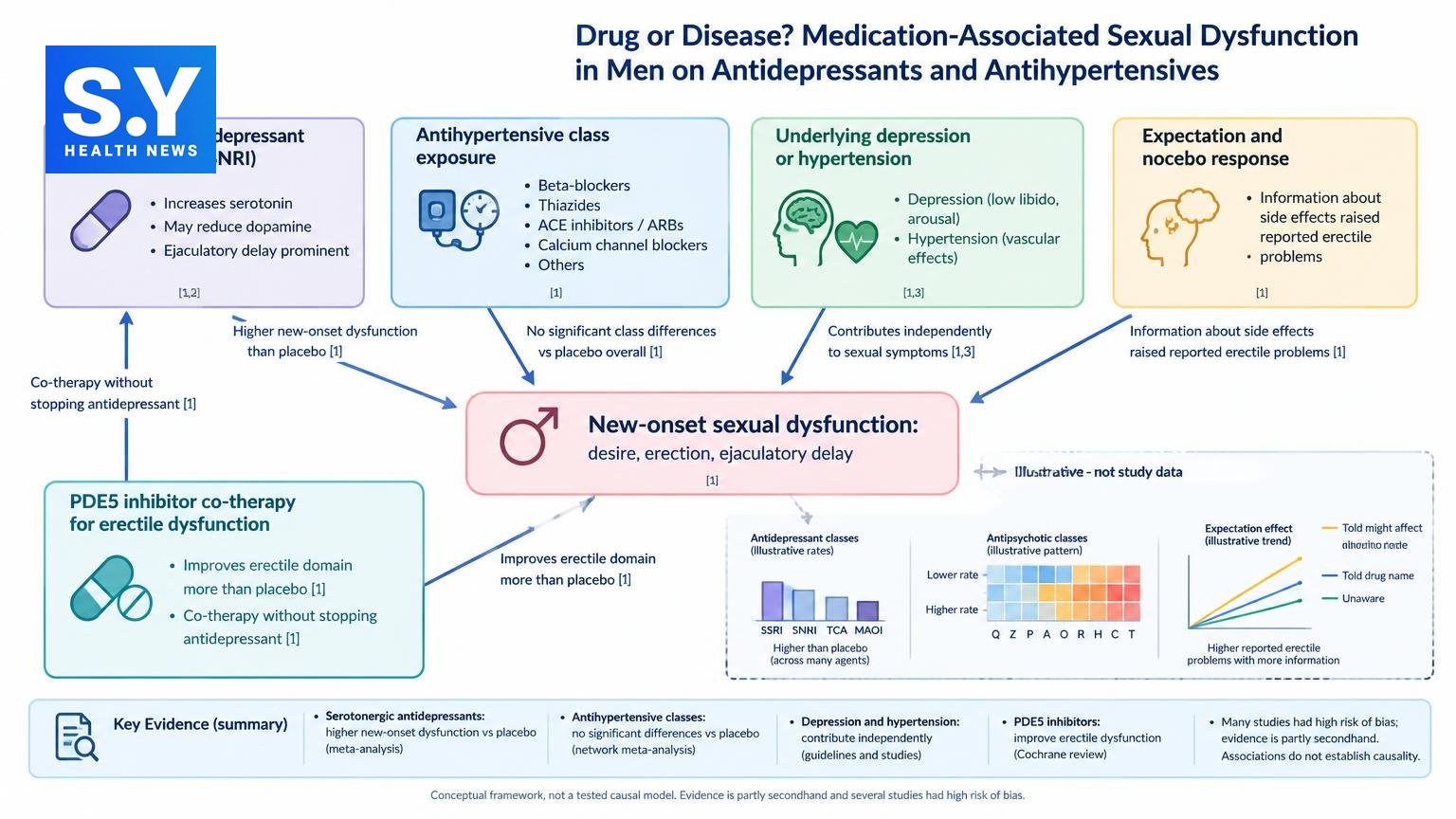
Conceptual framework: Conceptual framework, not a tested causal model. Serotonergic antidepressant exposure shows a placebo-controlled association with new-onset sexual dysfunction; antihypertensive classes show no significant differences versus placebo overall in network meta-analysis; depression and hypertension contribute independently; expectation raised reported erectile problems in one small trial. PDE5 inhibitor co-therapy improves erectile dysfunction without stopping the antidepressant. Evidence is partly secondhand and several studies had high risk of bias.
Academic References & Evidence
- 抗憂鬱藥、血壓藥會造成性功能障礙嗎?吃身心科藥硬不起來、射不出來怎麼辦|台中昭安泌尿科 – 昭安泌尿科診所.
- 仲秋. 什么药物会导致男人性功能下降.
- 性功能障礙如何治療?. 2026
- 吴元翼. 引发男性阳痿的原因有哪些. 2026
- 性功能减退是什么原因造成的_民福康. 2026
- 吴元翼. 功能性阳痿的原因有哪些. 2026
SANYUN Science Center explains published research on men's reproductive and sexual health, connecting scientific evidence with everyday questions while making sources and limitations clear.
Disclaimer: This article is for scientific education and research communication only. It does not provide medical advice, diagnosis, or individualized treatment recommendations, and does not endorse any medication, supplement, device, penile enlargement procedure, or other intervention. Decisions about sexual and reproductive health should be made in consultation with a qualified healthcare professional. Do not delay seeking professional care because of information in this article.
Original Content & Copyright Notice
- This article is prepared for SANYUN Science Center, drawing on published research and publicly available academic literature on men’s sexual and reproductive health. Its editorial explanations and presentation are developed for this platform.
- Copyright in the original editorial content, selection, and arrangement is reserved by SANYUN Science Center to the extent protected by applicable law. Referenced research, quotations, and third-party materials remain subject to the rights of their respective owners. This notice does not claim ownership of scientific facts or third-party research.
- Except where permitted by applicable law or an applicable license, prior written permission is required to reproduce, republish, translate, adapt, redistribute, or commercially reuse protected content. Attribution alone does not grant permission for such reuse.
- For permitted quotation or authorized reuse, clearly identify the source and retain a link to the original article.
- Source: SANYUN Science Center
- Original URL: Retain the original article URL on science.san-yun.com.
- Copyright Holder: SANYUN Science Center, for its own protected editorial content.
- Quotation, excerpts, or authorized reuse must not distort the scientific meaning, omit material limitations or disclaimers, or imply unverified medical claims, product efficacy, or endorsement by SANYUN Science Center.



