




Category: Health Academy
Core Research Direction: Informed decision-making and education about prostate and sexual health for men, delivered through a quality-improvement learning collaborative for health centers
Search Intent: How can health centers improve education and decision support for men about prostate conditions and sexual health, including erectile dysfunction?
Platform: SANYUN Science Center
Evidence reviewed through: 2026-11-20
Executive Summary
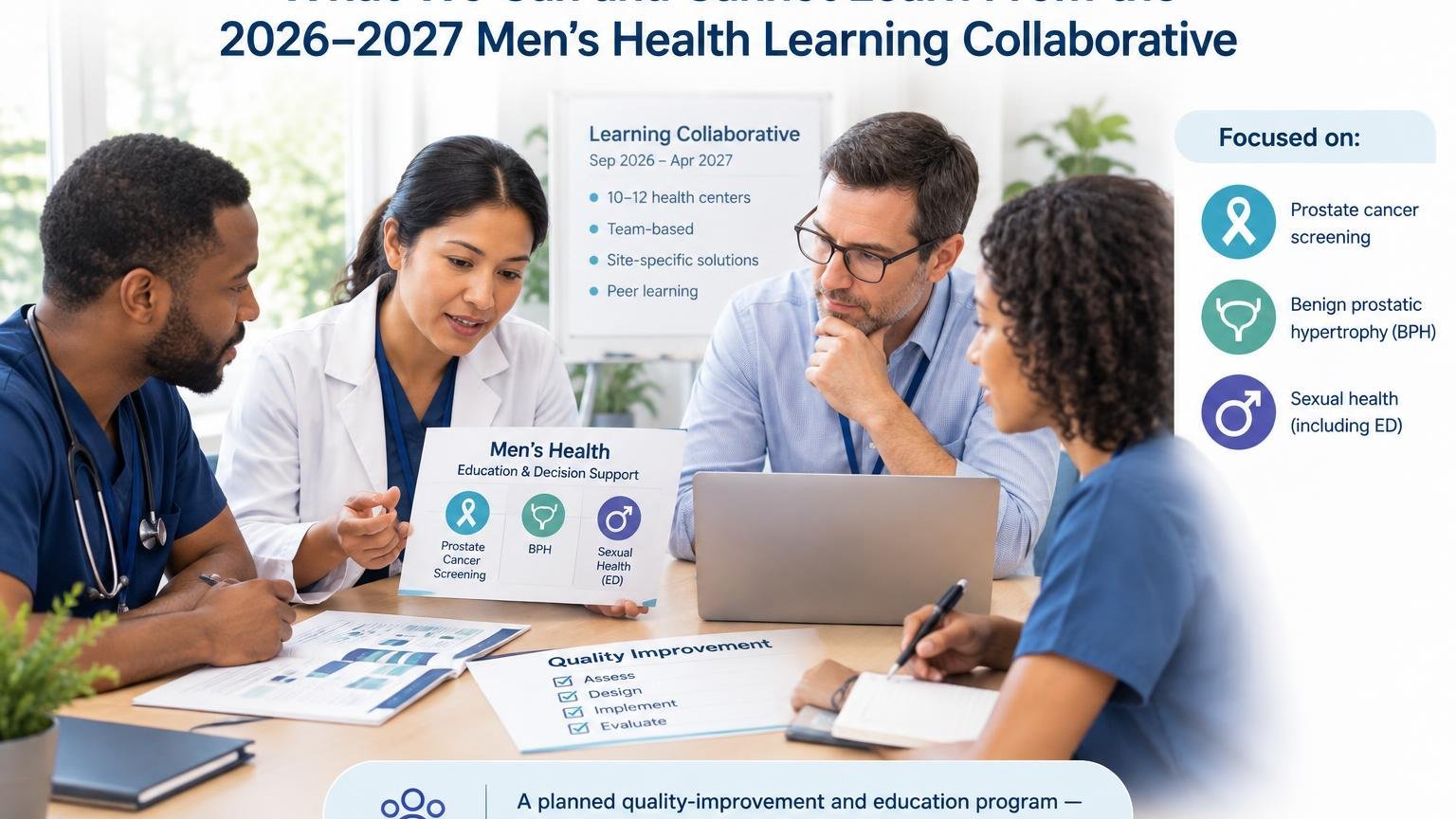
Health centers face a practical task: making conversations about prostate conditions and sexual health clear, non-rushed and genuinely useful for men. A planned quality-improvement learning collaborative, scheduled to run from September 2026 through April 2027, proposes one approach. Its materials say it will bring together 10–12 health center organizations to strengthen how they support men and their families in making informed decisions about prostate and sexual health. The program's stated focus covers patient education and decision support for prostate cancer screening, benign prostatic hypertrophy and sexual health, including erectile dysfunction.[1][2]
It is important to be precise about what this is. The collaborative is an education and quality-improvement program. Its published objectives describe what participating teams are expected to assess or design; they do not report measured patient outcomes or changes in screening rates, diagnosis, treatment uptake or satisfaction. The program is not a clinical trial, and no effectiveness data are presented in the available materials. Read as a curriculum and improvement framework, it is informative; read as evidence that a particular education model works, it is not yet sufficient.[3]
Why This Matters for Men's Health Education
The program's application materials state that men have historically underutilized health care and face multiple barriers to engaging in care and making informed health decisions. This is a framing assertion rather than an empirical result in the packet: no data, measurement instrument or citation is provided. Still, the framing explains why the collaborative focuses on decision support rather than screening promotion alone. The goal is not to push every eligible man toward testing or treatment, but to make sure conversations include enough information for a person to participate meaningfully in decisions that are right for him.
Prostate cancer screening is a useful example of why decision quality matters. Screening decisions involve trade-offs—between possible earlier detection and possible harms such as false positives, overdiagnosis and treatment side effects—that are not captured by a simple recommendation. For a beginner's overview of what a PSA result can and cannot show, see PSA Screening for Prostate Cancer: What a Blood Test Can and Cannot Tell You. Benign prostatic hypertrophy and erectile dysfunction raise different issues: symptoms, quality of life, embarrassment, partner dynamics and a range of treatment preferences. Decision support has to accommodate all of these, not just offer a leaflet.
The Program's Proposed Mechanism
The program's logic is a quality-improvement loop rather than a distinct biological mechanism. Participating health center teams will be asked to assess strengths and areas for improvement in education and decision support for men related to sexual health and prostate conditions. They will then design site-specific interventions, use quality-improvement tools and skills to implement selected interventions, and evaluate patient-level and system-level barriers to improve education and decision support for men and their families. In principle, this sequence moves from local assessment to tailored change, then to barrier review and iteration.
The design is intentionally local. Site-specific interventions are meant to fit different workflows, populations and electronic health record systems. Participation expectations include an ability to make changes to the electronic health record to improve prostate cancer screening processes, and an adequate number of male patients over the age of 40 to implement changes. Those expectations signal that the program is aimed at organizations with enough infrastructure and patient volume to test operational changes, not at individual clinicians working without team support.
Each participating organization was planned to receive a 12,500 US dollar stipend. The program materials also describe support from an independent medical educational grant from Novartis, and the CME Passport listing indicates a monetary disclosure. These details matter for how readers interpret the program: funding and payment arrangements are normal in continuing education, but they should be considered when weighing the program's framing and priorities.
What the Evidence Shows—and What It Does Not
The available sources describe a structured educational activity. The collaborative was planned as eight monthly Zoom sessions on the third Thursday of each month, starting September 17, 2026, from 11:30 a.m.–12:30 p.m. PT / 2:30–3:30 p.m. ET. It also includes four quality-improvement sessions on December 3, 2026, January 7, 2027, January 28, 2027 and February 25, 2027, from 11:30 a.m.–12:00 p.m. PT / 2:30–3:00 p.m. ET. The CME Passport listing describes the activity as a Regularly Scheduled Series and gives an activity period of 09/17/2026–04/15/2027.
Notably absent from the packet are outcome data: no pre/post change in clinician knowledge, no patient-reported decision quality, no measure of screening discussions, no rates of erectile dysfunction evaluation and no follow-up comparison group. The stated learning objectives are written in the future-oriented language of intended capability, not in the past tense of achieved results. That is normal for a program announcement, but it means the collaborative should not be cited as evidence that this education model improves care. It is an intervention protocol and learning framework, not a completed evaluation.
How the Program Addresses Prostate and Sexual Health Topics
The planned content separates three areas that are often blurred together in rushed primary care visits. Prostate cancer screening is a decision-support conversation about whether to test and what results mean. Benign prostatic hypertrophy is a symptom-and-treatment conversation about urinary function, impact on daily life and options. Sexual health, including erectile dysfunction, is a conversation about function, confidence, relationships and cardiovascular and metabolic health signals. Each area has its own evidence base and its own communication challenges.
Erectile dysfunction is a particularly important example because it is often treated as a sensitive but minor issue, when it can also be a signal worth clinical attention. For a fuller discussion of the vascular and endothelial context, see Erectile Dysfunction as a Health Signal: What Trouble Getting or Keeping an Erection Can Reveal. For men and clinicians comparing treatment directions, a review of randomized preference evidence is also available: What Men With Erectile Dysfunction Actually Prefer. The collaborative's decision-support focus is consistent with those broader educational priorities, but the program materials themselves do not report patient-level outcomes.
Table: What the Program Plans and What It Does Not Report
| Program element | Planned detail | Interpretation |
|---|---|---|
| Participating organizations | 10–12 health center organizations | Planned scope; not an observed sample of clinics |
| Program period | September 2026 through April 2027 | Planned timeline; outcomes not yet reported |
| Core topic areas | Prostate cancer screening, benign prostatic hypertrophy, sexual health including erectile dysfunction | Planned content focus; effectiveness not evaluated in the packet |
| Session structure | Eight monthly Zoom sessions, plus four quality-improvement sessions | Educational format; attendance and learning outcomes not reported |
| Teams | About 3–5 interdisciplinary members per organization | Planned team structure; actual composition not reported |
| Patient eligibility context | Adequate number of male patients over age 40 | Operational planning requirement; no sample size specified |
| Stipend | 12,500 US dollars per participating organization | Program logistics; not a health outcome |
Interpretation and Limitations
The biggest limitation is the difference between a planned program and evaluated evidence. Quality-improvement collaboratives are popular because they can build local capacity, create peer learning and adapt to context. But their results depend heavily on implementation, leadership, staffing and patient population. Without reported data, readers cannot know whether participating health centers improved decision support, whether men felt more informed, or whether clinical processes changed. The program's own objectives are appropriately modest in that respect: assess, design, implement and evaluate are steps, not proof.
A second limitation is scope. Participation expectations describe organizations located in Baltimore, Detroit, Houston, Los Angeles and New York City, with electronic health record change capacity and a sufficient volume of male patients over 40. Those criteria may make the program relevant to urban health centers with quality-improvement infrastructure, but they limit how far the approach can be generalized. The packet also does not describe how the program will measure success, what comparison data will be collected or whether patient-facing outcomes will be reported.
There is also a communication caveat. Decision support is not the same as persuasion toward screening or treatment. Good decision support helps a man understand the likely benefits and harms of options, clarify what matters to him and participate in a plan that fits his values. The program's language about informed decision-making is consistent with that goal, but the actual quality of the conversations will depend on tools, training and time. Those implementation details are not available in the packet.
Research Outlook
The useful next step would be transparent reporting. That could include pre/post measures of clinician knowledge and confidence, patient-reported decision quality, documentation of screening discussions, evaluation of erectile dysfunction and benign prostatic hypertrophy conversations, and a description of site-specific interventions and barriers. A comparison across participating sites would strengthen interpretation, even if it is not a randomized design. Without such reporting, the collaborative remains a promising educational structure rather than demonstrated best practice.
For clinicians and health center teams, the program is still a useful template: assess local strengths, design site-specific changes, use quality-improvement methods, and evaluate patient-level and system-level barriers. The key is to treat it as a starting framework and to collect local data rather than assume benefit. For a related look at how clinician education programs are constructed, see Clinician Education on Men's Prostate and Sexual Health: What 2026 Programs Actually Cover.
Key Takeaways
- The 2026–2027 men's health learning collaborative is a planned quality-improvement and education program for 10–12 health center organizations, not a completed clinical study.
- Its stated focus is patient education and decision support for prostate cancer screening, benign prostatic hypertrophy and sexual health, including erectile dysfunction.
- The program's objectives are to assess local strengths and gaps, design site-specific interventions, apply quality-improvement tools and evaluate barriers—steps that describe intent rather than demonstrated outcomes.
- The available materials do not report patient outcomes, clinician behavior change or effectiveness data, so the collaborative cannot be cited as proof that this education model improves care.
- Practical value depends on local implementation, measurement and follow-up, and on keeping decision support balanced rather than promotional.
Questions and Answers
What is the men's health learning collaborative planned for 2026–2027?
It is a planned quality-improvement and education program that intends to bring together 10–12 health center organizations from September 2026 through April 2027 to strengthen informed decision support about prostate and sexual health. Its focus includes prostate cancer screening, benign prostatic hypertrophy and sexual health, including erectile dysfunction. It is an educational collaborative, not a completed clinical trial, and the available materials do not report patient outcomes.
What are the main goals of the men's health decision-support collaborative?
The stated learning objectives are for participating teams to assess strengths and gaps in education and decision support, design site-specific interventions, use quality-improvement tools and skills to implement selected interventions, and evaluate patient-level and system-level barriers. These are intended capabilities and process steps, not measured results. The program aims to help men and their families participate more actively in decisions about prostate and sexual health care.
Does the learning collaborative prove that decision support improves prostate and sexual health outcomes?
No. The packet describes a planned program and its objectives, but it does not report pre/post changes in clinician knowledge, patient decision quality, screening discussions or erectile dysfunction evaluation. Statements about improving education and decision support are future-oriented goals. Without outcome data or a comparison group, the collaborative cannot be cited as evidence that this model improves care. It is a framework for local quality improvement.
Which health centers can participate in the men's health learning collaborative?
The application materials describe organizations located in Baltimore, Detroit, Houston, Los Angeles and New York City. Teams should have about 3–5 interdisciplinary members, the ability to make electronic health record changes to improve prostate cancer screening processes, and an adequate number of male patients over age 40 to implement changes. Space is limited to 10–12 organizations. These are planning criteria, not evidence of program effectiveness.
What are the limitations of the men's health collaborative evidence?
The main limitation is that the sources describe planned activities and learning objectives rather than observed outcomes. No patient-level or system-level results are reported, and success measures are not specified in the packet. The program is also geographically and structurally selective, requiring electronic health record capacity and sufficient patient volume. Funding from an independent medical educational grant and a monetary disclosure are relevant context for interpretation but do not by themselves establish bias or benefit.
How should clinicians use the men's health collaborative as a practical model?
It can serve as a template for local quality improvement: assess current education and decision support, design site-specific changes, apply improvement tools and review barriers. But clinicians should collect their own before-and-after data rather than assume benefit. Decision support should remain balanced, helping men understand trade-offs in prostate cancer screening and options for benign prostatic hypertrophy and erectile dysfunction, rather than pushing a single choice.
Sources and References
- Informed Decision Making in Men’s Health Learning Collaborative Application.
- ACCME | CME Passport.
- Learning Session 5 – Informed Decision Making in Men’s Health Learning Collaborative (January 21, 2027).
SANYUN Science Center explains published research on men's reproductive and sexual health, connecting scientific evidence with everyday questions while making sources and limitations clear.
Disclaimer: This article is for scientific education and research communication only. It does not provide medical advice, diagnosis, or individualized treatment recommendations, and does not endorse any medication, supplement, device, penile enlargement procedure, or other intervention. Decisions about sexual and reproductive health should be made in consultation with a qualified healthcare professional. Do not delay seeking professional care because of information in this article.
Original Content & Copyright Notice
- This article is prepared for SANYUN Science Center, drawing on published research and publicly available academic literature on men’s sexual and reproductive health. Its editorial explanations and presentation are developed for this platform.
- Copyright in the original editorial content, selection, and arrangement is reserved by SANYUN Science Center to the extent protected by applicable law. Referenced research, quotations, and third-party materials remain subject to the rights of their respective owners. This notice does not claim ownership of scientific facts or third-party research.
- Except where permitted by applicable law or an applicable license, prior written permission is required to reproduce, republish, translate, adapt, redistribute, or commercially reuse protected content. Attribution alone does not grant permission for such reuse.
- For permitted quotation or authorized reuse, clearly identify the source and retain a link to the original article.
- Source: SANYUN Science Center
- Original URL: Retain the original article URL on science.san-yun.com.
- Copyright Holder: SANYUN Science Center, for its own protected editorial content.
- Quotation, excerpts, or authorized reuse must not distort the scientific meaning, omit material limitations or disclaimers, or imply unverified medical claims, product efficacy, or endorsement by SANYUN Science Center.



