




Category: Health Academy
Core Research Direction: Men's Health Week 2024 (UK) as a public-awareness campaign: its stated aims, themes (prostate, mental health, men's health counts), and the statistics campaign sources cite about men's health, sexual health and help-seeking — clarifying what these sources are (advocacy/charity/public-information documents, not primary research) and what they can and cannot establish.
Search Intent: What does the 2024 Men's Health Week campaign in the UK say about men's health, why does it matter to men's sexual and reproductive health, and how strong is the evidence behind the statistics and claims the campaign sources present?
Platform: SANYUN Science Center
Evidence reviewed through: 2026-11-23
Executive Summary
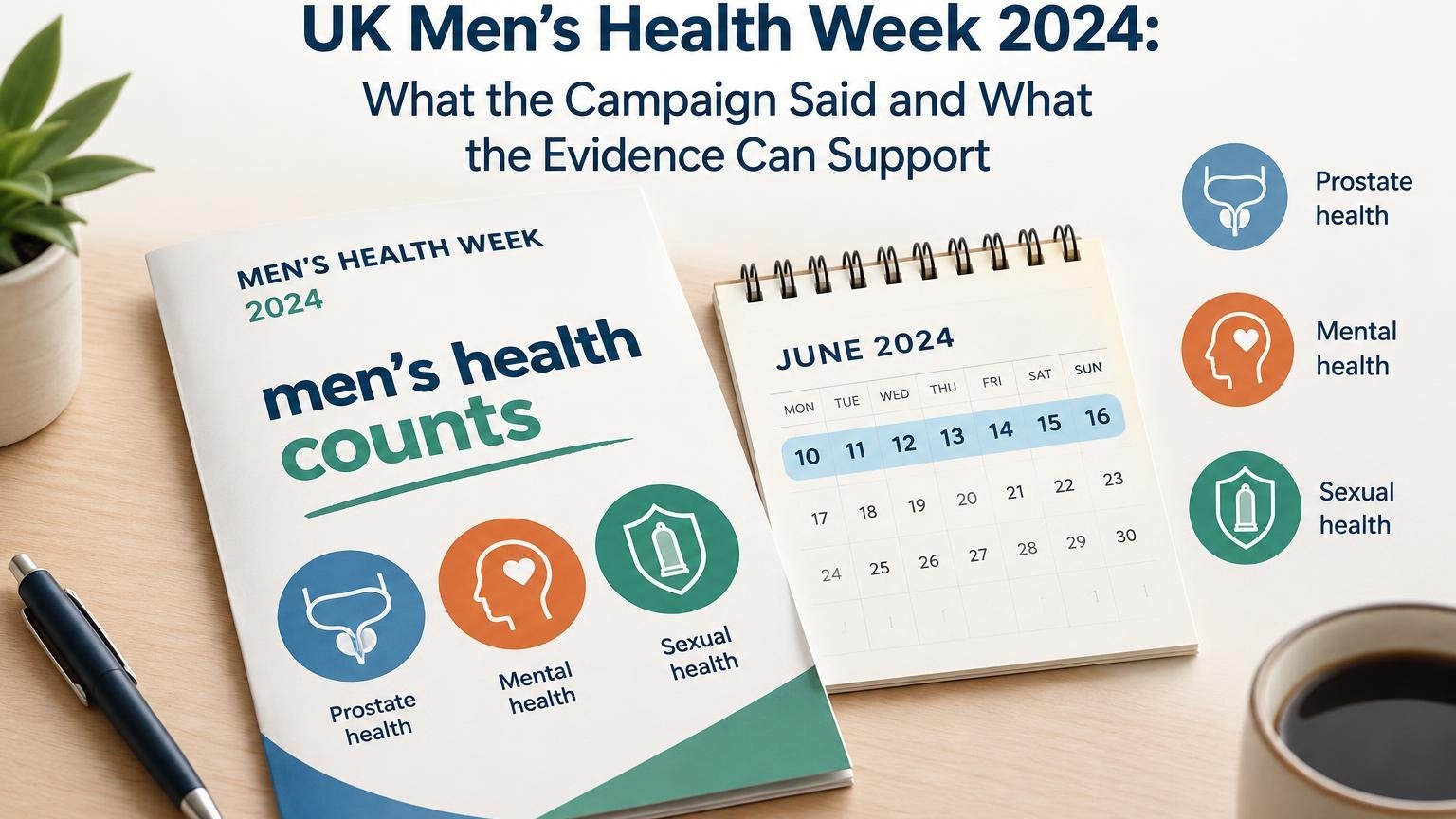
Men's Health Week 2024 in the UK ran from Monday 10 to Sunday 16 June and was organised by the Men's Health Forum, according to a trade-union bulletin that circulated the campaign material. The bulletin describes the week's aims as raising awareness of health problems that affect men disproportionately, supporting healthier lifestyle choices, and encouraging earlier detection and treatment. It gives the 2024 UK theme as 'Let's Talk Prostate', with the accompanying message 'men's health counts'.[1]
A separate NHS sexual health service page uses the same week to promote STI testing, condom use, PrEP and PEP access, and vaccination for men who have sex with men. A private-provider article instead describes the 2024 focus as 'Mental Health Matters'. The sources reviewed here are campaign, advocacy and service-communication documents; none is a primary research report, and none supplies its own study design, sample or statistical methods.[2][3][4]
That does not make the material useless. It does mean the numbers should be read as awareness-message inputs, not as independent evidence that a particular intervention works or that a stated cause produces a stated outcome. The picture is further complicated by inconsistency between the sources: the theme is described differently, and prostate-cancer incidence is quoted as 55,000 new cases a year in one bulletin and about 52,000 in another.
Why This Matters for Men's Sexual and Reproductive Health
An awareness week is one of the few moments when prostate health, mental health, sexual health and help-seeking are discussed together in public-facing channels. The NHS service page frames sexual health as linked to mental and physical wellbeing and names concerns that many men recognise but seldom raise: pregnancy and STI worries, penis size and shape, premature ejaculation, and difficulty getting or maintaining an erection.
That framing is a useful prompt for conversation, but it is a statement of service advice and clinical common sense, not a measured association from a cohort or trial. Reproductive and sexual health also overlap with the help-seeking question that runs through the campaign material. If working-age men are less likely to visit a doctor, as one article reports secondhand, then conditions that depend on a conversation — erectile difficulty, STI risk, prostate symptoms, low mood — may present later.
That pathway is plausible and is a stated rationale for the campaign, but the reviewed sources do not test it. They report an aim, not an evaluated effect. Readers interested in how screening and self-examination campaigns handle similar questions of evidence can find a parallel discussion in this analysis of testicular cancer awareness and self-examination evidence.
The Biological and Social Mechanism Claims
The campaign material offers three overlapping explanations for poorer male health outcomes. The first is behavioural: men are described as more likely to smoke, drink to excess, carry excess weight and avoid preventive contact with services. The union bulletin ties poorer lifestyles to a high proportion of chronic disease and states that smoking causes over 90% of lung cancers in men. The World Cancer Research Fund estimate reproduced in the same bulletin holds that around 40% of cancer cases could be prevented through a healthier lifestyle. Both figures are prevention and attribution estimates quoted secondhand; they are not outcomes measured in these documents.
The second explanation is social and psychological. One article describes suggestions that societal norms and gender attitudes shape male health behaviour, including the idea that health-seeking is seen as 'feminine' and that participation in risky behaviour is more socially acceptable for men. The same article attributes men's lower mental-health help-seeking to stigma and expectations, and links that to more severe outcomes including suicide. These are framed as suggestions and attributions, not as tested causal findings; no data or citation is given for the pathway itself.
The third explanation is service-facing. The sources argue that late presentation and low screening attendance allow problems to become less treatable. One article states that women are more likely to attend NHS health screenings than men and connects lower attendance to undetected high blood pressure, cholesterol problems, poor glucose regulation, heart disease and type 2 diabetes. That is a plausible chain, but the article does not show that attendance differences cause those detection differences; it asserts the link.
What the Cited Statistics Show — and What They Do Not
The most concrete numbers appear in the union bulletin and the workplace-wellbeing article. The bulletin lists prostate cancer at 55,000 new cases a year in UK men and says men aged 50 and over may be advised to have a PSA test, usually if they have symptoms. Crucially, it also notes that PSA can be raised by other conditions and cannot on its own confirm prostate cancer. That caveat is an important accuracy point: a screening or diagnostic test's limitations belong in the same paragraph as its recommendation, otherwise awareness messaging can imply more certainty than the test provides.
The workplace article gives approximately 52,000 UK prostate-cancer diagnoses a year, lifetime risk of 1 in 8 overall and about 1 in 6 in men of black ethnicity. It also cites Office for National Statistics figures for 2020/22 showing male life expectancy of 78.6 years versus 82.6 years for females, and a Men's Health Forum figure that in 2020 one in five male deaths occurred before age 65. These are secondhand summaries; the article does not provide the exact ONS dataset, the calculation method or the reference year definitions behind each figure.
The same article attributes to the Men's Health Forum a cluster of comparative percentages: men make up 76% of premature heart-disease deaths, are 43% more likely to die from cancer than women, represented 63% of premature COVID-19 deaths, are 26% more likely to have type 2 diabetes, make up 68.5% of diabetic amputations, and represent 66% of alcohol-related deaths. It also reports that working-age men are on average 32% less likely to visit a doctor than their peers. Each figure carries a denominator problem: relative risks, proportions of deaths and service-use differences are not interchangeable, and the source does not supply the definitions needed to compare them.
| Campaign figure | What the source says | What it can support | What it cannot establish |
|---|---|---|---|
| Prostate cancer burden | 55,000 new UK cases a year in the union bulletin; about 52,000 a year in the workplace article | Public messaging that prostate cancer is common in UK men | A single precise incidence estimate; the two sources disagree and neither gives the primary dataset |
| Lifetime prostate-cancer risk | 1 in 8 overall; about 1 in 6 in men of black ethnicity | Awareness that risk differs between groups | A tested explanation for the difference or a current population estimate without the underlying registry analysis |
| Male life expectancy | 78.6 years for males versus 82.6 years for females, 2020/22, attributed to ONS | A headline gap of about 4 years between male and female life expectancy in the stated period, as attributed to ONS | Cause, preventability or the specific dataset and method used |
| Help-seeking | Working-age men on average 32% less likely to visit a doctor than their peers | A rationale for campaigns encouraging earlier presentation, based on a reported 32% difference | The definition of 'peers', the data source, or whether the gap causes later diagnosis |
| Mental-health service use | 75% of suicides are men; 34% of IAPT referrals are male | A prompt to discuss male mental-health help-seeking | A current national estimate or a causal explanation for the referral gap |
| Prevention estimate | Around 40% of cancer cases could be prevented with a healthier lifestyle | A motivational public-health message | A measured outcome in this campaign material; the underlying model and assumptions are not supplied |
The suicide and mental-health service figures follow the same pattern. The article cites Samaritans research for the statement that 75% of all suicides are men, that suicide is the biggest cause of death in men under 50, and that only 34% of people referred to the Improving Access to Psychological Therapies service are male. The direction of those figures is consistent with the campaign's mental-health message, but the source does not give the underlying report, jurisdiction, time period or referral definitions, so they should be treated as awareness prompts rather than as a current epidemiological summary.
The Sexual Health Content: Practical Advice With Limited Evidence Claims
The NHS service page is the most specific sexual-health document in the set. It advises STI testing regularly and with each new partner, notes that home kits cover chlamydia, gonorrhoea, HIV and syphilis, and describes condoms as the only contraceptive method that protects against both pregnancy and STIs. It presents PrEP as a very effective HIV-prevention method, particularly for people at higher risk including men who have sex with men, and lists a service package of PrEP and PEP, three-monthly check-ups, and hepatitis A, hepatitis B and HPV vaccination for that group.
Those statements are consistent with established public-health guidance, but the page itself supplies no efficacy estimates, trial data or references. It is a service-communication document, not an evaluation of the service or of any single intervention. Readers should therefore treat it as a reliable pointer to what the local service offers and what it recommends, not as an independent review of PrEP, condoms or testing effectiveness.
Men weighing prostate symptoms or screening conversations may find it useful to compare this material with a fuller discussion of what PSA screening for prostate cancer can and cannot tell you, since the campaign bulletin itself notes that PSA cannot on its own confirm disease.
Interpretation and Limitations
The central interpretative point is that the 2024 material is advocacy and awareness communication. Its stated aims are to raise awareness, encourage healthier choices and support earlier detection and treatment; the sources describe these as objectives rather than as evaluated outcomes. No document in this set reports a randomised comparison, a pre/post survey or a controlled evaluation of the week itself. A reader cannot conclude from these pages that Men's Health Week changed help-seeking, diagnosis rates or outcomes.
There are also unresolved inconsistencies. The theme is described as 'Mental Health Matters' in one article and as 'Let's Talk Prostate' with 'men's health counts' in two others; the prostate-cancer annual figure differs between 55,000 and about 52,000; and the '1 in 8' lifetime risk statement is repeated without its underlying registry analysis. These do not mean the campaign was wrong, but they do mean the campaign cannot be used as a citable reference standard for any single statistic. Source attribution — ONS, Samaritans, Men's Health Forum, World Cancer Research Fund — is present in places but incomplete in others.
Historical and organisational claims are similarly secondhand. Two sources state that Men's Health Week was created or first established in the United States in 1994; neither provides a citation. The week's timing — the Monday before Father's Day through Father's Day — is stated in the union bulletin as an organising convention. These are useful context, but they are not research findings and should not be presented as such.
Research Outlook
The more useful evidence questions sit outside the reviewed documents. They include whether awareness weeks actually shift help-seeking or screening uptake in men; whether prostate-awareness messaging can be delivered without overstating what PSA can confirm; whether different risk groups, including men of black ethnicity and men who have sex with men, are reached equitably; and whether sexual-health and mental-health messaging can be integrated in ways that men find usable. The reviewed sources highlight the need for these questions but do not answer them.
A practical approach for readers is to use the campaign as a conversation starter and a signpost, then verify any specific statistic against the primary source it names — ONS for life expectancy, the relevant cancer registry for prostate incidence, the named mental-health charity for suicide figures. This is not a criticism of awareness campaigns; it is a way to use them responsibly when the underlying evidence is not published alongside the message. Readers weighing specific screening decisions may also benefit from a broader look at cancer screening evidence and its limits.
Key Takeaways
- Men's Health Week 2024 in the UK ran 10–16 June, was organised by the Men's Health Forum, and was framed around prostate awareness and the message 'men's health counts', according to a union bulletin.
- One private-provider article instead describes the 2024 focus as 'Mental Health Matters', so the campaign's public theme is not described consistently across secondary sources.
- The sexual-health page recommends regular STI testing, condom use, PrEP/PEP access and vaccination for higher-risk groups, but supplies no efficacy data or references of its own.
- The cited statistics are secondhand and inconsistently sourced: prostate cancer is given as 55,000 versus about 52,000 new cases a year, and figures such as 78.6 versus 82.6 years of life expectancy, 75% of suicides being men and 34% of IAPT referrals being male lack their underlying reports in the source.
- The reviewed documents are awareness and service-communication materials, not primary research; they can frame questions and signpost services but cannot establish that the campaign changed health outcomes.
Questions and Answers
What was the theme of UK Men's Health Week 2024 and why do sources disagree?
A union bulletin and a workplace article describe the 2024 UK theme as 'Let's Talk Prostate' with the message 'men's health counts'. A separate private-provider article describes the focus as 'Mental Health Matters'. The disagreement reflects inconsistent secondary reporting rather than a research finding; readers should treat the prostate theme as the more widely repeated campaign framing, while recognising that mental health was also part of the wider message.
What does the NHS sexual health page recommend for men during Men's Health Week?
The page recommends regular STI testing and testing with each new partner, using condoms consistently, and accessing PrEP and PEP, with three-monthly check-ups and hepatitis A, hepatitis B and HPV vaccination for men who have sex with men. It also encourages talking to clinic staff about sexual concerns. These are service recommendations, not an evaluation of the interventions' effectiveness.
How strong is the evidence behind the 55,000 annual prostate cancer case figure cited in Men's Health Week 2024 material?
The 55,000 new cases a year figure appears in a union bulletin as a secondary summary without a primary citation, and a workplace article gives a different figure of about 52,000 a year. Neither supplies the underlying registry dataset, definitions or time period. The figure is best treated as an awareness prompt indicating that prostate cancer is common, not as a verified single incidence estimate.
Does Men's Health Week 2024 evidence show that awareness campaigns improve men's health outcomes?
No. The reviewed sources state the campaign's aims — raising awareness, encouraging healthier choices and earlier detection — but none reports an evaluation, survey or controlled comparison of the week itself. They can support the claim that the campaign intended to change behaviour, not that it did. Questions about whether awareness weeks shift help-seeking or screening uptake remain open in this evidence set.
What are the main inconsistencies in the 2024 Men's Health Week source material?
The theme is described as 'Mental Health Matters' in one article and as 'Let's Talk Prostate' with 'men's health counts' in others. Prostate-cancer incidence is given as 55,000 new cases a year in one bulletin and about 52,000 in another. Several figures are attributed to named bodies but lack the underlying reports, definitions and time periods needed to verify them.
What should men take from the 2024 Men's Health Week prostate and PSA messaging?
The union bulletin states that men aged 50 and over may be advised to have a PSA test, usually if they have symptoms, and correctly notes that raised PSA can have other causes and cannot alone confirm prostate cancer. That caveat matters: PSA is an initial test, not a diagnosis. Men with urinary symptoms or concerns should discuss testing with a clinician rather than relying on a single campaign figure.
Sources and References
- Dave Joyce. LTB 190/24 – Men’s Health Week 2024 – Monday 10 – Sunday 16 June – Theme – ‘Let’s Talk Prostate’ & ‘Mens Health Counts:’. 2024
- Men’s Health Week – 10th-16th June 2024 | Sexual Health Bucks.
- Men's Health Week 10th-16th June | Sussex Premier Health – Private healthcare provider in Sussex and Kent. 2024
- Sarah McLoughlin. Men’s Health Week – Know the Facts – Health at Work.
SANYUN Science Center explains published research on men's reproductive and sexual health, connecting scientific evidence with everyday questions while making sources and limitations clear.
Disclaimer: This article is for scientific education and research communication only. It does not provide medical advice, diagnosis, or individualized treatment recommendations, and does not endorse any medication, supplement, device, penile enlargement procedure, or other intervention. Decisions about sexual and reproductive health should be made in consultation with a qualified healthcare professional. Do not delay seeking professional care because of information in this article.
Original Content & Copyright Notice
- This article is prepared for SANYUN Science Center, drawing on published research and publicly available academic literature on men’s sexual and reproductive health. Its editorial explanations and presentation are developed for this platform.
- Copyright in the original editorial content, selection, and arrangement is reserved by SANYUN Science Center to the extent protected by applicable law. Referenced research, quotations, and third-party materials remain subject to the rights of their respective owners. This notice does not claim ownership of scientific facts or third-party research.
- Except where permitted by applicable law or an applicable license, prior written permission is required to reproduce, republish, translate, adapt, redistribute, or commercially reuse protected content. Attribution alone does not grant permission for such reuse.
- For permitted quotation or authorized reuse, clearly identify the source and retain a link to the original article.
- Source: SANYUN Science Center
- Original URL: Retain the original article URL on science.san-yun.com.
- Copyright Holder: SANYUN Science Center, for its own protected editorial content.
- Quotation, excerpts, or authorized reuse must not distort the scientific meaning, omit material limitations or disclaimers, or imply unverified medical claims, product efficacy, or endorsement by SANYUN Science Center.



