




Category: Penile Size
Core Research Direction: Adult penile size: distinguishing true micropenis from normal-variation size anxiety (small penis syndrome/penile dysmorphic disorder), and what the evidence says about normative measurements and the limits of enlargement interventions.
Search Intent: How common is a genuinely small (micropenis) versus a normal-sized penis, how is penile length measured and defined, and what does the evidence actually support for enlargement procedures?
Platform: SANYUN Science Center
Evidence reviewed through: 2026-11-16
Executive Summary
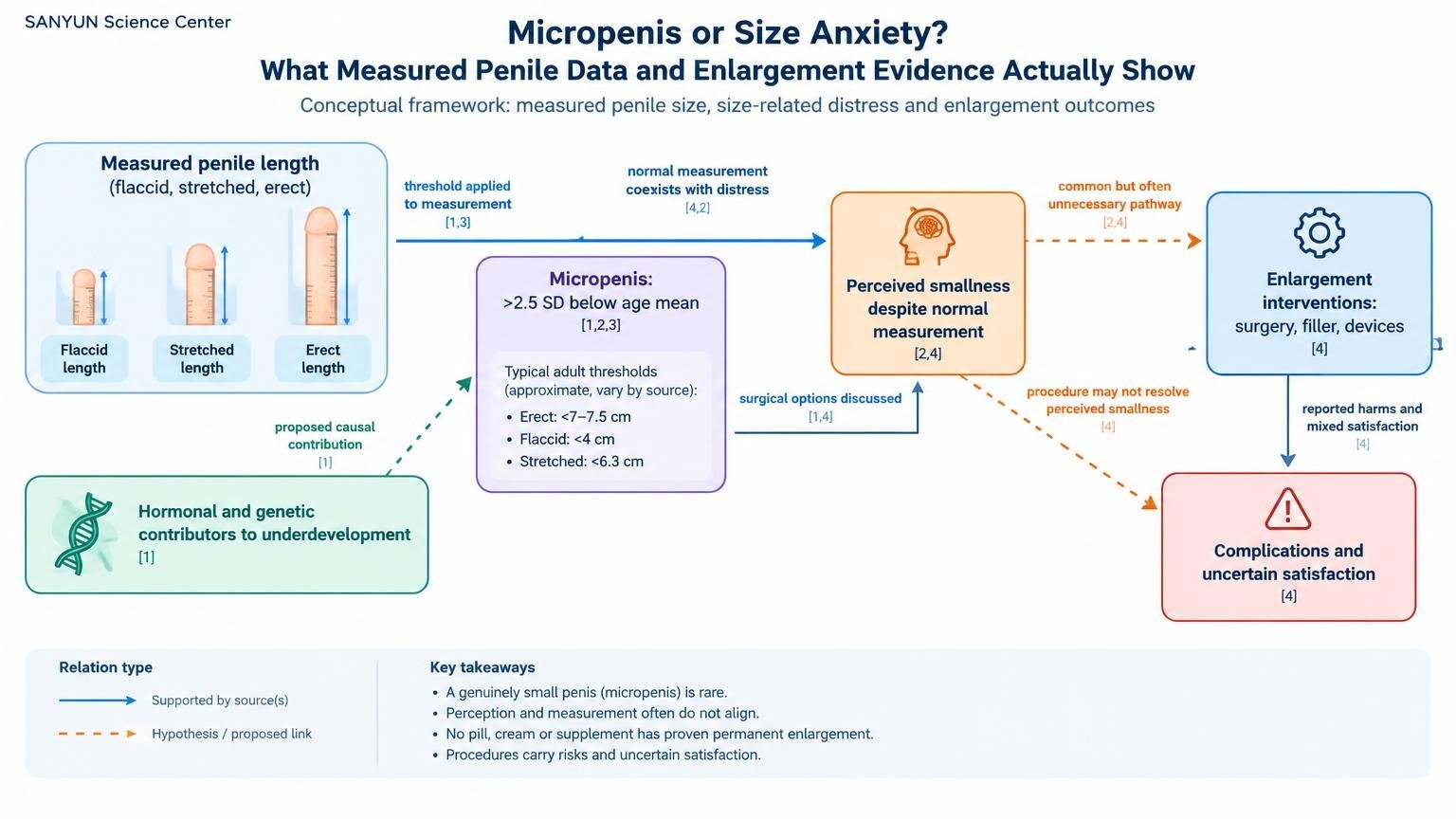
Concern about penile size is common, but a genuinely small penis is rare. Clinic-level sources converge on a definitional anchor: micropenis is a structurally normal penis whose length lies more than 2.5 standard deviations below the mean for age, with adult thresholds usually expressed around 7 to 7.5 cm erect, under 4 cm flaccid, or roughly 6.3 cm stretched. Reported prevalence in the supplied sources spans 0.6% of male newborns to a range of 0.6–2% of all men, and those figures are quoted without named primary studies, so they should be read as indicative rather than precise.[1][2][3]
The bigger clinical problem is mismatch between perception and measurement. A clinic guide citing a systematic review of clinician measurements in up to 15,521 men puts mean erect length near 13.1 cm and flaccid near 9.2 cm, with a wide normal range; another clinic explainer cites a 2015 British study giving 13.12 cm erect, 13.24 cm stretched and 9.16 cm flaccid. A separate clinic guide reports that most men requesting lengthening surgery measured within normal limits. Persistent distress about a normal-sized penis is described as small penis syndrome or penile dysmorphic disorder, with quoted prevalence of 1–3% of men.[4]
Intervention evidence is weaker than marketing suggests. No pill, cream or supplement has demonstrated permanent gain. Ligament-release surgery is claimed to add 2–6 cm of visible flaccid length in clinic promotional text, but a more cautious clinic guide reports published averages of roughly 1–2 cm with high individual variability and some men gaining little or nothing. A cited systematic review of normal-sized men concluded that many procedures carry high complication rates and uncertain satisfaction.
Why This Matters
Size worry is not trivial. The clinic sources describe shame, avoidance of intimacy, avoidance of shared changing rooms and reduced sexual confidence among men whose measured size is normal. When the distress becomes persistent and functionally limiting, it is framed as a treatable condition rather than a cosmetic preference, which changes the appropriate first step from a procedure to an assessment.
The asymmetry between men's and partners' satisfaction is one of the more useful findings for counseling. In a survey of more than 50,000 adults cited by a clinic guide, only about half of men were satisfied with their own size, while 85% of women were satisfied with their partner's size. That gap supports the view that the problem usually sits in self-perception rather than in the anatomy being evaluated.
Misclassification also matters clinically. A buried penis caused by excess suprapubic fat in men with obesity can look like micropenis but is anatomically different, and the visible-length effect of fat loss is a visual change rather than true growth. Treating one as the other leads to the wrong conversation and, potentially, the wrong operation.
Definitions and Measurement: Why the Numbers Do Not Align
Micropenis is a diagnosis of measurement, not appearance. The consistent element across sources is the statistical rule: length more than 2.5 standard deviations below the age-matched mean in a structurally normal penis. The cutoffs attached to that rule differ by source and by which length is being measured. One clinic explainer gives under 7 cm erect or under 4 cm flaccid; another gives under 4 cm flaccid and under 7.5 cm erect; a patient-education page uses stretched length, roughly under 2.5 inches (about 6.3 cm) in adults, with a lower infant threshold under 1.9 cm and age-adjusted norms for children.
Those differences are not trivial, because flaccid, stretched and erect lengths are different measurements with different reliability. Flaccid length varies with temperature, stress and time of day, and the clinic guide explicitly cautions that it does not predict erect size well. Stretched length is the standard pediatric and diagnostic measure, taken dorsally from the pubic bone to the tip and compared against age- and size-matched norms. Erect length is what patients usually care about but is the least standardized to obtain in a clinic room.
| Measure | Reported normative value | Reported micropenis threshold | Key interpretive caveat |
|---|---|---|---|
| Erect length | About 13.1 cm (systematic review, up to 15,521 men); 13.12 cm in a cited 2015 British study | Under 7 cm or under 7.5 cm depending on source | Sources disagree on the cutoff; figures come from secondary clinic citations |
| Flaccid length | About 9.2 cm (systematic review); 9.16 cm in the cited British study | Under 4 cm | Highly variable with temperature and situation; poor predictor of erect size |
| Stretched length | 13.24 cm in the cited British study | Roughly under 6.3 cm in adults; under 1.9 cm in infants | Standard diagnostic measure; age-adjusted norms required |
| Erect circumference | 11.66 cm | Not applicable | Girth is reported separately and is not part of the length-based definition |
| Flaccid circumference | 9.31 cm | Not applicable | Same caveats as flaccid length |
The normative figures themselves come through secondary channels. The systematic review attributed to Veale and colleagues in 2015 is described in a clinic guide as pooling clinician measurements from up to 15,521 men, but the original paper is not part of the supplied material, and the smaller discrepancies between 13.1 and 13.12 cm likely reflect rounding or different subgroup handling rather than a real disagreement. Readers should treat these as robust central tendencies with a wide spread, not as a target.
True Micropenis: Causes and Evidence Gaps
The dominant proposed mechanism is insufficient androgen exposure during fetal development. One clinic explainer attributes micropenis mainly to inadequate testosterone production, assigning about 50% of cases to hypogonadotropic hypogonadism (pituitary or hypothalamic understimulation) and about 25% to hypergonadotropic hypogonadism (testicular dysfunction). It further attributes about 15% to at least partial androgen resistance and about 10% to idiopathic causes.
These proportions should be handled with caution. They are uncited, and a patient-education source puts the idiopathic share at up to 50%, a direct conflict with the 10% figure. Such disagreement is a signal that the causal breakdown is not settled in the supplied evidence and may reflect different referral populations rather than a contradiction about biology. Readers should not treat any of these percentages as a stable epidemiological estimate.
A second gap concerns function. One clinic source asserts that micropenis is basically free of functional problems, apart from occasional limitations during intercourse related to length. That claim is not supported by outcome data in the supplied material and sits uneasily with the same sources' emphasis on psychosocial burden. Fertility, hormonal status and psychosocial wellbeing are all plausible areas of impact, but the packet does not provide measured outcomes.
Prevalence is similarly uncertain. The 0.6% figure for male newborns and the 0.6–2% range for all men are quoted without named studies, and the two are not obviously the same denominator. A defensible summary is that true micropenis is uncommon, most likely in the low single digits as a percentage, but the supplied sources do not allow a precise estimate.
When Measurement Is Normal but Distress Is Real
Small penis syndrome and penile dysmorphic disorder describe persistent distress about size despite objectively normal measurements. One clinic explainer reports that nearly half of men would like a larger penis, while 1–3% hold a pathological belief that theirs is too small despite normal size, with consequences including grief, anxiety, depression, avoidance of nudity and withdrawal from relationships. Another clinic guide frames daily worry that disrupts relationships, shared changing rooms or overall confidence, despite normal measured size, as a named and treatable condition.
The comparison mechanisms are mundane and well described. Looking down at one's own body foreshortens the view; adult media present a selected population of performers and camera angles; and shared changing rooms invite comparison of flaccid states that vary widely and say little about erect size. The clinic sources recommend mirror-based viewing and, more importantly, an actual clinician measurement as a way to interrupt the worry cycle.
What the evidence does not establish is how well psychological treatment performs relative to procedures, because no comparative trial data appear in the packet. The claim that men with normal size and high anxiety often remain dissatisfied even after procedures is presented as an interpretive statement rather than a measured outcome, and should be treated as a hypothesis consistent with clinical experience rather than a quantified finding.
What the Evidence Shows for Enlargement Interventions
The strongest available statement is a negative one: no pill, cream or supplement has evidence of permanent size gain. Beyond that, the evidence base thins quickly. A systematic review cited in one clinic guide concluded that among men of normal size, many enlargement procedures carry high complication rates and uncertain satisfaction, but the packet does not supply numerical complication rates or a pooled effect estimate.
For ligament-release surgery, the sources disagree in a way that matters for informed consent. Two clinic sources claim visible flaccid gains of 2–6 cm, while a third clinic guide reporting on published research gives averages of roughly 1–2 cm, with large individual variation and some men experiencing almost no change. The 2–6 cm figure appears in promotional or explanatory clinic text without a named study, whereas the 1–2 cm figure is explicitly described as a published average. Neither figure describes erect length gain, and neither is accompanied by complication rates.
Girth interventions follow a different pattern. Hyaluronic acid filler produces temporary girth increase lasting roughly 1–2 years, without adding length, and can be dissolved if results are unsatisfactory, though it carries its own risks of irregular nodules, migration and inflammation. Autologous fat injection is limited by unpredictable fat resorption. No method in the supplied material guarantees permanent results, and surgery is described as producing lasting but limited and highly variable change exchanged for real risks.
Non-medical methods range from ineffective to hazardous. Vacuum pumps draw blood into the penis for temporary enlargement lasting minutes to hours and have a legitimate role in erectile dysfunction care, but no evidence of permanent gain. Online stretching and jelqing techniques have no research support and are associated with reported injuries including fibrosis and penile curvature. Injection of non-medical substances such as liquid silicone or oils is described as the most dangerous category, with reports of chronic inflammatory masses, tissue necrosis and permanent deformity.
Interpretation and Limitations
The supplied material is almost entirely secondary. It comprises clinic explainer pages, a commercial patient-education note and one clinic guide that cites primary literature, plus a literature-index search page that lists titles and citation counts but no study results. No primary trial, meta-analysis text or guideline document is included. Every numerical claim in this review therefore inherits the limitations of those intermediaries, including selective citation, commercial interest in procedure uptake and, in at least one case, internally inconsistent percentages and irrelevant references.[5]
The specific conflicts are informative rather than fatal. Erect-length cutoffs of 7 versus 7.5 cm, idiopathic shares of 10% versus up to 50%, and surgical gains of 2–6 cm versus 1–2 cm all reflect the difference between promotional clinic text and summaries of published research. Where sources disagree, this review has preferred the more conservative and better-attributed figure and flagged the discrepancy rather than averaging the numbers.
Several important questions remain unanswered in this packet. There are no data on erect-length outcomes after ligament release, no complication rates, no validated psychological treatment trials, no long-term satisfaction data and no evidence on how often apparent micropenis turns out to be a buried penis. The distinction between statistical rarity and clinical significance is central: a measurement 2.5 standard deviations below the mean is a definitional boundary, not a verdict on function or wellbeing.
Research Outlook
The most useful next steps would be prospective outcome registries for enlargement procedures that report erect and flaccid length, complication rates and validated satisfaction and body-image measures separately for men with micropenis and men with normal-size anxiety. Cluster or search results indicate active publication on micropenis etiology and pediatric management, but the packet supplies only titles and citation counts, not findings, so no conclusions about recent primary evidence can be drawn here.
A second priority is standardization. Because flaccid, stretched and erect measurements are not interchangeable, and because thresholds differ between sources, comparative research requires a stated technique, a stated landmark and age- and size-matched norms. Until that standardization is routine, prevalence estimates and cutoff values will continue to drift.
Key Takeaways
- Micropenis is defined statistically, as length more than 2.5 standard deviations below the age-matched mean in a structurally normal penis, with reported adult thresholds around 7–7.5 cm erect, under 4 cm flaccid or roughly 6.3 cm stretched.
- Reported prevalence is low, from 0.6% of male newborns to a 0.6–2% range in men, but the supplied figures lack named primary sources.
- Most men seeking lengthening surgery in the cited literature measured within the normal range, and only about half of men in a large survey were satisfied with their own size versus 85% of women with their partner's.
- Persistent distress about a normal-sized penis is described as small penis syndrome or penile dysmorphic disorder, quoted at 1–3% of men, and is framed as treatable in its own right.
- No pill, cream or supplement has evidence of permanent gain; filler adds temporary girth for about 1–2 years; published ligament-release averages are roughly 1–2 cm of visible flaccid length with high variability, despite clinic claims of 2–6 cm.
- A buried penis from suprapubic fat can mimic micropenis, and weight loss changes visibility rather than true size.
Questions and Answers
What is micropenis and how is it defined by penile length?
Micropenis is a structurally normal but abnormally small penis, defined as length more than 2.5 standard deviations below the mean for age. Reported adult thresholds vary by source: under 7 cm or under 7.5 cm erect, under 4 cm flaccid, or roughly under 6.3 cm stretched. Measurement technique and age-matched norms therefore matter as much as the number itself.
How common is true micropenis compared with penis size anxiety?
True micropenis is uncommon, with supplied sources reporting 0.6% of male newborns and a 0.6–2% range among men, though these figures lack named primary studies. By contrast, nearly half of men say they would like a larger penis, and 1–3% hold a pathological belief of smallness despite normal size. Most men requesting lengthening surgery measured within normal limits.
How strong is the evidence that penis enlargement surgery works?
Limited and conflicting. Clinic promotional text claims 2–6 cm of visible flaccid gain from ligament release, but a clinic guide summarizing published research reports averages of roughly 1–2 cm with high variability and some men gaining little or nothing. A cited systematic review found high complication rates and uncertain satisfaction in normal-sized men. No erect-length outcome data are supplied.
Do pills, creams, pumps or stretching actually increase penile size permanently?
The supplied evidence says no. No pill, cream or supplement has demonstrated permanent gain. Vacuum pumps enlarge temporarily for minutes to hours and are used in erectile dysfunction care, not for permanent size. Online stretching and jelqing techniques lack research support and are linked to reported injuries including fibrosis and penile curvature.
What are the limitations of the evidence on micropenis and penile enlargement?
The material is almost entirely secondary, drawn from clinic explainers, a commercial patient-education page and one clinic guide citing primary literature. Sources disagree on erect cutoffs, idiopathic proportions and surgical gains, and no trial data, complication rates or long-term satisfaction outcomes are supplied. Figures should be read as indicative rather than definitive.
What is small penis syndrome or penile dysmorphic disorder?
It is persistent distress about having a small penis despite objectively normal measurements, quoted at 1–3% of men, with consequences such as anxiety, depression, avoidance of intimacy and withdrawal from relationships. It is framed as a treatable condition in its own right, and clinicians generally recommend assessment and psychological support before any cosmetic procedure.
Conceptual framework: Conceptual framework, not a causal model or biological pathway. Measured length is compared with age-matched thresholds for micropenis, while perceived smallness can occur despite normal measurement. Hormonal contributions are proposed; links from perceived smallness to procedures and from procedures to persistent dissatisfaction are hypothesis-level, and the framework rests on secondary clinic sources with conflicting cutoffs.
Academic References & Evidence
- Micropenis: Is My Penis Too Small? – Dr Kuehhas.
- Small penis or distorted self-perception? Dr Kuehhas.
- Is Micro Penis Real? Get the Doctor’s Urgent Answer Now! | Ubie Doctor's Note.
- Noppon Arunkajohnsak (Win). เพิ่มขนาดน้องชาย: ขนาดปกติ อะไรได้ผลจริง ความเสี่ยง.
- Micropenis.
SANYUN Science Center explains published research on men's reproductive and sexual health, connecting scientific evidence with everyday questions while making sources and limitations clear.
Disclaimer: This article is for scientific education and research communication only. It does not provide medical advice, diagnosis, or individualized treatment recommendations, and does not endorse any medication, supplement, device, penile enlargement procedure, or other intervention. Decisions about sexual and reproductive health should be made in consultation with a qualified healthcare professional. Do not delay seeking professional care because of information in this article.
Original Content & Copyright Notice
- This article is prepared for SANYUN Science Center, drawing on published research and publicly available academic literature on men’s sexual and reproductive health. Its editorial explanations and presentation are developed for this platform.
- Copyright in the original editorial content, selection, and arrangement is reserved by SANYUN Science Center to the extent protected by applicable law. Referenced research, quotations, and third-party materials remain subject to the rights of their respective owners. This notice does not claim ownership of scientific facts or third-party research.
- Except where permitted by applicable law or an applicable license, prior written permission is required to reproduce, republish, translate, adapt, redistribute, or commercially reuse protected content. Attribution alone does not grant permission for such reuse.
- For permitted quotation or authorized reuse, clearly identify the source and retain a link to the original article.
- Source: SANYUN Science Center
- Original URL: Retain the original article URL on science.san-yun.com.
- Copyright Holder: SANYUN Science Center, for its own protected editorial content.
- Quotation, excerpts, or authorized reuse must not distort the scientific meaning, omit material limitations or disclaimers, or imply unverified medical claims, product efficacy, or endorsement by SANYUN Science Center.



