




Category: Clinical Insights
Core Research Direction: Clinical monitoring of testosterone replacement therapy in adult men: guideline-based efficacy and safety surveillance (testosterone target ranges, symptom response, haematocrit, PSA, lipids, cardiovascular risk) rather than any single trial question
Search Intent: In adult men starting or changing testosterone replacement therapy, what should be monitored—and how often—to assess efficacy and safety, and what does the available evidence actually establish?
Platform: SANYUN Science Center
Evidence reviewed through: 2026-11-05
Executive Summary
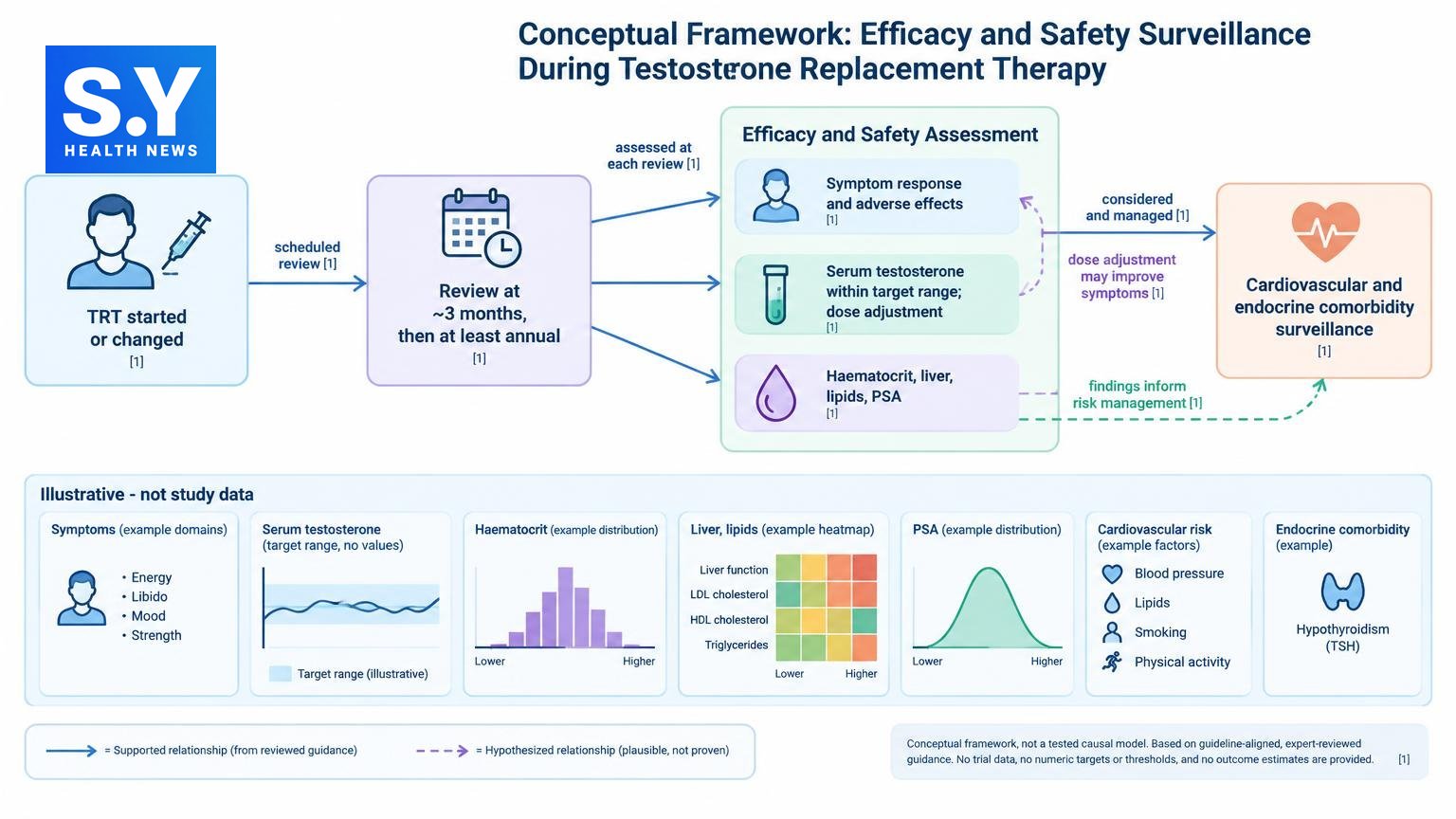
Monitoring adult men who receive testosterone replacement therapy is a structured surveillance task rather than a single measurement. Guideline-aligned guidance summarized in the available clinical reference recommends a review approximately 3 months after starting or changing therapy to assess treatment response and tolerability, followed by at least annual reviews unless clinical indications call for earlier assessment.[1]
At each review, the recommended approach includes assessing symptom improvement related to testosterone deficiency and any adverse effects the patient reports, monitoring serum testosterone to keep levels within the target therapeutic range with dose adjustment to avoid under- or overtreatment, and evaluating parameters testosterone can influence: haematocrit, liver function, lipid profile and prostate health including PSA.
Cardiovascular risk factors should be considered and managed, because testosterone therapy may have implications for cardiovascular health. Comorbid endocrine conditions such as hypothyroidism warrant monitoring of relevant parameters such as TSH. Persistent symptoms despite dose adjustment should prompt consideration of alternative causes or specialist referral, and each review should reinforce lifestyle advice and information about benefits and risks.
The important caveat is evidentiary. These are expert-reviewed, guideline-aligned recommendations rather than results of a new trial or systematic review, and the supplied evidence provides no numeric target testosterone range, no assay or sampling specifications, and no quantified risk estimates for haematocrit, prostate or cardiovascular outcomes. The framework is therefore clinically useful but not outcome-validated in the material reviewed here.
Why This Matters
Testosterone replacement therapy is a long-term hormonal intervention in adult men, and the parameters it can influence are not trivial: red cell mass, lipid fractions, prostate biology and cardiovascular risk. A monitoring plan is the mechanism by which a prescriber distinguishes a patient who is responding from one who is under-treated, over-treated, or developing a complication.
The surveillance question also matters because monitoring practice can drift. Without a defined review interval, patients may be started and then not reassessed, or may be reassessed with a single testosterone level and no discussion of symptoms or tolerability. The guidance that a review should occur at about 3 months after starting or changing therapy, and at least annually thereafter, sets an explicit cadence for those conversations.
A second reason is that monitoring findings drive decisions. The recommended approach explicitly links serum testosterone measurement to dose adjustment to avoid under- or overtreatment, and links persistent symptoms despite adjustment to reconsideration of the diagnosis or specialist referral. Monitoring is not a passive data-collection exercise; it is the feedback loop of treatment.
What the Recommended Monitoring Framework Contains
The clinical reference organizes monitoring across efficacy and safety domains. Efficacy rests on two pillars: patient-reported symptom improvement related to testosterone deficiency, and serum testosterone within the target therapeutic range. Safety rests on adverse-effect review and on laboratory and clinical surveillance of parameters testosterone can influence, together with cardiovascular risk factor management and attention to interacting endocrine conditions.
| Monitoring domain | What is assessed | Practical interpretation |
|---|---|---|
| Review schedule | Review about 3 months after starting or changing therapy; at least annual reviews thereafter unless clinical indications require earlier assessment | Sets the cadence for efficacy and safety checks rather than relying on ad hoc visits |
| Symptom response | Improvement in symptoms related to testosterone deficiency | Patient-reported efficacy; should be interpreted alongside serum levels |
| Serum testosterone | Level within the target therapeutic range, with dose adjustment to avoid under- or overtreatment | The target range and sampling timing are not specified in the supplied evidence |
| Haematocrit | Change in haematocrit, including polycythaemia | Testosterone can influence this parameter; no quantified thresholds supplied |
| Prostate health | PSA levels in men | Surveillance parameter because testosterone can influence prostate measures |
| Metabolic and liver parameters | Liver function abnormalities and lipid profile changes | Laboratory surveillance for effects testosterone can influence |
| Cardiovascular risk | Consideration and management of cardiovascular risk factors | Framed cautiously as possible implications for cardiovascular health |
| Comorbid endocrine conditions | Relevant parameters such as TSH where hypothyroidism is present | Reflects possible interaction with other endocrine conditions |
Biological and Clinical Rationale for Each Parameter
The guidance explains why each parameter is monitored: testosterone can influence haematocrit, liver function, lipids and prostate measures, including PSA. This is a mechanistic rationale rather than a quantified risk statement. It establishes plausibility and justifies surveillance, but it does not tell a clinician how often a given abnormality occurs or how large an effect to expect.
Cardiovascular surveillance is framed even more cautiously. The reference states that cardiovascular risk factors should be considered and managed appropriately because testosterone therapy may have implications for cardiovascular health. The word "may" is doing real work here: the supplied evidence gives no direction, magnitude or study-level estimate for a cardiovascular effect. In practice this supports good cardiovascular preventive care during therapy rather than a claim that therapy causes or prevents cardiovascular events.
The endocrine interaction point is similarly mechanistic. In patients with comorbidities such as hypothyroidism, relevant parameters such as TSH should be monitored because testosterone therapy may interact with other endocrine conditions. This is a prompt to keep comorbidity surveillance active, not evidence of a defined pharmacological interaction with a quantified effect.
What the Evidence Shows — and What It Does Not
The central finding of the supplied evidence is a recommended process: review at approximately 3 months after starting or changing therapy, then at least annually unless earlier assessment is clinically indicated; assess symptoms and adverse effects at each review; monitor serum testosterone against a target therapeutic range and adjust the dose to avoid under- or overtreatment; and evaluate haematocrit, liver function, lipids and prostate health including PSA.
What the evidence does not provide is equally important. No numerical target testosterone range is stated, and no assay standardization, sample timing relative to dosing, or threshold for dose adjustment is supplied. No quantified risk estimates are given for polycythaemia, lipid change, PSA rise or cardiovascular events. The source is described as a guideline-aligned, expert-reviewed answer, so the recommendations represent synthesis and clinical consensus rather than primary trial data.
This distinction matters for interpretation. A recommendation to monitor haematocrit is not the same as evidence that a specific haematocrit threshold should trigger a specific action, and a recommendation to consider cardiovascular risk factors is not evidence that treating them during therapy changes outcomes. Readers should treat the framework as a defensible standard of care process while recognizing that the outcome-level evidence is not contained in the reviewed material.
Interpreting Monitoring Results in Practice
A practical reading of the framework is that efficacy and safety should be judged together at each review. A patient whose symptoms have improved and whose serum testosterone sits within the target range is responding; a patient with persistent symptoms despite dose adjustment should have alternative causes considered or be referred to a specialist with expertise in hormone therapy. Neither judgment should rest on a laboratory value alone.
Safety interpretation requires the same restraint. Because the guidance does not specify action thresholds, clinicians must apply local protocols and clinical judgment when haematocrit, lipids, liver parameters or PSA change. The framework's contribution is to ensure these are looked at on a defined schedule and in the context of the patient's cardiovascular risk profile and comorbidities, including endocrine conditions such as hypothyroidism.
The recommendation to provide lifestyle advice and reinforce information about benefits and risks at each review is easy to overlook but is part of the surveillance standard. It frames monitoring as shared decision-making over time, particularly relevant for a long-term therapy whose benefit-risk balance can shift as a patient ages and as cardiovascular and prostate risk factors change.
Limitations and Evidence Gaps
The most important limitation is the nature of the source. It is a guideline-aligned, clinically reviewed summary without primary data, study design, sample sizes or denominators. It cannot establish the comparative effectiveness of one monitoring interval over another, nor can it quantify how much symptom improvement or which testosterone level best predicts benefit. Those questions require trials or well-conducted observational studies that are not part of the reviewed material.
A second limitation is the absence of operational detail. The guidance recommends monitoring serum testosterone within a target therapeutic range but does not state the range, assay method or sampling schedule. It recommends evaluating haematocrit, lipids, liver function and PSA but does not state thresholds, frequencies beyond the general review cadence, or management algorithms for abnormal results. Clinicians must therefore translate the framework using local guidelines and laboratory standards.
A third limitation concerns causal inference. The cardiovascular statement is explicitly cautious, and the endocrine-interaction statement is mechanistic. Neither should be read as establishing that testosterone therapy causes a specific cardiovascular outcome or that a specific monitoring intervention prevents one. The framework is best understood as a process standard with a plausible biological rationale, not as proof of outcome benefit.
Research Outlook
Several questions follow directly from the gaps. Which review interval best balances detection of under- and overtreatment against burden on patients and services? Which testosterone assay and sampling timing give the most reproducible assessment of the target range? What haematocrit, lipid and PSA trajectories during therapy best predict clinically important events? And do structured monitoring programs, compared with usual care, improve symptom control, safety or cardiovascular outcomes?
Until such evidence exists, the defensible position is to follow the recommended structure: review at about 3 months after starting or changing therapy, reassess at least annually unless earlier review is indicated, assess symptoms and adverse effects, check serum testosterone against the target range and adjust, and surveil haematocrit, liver function, lipids and PSA while managing cardiovascular risk factors and relevant comorbidities. This is a reasonable process standard, and it should be described as such rather than as proven outcome benefit.
Key Takeaways
- Guideline-aligned guidance recommends reviewing patients about 3 months after starting or changing testosterone therapy, then at least annually unless clinical indications require earlier assessment.
- Efficacy assessment combines symptom improvement related to testosterone deficiency with serum testosterone kept within the target therapeutic range through dose adjustment.
- Safety surveillance covers haematocrit including polycythaemia, liver function, lipid profile and prostate health including PSA, because testosterone can influence these parameters.
- Cardiovascular risk factors should be considered and managed, and comorbid endocrine conditions such as hypothyroidism warrant monitoring of relevant parameters such as TSH.
- Persistent symptoms despite dose adjustment warrant consideration of alternative causes or specialist referral, and each review should reinforce lifestyle advice and benefit-risk information.
- The evidence base is a guideline-aligned expert summary without primary data, numeric target ranges, thresholds or quantified outcome risks; it supports a process standard, not proven outcome benefit.
Questions and Answers
What does monitoring testosterone replacement therapy in adult men involve?
Monitoring combines efficacy and safety checks on a defined schedule. Guideline-aligned guidance recommends a review about 3 months after starting or changing therapy, then at least annual reviews unless earlier assessment is indicated. Each review assesses symptom improvement and adverse effects, monitors serum testosterone against the target therapeutic range with dose adjustment, and evaluates haematocrit, liver function, lipids and prostate health including PSA.
When should the first review occur after starting or changing testosterone therapy?
The recommended first review is approximately 3 months after starting or changing testosterone therapy, to assess treatment response and tolerability. After that, reviews should continue at least annually unless clinical indications require earlier assessment. The supplied evidence does not compare different review intervals in a trial, so the 3-month timing reflects guideline-aligned expert guidance rather than a demonstrated outcome advantage.
Which laboratory and clinical parameters should be checked during testosterone replacement therapy?
The recommended surveillance includes serum testosterone to confirm the level is within the target therapeutic range, haematocrit to detect polycythaemia, liver function, lipid profile and prostate health including PSA, because testosterone can influence these parameters. Cardiovascular risk factors should be considered and managed, and relevant parameters such as TSH monitored where hypothyroidism or other endocrine comorbidity is present.
How strong is the evidence behind testosterone therapy monitoring recommendations?
The available source is a guideline-aligned, clinically reviewed summary rather than primary trial data or a systematic review. It provides no study design, sample sizes, numeric target testosterone range, action thresholds or quantified risk estimates for haematocrit, prostate or cardiovascular outcomes. The recommendations are therefore a defensible process standard with mechanistic rationale, not proof that this monitoring schedule improves clinical outcomes.
What happens if symptoms persist despite testosterone dose adjustment?
Guidance recommends considering alternative causes of the persistent symptoms or referring the patient to a specialist with expertise in hormone therapy. This should occur alongside continued review of serum testosterone, symptom response, adverse effects and safety parameters. The supplied evidence does not specify which alternative diagnoses to prioritize or how long to persist with dose adjustment before referral, so clinical judgment and local protocols apply.
Does testosterone replacement therapy monitoring reduce cardiovascular risk?
The available guidance does not establish that. It recommends considering and managing cardiovascular risk factors because testosterone therapy may have implications for cardiovascular health, a deliberately cautious statement. No direction, magnitude or study-level estimate for cardiovascular effects is supplied, so monitoring should be understood as good preventive care during therapy rather than proven cardiovascular risk reduction.
Conceptual framework: Conceptual framework, not a tested causal model. It summarizes guideline-aligned surveillance of adult men on testosterone replacement therapy: review about 3 months after starting or changing therapy and at least annually thereafter, with symptom and adverse-effect assessment, serum testosterone target monitoring, haematocrit, liver, lipid and PSA checks, and cardiovascular and endocrine comorbidity review. Relations are supported by the reviewed guidance or proposed as plausible; the source provides no trial data, numeric thresholds or outcome estimates.
Academic References & Evidence
SANYUN Science Center explains published research on men's reproductive and sexual health, connecting scientific evidence with everyday questions while making sources and limitations clear.
Disclaimer: This article is for scientific education and research communication only. It does not provide medical advice, diagnosis, or individualized treatment recommendations, and does not endorse any medication, supplement, device, penile enlargement procedure, or other intervention. Decisions about sexual and reproductive health should be made in consultation with a qualified healthcare professional. Do not delay seeking professional care because of information in this article.
Original Content & Copyright Notice
- This article is prepared for SANYUN Science Center, drawing on published research and publicly available academic literature on men’s sexual and reproductive health. Its editorial explanations and presentation are developed for this platform.
- Copyright in the original editorial content, selection, and arrangement is reserved by SANYUN Science Center to the extent protected by applicable law. Referenced research, quotations, and third-party materials remain subject to the rights of their respective owners. This notice does not claim ownership of scientific facts or third-party research.
- Except where permitted by applicable law or an applicable license, prior written permission is required to reproduce, republish, translate, adapt, redistribute, or commercially reuse protected content. Attribution alone does not grant permission for such reuse.
- For permitted quotation or authorized reuse, clearly identify the source and retain a link to the original article.
- Source: SANYUN Science Center
- Original URL: Retain the original article URL on science.san-yun.com.
- Copyright Holder: SANYUN Science Center, for its own protected editorial content.
- Quotation, excerpts, or authorized reuse must not distort the scientific meaning, omit material limitations or disclaimers, or imply unverified medical claims, product efficacy, or endorsement by SANYUN Science Center.



