




Category: Penis Enlargement
Core Research Direction: Retrospective, single-center surgical case series describing the NEF (No Extenders No Fat) technique for combined penile lengthening and thickening: reported length and girth gains, reoperation and complication rates, measurement caveats, and the unverifiable reproducibility and generalizability of a 750-patient retrospective cohort.
Search Intent: What does a 750-patient retrospective case series report about measured length and girth gains, reoperation and complication rates after combined penile lengthening and thickening surgery, and what can such a single-center observational design not establish?
Platform: SANYUN Science Center
Evidence reviewed through: 2026-11-14
Executive Summary
A published 2023 retrospective case series describes 750 primary penile lengthening and thickening procedures performed with a technique the authors call NEF (No Extenders No Fat) by one medical team between 1 January 2018 and 31 December 2022. The series reports a mean immediate flaccid length gain of 4.8 cm and a mean flaccid gain of 4.3 cm at six months, together with a mean mid-shaft circumference increase of 1.17 cm at six months.[1]
The authors report that 64 patients (8.5%) requested further surgery for more size and that revisions were actually performed in 35 cases (4.6%). Recorded complications were mostly minor and managed conservatively, but the series also includes one major intraoperative bleeding event. The article classifies its own evidence level as 4c therapeutic, which is consistent with an uncontrolled observational design rather than a comparative trial.
The central caution is that this design can describe what happened in one team's patients; it cannot show that the technique outperforms alternatives, that gains are durable beyond six months, or that the same results would be reproduced elsewhere. The authors themselves state that final gain depends on individual healing and anatomy and that not a single centimetre can be guaranteed.
Why This Matters
Penile size concerns are common and psychologically consequential. The authors note that most men seeking enlargement have a penis considered normal by clinical standards, and they describe associated shame, reduced quality of life, sexual-function anxiety and, in some accounts, low mood. They recommend psychological assessment and preoperative counselling, especially where penile dysmorphophobia is suspected.[2]
Surgery for this indication sits in a contested space. The authors list numerous non-surgical options (herbal products, traction exercises, weights, extender devices, vacuum pumps) and surgical options (pubic liposuction, suspensory ligament division, synthetic or autologous injections), and state that there is no clear consensus on when and how they should be used, with variable results and satisfaction. A large reported figure in their introduction is that 45% of more than 25,000 healthy men surveyed wished for a larger penis; this is an external secondary citation, not a finding of the present cohort.
For readers weighing such surgery, the useful question is not only 'what gains were reported' but 'how were gains measured, in whom, by whom, and against what comparator'. This case series answers the first question in some detail and the last question not at all.
The NEF Technique and Its Proposed Mechanism
NEF combines three elements in a single operation: a skin advancement flap, a Scarpa fascia flap and nanofat infiltrated at the deep fasciae of the penis. The authors state that lengthening and thickening must be performed together, because nanofat is intended to limit retraction and because partial release of the suspensory ligament is needed to access the deep fasciae for infiltration.
Lengthening involves partial subperiosteal release of the suspensory ligament under artificial erection, with limited release if substantial vessels are encountered or if penile attachment to the pubis appears compromised. A Scarpa fascia flap is then turned over and interposed between the ligament and the pubis, and the skin is advanced in a V-Y pattern. The authors propose that the fascia flap adheres to the periosteum, survives as a graft and prevents the ligament from reattaching, thereby preserving length. That mechanism is a stated hypothesis rather than something tested with controlled measurement or histology in the supplied text.
Thickening uses adipose tissue harvested from the abdomen, processed toward nanofat and infiltrated at the level of the deep fasciae through small basal incisions, deliberately avoiding subcutaneous injection. The 'no fat' label is explained as removal of viable adipocytes during processing, while adipose-derived stem cells are described as retaining functional properties; this rationale rests on cited prior work not included in the packet. The authors caution that more volume is not necessarily better, because excess volume may compromise survival of the injected cells.
The authors also warn that the suspensory ligament cannot be released beyond a certain point because doing so could impair erection. This is presented as a technical caution; the supplied text does not report erectile-function outcomes from the cohort, so the practical size of that risk cannot be judged from this series.
Who Was Studied
The cohort comprised 750 patients with a mean age of 47 years 6 months (range 25 to 55 years). Inclusion was restricted to healthy men aged 25 to 55, and patients were excluded for obesity, connective-tissue disease, simultaneous operations, autoimmune disease, HIV, previous penile fillers or surgery, and a flaccid measured size below 3 cm or above 8 cm.
These filters matter for interpretation. A series that excludes men outside a defined flaccid size window and excludes those with prior penile surgery is not a picture of everyone requesting enlargement. Reported averages therefore describe a selected, relatively healthy surgical population treated by one team, not the full range of presentations.
Anaesthesia was usually propofol sedation with direct nerve blockade at the penile base and suspensory ligament, with 56 cases (7.5%) performed under epidural anaesthesia. Mean post-surgical hospital stay was 3 hours 10 minutes and no patient required admission, which reflects an ambulatory protocol as much as the procedure itself.
What the Evidence Shows
The headline results are substantial in magnitude. Mean flaccid length gain immediately after surgery was 4.8 cm, with a range of 2 to 8.1 cm. When measurement was repeated at six months under similar conditions, mean flaccid gain was 4.3 cm, with a range of 1.2 to 7.1 cm. At six months, mid-shaft circumference had increased by a mean of 1.17 cm (minimum 0.5, maximum 1.8 cm). The authors judged immediate postoperative girth measurement uninformative because of inevitable inflammation, so only the six-month girth figure is reported.
Two features of these numbers deserve emphasis. First, length was measured flaccid, with the patient supine in clinic, and the authors do not report erect length outcomes in the supplied text. Second, the range is wide: a mean gain of several centimetres conceals patients near the lower bound and patients near the upper bound, and the authors explicitly link final gain to healing and anatomy.
Satisfaction was inferred indirectly from revision requests rather than from a validated questionnaire. Of 750 patients, 64 (8.5%) asked for further surgery to gain more size, mostly in both length and girth, while revisions were ultimately performed in 35 (4.6%). Of those 35, 28 had the thickening procedure repeated, 4 had scar-related release of the suspensory ligament area, and 3 had both. The authors note that the same gain may satisfy one patient and not another, which is a useful reminder that centimetres and satisfaction are not interchangeable.
| Reported outcome | Result in the series | Timing and measurement | Key interpretation |
|---|---|---|---|
| Flaccid length gain | Mean 4.8 cm (range 2 to 8.1 cm) | Immediate postoperative; measured flaccid in clinic | Includes early postoperative tissue changes; no comparator group |
| Flaccid length gain | Mean 4.3 cm (range 1.2 to 7.1 cm) | Six months; repeat measurement under similar conditions, patient supine | Wide individual range; no blinded or independent assessment reported |
| Mid-shaft circumference gain | Mean 1.17 cm (minimum 0.5, maximum 1.8 cm) | Six months | Immediate girth not reported because inflammation was judged uninformative |
| Revision requests | 64 patients (8.5%) | Not explicitly time-defined in supplied text | Indirect satisfaction proxy, not a validated measure |
| Revisions performed | 35 patients (4.6%) | Not explicitly time-defined in supplied text | 28 repeat thickening, 4 scar release, 3 both |
| Penile and pubic ecchymosis | 126 patients (16.8%) | Postoperative; all managed conservatively | Most frequent recorded complication |
| Wound healing disturbance | 46 patients (6.1%) | Suture opening, hypertrophic, dehiscent or keloid scar | Usually revised under local anaesthesia around six months |
| Graft resorption | 35 patients (4.6%) | Partial or total; repeat procedure at one year | Reflects unpredictable graft take |
| Partial V-Y flap necrosis | 7 patients (1%) | Postoperative | Small absolute number of events |
| Major bleeding | 1 patient | Intraoperative during ligament dissection | Required 2 units of red blood cells and 2 revision surgeries |
Complications and Their Interpretation
Recorded complications were led by penile and pubic ecchymosis in 126 patients (16.8%), all managed conservatively. Wound healing disturbances, including suture opening and hypertrophic, dehiscent or keloid scarring, occurred in 46 patients (6.1%) and were generally revised under local anaesthesia around six months. Partial or total resorption of the thickening graft occurred in 35 patients (4.6%) and was managed by repeating the procedure at one year. Scar-related retraction affected 32 patients (4.2%), with only 4 requiring surgical revision, and partial necrosis of the V-Y flap occurred in 7 patients (1%).
Two urinary retention cases were recorded and attributed more to epidural anaesthesia than to the surgery itself. The single major complication was a patient with substantial sheet-like bleeding during suspensory ligament dissection who required 2 units of red blood cells and 2 revision operations. A single event in 750 patients does not yield a precise risk estimate, and retrospective recording may capture mild events inconsistently in either direction.
The authors also flag adherence to postoperative care, which includes traction massage and periodic masturbation intended to support graft nutrition, as a practical difficulty. This is a relevant but non-quantified limitation: reported outcomes may depend on aftercare that is hard to standardise or verify.
Measurement Caveats
The series is unusually candid about measurement. The authors stress that the same physician should measure under reproducible conditions, that the patient should undress in front of the professional because self-traction before measurement is common, and that the penis responds abruptly to emotion, temperature, time of day and proximity of physical or sexual activity. In patients attending on consecutive days, they found differences of up to 2 cm attributable to such physiological variation, although the size of that subset is not stated.
They also note a definitional problem: after surgery, part of the penis lies beneath hair-bearing skin, so a patient may place a ruler at the hairless skin boundary and measure the skin rather than the penis. All reported gains were flaccid, clinic-based measurements, and the supplied text reports no erect length, no volumetric imaging and no independent assessor. These are not reasons to dismiss the numbers, but they do mean the reported gains should be read as operating-characteristic-dependent estimates rather than fixed anatomical constants.
Interpretation and Limitations
The core limitation is design. This is a retrospective, single-team case series without a comparison group, randomisation or blinding, and the authors themselves label it level 4c therapeutic. Such a design can document feasibility, describe a range of outcomes and generate hypotheses about which patients benefit; it cannot establish that NEF is superior to other operations, non-surgical approaches or no intervention, because patients who chose surgery may differ systematically from those who did not.
A second limitation is reproducibility. The authors present NEF as a reproducible technique, but reproducibility across surgeons depends on training, case selection, operative detail and aftercare, none of which can be evaluated from one centre's experience. The reported complication and revision rates are therefore that team's rates, not a benchmark that other clinics can assume. The technique's own mechanistic claims, such as the fascia flap preventing ligament reattachment, remain proposed explanations rather than demonstrated mechanisms in the supplied text.
A third limitation concerns outcomes that matter most to patients. The series does not report validated satisfaction scores, erectile function, sensation, urinary function beyond retention events, or durability beyond six months. Its satisfaction signal is revision requests, which conflate genuine dissatisfaction, desire for further size and individual expectation. The authors' statement that no single centimetre can be guaranteed is consistent with the wide observed ranges and with the dependence of final gain on healing and anatomy.
Finally, the clinical context is not neutral. The authors recommend preoperative psychological support and professional counselling, especially where dysmorphophobia is suspected, and frame surgery as a quality-of-life procedure rather than a cure for a complex. That framing is a clinical opinion, not a tested intervention, but it is a reasonable starting point for conversations about whether surgery is the right step at all.
Research Outlook
What would move this field beyond a case series? Prospective cohorts with pre-specified measurement protocols, standardised erect and flaccid measurement, independent assessors, validated patient-reported satisfaction and sexual-function instruments, and follow-up long enough to capture retraction, graft resorption and revision. Comparative designs, including comparison with non-surgical care or with watchful waiting, would be needed before any claim of superiority could be supported.
Multi-surgeon studies would also test the claim of reproducibility, and reporting should separate outcomes for men with normal anatomy from those with dysmorphophobia or other psychological presentations. Until then, the honest summary is that a large single-team series reports meaningful average gains with a mostly manageable complication profile, while leaving comparative effectiveness, durability, functional outcomes and generalisability unresolved.
Key Takeaways
- The evidence base is a retrospective single-team case series of 750 procedures performed between 2018 and 2022, self-classified as level 4c therapeutic, with no comparison group.
- Reported mean flaccid length gain was 4.8 cm immediately after surgery and 4.3 cm at six months, with wide individual ranges (2 to 8.1 cm and 1.2 to 7.1 cm respectively).
- Reported mean mid-shaft circumference gain at six months was 1.17 cm (range 0.5 to 1.8 cm), with immediate girth not reported because of inflammation.
- Revision requests were recorded in 64 patients (8.5%) and revisions performed in 35 (4.6%); satisfaction was not measured with a validated instrument.
- Complications were led by ecchymosis (16.8%) and wound healing disturbance (6.1%); one major intraoperative bleeding event required transfusion and two revision surgeries.
- Measurement variability of up to 2 cm between consecutive days, flaccid-only clinic measurement and the absence of independent assessment limit how precisely the reported gains can be interpreted.
Questions and Answers
What is the NEF technique for penile enlargement and thickening?
NEF stands for No Extenders No Fat. It combines a skin advancement flap, a Scarpa fascia flap interposed after partial suspensory ligament release, and nanofat infiltrated at the deep fasciae of the penis. The authors state that lengthening and thickening must be done together, and describe the fascia flap and nanofat as intended to limit retraction and subcutaneous complications. The proposed mechanisms remain hypotheses rather than demonstrated processes.
How much length and girth gain did the 750-patient NEF series report?
The series reported a mean immediate flaccid length gain of 4.8 cm (range 2 to 8.1 cm) and a mean six-month flaccid gain of 4.3 cm (range 1.2 to 7.1 cm). Mean mid-shaft circumference gain at six months was 1.17 cm (range 0.5 to 1.8 cm). These are averages from a single team's clinic-based measurements, not guaranteed individual outcomes.
How strong is the evidence for penile enlargement surgery from this case series?
It is observational and uncontrolled. The article classifies itself as level 4c therapeutic: a retrospective, single-team series of 750 procedures without randomisation, blinding, a comparison group or independent measurement. It can describe what happened in that practice and generate hypotheses, but it cannot show superiority over other techniques, non-surgical care or no treatment, nor establish causality.
Who was included in the NEF penile enlargement study, and who might the results not apply to?
Participants were healthy men aged 25 to 55 with a flaccid measured size between 3 and 8 cm, excluding obesity, connective-tissue and autoimmune disease, HIV, prior penile surgery or fillers, and simultaneous operations. Results therefore may not generalise to older men, men outside that size window, men with prior penile surgery, or patients treated by other surgical teams with different experience and aftercare.
What complications and revision rates were reported after NEF penile surgery?
Ecchymosis occurred in 16.8% and wound healing disturbance in 6.1%; graft resorption in 4.6%, scar retraction in 4.2% and partial V-Y flap necrosis in 1%. Revisions were requested by 8.5% and performed in 4.6%. One major intraoperative bleed required transfusion and two revision operations. Retrospective recording and a single centre limit precise risk estimation.
Why are penile length measurements after enlargement surgery difficult to interpret?
The authors measured flaccid length in clinic with the patient supine and stress the need for the same physician and reproducible conditions. They found differences of up to 2 cm between consecutive-day measurements attributed to stress, temperature and physiological variation, and noted that patients may measure skin rather than penis after surgery. No erect length or independent assessment is reported.
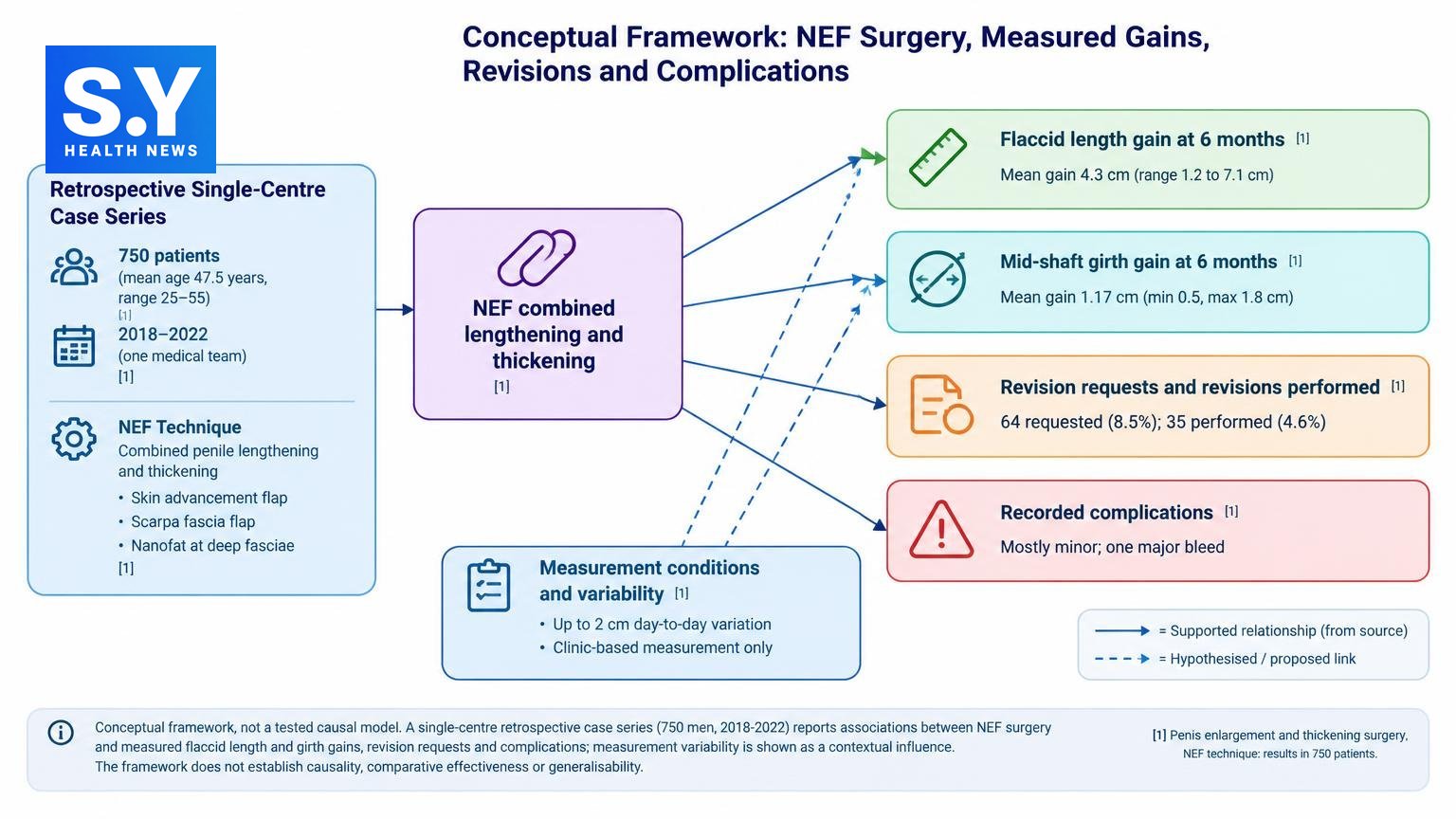
Conceptual framework: Conceptual framework, not a tested causal model. A single-centre retrospective case series (750 men, 2018-2022) reports associations between NEF surgery and measured flaccid length and girth gains, revision requests and complications; measurement variability is shown as a contextual influence. The framework does not establish causality, comparative effectiveness or generalisability.
Academic References & Evidence
- César NOVAL FONT; Miguel PERÁN TERUEL; Felipe ORDOÑO DOMÍNGUEZ; Javier JUÁREZ ESCALONA; Sebastián RODRÍGUEZ-ÁLVAREZ; Erasmo A. POLEO LOVERA. Penis enlargement and thickening surgery. NEF technique: results in 750 patients. Cirugía Plástica Ibero-Latinoamericana. 2023 49(2):129-138 DOI: 10.4321/S0376-78922023000200005.
- Cirugía de alargamiento y engrosamiento de pene. Técnica NEF: resultados en 750 pacientes.
SANYUN Science Center explains published research on men's reproductive and sexual health, connecting scientific evidence with everyday questions while making sources and limitations clear.
Disclaimer: This article is for scientific education and research communication only. It does not provide medical advice, diagnosis, or individualized treatment recommendations, and does not endorse any medication, supplement, device, penile enlargement procedure, or other intervention. Decisions about sexual and reproductive health should be made in consultation with a qualified healthcare professional. Do not delay seeking professional care because of information in this article.
Original Content & Copyright Notice
- This article is prepared for SANYUN Science Center, drawing on published research and publicly available academic literature on men’s sexual and reproductive health. Its editorial explanations and presentation are developed for this platform.
- Copyright in the original editorial content, selection, and arrangement is reserved by SANYUN Science Center to the extent protected by applicable law. Referenced research, quotations, and third-party materials remain subject to the rights of their respective owners. This notice does not claim ownership of scientific facts or third-party research.
- Except where permitted by applicable law or an applicable license, prior written permission is required to reproduce, republish, translate, adapt, redistribute, or commercially reuse protected content. Attribution alone does not grant permission for such reuse.
- For permitted quotation or authorized reuse, clearly identify the source and retain a link to the original article.
- Source: SANYUN Science Center
- Original URL: Retain the original article URL on science.san-yun.com.
- Copyright Holder: SANYUN Science Center, for its own protected editorial content.
- Quotation, excerpts, or authorized reuse must not distort the scientific meaning, omit material limitations or disclaimers, or imply unverified medical claims, product efficacy, or endorsement by SANYUN Science Center.



