




Category: Erectile Dysfunction
Core Research Direction: Critical appraisal of diagnostic measurement and therapeutic evidence quality in erectile dysfunction: what NPT testing can and cannot establish, and how reliable the current treatment evidence base is
Search Intent: How reliable is the evidence behind erectile dysfunction diagnosis and treatment, and what can nocturnal penile tumescence testing actually tell us about psychogenic versus organic causes?
Platform: SANYUN Science Center
Evidence reviewed through: 2026-11-15
Executive Summary
Two very different questions sit behind the phrase "evidence-based erectile dysfunction care." The first is diagnostic: can a measurement separate a psychological cause from a physical one? The second is therapeutic: how much confidence should clinicians and patients place in the trials behind each treatment? The supplied evidence answers the first question skeptically and the second cautiously.[1][2]
On diagnosis, a methodological analysis of nocturnal penile tumescence (NPT) monitoring argued that the field's foundational assumption — that nighttime erection recordings can distinguish psychogenic from organic impotence — had never been demonstrated in patients classified independently of NPT itself.
On treatment, an umbrella review published in 2026 found that the evidence base is predominantly low or very low quality, even though statistically significant improvements appeared for both pharmacological and nonpharmacological interventions.
The practical implication is not that these tools and treatments are worthless. It is that certainty must be stated honestly: a positive nighttime recording is not proof of a psychological cause, and a significant trial result is not proof of a reliable effect.
Why This Matters
Erectile dysfunction is common, treatable and frequently linked to cardiovascular risk, so the stakes of getting the evidence story right are high. Because the condition sits at the intersection of vascular, neurological, hormonal and psychological factors, clinicians and patients naturally want a test that sorts one cause from another. NPT monitoring promised exactly that: an objective, sleep-based measure that would reveal whether the erectile machinery itself was intact.[3]
The appeal is easy to understand. If erections occur during sleep but not with a partner, the reasoning goes, the problem must be psychological; if they never occur, it must be organic. That inference is intuitively attractive and clinically consequential, because it can redirect a man toward either sex therapy or medical workup. The question is whether the inference was ever rigorously tested, and the supplied commentary says it was not.
The therapeutic side matters just as much. Patients make decisions about medications, devices and procedures on the assumption that the supporting trials are solid. When an umbrella review reports that more than half of the included meta-analyses were rated critically low quality and that nearly half of all summary effects were very low quality, that assumption deserves scrutiny.
Biological and Measurement Foundations
An erection is a vascular event coordinated by nerves. In the standard mechanistic account, sexual arousal triggers nerve signals that release nitric oxide in the penile arteries; nitric oxide activates guanylate cyclase, which produces cyclic GMP; cyclic GMP relaxes arterial smooth muscle and allows blood to fill the corpora cavernosa. Disruption anywhere along that chain — vascular, neural, hormonal or psychological — can impair erection.
This mechanism explains why researchers looked to sleep-related erections. If the vascular and neural machinery is intact, erections should occur during rapid-eye-movement sleep without any need for arousal or desire. NPT monitoring therefore measures something real and physiologically meaningful; the difficulty lies in moving from a physiological signal to a categorical clinical verdict about cause.
The 1980 analysis raised three technical problems with that leap. First, the core discriminating assumption had never been validated. Second, an adequate NPT evaluation requires direct observation of one of the patient's fullest erections, and this step was not always performed, with a case report illustrating the resulting risk of misdiagnosis. Third, published criteria for diagnosing psychogenic impotence disagreed with one another.
The author's proposed remedy was to anchor criteria in whether the physiological mechanisms required for erection are intact, rather than in values recorded from normal subjects. That is a meaningful methodological shift, but the commentary presents it as a proposal, not as validated practice.
| NPT evaluation issue | What the source reports | Implication for diagnosis |
|---|---|---|
| Discrimination premise | The ability of NPT to separate psychogenic from organic impotence was argued never to have been demonstrated in patients classified independently of NPT | The test cannot be treated as a validated gold standard for cause |
| Observation of fullest erection | Required for an adequate NPT evaluation but not always performed | Omitting it creates a documented risk of misdiagnosis, illustrated by case report |
| Diagnostic criteria | Literature criteria for psychogenic impotence disagreed; integrity-based criteria proposed | Comparability across studies and clinics is compromised |
| Evidence needed | Studies with independent patient classification to define clinical applicability limits | A research agenda, not a completed validation |
What the Diagnostic Evidence Shows
The supplied material on NPT is a methodological commentary with an illustrative case report, published in Psychosomatic Medicine in 1980. It is not a validation study, and it reports no sensitivity, specificity or agreement statistics. Its value is in framing a problem precisely: the test's central claim rested on an assumption that had not been tested against an independent reference standard.[4]
That framing still matters. A diagnostic test can be reliable in the narrow sense — producing consistent readings — while being invalid for the inference it is used to support. If a clinician records that sleep erections were present, the correct inference may be that some erectile capacity exists, not that the cause of the patient's difficulty is psychological.
The commentary also highlights how measurement protocols shape conclusions. The requirement for direct observation is not a technicality; without it, a recording may reflect movement artifact, poor device placement or an erection that is not representative. The case report makes the point that a misclassification can then drive a wrong treatment path.
It is important not to overstate the age of this source as a refutation of modern practice. The article reflects the literature as of 1980, and later technologies and scoring approaches are not evaluated in the supplied material. What survives is the logical point: any claim that a physiological measurement establishes cause requires validation against independent classification.
What the Treatment Evidence Shows
The 2026 umbrella review searched PubMed, Web of Science, the Cochrane Library and Embase, covering studies published up to October 2025. From 1,191 studies it extracted 23 published meta-analyses, yielding 42 summary effects distributed across the IIEF (n=20), IIEF-5 (n=9), IIEF-EF (n=6) and erectile hardness score (n=7) across 36 interventions.
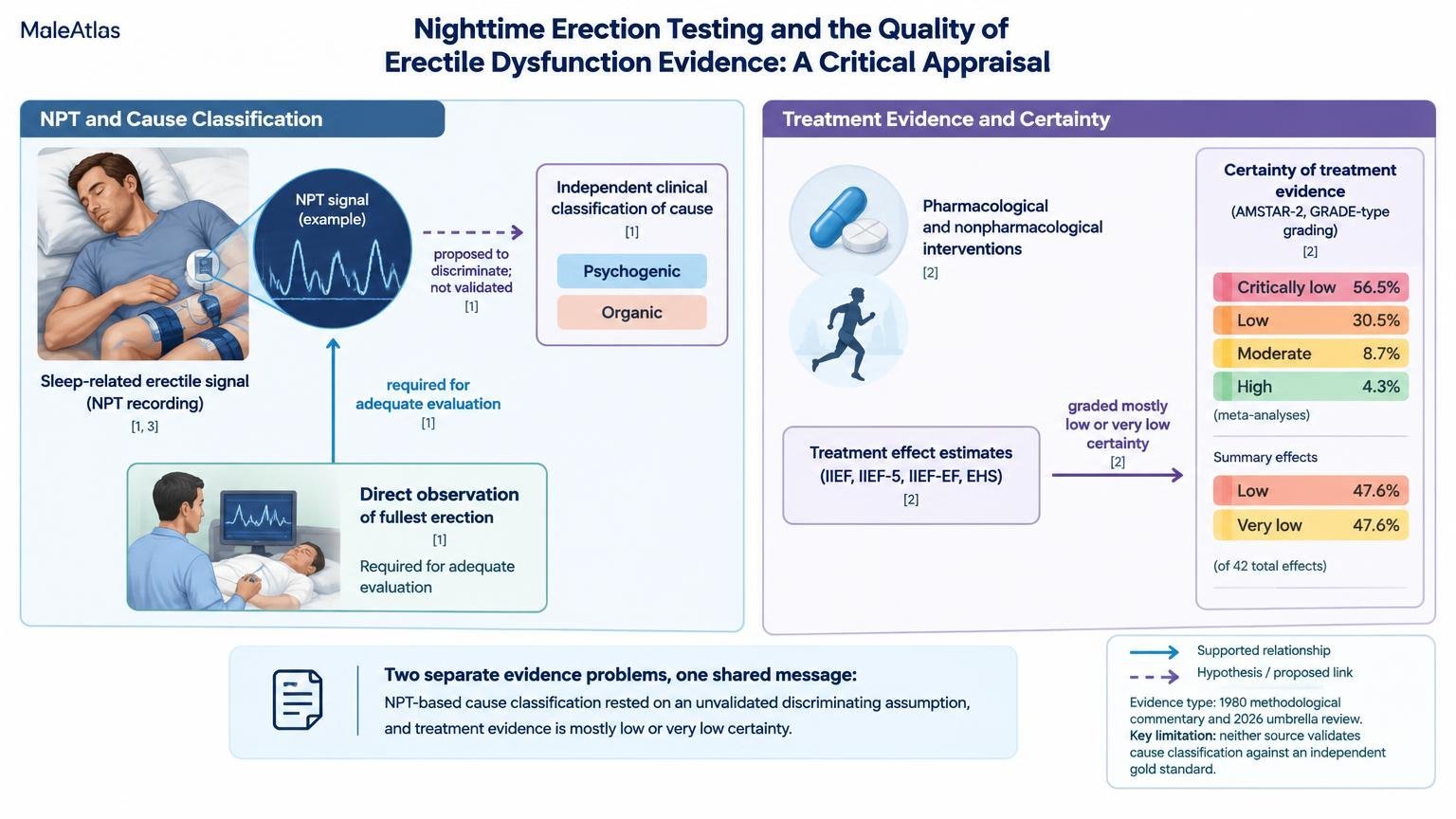
Quality was assessed with AMSTAR-2. Thirteen meta-analyses (56.5%) were rated critically low, seven (30.5%) low, two (8.7%) moderate and one (4.3%) high. At the level of summary effects, only two were rated high and moderate quality respectively, while 20 (47.6%) were low and 20 (47.6%) very low.
The authors' conclusion is unambiguous: the evidence base is predominantly low or very low quality. Statistically significant improvements were observed for both pharmacological and nonpharmacological interventions, but they caution that these findings should be interpreted carefully because of limited patient numbers and the subjective nature of the outcome measures.
Two points deserve emphasis. First, the endpoints themselves are largely patient-reported or rater-based, which introduces expectation effects and limits blinding. Second, the review states that the treatment landscape is increasingly diverse while the reliability of evidence is poor, and it recommends better-designed single-treatment studies and high-quality meta-analyses of intertreatment comparisons. That recommendation describes a gap, not a result.
Specific treatments illustrate the same pattern at different levels of confidence. A 2025 Cochrane review of 21 randomized trials (1,357 men) found that low-intensity shockwave therapy may improve IIEF-EF scores by roughly 3.9 points short-term and 5.3 points long-term versus sham, but with low certainty, and several included studies were industry-funded.
In men with hypogonadism and preexisting or high cardiovascular risk, the TRAVERSE trial (n=5,246) found transdermal testosterone noninferior to placebo for major adverse cardiac events (HR 0.96, 95% CI 0.78–1.17) over a mean 21.7 months. That is a cardiac safety finding; it does not establish erectile efficacy, and the primary trial report is not among the supplied materials.
Adjacent Signals and Their Limits
Several bodies of evidence connect ED to broader health states, and each carries design limitations worth naming. An analysis of 53,517 FDA Adverse Event Reporting System reports from 2004 to 2024 reproduced labeled side effects for all four PDE5 inhibitors and flagged unlabeled nervous-system, cardiovascular and eye signals that need further study; spontaneous reports cannot establish incidence or causation.
In a 2024 database analysis of 3,094 non-diabetic, non-hypogonadal men aged 18–50 taking semaglutide for weight loss, new ED diagnosis or PDE5 inhibitor prescription occurred in 1.47% versus 0.32% of matched unexposed men, and testosterone deficiency in 1.53% versus 0.80%. Absolute rates were low, and the observational design cannot establish causation.
Among 150 men newly diagnosed with moderate to severe obstructive sleep apnea, ED prevalence was 51%; this is a selected cohort and may not generalize. A 2023 meta-analysis of 8 studies (457 patients) reported higher post-treatment IIEF-5 scores with sildenafil than with CPAP (37.7 versus 27.3), while a 2021 Cochrane review rated CPAP versus no CPAP evidence as very uncertain.
The cardiovascular association is widely cited and reported secondhand here: an umbrella review described as finding elevated risks of cardiovascular disease (RR 1.45, 95% CI 1.36–1.54), coronary heart disease (RR 1.50), cardiovascular mortality (RR 1.50), myocardial infarction (RR 1.55), stroke (RR 1.36) and all-cause mortality (RR 1.25). These are observational associations, and the underlying review was not supplied.
Interpretation and Limitations
The two halves of this evidence base fail in different ways, and separating them clarifies what a clinician can reasonably say. The NPT literature fails at the level of inference: a physiological signal is used to support a causal classification without independent validation. The treatment literature fails more at the level of certainty: many effects are statistically significant but rest on small samples, subjective endpoints and methodologically weak syntheses.
Statistical and clinical meaning must also be kept apart. A 3.9-point IIEF-EF improvement may be statistically detectable while remaining uncertain in magnitude and durability, which is precisely why the review graded it low certainty. Similarly, a relative risk of 1.45 for cardiovascular disease describes an association across populations, not an individual's predicted outcome.
The limitations of the sources themselves matter. The NPT analysis is a 1980 commentary with a single illustrative case, not a systematic validation. The treatment umbrella review synthesizes already-published meta-analyses, so its conclusions inherit their flaws. Much of the adjacent clinical detail is reported secondhand by a commercial physician guide, and the primary trials behind those figures were not supplied for independent appraisal.
Finally, the umbrella review's own framing is bounded: it covers studies published up to October 2025 and four named databases. Interventions and trials published later, or indexed elsewhere, are outside its scope.
Research Outlook
The diagnostic agenda is essentially the one the 1980 commentary proposed: studies that classify patients independently of the test under evaluation, so that the limits of clinical applicability can be defined rather than assumed. Whether modern sleep-based or stimulation-based approaches have since met that standard is not established by the supplied material, and readers should treat strong claims about cause classification with corresponding caution.
The therapeutic agenda is equally explicit. The umbrella review calls for well-designed studies of single treatments and for high-quality meta-analyses comparing treatments against one another, rather than accumulating more low-certainty syntheses. Until that work exists, the honest position is that many interventions show signals of benefit within an evidence base whose reliability is limited.
Key Takeaways
- The claim that NPT monitoring can separate psychogenic from organic impotence was argued in 1980 never to have been demonstrated in patients classified independently of NPT itself.
- Adequate NPT evaluation requires direct observation of one of the patient's fullest erections; omission of this step carries a documented, case-illustrated risk of misdiagnosis.
- Published NPT criteria for psychogenic impotence disagreed, and integrity-based criteria were proposed rather than validated.
- A 2026 umbrella review of 23 meta-analyses found 56.5% rated critically low quality and nearly half of 42 summary effects very low quality.
- Statistically significant treatment improvements exist, but the review urges caution because of limited patient numbers and subjective outcome measures.
- Low-intensity shockwave therapy showed roughly 3.9-point short-term and 5.3-point long-term IIEF-EF gains versus sham in a 2025 Cochrane review of 21 trials (1,357 men), with low certainty.
Questions and Answers
What is nocturnal penile tumescence testing and what was it supposed to show?
NPT monitoring records erections during sleep, on the reasoning that intact vascular and neural function should produce them without arousal or desire. It was used to try to separate psychogenic from organic impotence. A 1980 methodological analysis argued that this discriminating assumption had never been demonstrated in patients classified independently of NPT itself.
Can nighttime erection monitoring prove that erectile dysfunction is psychological?
Not on the evidence supplied. The 1980 commentary states that the ability of NPT to distinguish psychogenic from organic impotence was never demonstrated against independent classification, and that diagnostic criteria disagreed across the literature. A recording may show that some erectile capacity exists without establishing the cause of a man's difficulty.
How strong is the evidence base for erectile dysfunction treatments?
A 2026 umbrella review of 23 meta-analyses found the evidence predominantly low or very low quality: 13 meta-analyses (56.5%) were rated critically low by AMSTAR-2, and 20 of 42 summary effects were very low quality. Statistically significant improvements were seen, but the authors urge caution because of limited patient numbers and subjective outcome measures.
Does low-intensity shockwave therapy improve erectile function scores?
A 2025 Cochrane review of 21 randomized trials (1,357 men) found low-intensity shockwave therapy may improve IIEF-EF scores by roughly 3.9 points short-term and 5.3 points long-term versus sham, with low certainty of evidence. Several included studies were industry-funded, so the signal is suggestive rather than established.
What are the main limitations of the erectile dysfunction evidence reviewed here?
The NPT material is a 1980 commentary with a single illustrative case, not a validation study. The treatment umbrella review synthesizes already-published meta-analyses and inherits their flaws. Several clinical figures are reported secondhand by a commercial guide whose cited primary trials were not supplied, and observational designs cannot establish causation.
Why does statistical significance not settle whether an erectile dysfunction treatment works?
Significance indicates that an effect is unlikely to be due to chance under the trial's assumptions; it says little about magnitude, durability or methodological quality. The shockwave review's roughly 3.9-point short-term IIEF-EF gain was graded low certainty, and the umbrella review found subjective endpoints and small samples throughout the literature.
Conceptual framework: Conceptual framework — not a tested causal model. It shows two separate evidence problems: NPT-based cause classification rested on an unvalidated discriminating assumption and a required observation step, while treatment effect estimates are graded mostly low or very low certainty. Evidence type: a 1980 methodological commentary and a 2026 umbrella review. Key limitation: neither source validates cause classification against an independent gold standard.
Academic References & Evidence
- M D Wasserman. Theoretical and technical problems in the measurement of nocturnal penile tumescence for the differential diagnosis of impotence – PubMed. Psychosom Med. 1980 42(6):575-85 DOI: 10.1097/00006842-198011000-00006.
- Current treatment for erectile dysfunction: an umbrella review of systematic reviews and meta-analyses. 2026 DOI: 10.6084/m9.figshare.31562993.v1.
- Erectile Dysfunction.
- Wasserman, M. D.; Pollak, C. P.; Spielman, A. J.; Weitzman, E. D.. Theoretical and technical problems in the measurement of nocturnal penile tumescence for the differential diagnosis of impotence. Psychosomatic Medicine. 1980 42(6):575–585 DOI: 10.1097/00006842-198011000-00006.
SANYUN Science Center explains published research on men's reproductive and sexual health, connecting scientific evidence with everyday questions while making sources and limitations clear.
Disclaimer: This article is for scientific education and research communication only. It does not provide medical advice, diagnosis, or individualized treatment recommendations, and does not endorse any medication, supplement, device, penile enlargement procedure, or other intervention. Decisions about sexual and reproductive health should be made in consultation with a qualified healthcare professional. Do not delay seeking professional care because of information in this article.
Original Content & Copyright Notice
- This article is prepared for SANYUN Science Center, drawing on published research and publicly available academic literature on men’s sexual and reproductive health. Its editorial explanations and presentation are developed for this platform.
- Copyright in the original editorial content, selection, and arrangement is reserved by SANYUN Science Center to the extent protected by applicable law. Referenced research, quotations, and third-party materials remain subject to the rights of their respective owners. This notice does not claim ownership of scientific facts or third-party research.
- Except where permitted by applicable law or an applicable license, prior written permission is required to reproduce, republish, translate, adapt, redistribute, or commercially reuse protected content. Attribution alone does not grant permission for such reuse.
- For permitted quotation or authorized reuse, clearly identify the source and retain a link to the original article.
- Source: SANYUN Science Center
- Original URL: Retain the original article URL on science.san-yun.com.
- Copyright Holder: SANYUN Science Center, for its own protected editorial content.
- Quotation, excerpts, or authorized reuse must not distort the scientific meaning, omit material limitations or disclaimers, or imply unverified medical claims, product efficacy, or endorsement by SANYUN Science Center.



