




Category: Reproductive Care
Core Research Direction: What non-obstructive azoospermia (NOA) is, how common it is among men with infertility, and how a 2025 Chinese expert consensus classifies its causes and approaches diagnosis
Search Intent: In men with no sperm in the ejaculate despite normal ejaculation, what causes should be considered and how is non-obstructive azoospermia diagnosed?
Platform: SANYUN Science Center
Evidence reviewed through: 2026-11-25
Executive Summary
Non-obstructive azoospermia (NOA) is a condition in which no sperm are found in the ejaculate because sperm production in the testicles is impaired, not because the reproductive tract is blocked. A 2025 expert consensus from the Chinese Medical Doctor Association's reproductive medicine group describes NOA as complex and highly heterogeneous, with genetic, endocrine, gonadal developmental, environmental and idiopathic contributors.[1]
According to figures cited in the consensus, azoospermia affects 5%–10% of men presenting for infertility evaluation, and NOA accounts for about 60% of azoospermia cases. These figures are attributed to prior professional society documents rather than generated by the consensus itself, so they describe the broader context rather than a new measurement.
The consensus organizes NOA causes into three categories—congenital, acquired and idiopathic—and for each category reviews epidemiology, mechanisms, diagnostic steps and key points. Accurate classification and diagnosis is presented as the foundation for individualized care, although the consensus itself describes cause identification as still limited and diagnosis as previously lacking a standardized pathway.
Why This Matters
Infertility is often discussed as a couple's issue, but male factors contribute substantially. A separate 2025 consensus summarized in the same journal issue states that male factors account for nearly 50% of the global 8%–12% of couples with infertility, and that male genital tract infections are one important cause of male infertility. That statement comes from a companion document focused on infections, so it should be read as context rather than as a NOA-specific prevalence estimate.[2]
For a man who has no sperm in his ejaculate, the practical questions are whether the cause is obstructive or non-obstructive, and whether a specific treatable or heritable condition can be identified. The 2025 consensus matters because it tries to standardize how clinicians think through those questions, even though much of the underlying evidence is observational and the cause often remains unknown.
What NOA Is and How It Differs From Obstruction
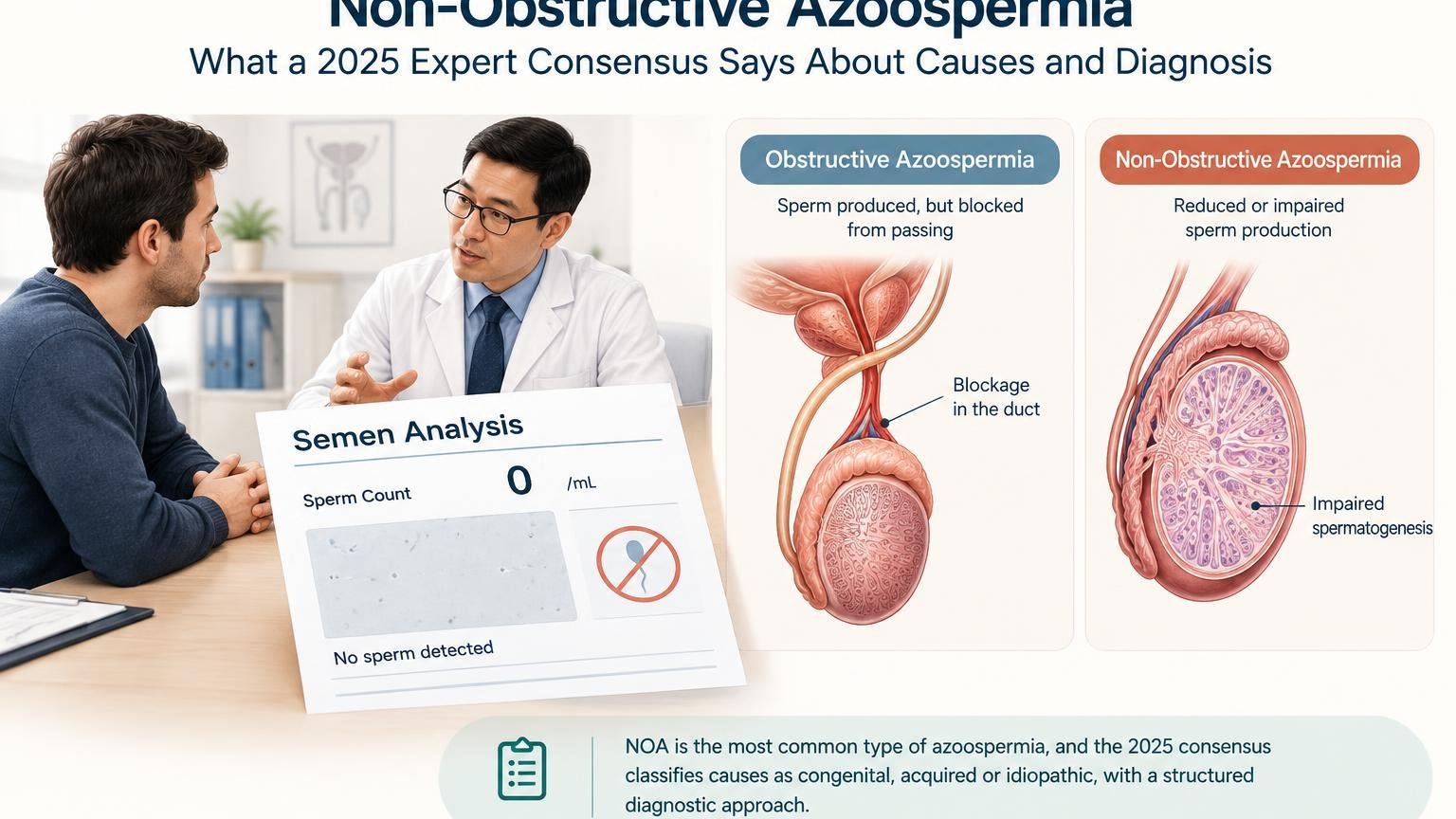
Azoospermia means no sperm in the ejaculate. The key distinction is between obstructive azoospermia, where sperm are produced but cannot pass through the reproductive tract, and non-obstructive azoospermia, where the testicles themselves do not produce enough sperm to appear in the ejaculate. The consensus defines NOA specifically as a disorder of testicular spermatogenesis, making it a production problem rather than a plumbing problem.
This distinction is not just academic. Obstructive cases may be potentially correctable or bypassable, whereas NOA reflects impaired spermatogenesis and is managed differently. The consensus's emphasis on classifying NOA causes reflects the need to separate cases with identifiable genetic, hormonal or developmental explanations from those that remain unexplained.
How the Consensus Classifies Causes
The consensus divides NOA causes into congenital, acquired and idiopathic categories. This structure is intended to give clinicians a systematic way to consider genetic conditions, developmental abnormalities, hormonal disorders, environmental exposures and unexplained cases in a consistent order. The categorization is an organizational and diagnostic framework, not a claim that every category has a precise prevalence.
Congenital causes include genetic and developmental factors present from birth. Acquired causes include conditions or exposures that damage testicular function later, such as certain infections, treatments or environmental exposures. Idiopathic cases are those in which no cause is identified after evaluation. The consensus acknowledges that despite advances in molecular genetics and endocrine testing, the proportion of NOA cases with an identified cause remains limited.
| Cause category | What it covers | Diagnostic implication | Uncertainty |
|---|---|---|---|
| Congenital | Genetic, endocrine and gonadal developmental factors present from birth | Prompts consideration of genetic and developmental evaluation | Specific prevalence not stated in the consensus summary |
| Acquired | Later insults such as infections, treatments or environmental exposures | Prompts review of medical history and exposures | Exposure–effect relationships are heterogeneous |
| Idiopathic | No cause identified after evaluation | Remains a substantial residual category | Cause identification rate explicitly described as limited |
How Diagnosis Is Approached
The consensus describes diagnostic workflows and key points for each cause category. The general logic is to confirm that azoospermia is truly present, distinguish non-obstructive from obstructive patterns, and then pursue cause-specific evaluation. The consensus states that accurate classification and diagnosis is the basis for individualized precision treatment, though that framing is an expert rationale rather than a demonstrated outcome of the pathway.
The consensus also acknowledges that NOA diagnosis has lacked a standardized unified process. That admission is important: it means the consensus is proposing structure rather than reporting that a validated pathway already exists. Readers should not interpret the document as evidence that any single test sequence has been proven superior in comparative trials.
What the Evidence Shows and What It Cannot Show
The 2025 document is an expert consensus, not a clinical trial or systematic review. Its statements about prevalence—5%–10% of male infertility for azoospermia and about 60% of azoospermia for NOA—are cited from prior professional society documents. They are useful orientation figures but should not be treated as precise measurements from a new study. The denominators and populations behind those percentages are not fully described in the available summary.
The consensus does not quantify how often a specific cause is found after full evaluation, nor does it report diagnostic yield by test. It states that cause identification remains limited, which is an honest acknowledgment of the field's current limits. The distinction between what is recommended and what has been proven to improve outcomes is essential when reading consensus documents.
Interpreting the Classification
The three-category structure is a practical tool for clinical reasoning. It encourages clinicians to consider congenital and acquired contributors before labeling a case idiopathic. However, the categories are broad and overlapping. For example, a genetic condition may be congenital but only manifest as infertility in adulthood, and an acquired exposure may interact with genetic susceptibility. The consensus does not resolve these overlaps; it provides a starting framework.
The inclusion of an idiopathic category is itself a recognition that current testing does not explain all cases. That is not a failure of the consensus but a reflection of the state of the evidence. Men with unexplained NOA may still have genetic or epigenetic causes that are not yet discoverable with routine testing.
Limitations and Evidence Gaps
This explainer is based on the published abstract, bibliographic record and journal table of contents; the full consensus text was not available for detailed review. The summary describes the document's structure and stated aims but cannot verify the specific diagnostic recommendations, thresholds or evidence ratings used within each section. The consensus is also regionally produced, reflecting Chinese clinical practice and literature, which may limit direct transferability to other health systems.[3]
The prevalence figures cited are secondary and not specific to the consensus's own data collection. There is no randomized evidence that the proposed classification improves reproductive outcomes compared with other approaches. The document's value lies in standardization and education, not in proving that one diagnostic sequence is superior.
Research and Clinical Outlook
The consensus reflects a broader effort to bring molecular genetics, endocrine evaluation and developmental assessment into a coherent NOA diagnostic pathway. Its emphasis on cause classification aligns with the growing recognition that NOA is not a single disease but a final common pathway of many different problems. Future updates will likely need to incorporate new genetic discoveries and evidence on diagnostic yield.
A related point from the companion consensus on genital tract infections is that even in cases of testicular atrophy from mumps, sperm usable clinically can sometimes still be obtained through micro-TESE. That observation belongs to a different document and should not be generalized to all NOA, but it illustrates why etiologic classification and fertility preservation discussions are connected.
Key Takeaways
- NOA is defined by impaired testicular sperm production, not by obstruction, and it accounts for about 60% of azoospermia cases according to figures cited in the 2025 consensus.
- Azoospermia affects 5%–10% of men presenting for infertility evaluation, based on cited prior professional society documents.
- The consensus classifies NOA causes as congenital, acquired or idiopathic and proposes category-specific diagnostic priorities.
- Cause identification remains limited despite advances in genetics and endocrine testing, so idiopathic cases remain common.
- The document is expert consensus guidance, not primary evidence that a specific diagnostic pathway improves outcomes.
Questions and Answers
What is non-obstructive azoospermia?
Non-obstructive azoospermia is the absence of sperm in the ejaculate caused by impaired sperm production in the testicles rather than a blockage in the reproductive tract. The 2025 expert consensus defines it as a disorder of testicular spermatogenesis. It is distinct from obstructive azoospermia, where sperm are produced but cannot exit.
How common is non-obstructive azoospermia among infertile men?
According to figures cited in the 2025 consensus, azoospermia affects 5%–10% of men presenting for infertility evaluation, and non-obstructive azoospermia accounts for about 60% of azoospermia cases. These percentages come from prior professional society documents rather than new data, so they are orientation figures with some uncertainty about the underlying populations.
How does the 2025 consensus classify causes of non-obstructive azoospermia?
The consensus groups causes into congenital, acquired and idiopathic categories. Congenital causes include genetic, endocrine and developmental factors. Acquired causes include later insults such as infections or exposures. Idiopathic cases have no identified cause after evaluation. The framework is intended to standardize diagnostic thinking, not to provide exact prevalence for each category.
How strong is the evidence behind the 2025 NOA consensus?
The document is an expert consensus based on literature review and expert discussion, not a clinical trial or systematic review. Its prevalence figures are cited from earlier professional society documents. It acknowledges that cause identification remains limited and that standardized diagnostic pathways have been lacking. It should be read as guidance reflecting current practice, not as proof that the recommended pathway improves outcomes.
What are the limitations of the 2025 non-obstructive azoospermia consensus?
The available summary does not provide detailed diagnostic thresholds, evidence ratings or diagnostic yield data. The consensus reflects Chinese clinical practice and may not transfer directly to other settings. It does not report comparative outcome data showing that its classification system improves fertility results. The full text would be needed to evaluate the strength of specific recommendations.
What should men with no sperm in the ejaculate understand about NOA diagnosis?
Azoospermia requires evaluation to distinguish obstructive from non-obstructive causes. The 2025 consensus proposes a structured approach that considers congenital, acquired and idiopathic factors. Because cause identification remains limited, some cases will remain unexplained. Men should discuss the diagnostic pathway and its uncertainties with a reproductive medicine specialist rather than assuming a single test will provide all answers.
Sources and References
- 中国医师协会生殖医学专业委员会生殖男科学组. 非梗阻性无精子症病因及诊断专家共识(2025年). 中华生殖与避孕杂志. 2025 45(10):985-1002 DOI: 10.3760/cma.j.cn101441-20250612-00264.
- 中国医师协会生殖医学专业委员会生殖男科学组. MedNexus:2025年第45卷第10期. 中华生殖与避孕杂志. 2025 45(10) DOI: 10.3760/cma.j.cn101441-20250612-00264.
- 安庚; 熊承良; 陈向锋; 郭海彬; 潘峰; 彭天文; 尹太郎; 周梁; 陈厚仰; 贺小进; 李朋. 非梗阻性无精子症病因及诊断专家共识(2025年). 中华生殖与避孕杂志. 2025 45(10)
SANYUN Science Center explains published research on men's reproductive and sexual health, connecting scientific evidence with everyday questions while making sources and limitations clear.
Disclaimer: This article is for scientific education and research communication only. It does not provide medical advice, diagnosis, or individualized treatment recommendations, and does not endorse any medication, supplement, device, penile enlargement procedure, or other intervention. Decisions about sexual and reproductive health should be made in consultation with a qualified healthcare professional. Do not delay seeking professional care because of information in this article.
Original Content & Copyright Notice
- This article is prepared for SANYUN Science Center, drawing on published research and publicly available academic literature on men’s sexual and reproductive health. Its editorial explanations and presentation are developed for this platform.
- Copyright in the original editorial content, selection, and arrangement is reserved by SANYUN Science Center to the extent protected by applicable law. Referenced research, quotations, and third-party materials remain subject to the rights of their respective owners. This notice does not claim ownership of scientific facts or third-party research.
- Except where permitted by applicable law or an applicable license, prior written permission is required to reproduce, republish, translate, adapt, redistribute, or commercially reuse protected content. Attribution alone does not grant permission for such reuse.
- For permitted quotation or authorized reuse, clearly identify the source and retain a link to the original article.
- Source: SANYUN Science Center
- Original URL: Retain the original article URL on science.san-yun.com.
- Copyright Holder: SANYUN Science Center, for its own protected editorial content.
- Quotation, excerpts, or authorized reuse must not distort the scientific meaning, omit material limitations or disclaimers, or imply unverified medical claims, product efficacy, or endorsement by SANYUN Science Center.



