




Category: Clinical Insights
Core Research Direction: Differential diagnosis of obstructive versus nonobstructive azoospermia in male infertility: what the current review-level literature establishes about prevalence, causal differentiation, and diagnostic pathways
Search Intent: When azoospermia is confirmed, how can clinicians distinguish obstructive from nonobstructive azoospermia, and how common is each type among infertile men?
Platform: SANYUN Science Center
Evidence reviewed through: 2026-11-24
Executive Summary
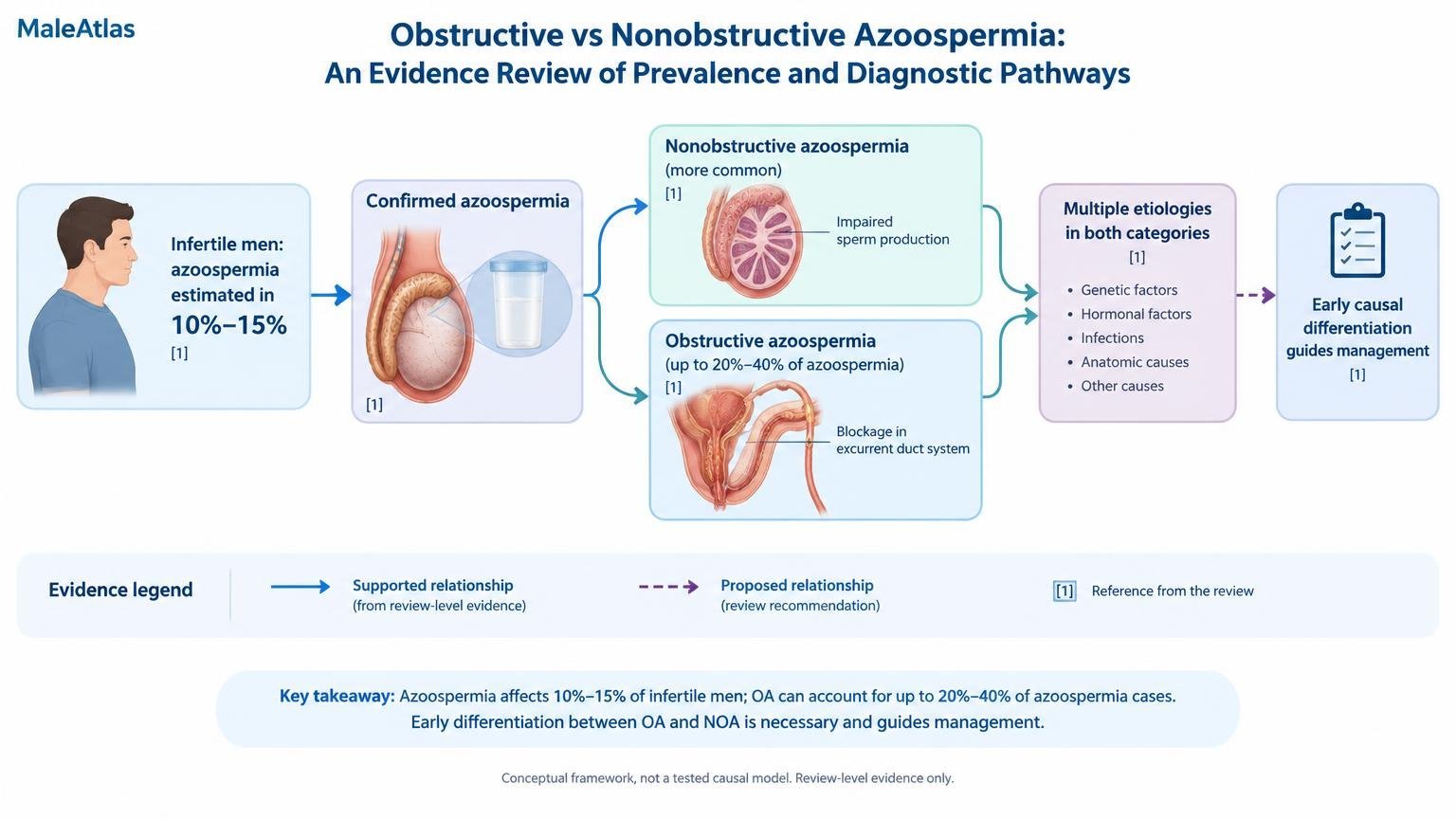
Azoospermia — the absence of sperm in the ejaculate — is estimated to affect 10%–15% of infertile men, according to a 2025 narrative review in the Asian Journal of Andrology. That same review states that once azoospermia is confirmed, an early causal differentiation between obstructive azoospermia (OA) and nonobstructive azoospermia (NOA) is necessary, because the two categories carry different etiologies and different management implications.[1]
The review reports that OA, although less common than NOA overall, can account for up to 20%–40% of azoospermia cases. Its stated purpose is to synthesize current guidelines and literature into a diagnostic approach for separating the two categories. This article interprets that review-level material; it is not a new systematic review, and no primary patient data were analyzed here.[2]
- Azoospermia is estimated at 10%–15% of infertile men in the reviewed literature.
- OA is described as less common than NOA but may represent up to 20%–40% of azoospermia cases.
- The review frames early OA-versus-NOA differentiation as necessary, not optional, once azoospermia is confirmed.
Why This Matters
The distinction between OA and NOA is not a taxonomic nicety. OA implies a physical or functional blockage somewhere along the excurrent duct system, whereas NOA implies impaired sperm production within the testis. That difference shapes what a clinician looks for next, what a couple can reasonably expect, and which reproductive options are worth discussing. The review states plainly that correctly distinguishing the two types has profound implications for managing the infertile man.
Prevalence framing matters for how clinicians reason about probability before any test is ordered. If azoospermia is estimated at 10%–15% of infertile men, then azoospermia is an uncommon but far from rare presentation in a male-fertility practice. Within that group, NOA is described as the more common category, while OA can represent up to 20%–40% of cases. A clinician who assumes every azoospermic man has NOA will misclassify a meaningful minority.
Defining the Two Categories
Obstructive azoospermia refers to absent sperm in the ejaculate caused by obstruction, while nonobstructive azoospermia refers to absent sperm attributable to failure of sperm production. The review emphasizes that a multitude of etiologies can produce either category. That etiological breadth is precisely why the review argues for a structured diagnostic approach rather than a single test.
| Concept | Definition as framed in the review | Interpretation |
|---|---|---|
| Azoospermia prevalence | Estimated 10%–15% of infertile men | Establishes azoospermia as a recurring presentation in male-fertility evaluation |
| Nonobstructive azoospermia (NOA) | Absent ejaculate sperm with production failure; described as more common than OA | The default probability category in most azoospermic men |
| Obstructive azoospermia (OA) | Absent ejaculate sperm caused by obstruction; can represent up to 20%–40% of azoospermia | A clinically important minority that must not be assumed away |
| Causal differentiation | Early separation of OA from NOA once azoospermia is confirmed | Framed by the review as necessary, not optional |
What the Evidence Shows
The core quantitative claims in the review are two prevalence figures. The first concerns how common azoospermia is among infertile men; the second concerns how often the obstructive subtype appears within azoospermia. Both are reported as estimates or ranges rather than as a single pooled point estimate, and the review excerpt does not disclose the underlying studies or denominators that generate them.
The claim about OA deserves careful reading. The review states that OA can represent upward 20%–40% of azoospermia cases. That phrasing places 20%–40% as an upper framing rather than a fixed midpoint, and it signals real variation across settings. A clinician should treat this as a plausible ceiling range, not as a precise probability to apply to an individual patient.
Beyond prevalence, the review's contribution is procedural: it brings together current guidelines and literature to supply reproductive physicians with a diagnostic armamentarium for distinguishing NOA from OA. That is a synthesis of existing practice recommendations, not a report of a new diagnostic test or a head-to-head comparison of diagnostic strategies.
Interpreting the Prevalence Numbers
Two interpretive cautions follow from the numbers. First, prevalence estimates in review articles often derive from heterogeneous clinic populations, and the review excerpt does not specify how the 10%–15% figure was assembled. Second, the OA range of up to 20%–40% is wide enough that real-world case mix — referral patterns, geography, prior surgery rates — could easily shift where a given practice sits within it.
There is also a definitional trap. A percentage of azoospermia cases is not the same as a percentage of infertile men. The 10%–15% figure applies to infertile men; the 20%–40% figure applies within azoospermia. Lay readers and even some clinicians can conflate the two denominators, which produces wildly different impressions of how common OA actually is.
The Diagnostic Pathway as Described
The review's stated logic runs in two steps. Step one is confirming azoospermia. Step two is early causal differentiation between OA and NOA. The word "early" is significant: the review does not frame differentiation as a late-stage question to be answered only after other avenues are exhausted, but as something that should follow confirmation promptly.
The review positions this differentiation as the point at which management diverges, which is consistent with its statement that the two categories have distinct etiologies and distinct management implications. The excerpt available to this analysis describes the framework and its rationale rather than enumerating the individual tests in sequence; readers should consult the full review for the itemized diagnostic armamentarium.
Interpretation and Limitations
The most important limitation is one of evidence type. The source is a narrative review that amalgamates guidelines and literature; it is not a systematic review with a registered protocol, formal risk-of-bias assessment, or meta-analysis. That design is well suited to producing a practical diagnostic framework, but it does not independently establish the accuracy of any single test or sequence.
The prevalence estimates carry their own uncertainty. The review excerpt provides ranges without stating the basis of the estimate — whether pooled from multiple cohorts or drawn from single studies — and the limitations of that reporting limit how confidently the numbers can be generalized. The OA figure is explicitly framed as an upper range, which further argues against treating it as a fixed probability.
A further constraint is scope. The review excerpt does not report outcomes data such as diagnostic yield, misclassification rates, or the proportion of men in whom the initial categorization later changed. As a result, this analysis can describe what the review asserts about prevalence and diagnostic logic, but cannot quantify how well any particular pathway performs in practice.
There are also broader questions about how review-level recommendations should be read. Systematic reviews and guideline syntheses in adjacent fields have been criticized for heterogeneous included studies and limited critical appraisal, which can make conclusions clinically uncertain even when sophisticated synthesis is applied. That critique was developed in a different clinical area and cannot be transplanted wholesale, but it is a useful reminder that narrative synthesis inherits the quality of what it summarizes.[3]
Research Outlook
The review's framing suggests several questions that review-level evidence alone cannot answer. How often does early categorization between OA and NOA hold up after fuller evaluation? Which elements of the diagnostic armamentarium carry the most discriminating value, and in what order? Do the prevalence ranges shift materially across referral settings and populations?
Answering those questions would require prospective diagnostic-accuracy studies and transparent reporting of denominators, neither of which the current review supplies. Until then, the review is best read as a structured statement of current clinical logic — a map of the reasoning clinicians are expected to follow — rather than as proof that the map outperforms alternatives.
Key Takeaways
- Azoospermia is estimated to affect 10%–15% of infertile men in the reviewed literature.
- Once confirmed, the review argues for early differentiation between obstructive and nonobstructive azoospermia.
- OA is less common than NOA but may represent up to 20%–40% of azoospermia cases.
- Both categories have multiple etiologies, and correct classification has important management implications.
- The source is a narrative review synthesizing guidelines and literature, not a systematic review or meta-analysis.
Questions and Answers
What is the difference between obstructive and nonobstructive azoospermia?
Obstructive azoospermia means no sperm appear in the ejaculate because of obstruction along the duct system, while nonobstructive azoospermia means production itself is impaired. The review stresses that both have many possible etiologies, so the labels describe broad causal categories rather than single diseases, and correct classification has major management implications.
How common is azoospermia among infertile men?
Azoospermia is estimated to affect 10%–15% of infertile men, according to the 2025 Asian Journal of Andrology review. This is a review-level estimate rather than a pooled point estimate, and the excerpt does not specify how the underlying studies or denominators were assembled, so the figure should be read as an approximate population-level guide rather than a precise per-patient probability.
What proportion of azoospermia cases are obstructive?
The review reports that obstructive azoospermia, although less common than nonobstructive azoospermia, can represent up to 20%–40% of azoospermia cases. The phrasing frames this as an upper range with likely variation across settings, and the underlying source studies are not detailed in the excerpt, so it should not be applied to an individual patient as a fixed probability.
How strong is the evidence behind this obstructive versus nonobstructive azoospermia review?
It is narrative review-level evidence. The authors describe their work as an amalgamation of current guidelines and literature intended to give clinicians a diagnostic armamentarium. That is useful for mapping clinical logic, but the design is not a systematic review with formal risk-of-bias assessment or meta-analysis, and it does not itself test the accuracy of any diagnostic pathway.
Can the prevalence figures be applied to every clinic population?
Not directly. The azoospermia estimate of 10%–15% of infertile men and the OA figure of up to 20%–40% of azoospermia cases come from review-level synthesis without stated denominators in the excerpt. Referral patterns, geography and prior surgery could shift where a given practice falls, so these ranges are best used to frame probability, not to predict an individual case.
Why does early differentiation between OA and NOA matter in male infertility care?
The review states that confirmation of azoospermia necessitates early causal differentiation between OA and NOA. The rationale is that the two categories have different etiologies and different management implications, so misclassification sends a couple down the wrong clinical path. The review positions this step as a prompt next move after confirmation rather than a later afterthought.
Conceptual framework: Conceptual framework, not a tested causal model. A narrative review estimates azoospermia in 10%–15% of infertile men and states early differentiation of obstructive from nonobstructive azoospermia is necessary, with OA reaching up to 20%–40% of cases. Two branches are supported by review statements; the pathway link is proposed. Review-level evidence only.
Academic References & Evidence
- Logan HUBBARD; Amarnath RAMBHATLA; Giovanni M COLPI. Differentiation between nonobstructive azoospermia and obstructive azoospermia: then and now.. Asian Journal of Andrology. 2025 27(3):298-306
- Asian Journal of Andrology. Asian Journal of Andrology DOI: 10.4103/aja202475.
- Challenges in interpretaion of randomised clinical trials included in systematic reviews and clinical guidelines.
SANYUN Science Center explains published research on men's reproductive and sexual health, connecting scientific evidence with everyday questions while making sources and limitations clear.
Disclaimer: This article is for scientific education and research communication only. It does not provide medical advice, diagnosis, or individualized treatment recommendations, and does not endorse any medication, supplement, device, penile enlargement procedure, or other intervention. Decisions about sexual and reproductive health should be made in consultation with a qualified healthcare professional. Do not delay seeking professional care because of information in this article.
Original Content & Copyright Notice
- This article is prepared for SANYUN Science Center, drawing on published research and publicly available academic literature on men’s sexual and reproductive health. Its editorial explanations and presentation are developed for this platform.
- Copyright in the original editorial content, selection, and arrangement is reserved by SANYUN Science Center to the extent protected by applicable law. Referenced research, quotations, and third-party materials remain subject to the rights of their respective owners. This notice does not claim ownership of scientific facts or third-party research.
- Except where permitted by applicable law or an applicable license, prior written permission is required to reproduce, republish, translate, adapt, redistribute, or commercially reuse protected content. Attribution alone does not grant permission for such reuse.
- For permitted quotation or authorized reuse, clearly identify the source and retain a link to the original article.
- Source: SANYUN Science Center
- Original URL: Retain the original article URL on science.san-yun.com.
- Copyright Holder: SANYUN Science Center, for its own protected editorial content.
- Quotation, excerpts, or authorized reuse must not distort the scientific meaning, omit material limitations or disclaimers, or imply unverified medical claims, product efficacy, or endorsement by SANYUN Science Center.



