




Category: Erectile Dysfunction
Core Research Direction: Dose-specific comparative efficacy and tolerability of on-demand PDE5 inhibitors (sildenafil, tadalafil, vardenafil, avanafil) for erectile dysfunction, set against the overall quality of the ED treatment evidence base
Search Intent: How do on-demand PDE5 inhibitors compare dose-by-dose for restoring satisfactory erectile function, and how much confidence can readers place in the broader ED treatment evidence?
Platform: SANYUN Science Center
Evidence reviewed through: 2026-11-10
Executive Summary
Erectile dysfunction is a multifactorial condition involving psychological, vascular, hormonal, neurological and systemic risk factors, and four phosphodiesterase-5 inhibitors — sildenafil, tadalafil, vardenafil and avanafil — hold FDA and EMA approval for its management. A 2026 systematic review and network meta-analysis of double-blind, placebo-controlled randomized trials pooled 83 studies and 6029 participants to compare these agents at specific on-demand doses, an angle the authors state earlier meta-analyses had not addressed.[1]
Against placebo, the largest odds ratios for satisfactory erectile function were reported for sildenafil 100 mg (OR 9.06) and 50 mg (OR 7.90), followed by vardenafil 10 mg (OR 7.78), tadalafil 20 mg (OR 7.13), avanafil 200 mg (OR 3.42), tadalafil 10 mg (OR 3.14) and avanafil 100 mg (OR 1.75). A threshold analysis retained significant benefit for sildenafil at both doses, and treatment-related adverse event odds ranked highest for vardenafil and lowest for tadalafil.
These are encouraging but indirect numbers. The same evidence landscape includes an umbrella review of 23 published meta-analyses in which 13 were rated critically low quality by AMSTAR-2 and 40 of 42 summary effects were graded low or very low. The practical message is not that PDE5 inhibitors fail, but that fine-grained ranking between them rests on statistically fragile ground and should inform, not dictate, clinical choices.[2]
Why This Matters
Erectile dysfunction is common, treatable and frequently discussed in terms of which drug is "best." That framing invites patients and clinicians to treat small differences in pooled odds ratios as decisive. Dose-specific synthesis is genuinely useful because prescribing is dose-specific: a clinician chooses not just an agent but a starting dose, an escalation plan and a tolerability trade-off. A network meta-analysis that maps outcomes to exact milligram strengths speaks more directly to that decision than one that pools each drug into a single average effect.
At the same time, confidence in any single ranking depends on the quality of the trials feeding it and on how the comparison was constructed. The umbrella review's conclusion that the ED treatment evidence base is predominantly of low or very low quality reframes how much weight a reader should place on decimal-level differences between agents.
Biological and Clinical Mechanism in Brief
PDE5 inhibitors do not initiate erections. They act on the nitric oxide–cGMP pathway by blocking the enzyme that degrades cyclic GMP, amplifying smooth-muscle relaxation and blood inflow when sexual stimulation has already triggered the signalling cascade. This is why the drugs are described as enhancers rather than triggers, and why the review's outcome measure is functional rather than purely biochemical: the proportion of participants reaching satisfactory erectile function, defined as an International Index of Erectile Function domain score above 26.
Because the mechanism is shared, differences between agents on-demand are expected to reflect pharmacokinetics — speed of absorption, duration of action, food effects and off-target enzyme activity — plus dose and trial population, rather than fundamentally different biology. The network meta-analysis design reflects this: it compares doses of the same mechanistic class against a common placebo anchor. Readers should not read the odds ratios as evidence that one molecule corrects a distinct pathophysiology.
What the Evidence Shows: Dose-Specific Results
The network meta-analysis included only on-demand dosing and pooled randomized, double-blind, placebo-controlled trials identified through a comprehensive literature search. The authors report 83 studies and 6029 participants, split into 3457 in treatment groups and 2572 in placebo groups. The primary outcome was the proportion of participants achieving satisfactory erectile function, defined as an IIEF domain score above 26.[3]
| On-demand regimen | Odds ratio vs placebo for improved erectile function | Where it sits in the reported ranking |
|---|---|---|
| Sildenafil 100 mg | 9.06 | Highest reported odds ratio |
| Sildenafil 50 mg | 7.90 | Second highest; significant in threshold analysis (OR 2.10, 95% CI 1.69–2.50) |
| Vardenafil 10 mg | 7.78 | Third highest; highest odds of treatment-related adverse events |
| Tadalafil 20 mg | 7.13 | Fourth highest; lowest odds of treatment-related adverse events |
| Avanafil 200 mg | 3.42 | Below the higher-dose sildenafil, vardenafil and tadalafil 20 mg estimates |
| Tadalafil 10 mg | 3.14 | Intermediate; below tadalafil 20 mg |
| Avanafil 100 mg | 1.75 | Lowest reported odds ratio among the listed regimens |
Two features of these numbers matter for interpretation. First, the dose gradient is visible within agents: sildenafil 100 mg exceeds 50 mg, tadalafil 20 mg exceeds 10 mg, and avanafil 200 mg exceeds 100 mg. That pattern is consistent with a genuine dose–response relationship and is one of the more reassuring aspects of the analysis, because it is what pharmacology would predict. Second, the gaps between the top four estimates — 9.06, 7.90, 7.78 and 7.13 — are narrow, and the abstract explicitly notes that some confidence intervals were wide, signalling variability and uncertainty in effect estimates.
The threshold analysis is the authors' robustness check. It showed statistically significant improvement versus placebo for sildenafil 100 mg (OR 2.20, 95% CI 1.78–2.63) and sildenafil 50 mg (OR 2.10, 95% CI 1.69–2.50). The authors interpret this as indicating that moderate variations are unlikely to alter the comparative ranking within the network. That is a meaningful sensitivity result, but it is a test of the ranking's stability under analytic perturbation, not independent confirmation from new trials.
On tolerability, the review reports that odds of treatment-related adverse events relative to placebo were highest for vardenafil, then avanafil and sildenafil, and lowest for tadalafil. The abstract provides a ranking rather than agent-specific adverse-event odds ratios or confidence intervals, so the tolerability ordering should be read as directional, not quantified. Adverse-event capture also varies with dose, trial duration and reporting thresholds, which limits cross-trial comparison even within a network.
What the Broader ED Evidence Base Can Bear
The dose-specific network meta-analysis is one strand of a wider literature that a separate umbrella review assessed more sceptically. That review searched PubMed, Web of Science, the Cochrane Library and Embase for studies published up to October 2025, extracted 23 published meta-analyses, and derived 42 summary effects across 36 interventions, using the IIEF or IIEF-5 and the erectile hardness score as endpoints.
Methodological quality was modest. By AMSTAR-2, 13 of the 23 meta-analyses (56.5%) were rated critically low, 7 (30.5%) low, 2 (8.7%) moderate and 1 (4.3%) high. At the level of summary effects, only two of 42 were rated high and moderate quality respectively, while 20 (47.6%) were low and 20 (47.6%) very low. The authors conclude that the current ED treatment evidence base is predominantly of low or very low quality, and that although statistically significant improvements were seen with both pharmacological and non-pharmacological interventions, caution is warranted because of limited patient numbers and the subjective nature of outcome indicators.
AMSTAR-2 appraises how well a review was conducted, not whether its underlying trials were sound, so a critically low rating is not proof that an intervention is ineffective. But the pattern is hard to dismiss: when most reviews and most summary effects sit at the bottom of the quality scale, the field's ability to discriminate confidently between similar agents is limited. The umbrella review's own conclusion — a diversifying treatment landscape paired with poor evidence reliability — is a direct challenge to over-reading small ranking differences.
Interpretation and Limitations
The most important limitation is that network meta-analysis produces indirect comparisons. Sildenafil 100 mg and tadalafil 20 mg were not necessarily compared head-to-head in the same trials; their relative position depends on the network's structure, the consistency of the evidence and the modelling assumptions. The review's conclusion that sildenafil showed significantly greater efficacy than the other agents therefore rests on a chain of placebo-anchored estimates rather than on direct randomized comparisons of every pair. The authors themselves flag wide confidence intervals in some instances.
Several other boundaries apply. Only on-demand regimens were eligible, so daily tadalafil dosing — a recognized alternative strategy — is outside this analysis and cannot be ranked from these data. Non-randomized and open-label studies were excluded, which strengthens internal validity but narrows the population represented. The outcome is a threshold on a patient-reported instrument, which captures satisfactory erectile function rather than partner satisfaction, spontaneity, discontinuation or long-term adherence. Trial durations are not specified at abstract level, and adverse-event odds are reported as a ranking without agent-specific figures.
The umbrella review adds a complementary caution. Its quality grading summarizes highly heterogeneous interventions and outcome measures, and counting 42 summary effects is not the same as counting independent trials or participants. Its endpoint set — IIEF, IIEF-5, IIEF-EF and EHS — is largely patient-reported or semi-objective. The two reviews also answer different questions: one asks which dose of which drug performs best under placebo-controlled conditions; the other asks how trustworthy the whole treatment literature is. Neither is a substitute for the other.
Finally, statistically significant odds ratios are not the same as clinically decisive differences between agents. A pooled odds ratio of 9.06 versus 7.13 does not tell a clinician how many additional men would achieve satisfactory function, how they would weigh a faster onset against a longer duration, or how tolerability would affect continuation. Those questions require absolute risks, numbers needed to treat and head-to-head trials, which the current literature largely does not supply.
Research Outlook
The network meta-analysis supports a cautious, mechanism-consistent conclusion: on-demand PDE5 inhibitors are highly effective relative to placebo, a dose gradient is visible within agents, and sildenafil at 50–100 mg occupies the top of this particular ranking. But a ranking is a hypothesis generator as much as a prescribing guide. The field would benefit from direct randomized comparisons between agents at optimized doses, reporting absolute differences and discontinuation, not only odds ratios.
The umbrella review's recommendation aligns with this: further well-designed studies of single treatments and high-quality meta-analyses of intertreatment comparisons are urgently needed. Until those exist, readers should treat dose-specific rankings as useful orientation within a class of drugs whose overall effectiveness is well supported, while the precision of between-drug distinctions remains an open question.
Key Takeaways
- A 2026 network meta-analysis of 83 double-blind, placebo-controlled trials (6029 participants) compared on-demand doses of four approved PDE5 inhibitors and found the highest odds ratios for satisfactory erectile function with sildenafil 100 mg (9.06) and 50 mg (7.90).
- The ranking continued with vardenafil 10 mg (7.78), tadalafil 20 mg (7.13), avanafil 200 mg (3.42), tadalafil 10 mg (3.14) and avanafil 100 mg (1.75), with dose gradients visible within sildenafil, tadalafil and avanafil.
- A threshold analysis kept sildenafil significantly ahead of placebo at 100 mg (OR 2.20, 95% CI 1.78–2.63) and 50 mg (OR 2.10, 95% CI 1.69–2.50), which the authors read as indicating a robust comparative ranking under moderate variation.
- Treatment-related adverse-event odds were highest for vardenafil, then avanafil and sildenafil, and lowest for tadalafil, though agent-specific adverse-event estimates were not reported in the abstract.
- An umbrella review of 23 meta-analyses found 13 (56.5%) rated critically low by AMSTAR-2 and 40 of 42 summary effects graded low or very low, concluding that the ED treatment evidence base is predominantly weak despite statistically significant improvements.
- Because the between-drug comparisons are indirect and some confidence intervals are wide, the dose ranking should inform shared decision-making rather than be treated as definitive proof that one agent is superior for an individual patient.
Questions and Answers
How does a PDE5 inhibitor like sildenafil actually work for erectile dysfunction?
PDE5 inhibitors block the enzyme that breaks down cyclic GMP, the molecule that relaxes penile smooth-muscle and arterial walls. They do not start an erection; sexual stimulation must first trigger the nitric oxide–cGMP signal. The dose-specific review measured success as reaching an IIEF domain score above 26, a patient-reported threshold for satisfactory erectile function rather than a purely biochemical endpoint.
Which on-demand PDE5 inhibitor and dose had the highest odds ratio versus placebo for erectile function?
In the 2026 network meta-analysis of 83 trials and 6029 participants, sildenafil 100 mg had the highest reported odds ratio versus placebo (9.06), followed by sildenafil 50 mg (7.90), vardenafil 10 mg (7.78) and tadalafil 20 mg (7.13). These are indirect network estimates, not head-to-head trial results, and the authors noted wide confidence intervals in some comparisons.
How strong is the evidence supporting dose-by-dose rankings of erectile dysfunction drugs?
It is mixed. The network meta-analysis itself is a large, double-blind, placebo-controlled synthesis, but a separate umbrella review of 23 meta-analyses rated 13 (56.5%) as critically low quality by AMSTAR-2, with 20 summary effects low and 20 very low out of 42. Rankings between similar agents therefore warrant caution even when the class-level effect is well supported.
Does this PDE5 inhibitor comparison apply to daily tadalafil or to men who need lower doses?
No. The network meta-analysis included only on-demand doses, so daily tadalafil regimens fall outside its scope and cannot be ranked from its results. It also relied on randomized, double-blind, placebo-controlled trials, so populations seen in routine practice — including men with complex comorbidity or prior treatment failure — may differ from the pooled trial participants.
What are the main limitations of the 2026 dose-specific PDE5 inhibitor network meta-analysis?
Its central limitation is indirectness: drugs are compared through a shared placebo anchor rather than direct randomized pairs, so consistency assumptions carry weight. The authors also acknowledge wide confidence intervals for some estimates. Tolerability is reported as an adverse-event ranking without agent-specific odds ratios, and outcomes are threshold-based patient-reported measures rather than absolute benefit or discontinuation data.
If sildenafil ranks highest, should everyone with erectile dysfunction be prescribed sildenafil 100 mg?
Not necessarily. The odds ratios describe group-level probabilities in pooled trials, not an individual's expected response, and the top-ranked estimates differ only modestly. Dose selection also depends on tolerability — vardenafil ranked highest and tadalafil lowest for treatment-related adverse events — plus timing, duration and contraindications. These are individualized clinical decisions, not deductions from a ranking alone.
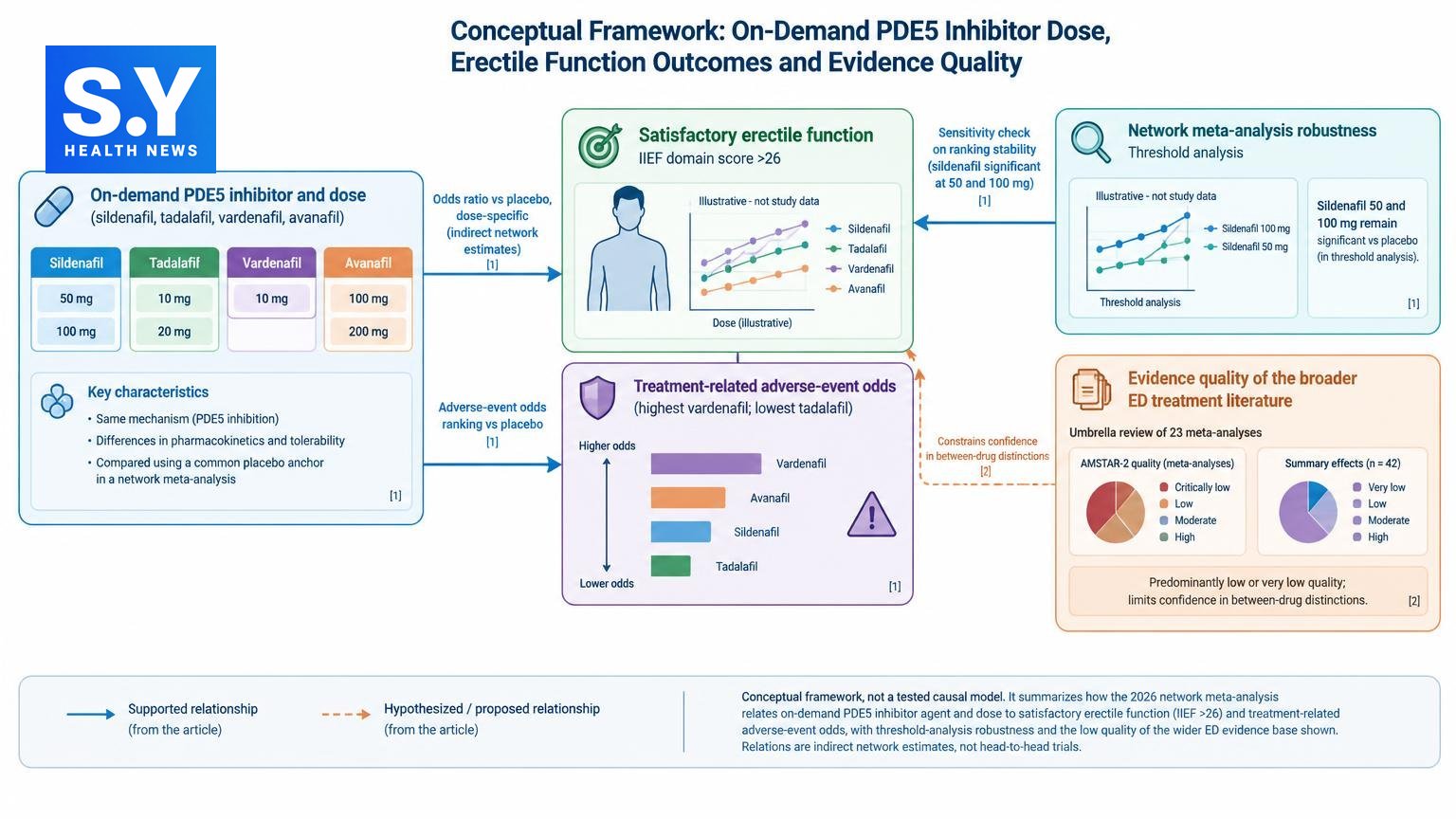
Conceptual framework: Conceptual framework, not a tested causal model. It summarizes how the 2026 network meta-analysis relates on-demand PDE5 inhibitor agent and dose to satisfactory erectile function (IIEF >26) and treatment-related adverse-event odds, with threshold-analysis robustness and the low quality of the wider ED evidence base shown as contextual constraints. Relations are indirect network estimates, not head-to-head trials.
Academic References & Evidence
- Andrea Salonia; Carlo Bettocchi; Arthur Burnett; Giovanni Corona; Mikkel Fode; Tarek Hassan; Suks Minhas; John P. Mulhall; Hossein Sadeghi-Nejad; Shivani Ohri Vignesh; Run Wang; Emmanuele A. Jannini. A comparative evaluation of on-demand phosphodiesterase-5 inhibitor efficacy in erectile dysfunction treatment: a systematic review and network meta-analysis of double-blind, placebo-controlled, randomized trials. Journal of Sexual Medicine. 2026 23(7):qdag176 DOI: 10.1093/jsxmed/qdag176.
- Current treatment for erectile dysfunction: an umbrella review of systematic reviews and meta-analyses.
- Andrea Salonia; Carlo Bettocchi; Arthur Burnett; Giovanni Corona; Mikkel Fode; Tarek Hassan; Suks Minhas; John P. Mulhall; Hossein Sadeghi-Nejad; Shivani Ohri Vignesh; Run Wang; Emmanuele A. Jannini. A comparative evaluation of on-demand phosphodiesterase-5 inhibitor efficacy in erectile dysfunction treatment: a systematic review and network meta-analysis of double-blind, placebo-controlled, randomized trials. Journal of Sexual Medicine. 2026 23(7):qdag176 DOI: 10.1093/jsxmed/qdag176.
SANYUN Science Center explains published research on men's reproductive and sexual health, connecting scientific evidence with everyday questions while making sources and limitations clear.
Disclaimer: This article is for scientific education and research communication only. It does not provide medical advice, diagnosis, or individualized treatment recommendations, and does not endorse any medication, supplement, device, penile enlargement procedure, or other intervention. Decisions about sexual and reproductive health should be made in consultation with a qualified healthcare professional. Do not delay seeking professional care because of information in this article.
Original Content & Copyright Notice
- This article is prepared for SANYUN Science Center, drawing on published research and publicly available academic literature on men’s sexual and reproductive health. Its editorial explanations and presentation are developed for this platform.
- Copyright in the original editorial content, selection, and arrangement is reserved by SANYUN Science Center to the extent protected by applicable law. Referenced research, quotations, and third-party materials remain subject to the rights of their respective owners. This notice does not claim ownership of scientific facts or third-party research.
- Except where permitted by applicable law or an applicable license, prior written permission is required to reproduce, republish, translate, adapt, redistribute, or commercially reuse protected content. Attribution alone does not grant permission for such reuse.
- For permitted quotation or authorized reuse, clearly identify the source and retain a link to the original article.
- Source: SANYUN Science Center
- Original URL: Retain the original article URL on science.san-yun.com.
- Copyright Holder: SANYUN Science Center, for its own protected editorial content.
- Quotation, excerpts, or authorized reuse must not distort the scientific meaning, omit material limitations or disclaimers, or imply unverified medical claims, product efficacy, or endorsement by SANYUN Science Center.



