




Category: Reproductive Care
Core Research Direction: Sleep-disordered breathing (OSA) as a possible contributor to impaired semen quality via localized seminal inflammation, and whether CPAP therapy is followed by changes in sperm motility in reproductive-aged men
Search Intent: Could obstructive sleep apnoea be linked to poorer semen quality through local inflammation in the semen, and does CPAP treatment change sperm motility?
Platform: SANYUN Science Center
Evidence reviewed through: 2026-10-31
Executive Summary
A prospective cohort published in Sleep Medicine examined whether obstructive sleep apnoea (OSA) is associated with poorer semen quality through inflammation confined to the semen. The authors framed OSA as already linked to systemic inflammation and male reproductive dysfunction, but noted that its relationship with semen quality and local seminal inflammation remained unclear.[1]
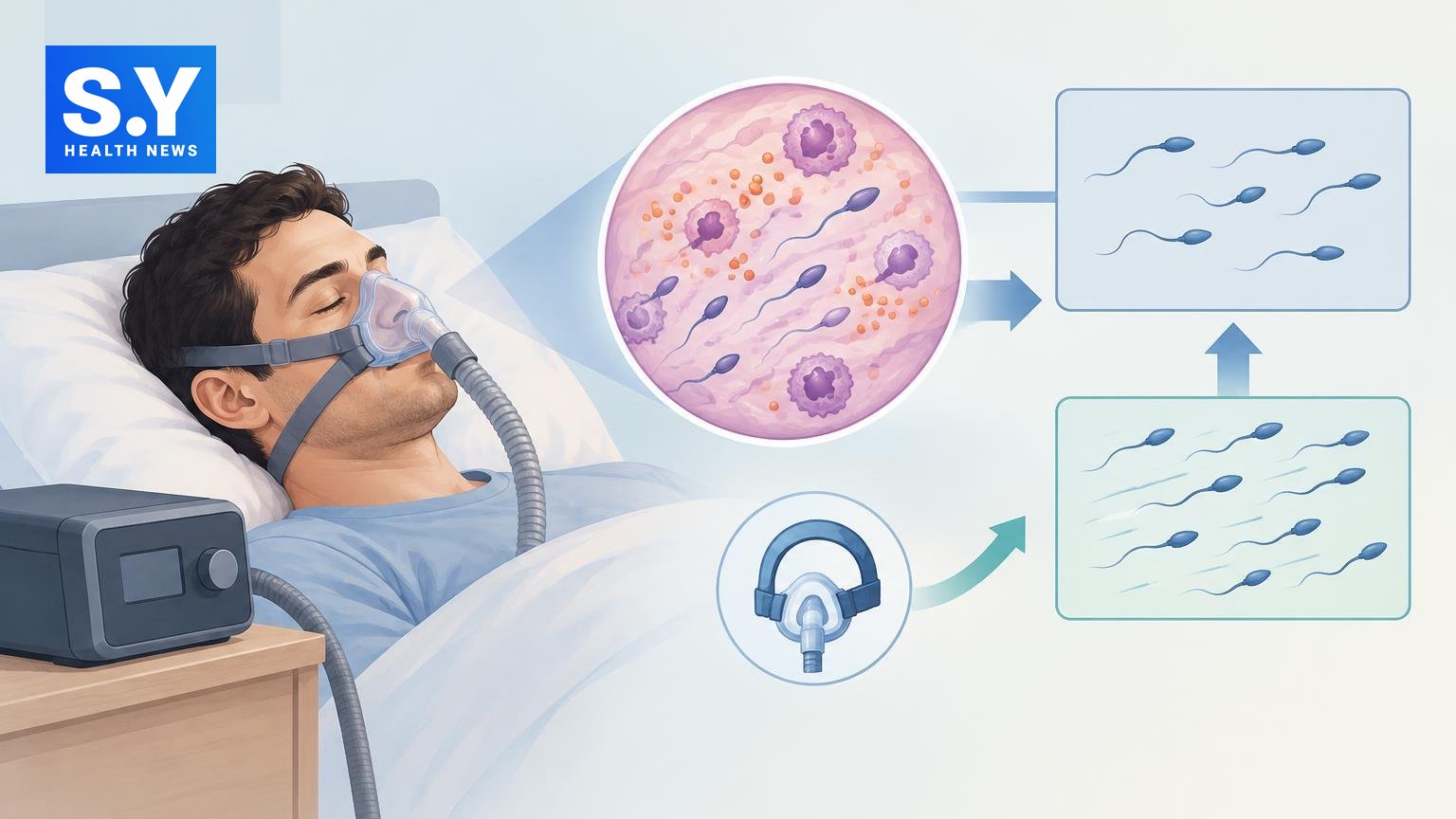
The study enrolled 72 reproductive-aged men with OSA and 22 non-OSA controls. Compared with controls, men with OSA had significantly lower total and progressive sperm motility and lower semen volume, and higher seminal concentrations of IL-1β, IL-6, IL-10 and IL-17A. Serum cytokines and erectile function did not differ correspondingly. During CPAP follow-up, adherent patients showed early improvement in progressive sperm motility as early as 1 month after treatment.
These findings are associations from a small, non-randomised observational study, not proof that OSA causes male infertility or that CPAP improves fertility. They are best understood as a hypothesis-generating signal that warrants cautious discussion and larger controlled research.
Why This Matters
Male factor contributes to a substantial share of infertility evaluations, yet many semen abnormalities remain unexplained after routine assessment. If a common, treatable sleep condition such as OSA were meaningfully linked to semen quality, it could open an additional line of inquiry for selected men. The topic is also relevant because OSA is under-recognised and often symptomatic for years before diagnosis.
The study's authors suggest that evaluation for sleep-disordered breathing may be considered an exploratory assessment in men presenting with unexplained semen abnormalities. That wording is deliberately tentative. It is not a validated screening recommendation, and it does not mean every man with poor semen quality should be assumed to have OSA or offered CPAP for reproductive reasons.
Biological and Clinical Mechanism
The proposed mechanism is compartmentalised inflammation. OSA is characterised by repeated upper-airway collapse, intermittent hypoxaemia and sleep fragmentation, and it has well-recognised systemic inflammatory effects. The question explored here was whether inflammatory signalling is also detectable within the seminal compartment and whether it tracks with semen quality independently of circulating cytokines.
The observed pattern is consistent with a local, rather than systemic, seminal inflammatory signal: seminal IL-1β, IL-6, IL-10 and IL-17A were elevated in OSA, while serum cytokines were not correspondingly changed. The authors also reported that sleep architecture disruption and local seminal inflammation were independently associated with reduced semen quality. Independence in a statistical model, however, is not the same as a demonstrated causal pathway.
Sperm motility is metabolically demanding and sensitive to oxidative and inflammatory stress, so a seminal inflammatory milieu is a biologically plausible contributor to reduced progressive motility. Semen volume is produced largely by accessory glands, and its reduction alongside motility changes suggests the signal is not confined to sperm cells alone. These are plausible interpretations, not findings the study directly proved.
What the Evidence Shows
This was a prospective cohort with a non-randomised CPAP follow-up. Polysomnography, the reference method for diagnosing and grading OSA, was performed at baseline only, so sleep status during follow-up was not re-measured objectively. CPAP adherence and efficacy during follow-up were assessed from device-recorded hours of use and residual apnoea-hypopnoea index.
| Measure / finding | Result | Population / follow-up | Limitations |
|---|---|---|---|
| enrolled participants | 72 OSA; 22 non-OSA controls men | reproductive-aged men with OSA and non-OSA controls; n=94 total (72 OSA, 22 controls) | Non-randomized design; small control group; single-center prospective cohort. |
| Objective sleep assessment (polysomnography) was conducted only at baseline, not at follow-up. | baseline only | No repeat sleep assessment during follow-up. | |
| CPAP adherence and efficacy were assessed using device-recorded hours of use and residual apnoea-hypopnoea index during follow-up. | CPAP follow-up | Follow-up allocation to CPAP was non-randomized. | |
| sperm motility, semen volume, seminal cytokines | 72 men with OSA vs 22 non-OSA controls; n=94; baseline comparison | Cross-sectional comparison within a prospective cohort; small control group; cannot establish causality. | |
| progressive sperm motility | improvement as early as 1 month | CPAP-adherent patients within the cohort; as early as 1 month post-treatment | Non-randomized CPAP follow-up; adherence-based subgroup; not a controlled trial of CPAP. |
| Disrupted sleep architecture and local seminal inflammation were each independently associated with reduced semen quality. | men with OSA in the cohort | Observational association; independence based on the study's modeling, not causal proof. |
The baseline comparison is the study's clearest result. Men with OSA had significantly lower total and progressive sperm motility and lower semen volume than controls, alongside higher seminal IL-1β, IL-6, IL-10 and IL-17A. The absence of corresponding serum cytokine or erectile function differences is notable because it argues against a simple explanation in which general illness, systemic inflammation or erectile dysfunction explains the semen findings.
The longitudinal signal came from CPAP-adherent patients, who demonstrated early improvements in progressive sperm motility as early as 1 month post-treatment. This is a short interval for a change in sperm output, which typically reflects spermatogenesis over roughly two to three months; early motility change could reflect effects on semen biochemistry, accessory gland function or measurement variability rather than a full cycle of new sperm production.
Interpretation and Limitations
Several design features limit what can be concluded. The control group was small at 22 men, and the total sample was 94. CPAP allocation was not randomised, so men who adhered to CPAP may have differed systematically from those who did not in ways that also affect semen quality, such as baseline OSA severity, body weight, smoking, or motivation and engagement with health care.
Because polysomnography was performed only at baseline, the study cannot show whether changes in sleep-disordered breathing during follow-up tracked with changes in semen parameters. Adherence was measured by device-recorded hours and residual apnoea-hypopnoea index, which are objective but do not capture every aspect of treatment response. The short early motility finding also needs replication over longer, protocol-defined follow-up.
The authors themselves describe the clinical suggestion cautiously: CPAP therapy was accompanied by longitudinal improvements in sperm motility, and evaluation for sleep-disordered breathing may be considered an exploratory assessment in men with unexplained semen abnormalities. That is association language, consistent with an observational study, not a claim that CPAP treats infertility.
Research Outlook
The next useful steps would be larger cohorts with repeated objective sleep assessment, pre-specified CPAP assignment or randomised controlled designs, and semen analyses timed to spermatogenesis cycles rather than only early treatment windows. Such studies would need to account for confounders including body composition, smoking, alcohol use, medication, varicocele and other causes of male factor infertility.
It would also be valuable to test whether seminal cytokine profiles change in parallel with sperm motility during treatment, which would strengthen or weaken the compartmentalised inflammation hypothesis. Until such data exist, the current findings remain a biologically plausible signal from a single small cohort rather than an established causal relationship.
Key Takeaways
- In a prospective cohort of 72 men with OSA and 22 non-OSA controls, OSA was associated with lower total and progressive sperm motility and lower semen volume.
- Men with OSA also had higher seminal IL-1β, IL-6, IL-10 and IL-17A, without corresponding serum cytokine or erectile function differences, suggesting a compartmentalised seminal inflammatory pattern.
- During non-randomised CPAP follow-up, adherent patients showed early improvement in progressive sperm motility as early as 1 month post-treatment.
- The study is small and observational, with baseline-only polysomnography and non-randomised CPAP allocation; it cannot establish causation or justify CPAP as a fertility treatment.
Questions and Answers
What is obstructive sleep apnoea, and how might it relate to semen quality?
OSA is a sleep-related breathing disorder in which the upper airway repeatedly collapses, causing intermittent hypoxaemia and sleep fragmentation. It is linked to systemic inflammation. The study tested whether OSA is also associated with inflammation within the seminal compartment and with poorer semen parameters, rather than assuming a systemic pathway alone.
What were the main findings of the study?
Compared with 22 non-OSA controls, 72 men with OSA had significantly lower total and progressive sperm motility and lower semen volume. Seminal IL-1β, IL-6, IL-10 and IL-17A were elevated, while serum cytokines and erectile function did not differ correspondingly. In CPAP follow-up, adherent patients showed early improvement in progressive sperm motility as early as 1 month after treatment.
How strong is the evidence that OSA causes poor semen quality?
It is limited. The study was a small prospective cohort with a non-randomised CPAP follow-up. Associations were observed, but causality cannot be inferred. The authors concluded that OSA is associated with reduced semen quality and localised seminal inflammation, not that it causes infertility.
Does CPAP improve sperm motility or fertility?
This study reported that adherent CPAP patients showed early improvement in progressive sperm motility as early as 1 month post-treatment, but the design was non-randomised and uncontrolled for CPAP assignment. That is a hypothesis-generating signal, not evidence that CPAP improves fertility. CPAP should be used for its established sleep and cardiovascular indications, not as a fertility treatment.
What are the main limitations of this study?
The control group was small at 22 men, polysomnography was performed only at baseline, and CPAP allocation was non-randomised. Adherence-based comparisons can be confounded by differences in baseline severity, body weight, smoking or health engagement. The early 1-month motility change is a short interval relative to spermatogenesis and needs replication in controlled designs.
What should a man with unexplained poor semen quality take from this?
The findings suggest that sleep-disordered breathing could be considered an exploratory line of inquiry in selected men with unexplained semen abnormalities, as the authors proposed. They do not mean every man with poor semen quality has OSA or should start CPAP. Discussing sleep symptoms with a clinician is reasonable, but fertility evaluation should follow established clinical pathways.
Sources and References
- Yang Ji. Obstructive sleep apnoea is associated with reduced semen quality and compartmentalized seminal inflammation: A prospective cohort with non-randomized CPAP follow-up. Sleep Med
SANYUN Science Center explains published research on men's reproductive and sexual health, connecting scientific evidence with everyday questions while making sources and limitations clear.
Disclaimer: This article is for scientific education and research communication only. It does not provide medical advice, diagnosis, or individualized treatment recommendations, and does not endorse any medication, supplement, device, penile enlargement procedure, or other intervention. Decisions about sexual and reproductive health should be made in consultation with a qualified healthcare professional. Do not delay seeking professional care because of information in this article.
Original Content & Copyright Notice
- This article is prepared for SANYUN Science Center, drawing on published research and publicly available academic literature on men’s sexual and reproductive health. Its editorial explanations and presentation are developed for this platform.
- Copyright in the original editorial content, selection, and arrangement is reserved by SANYUN Science Center to the extent protected by applicable law. Referenced research, quotations, and third-party materials remain subject to the rights of their respective owners. This notice does not claim ownership of scientific facts or third-party research.
- Except where permitted by applicable law or an applicable license, prior written permission is required to reproduce, republish, translate, adapt, redistribute, or commercially reuse protected content. Attribution alone does not grant permission for such reuse.
- For permitted quotation or authorized reuse, clearly identify the source and retain a link to the original article.
- Source: SANYUN Science Center
- Original URL: Retain the original article URL on science.san-yun.com.
- Copyright Holder: SANYUN Science Center, for its own protected editorial content.
- Quotation, excerpts, or authorized reuse must not distort the scientific meaning, omit material limitations or disclaimers, or imply unverified medical claims, product efficacy, or endorsement by SANYUN Science Center.



