




Category: Erectile Dysfunction
Core Research Direction: Dose-specific comparative efficacy and tolerability of on-demand PDE5 inhibitors for erectile dysfunction, set against the overall quality of the ED treatment evidence base
Search Intent: Among on-demand PDE5 inhibitors, how do sildenafil, tadalafil, vardenafil, and avanafil compare at specific doses for improving erectile function and for treatment-related adverse events, and how much should readers trust this evidence?
Platform: SANYUN Science Center
Evidence reviewed through: 2026-11-14
Executive Summary
Erectile dysfunction is a multifactorial condition shaped by psychological, vascular, hormonal, neurological and systemic risk factors, and four phosphodiesterase-5 inhibitors (PDE5is) — sildenafil, tadalafil, vardenafil and avanafil — are approved by the US Food and Drug Administration and the European Medicines Agency for its management. A 2026 dose-specific network meta-analysis of randomized, double-blind, placebo-controlled trials addressed a gap its authors identified: earlier meta-analyses had not focused on dose-specific outcomes. The review compared dose-dependent efficacy and safety of the four agents using on-demand dosages, with the primary outcome defined as the proportion of participants achieving satisfactory erectile function, operationally an International Index of Erectile Function (IIEF) domain score above 26. Its network included 83 studies with 6029 participants, of whom 3457 were in treatment groups and 2572 in placebo groups.[1]
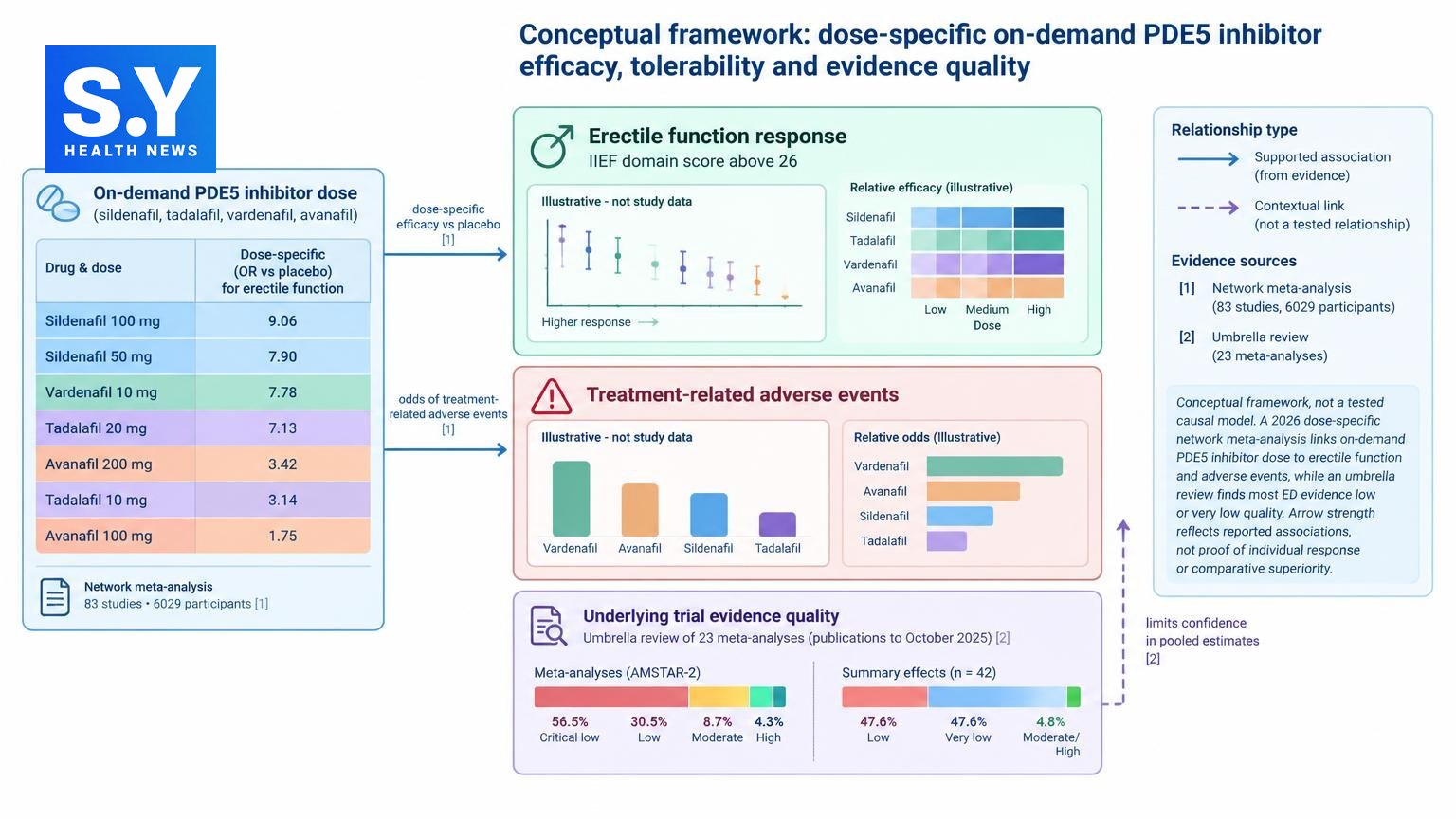
Against placebo, the pooled odds ratios for improving erectile function were highest for sildenafil 100 mg (OR 9.06) and sildenafil 50 mg (OR 7.90), followed by vardenafil 10 mg (OR 7.78), tadalafil 20 mg (OR 7.13), avanafil 200 mg (OR 3.42), tadalafil 10 mg (OR 3.14) and avanafil 100 mg (OR 1.75). A threshold analysis restricted to sildenafil yielded smaller but statistically significant estimates versus placebo: OR 2.20 (95% CI 1.78–2.63) for 100 mg and OR 2.10 (95% CI 1.69–2.50) for 50 mg, which the authors interpreted as indicating that moderate variations were unlikely to alter the comparative ranking. Treatment-related adverse events were most likely with vardenafil, followed by avanafil and sildenafil, and least likely with tadalafil, although some estimates had wide confidence intervals.
That ranking sits inside a far less confident evidence base. A separate umbrella review covering publications up to October 2025 extracted 23 published meta-analyses and 42 summary effects on 36 interventions, and found by AMSTAR-2 appraisal that 13 of 23 meta-analyses (56.5%) were critically low quality, 7 (30.5%) low quality, 2 (8.7%) moderate quality and 1 (4.3%) high quality. Of the 42 summary effects, only one each was rated high and moderate quality, while 20 (47.6%) were low and 20 (47.6%) very low. The authors concluded the current ED treatment evidence base is predominantly of low or very low quality and that statistically significant improvements, though observed for both pharmacological and nonpharmacological interventions, should be interpreted cautiously because of limited patient numbers and subjective outcome indicators.[2]
Read together, the two publications suggest that dose-specific PDE5 inhibitor comparisons are informative and mechanistically plausible, but that a single network estimate is not a treatment algorithm. The network meta-analysis provides an internally coherent ranking of on-demand doses; the umbrella review explains why confidence around that ranking should remain tempered. The practical implication is not that one drug should replace another universally, but that dose, timing, tolerability and individual context deserve explicit attention within shared clinical decisions.
Why Dose-Specific Comparisons Matter
Much of the clinical discussion around PDE5 inhibitors contrasts molecules — sildenafil versus tadalafil versus vardenafil versus avanafil — as if each were a single fixed exposure. In practice, dose is the exposure. A 50 mg tablet of sildenafil and a 100 mg tablet are different pharmacological events, and the same logic applies across the class. A pooled analysis that ignores dose can average high- and low-dose arms together and blur the very comparison clinicians and patients care about. The 2026 network meta-analysis explicitly responded to that gap, noting that while several meta-analyses had assessed PDE5 inhibitor efficacy, none had focused on dose-specific outcomes, and it therefore set out to compare dose-dependent efficacy and safety using on-demand dosages.
The question is also clinically relevant because the class is not interchangeable at the level of response. Erectile function is a graded physiological outcome, and the proportion of men reaching a satisfactory erectile function threshold is a meaningful public-health and trial metric. By defining the primary outcome as the proportion achieving an IIEF domain score above 26, the review anchored its comparison in a recognizable functional target rather than a purely statistical average. That design choice makes the results easier to interpret, but it does not resolve the underlying heterogeneity of the trials pooled, a point developed later in this review.
Biological and Clinical Mechanism
An erection is a vascular event coordinated by the nervous system, blood vessels, hormones and psychological state. Sexual arousal triggers nerve signals that release nitric oxide in the penile arteries; nitric oxide activates guanylate cyclase, which produces cyclic GMP, the molecule that relaxes smooth muscle in the arterial walls and allows blood to fill the corpora cavernosa. PDE5 inhibitors block the enzyme that breaks down cGMP, prolonging the relaxation signal and supporting blood flow into the penis. They do not cause erections on their own; sexual stimulation is still required for the pathway to be engaged.[3]
This mechanism explains why PDE5 inhibitors are a class rather than a single drug, and why dose matters. Greater enzyme inhibition at a higher dose can produce a larger cGMP signal, but it can also produce more of the class-typical adverse effects that arise from vasodilation and related pathways. The network meta-analysis observed exactly this tension in aggregate: the efficacy ranking favored higher sildenafil doses, while the adverse-event ranking placed vardenafil highest, followed by avanafil and sildenafil, with tadalafil lowest. These are population-level summaries from randomized trials, not predictions for an individual man, and the review did not establish a mechanism for the between-drug differences in tolerability.
The mechanism also frames an important safety boundary that sits outside the efficacy comparisons. PDE5 inhibitors are absolutely contraindicated with nitrate medications and recreational nitrites, because the combination can cause severe, potentially fatal hypotension. This is not a dose-titration issue; it is a class-level prohibition. Any discussion of comparative efficacy is therefore subordinate to appropriate screening and contraindication review, which the network meta-analysis was not designed to address.
What the Evidence Shows: The 2026 Dose-Specific Network Meta-Analysis
The review pooled randomized, double-blind, placebo-controlled trials of on-demand PDE5 inhibitor doses. Its network comprised 83 studies and 6029 participants, with 3457 in treatment groups and 2572 in placebo groups. The primary outcome was the proportion of participants achieving satisfactory erectile function, defined as an IIEF domain score above 26. Because the analysis was a network meta-analysis, the dose-specific odds ratios are indirect comparisons anchored to placebo within a connected network of trials rather than head-to-head randomized contrasts of every pair of doses.
The main efficacy results, expressed as odds ratios versus placebo for improving erectile function, were as follows: sildenafil 100 mg OR 9.06 and sildenafil 50 mg OR 7.90; vardenafil 10 mg OR 7.78; tadalafil 20 mg OR 7.13; avanafil 200 mg OR 3.42; tadalafil 10 mg OR 3.14; and avanafil 100 mg OR 1.75. The ordering places sildenafil at the top of the pooled estimates, followed by tadalafil 20 mg, vardenafil 10 mg, avanafil 200 mg, tadalafil 10 mg and avanafil 100 mg. The authors concluded that PDE5 inhibitors are highly effective and that sildenafil showed significantly greater efficacy compared with the other PDE5 inhibitors. That conclusion is an inference from indirect network comparisons, not a series of direct randomized head-to-head wins.
The threshold analysis deserves separate attention because its numbers are often misread alongside the main network estimates. Restricted to sildenafil, it produced OR 2.20 (95% CI 1.78–2.63) for 100 mg and OR 2.10 (95% CI 1.69–2.50) for 50 mg versus placebo. These are smaller than the corresponding main-network odds ratios, which is expected because a threshold analysis examines the robustness of rankings under altered assumptions rather than reproducing the main model. The authors interpreted the result as showing that moderate variations were unlikely to alter the comparative ranking within the network. That is an interpretive judgment about stability, not a second independent estimate of treatment effect size.
On tolerability, the odds of treatment-related adverse events compared with placebo were highest for vardenafil, followed by avanafil and sildenafil, and lowest for tadalafil. The authors also cautioned that in some instances the wide confidence intervals showed higher variability and potential uncertainty in effect estimates. The review did not report a single composite safety ranking in the abstract that can be translated into an individual's expected experience, and adverse events were treatment-related events in trials rather than a comprehensive safety profile. The ordering is therefore a comparative signal worth discussing, not a guarantee that one agent will be better tolerated by a given patient.
| On-demand dose | Odds ratio vs placebo for improving erectile function | Interpretation within the network |
|---|---|---|
| Sildenafil 100 mg | 9.06 | Highest pooled estimate in the network; threshold analysis for sildenafil supported ranking stability |
| Sildenafil 50 mg | 7.90 | Second-highest pooled estimate; threshold analysis supported ranking stability |
| Vardenafil 10 mg | 7.78 | High efficacy estimate but highest odds of treatment-related adverse events in the network |
| Tadalafil 20 mg | 7.13 | High efficacy estimate with the lowest odds of treatment-related adverse events |
| Avanafil 200 mg | 3.42 | Intermediate efficacy estimate; adverse-event odds ranked between vardenafil and sildenafil |
| Tadalafil 10 mg | 3.14 | Lower efficacy estimate than tadalafil 20 mg; tolerability ranking is class-level, not dose-specific |
| Avanafil 100 mg | 1.75 | Lowest pooled efficacy estimate in the network; wide intervals in some estimates add uncertainty |
The table summarizes the dose-specific efficacy estimates and places the adverse-event ranking alongside them only where the source supports that pairing. It should not be read as a prescribing ladder. The network meta-analysis compared on-demand doses against placebo; it did not evaluate every dose against every other dose directly, and the tolerability ordering is a class-level comparison rather than a dose-by-dose safety matrix.
What the Evidence Shows: The Wider Quality Problem
A dose-specific network meta-analysis is only as trustworthy as the evidence it synthesizes. The umbrella review provides the broader quality context. It searched PubMed, Web of Science, the Cochrane Library and Embase for studies published up to October 2025, extracted 23 published meta-analyses, and derived 42 summary effects on IIEF (n=20), IIEF-5 (n=9), IIEF-EF (n=6) and the erectile hardness score (n=7) across 36 interventions. Appraised with AMSTAR-2, 13 meta-analyses (56.5%) were critically low quality, 7 (30.5%) low quality, 2 (8.7%) moderate quality and 1 (4.3%) high quality.
At the level of individual summary effects, only one was rated high quality and one moderate quality; 20 (47.6%) were rated low and 20 (47.6%) very low. The authors concluded that the current ED treatment evidence base is predominantly of low or very low quality, and that although statistically significant improvements were observed with both pharmacological and nonpharmacological interventions, those findings should be interpreted cautiously because of the limited number of patients and the subjective nature of outcome indicators. They further stated that the treatment landscape is increasingly diverse but the reliability of the evidence is poor, and recommended further well-designed studies of single treatments and high-quality meta-analyses of comparisons between treatments.
This is not a contradiction of the network meta-analysis; it is a statement about the substrate on which any such analysis rests. A network meta-analysis can produce precise-looking pooled odds ratios while inheriting the weaknesses of its included trials, including heterogeneity in populations, dosing schedules, outcome definitions and follow-up. The umbrella review's finding that most ED evidence is low or very low quality means readers should treat rankings as provisional and should not over-interpret small differences between adjacent estimates. Where the network meta-analysis itself flags wide confidence intervals in some instances, that warning aligns with the umbrella review's broader caution rather than sitting apart from it.
Statistical Versus Clinical Meaning
An odds ratio is a statistical summary of association within the trial network; it is not a probability that an individual man will respond. The dose-specific odds ratios versus placebo in the network meta-analysis range from 9.06 for sildenafil 100 mg down to 1.75 for avanafil 100 mg, and every one of these is a pooled estimate across heterogeneous trials. A higher odds ratio indicates a larger association with achieving the defined erectile function threshold in the trial population, not a guarantee of a better outcome for a particular patient with a particular comorbidity, partner context or dosing habit.
The threshold analysis illustrates the distinction especially well. Its estimates for sildenafil 100 mg (OR 2.20) and 50 mg (OR 2.10) are far smaller than the corresponding main-network odds ratios, yet both remain statistically significant with confidence intervals excluding 1.00. A statistically significant improvement is not the same as a clinically important one, and the authors' claim is about the robustness of the comparative ranking rather than about the magnitude of benefit an individual should expect. The labeling of that result as indicating robustness is an interpretation, appropriately presented as such.
Clinical meaning also depends on outcomes the network did not center. Erectile function scores are patient-reported and therefore subject to expectation, recall and relationship context. The umbrella review explicitly flags the subjective nature of outcome indicators as a reason for caution. A ranking built on a subjective functional threshold is useful for comparing trial arms, but it cannot capture the practical dimensions that shape real-world choices, such as onset, duration, food interaction, cost and prior response, which are not part of the dose-specific network estimates.
Interpretation and Limitations
The most important limitation is structural: the dose-specific comparisons are indirect. A network meta-analysis combines direct and indirect evidence to estimate relative effects across treatments that may never have been compared head-to-head in a dedicated trial. The authors' conclusion that sildenafil showed significantly greater efficacy than the other PDE5 inhibitors is therefore an inference within the network, not a summary of repeated direct randomized victories. The accompanying caution that wide confidence intervals in some instances indicated higher variability and uncertainty reinforces the need to read adjacent odds ratios as overlapping rather than sharply separated.
A second limitation concerns dose coverage. The network reports specific doses, but not every agent's full dose range appears in the headline results, and the dose-specific safety comparisons are not presented as a complete matrix. The efficacy ordering and the adverse-event ordering therefore answer different questions and should not be combined into a single composite score without transparent justification. The review's abstract also does not report the full set of confidence intervals for every dose-specific efficacy estimate, which limits how precisely readers can judge separation between neighboring ranks.
A third limitation is the quality of the underlying literature, as documented by the umbrella review. With most ED meta-analyses rated critically low or low quality and most summary effects rated low or very low, even a well-conducted dose-specific network meta-analysis inherits substantial uncertainty. The umbrella review's recommendation for further well-designed single-treatment studies and high-quality intertreatment comparisons is a direct statement that the current evidence is not sufficient for confident comparative guidelines. Population differences, baseline severity, comorbidity and trial-era effects are plausible sources of heterogeneity that the network summary cannot resolve.
Finally, the network meta-analysis was not designed to evaluate long-term safety, cardiovascular outcomes or drug interactions. The class-level contraindication with nitrates and recreational nitrites is a safety boundary that sits outside the comparative efficacy question, and its importance is not diminished by any efficacy ranking. Readers should also note that the adverse-event evidence discussed here is supplemented by broader pharmacovigilance signals beyond the trial network; a 2025 analysis of 53,517 FDA Adverse Event Reporting System reports from 2004 to 2024 identified label-listed side effects for all four drugs plus some nervous-system, cardiovascular and eye signals not on the labels that need further study. Spontaneous reporting databases cannot establish causality or incidence, so these signals are hypotheses for further investigation rather than confirmed risks.
Research Outlook
The clearest research priority is direct, adequately powered, double-blind randomized comparisons of doses across agents, rather than reliance on indirect network estimates. The umbrella review's authors explicitly recommend further well-designed studies on single treatments and high-quality meta-analyses of comparisons between treatments. Such studies would need to standardize outcome definitions, report full confidence intervals, and capture patient-reported domains that matter in practice. Until then, the dose-specific network meta-analysis should be read as the best available synthesis of a weak evidence base, not as a definitive hierarchy.
A second priority is mechanistic and tolerability research that explains why adverse-event odds differ across agents. The network meta-analysis reports a ranking, but not a causal explanation, and the wide intervals in some estimates suggest that the ranking is not equally precise everywhere. Future work could link dose, plasma exposure, vasodilatory effects and patient factors in a way that supports individualized selection rather than population averages. The 2026 narrative review cited in the broader literature on GLP-1 receptor agonists and sexual function illustrates how inconsistent the evidence can be when mechanisms and populations are heterogeneous, and it reinforces the case for cautious, design-specific interpretation.
Key Takeaways
- A 2026 dose-specific network meta-analysis of 83 double-blind, placebo-controlled trials (6029 participants) found the highest pooled odds ratios for improving erectile function with sildenafil 100 mg (OR 9.06) and 50 mg (OR 7.90), followed by vardenafil 10 mg (OR 7.78), tadalafil 20 mg (OR 7.13), avanafil 200 mg (OR 3.42), tadalafil 10 mg (OR 3.14) and avanafil 100 mg (OR 1.75).
- A threshold analysis restricted to sildenafil produced smaller but statistically significant estimates versus placebo (100 mg OR 2.20, 95% CI 1.78–2.63; 50 mg OR 2.10, 95% CI 1.69–2.50), which the authors interpreted as indicating ranking robustness rather than as a second measure of effect size.
- Treatment-related adverse-event odds were highest for vardenafil, followed by avanafil and sildenafil, and lowest for tadalafil, although wide confidence intervals in some instances signaled uncertainty.
- An umbrella review of 23 meta-analyses covering publications up to October 2025 rated 56.5% critically low quality and 30.5% low quality by AMSTAR-2; of 42 summary effects, 20 were low and 20 very low quality, leading its authors to call the ED evidence base predominantly low or very low quality.
- PDE5 inhibitors work by blocking cGMP breakdown and require sexual stimulation; they are absolutely contraindicated with nitrate medications and recreational nitrites because of severe hypotension risk, a safety boundary outside comparative efficacy rankings.
Questions and Answers
How do on-demand PDE5 inhibitor doses compare for erectile function in the 2026 network meta-analysis?
Against placebo, pooled odds ratios for improving erectile function were sildenafil 100 mg OR 9.06, sildenafil 50 mg OR 7.90, vardenafil 10 mg OR 7.78, tadalafil 20 mg OR 7.13, avanafil 200 mg OR 3.42, tadalafil 10 mg OR 3.14 and avanafil 100 mg OR 1.75. These are indirect network estimates from 83 trials, not head-to-head randomized comparisons of every pair of doses, so adjacent ranks overlap in uncertainty.
What is a PDE5 inhibitor and how does it produce an erection?
A PDE5 inhibitor blocks the enzyme that breaks down cyclic GMP, the molecule that relaxes penile arterial smooth muscle and allows blood to fill the corpora cavernosa. Sexual arousal still must trigger nitric oxide release and cGMP production, because these drugs do not cause erections on their own. This mechanism explains why adequate sexual stimulation is required and why the class is contraindicated with nitrates.
How strong is the overall evidence base for erectile dysfunction treatments?
An umbrella review of 23 meta-analyses covering publications up to October 2025 rated 13 (56.5%) critically low quality and 7 (30.5%) low quality by AMSTAR-2. Of 42 summary effects, only one was high quality and one moderate; 20 were low and 20 very low. The authors concluded the ED evidence base is predominantly low or very low quality and recommended better-designed studies and higher-quality intertreatment comparisons.
Which PDE5 inhibitor has the lowest odds of treatment-related adverse events?
In the 2026 network meta-analysis, the odds of treatment-related adverse events compared with placebo were highest for vardenafil, followed by avanafil and sildenafil, and lowest for tadalafil. However, the authors noted wide confidence intervals in some estimates, and this is a class-level ranking rather than a dose-by-dose safety matrix. It does not predict an individual patient's tolerability.
Can a network meta-analysis of PDE5 inhibitor doses guide individual treatment choices?
It can inform discussion but not dictate individual choice. Network estimates are pooled across heterogeneous trials, include indirect comparisons and inherit the low quality of much of the ED literature. Practical factors such as onset, duration, food interaction, cost and prior response are not captured by the dose-specific odds ratios. Contraindications, especially with nitrates, must be screened for regardless of any efficacy ranking.
What does the sildenafil threshold analysis add to the network meta-analysis?
The threshold analysis restricted to sildenafil produced statistically significant improvements versus placebo for 100 mg (OR 2.20, 95% CI 1.78–2.63) and 50 mg (OR 2.10, 95% CI 1.69–2.50). These smaller estimates test how robust the comparative rankings are under altered assumptions; the authors interpreted them as indicating that moderate variations were unlikely to change the ranking. They are not a second measure of expected clinical benefit.
Conceptual framework: Conceptual framework, not a tested causal model. A 2026 dose-specific network meta-analysis of 83 double-blind, placebo-controlled trials (6029 participants) links on-demand PDE5 inhibitor dose to the proportion achieving an IIEF domain score above 26 and to treatment-related adverse events. The umbrella review of 23 meta-analyses (publications to October 2025) rated most ED evidence low or very low quality, so arrow strength reflects reported associations, not proof of individual response or comparative superiority.
Academic References & Evidence
- Andrea Salonia; Carlo Bettocchi; Arthur Burnett; Giovanni Corona; Mikkel Fode; Tarek Hassan; Suks Minhas; John P. Mulhall; Hossein Sadeghi-Nejad; Shivani Ohri Vignesh; Run Wang; Emmanuele A. Jannini. A comparative evaluation of on-demand phosphodiesterase-5 inhibitor efficacy in erectile dysfunction treatment: a systematic review and network meta-analysis of double-blind, placebo-controlled, randomized trials. Journal of Sexual Medicine. 2026 23(7):qdag176 DOI: 10.1093/jsxmed/qdag176.
- Current treatment for erectile dysfunction: an umbrella review of systematic reviews and meta-analyses. 2026
- Erectile Dysfunction.
SANYUN Science Center explains published research on men's reproductive and sexual health, connecting scientific evidence with everyday questions while making sources and limitations clear.
Disclaimer: This article is for scientific education and research communication only. It does not provide medical advice, diagnosis, or individualized treatment recommendations, and does not endorse any medication, supplement, device, penile enlargement procedure, or other intervention. Decisions about sexual and reproductive health should be made in consultation with a qualified healthcare professional. Do not delay seeking professional care because of information in this article.
Original Content & Copyright Notice
- This article is prepared for SANYUN Science Center, drawing on published research and publicly available academic literature on men’s sexual and reproductive health. Its editorial explanations and presentation are developed for this platform.
- Copyright in the original editorial content, selection, and arrangement is reserved by SANYUN Science Center to the extent protected by applicable law. Referenced research, quotations, and third-party materials remain subject to the rights of their respective owners. This notice does not claim ownership of scientific facts or third-party research.
- Except where permitted by applicable law or an applicable license, prior written permission is required to reproduce, republish, translate, adapt, redistribute, or commercially reuse protected content. Attribution alone does not grant permission for such reuse.
- For permitted quotation or authorized reuse, clearly identify the source and retain a link to the original article.
- Source: SANYUN Science Center
- Original URL: Retain the original article URL on science.san-yun.com.
- Copyright Holder: SANYUN Science Center, for its own protected editorial content.
- Quotation, excerpts, or authorized reuse must not distort the scientific meaning, omit material limitations or disclaimers, or imply unverified medical claims, product efficacy, or endorsement by SANYUN Science Center.



