




Category: Premature Ejaculation
Core Research Direction: Diagnostic performance of the Premature Ejaculation Diagnostic Tool (PEDT) against intravaginal ejaculatory latency time (IELT) in Turkish men, and how contemporary consensus classifies and treats premature ejaculation subtypes
Search Intent: How well does the Premature Ejaculation Diagnostic Tool agree with measured intravaginal ejaculatory latency time, and what does current consensus recommend for diagnosing and treating premature ejaculation?
Platform: SANYUN Science Center
Evidence reviewed through: 2026-11-14
Executive Summary
A Turkish cross-sectional validation study tested a translated Premature Ejaculation Diagnostic Tool (PEDT) against a stopwatch-measured intravaginal ejaculatory latency time (IELT) in men with and without a self-reported complaint of premature ejaculation (PE). The investigators enrolled 94 men reporting PE and 88 men without PE, all of whom completed a Turkish version of the nine-item questionnaire; retest data were collected at a second visit from 78 men in the PE group and 69 in the control group.[1]
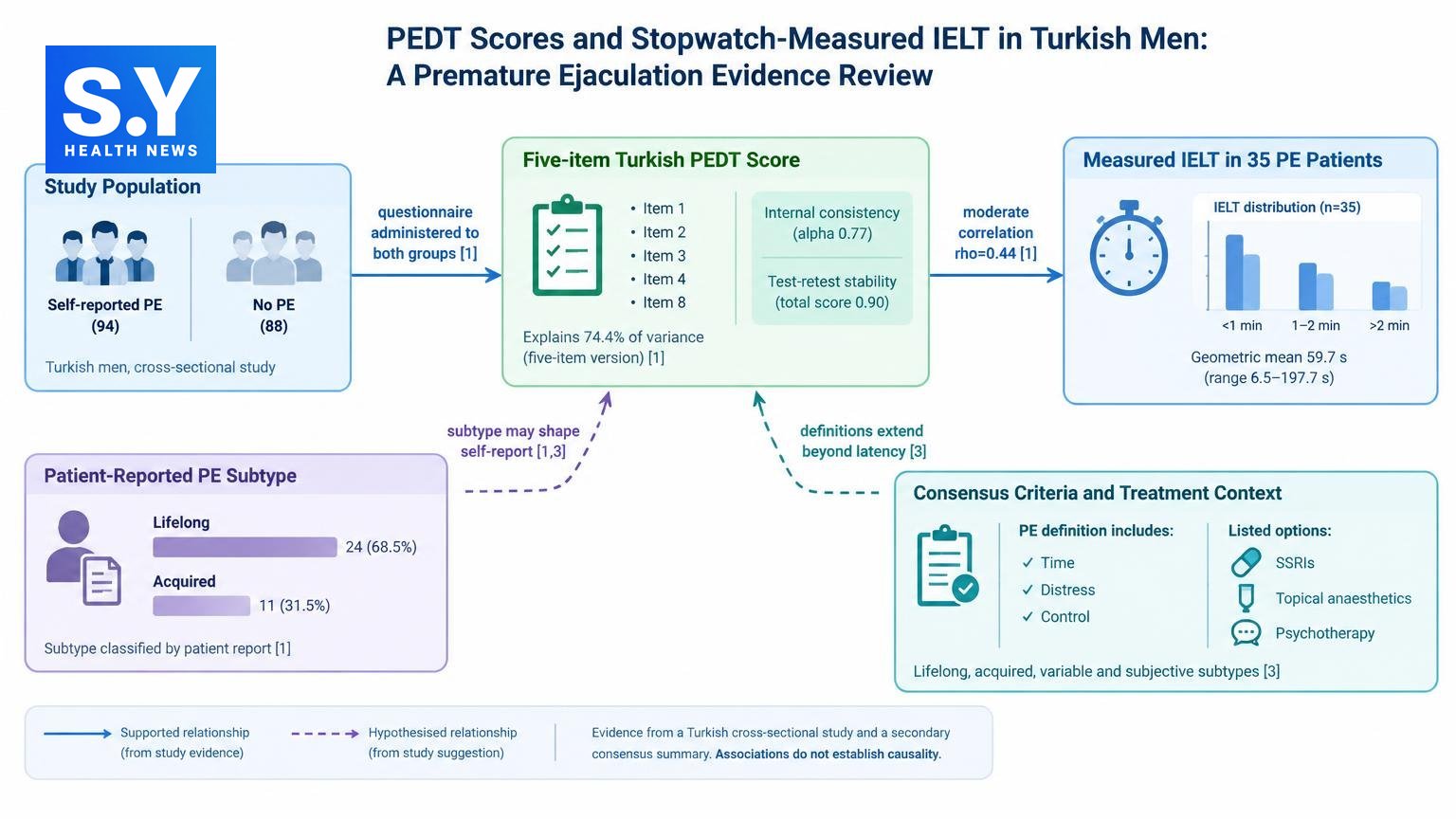
Factor analysis supported a shortened five-item version (questions 1, 2, 3, 4 and 8) that explained 74.4% of the variance, with no other combination explaining more. That five-item combination showed adequate internal consistency (Cronbach's alpha 0.77), and test-retest coefficients exceeded 0.80 for each item and reached 0.90 for the total score.
The validity anchor was considerably weaker. IELT was recorded for only 35 patients, all in the PE group, and the correlation between PEDT total score and IELT was rho=0.44. The authors described this as adequate and concluded that the five-item Turkish PEDT is a reliable screening questionnaire among Turkish patients. That conclusion is defensible for reliability; it does not establish that the questionnaire reproduces measured latency, and no sensitivity, specificity or agreement statistics appear in the supplied report.
Why This Matters
Ejaculatory disorders, including PE and delayed ejaculation, are common and carry a substantial impact on men's quality of life and their relationships, according to the Fifth International Consultation on Sexual Medicine (ICSM) review. Yet confirming PE in a clinic is awkward: measured latency is intrusive, varies between encounters, and captures only one part of a complaint that also involves distress and a sense of lost control.[2][3]
A short, psychometrically sound questionnaire would be attractive for busy services and for tracking change. The question the Turkish study implicitly poses is how far a self-report score can stand in for a physiological measurement — in screening, in research endpoints, and in monitoring response to treatment. A moderate correlation answers part of that question and leaves the rest open.
What the Two Measures Capture
IELT and the PEDT are not measuring the same thing. IELT is an interval in seconds, timed from vaginal penetration to ejaculation; it is physiological and relatively objective but represents one behavioural dimension. The PEDT was developed to apply diagnostic criteria systematically, so it records the man's appraisal of timing, control and bother rather than a measured interval.
Because one measure is a stopwatch reading and the other is a multidimensional self-report, a perfect correlation would be surprising. A coefficient of 0.44 is compatible with an instrument that is clinically informative while remaining partly independent of latency. That independence can be useful when the goal is to capture distress and control, but it also means a PEDT score cannot be read as a latency estimate or used interchangeably with one.
Consensus definitions have moved in a similar direction. The ICSM summary states that the definitions of PE and delayed ejaculation now incorporate time, distress and control criteria rather than relying on a latency threshold alone. That framing makes a multidimensional questionnaire conceptually attractive, but it also raises the bar for validation: an instrument should be tested against each of those dimensions, not against latency alone.
What the Turkish Validation Found
The design was a cross-sectional diagnostic validation in a clinical sample. Men with a self-reported complaint of PE (n=94) and men without PE (n=88) completed the translated nine-item PEDT. A second visit provided retest data from 78 PE-group men and 69 controls. Factor analysis identified the five-item combination described above; removing items did not increase the overall alpha.
Latency data were sparse. Among the 35 PE patients with recorded IELT, the geometric mean was 59.7 seconds, reported with a spread of plus or minus 46.2 and a range of 6.5 to 197.7 seconds. Twenty men (57.1%) reported IELT below 1 minute, 11 (31.5%) between 1 and under 2 minutes, and 4 (11.4%) above 2 minutes. No control-group IELT values appear in the supplied text.
Within the PE group, 24 patients (68.5%) reported lifelong PE and 11 (31.5%) reported acquired PE, classified by patient report rather than by structured interview. The correlation between PEDT total score and IELT in the 35 patients with latency data was rho=0.44.
| Study element | What was assessed | Reported result | Key caveat |
|---|---|---|---|
| Study sample | Men with self-reported PE versus men without PE | 94 with PE; 88 without PE | Clinical volunteers, not a population sample |
| Retest reliability sample | Second-visit PEDT administration | 78 PE-group men; 69 control men | Retest interval not stated in the supplied text |
| Factor structure | Variance explained by item combinations | Five items (1, 2, 3, 4, 8) explained 74.4% of variance | Analysis subset not fully specified |
| Internal consistency | Cronbach's alpha for the five-item version | 0.77 | No confidence interval reported |
| Test-retest correlation | Item-level and total-score stability | Items above 0.80; total score 0.90 | Short-term stability only; interval unstated |
| Latency anchor | Measured IELT in PE group | Geometric mean 59.7 s; range 6.5 to 197.7 s; n=35 | Small subset; no control IELT reported |
| PEDT-IELT association | Correlation coefficient | rho=0.44 | Moderate correlation, not a diagnostic agreement analysis |
| Subtype distribution | Patient-reported PE subtype | 24 (68.5%) lifelong; 11 (31.5%) acquired | Patient report rather than structured assessment |
Interpretation and Limitations
The reliability evidence is the strongest part of this work. A five-item instrument with alpha 0.77 and a total-score retest correlation of 0.90 is psychometrically reasonable for a screening questionnaire; in plain terms, the items score consistently together and give similar results on repeat administration. The factor analysis suggests the shortened version retains most of the measured construct, and deleting further items did not improve internal consistency.
The validity evidence is thinner, and the word moderate does real work here. A correlation of 0.44 means the questionnaire and measured latency share only part of their variance — they are related but not interchangeable. Because the supplied report contains no sensitivity, specificity or agreement statistics against an IELT-defined reference standard, the label diagnostic tool should be read as screening support rather than demonstrated diagnostic accuracy.
Several limitations constrain interpretation. IELT was available for only 35 patients, all in the PE group, so the correlation rests on a small and restricted range with no control comparison. Group membership was defined by self-reported complaint rather than by measured latency, and subtype was also patient-reported. The authors' suggestion that the PEDT may help measure treatment response was not tested, because no treatment or longitudinal outcome was evaluated in this study.
The authors' judgement that the PEDT is more applicable than IELT measurement in their population is a reasonable practical inference for a clinic, but it is an interpretive statement rather than a comparative outcome from the study. Generalisation beyond Turkish men attending urology services would require separate validation, and the supplied material does not report one.
Consensus Classification and Treatment Context
The Fifth ICSM review aimed to present evidence-based recommendations for the definition, classification and treatment of PE and delayed ejaculation. A secondary Chinese-language summary of that consensus reports that the work used a modified Delphi process and the GRADE system. These describe the methodology of a consensus exercise, not the results of a new clinical trial, and the secondary summary is not the primary consensus text.
According to that summary, PE is the most common male sexual complaint and is classified into lifelong, acquired, variable and subjective subtypes. Listed treatment options include selective serotonin reuptake inhibitors, topical anaesthetics and psychotherapy. Definitions now incorporate time, distress and control criteria. The supplied material provides no effect sizes, head-to-head efficacy comparisons or full recommendation text, so treatment statements should be read as a map of options rather than as evidence of relative benefit.
The same summary identifies a need for more evidence-based treatment research, particularly for delayed ejaculation. That is a forward-looking recommendation about the research agenda, not a finding about how current treatments perform.
Research Outlook
The most informative next step would be a validation design that measures IELT in both cases and controls, prespecifies a reference standard, and reports agreement statistics rather than a correlation coefficient alone. Analysing the variable and subjective subtypes separately would matter too, because those categories formalise presentations in which latency may be inconsistent or disproportionate to reported distress.
Longitudinal performance also needs direct testing. Using a questionnaire to track treatment response is a plausible application, but it requires evidence that scores change meaningfully when symptoms change — evidence this cross-sectional study could not provide. Until such data exist, the rho=0.44 finding is best treated as supportive but incomplete.
Key Takeaways
- The Turkish five-item PEDT showed adequate internal consistency (Cronbach's alpha 0.77) and strong test-retest stability (total score 0.90) in a clinical sample of 94 men with PE and 88 without.
- PEDT total score correlated with measured IELT at rho=0.44 — a moderate association, not diagnostic equivalence.
- IELT data existed for only 35 patients, all in the PE group, and no control latency values were reported, limiting the validity anchor.
- Consensus definitions now combine time, distress and control criteria and recognise lifelong, acquired, variable and subjective PE subtypes.
- Consensus-listed options include SSRIs, topical anaesthetics and psychotherapy, but the supplied summary gives no comparative effect estimates.
Questions and Answers
What is the Premature Ejaculation Diagnostic Tool and what does it measure compared with IELT?
The PEDT is a self-report questionnaire designed to apply diagnostic criteria for premature ejaculation systematically, capturing perceived timing, control and distress. IELT is a stopwatch-measured interval from vaginal penetration to ejaculation. In the Turkish study the five-item PEDT total score correlated with IELT at rho=0.44, indicating the two measures are related but capture partly different information and are not interchangeable.
How reliable was the five-item Turkish version of the PEDT?
Reliability was reasonable. The five-item combination (questions 1, 2, 3, 4 and 8) explained 74.4% of variance, had a Cronbach's alpha of 0.77, and showed test-retest correlations above 0.80 per item and 0.90 for the total score. Retest data came from 78 men in the PE group and 69 controls; the interval between visits was not stated in the supplied text.
How closely did PEDT scores agree with measured intravaginal ejaculatory latency time in Turkish men?
Only moderately. The correlation between PEDT total score and IELT was rho=0.44 among 35 patients with latency recorded, all in the PE group. Because the sample was small, no control IELT values were reported, and no sensitivity, specificity or agreement statistics were presented, the study supports screening use rather than establishing that the questionnaire can substitute for latency measurement.
What IELT values were reported in the Turkish premature ejaculation validation sample?
Among the 35 PE patients with recorded IELT, the geometric mean was 59.7 seconds, reported with a spread of plus or minus 46.2 and a range of 6.5 to 197.7 seconds. Twenty men (57.1%) had IELT below 1 minute, 11 (31.5%) between 1 and under 2 minutes, and 4 (11.4%) above 2 minutes. Control-group latency values were not reported.
How does the Fifth International Consultation on Sexual Medicine classify premature ejaculation subtypes?
A secondary summary of the consensus describes four subtypes: lifelong, acquired, variable and subjective. Definitions incorporate time, distress and control criteria rather than latency alone. The summary reports that recommendations were developed with a modified Delphi process and the GRADE system, but it provides no comparative treatment effect estimates and is not the primary consensus text.
Can a PEDT score be used to monitor treatment response in premature ejaculation?
That use has been proposed but not demonstrated here. The authors suggested the PEDT-IELT association supports measuring treatment response, but the study was cross-sectional with no treatment or longitudinal follow-up, so sensitivity to change was never tested. Monitoring use remains a hypothesis that requires dedicated longitudinal validation before it can guide practice.
Conceptual framework: Conceptual framework. A Turkish cross-sectional study enrolled 94 men with self-reported PE and 88 without PE; the five-item PEDT showed adequate internal consistency and strong test-retest stability. PEDT score correlated with measured IELT at rho=0.44 in 35 PE patients — a moderate association, not diagnostic equivalence. Subtype was patient-reported and consensus criteria are context only. Interpretive framework, not a causal model.
Academic References & Evidence
- E C Serefoglu; H I Cimen; A T Ozdemir; M D Balbay; T Symonds; M Berktas. Turkish validation of the premature ejaculation diagnostic tool and its association with intravaginal ejaculatory latency time. Int J Impot Res. 2009 21:139–144 DOI: 10.1038/ijir.2008.58.
- Contemporary consensus and emerging directions in premature and delayed ejaculation: recommendations from the 5th International Consultation on Sexual Medicine.. Sexual medicine reviews PMID: 42855438.
- 2026 ICSM专家共识:早泄和延迟射精的当代共识与新兴方向.
SANYUN Science Center explains published research on men's reproductive and sexual health, connecting scientific evidence with everyday questions while making sources and limitations clear.
Disclaimer: This article is for scientific education and research communication only. It does not provide medical advice, diagnosis, or individualized treatment recommendations, and does not endorse any medication, supplement, device, penile enlargement procedure, or other intervention. Decisions about sexual and reproductive health should be made in consultation with a qualified healthcare professional. Do not delay seeking professional care because of information in this article.
Original Content & Copyright Notice
- This article is prepared for SANYUN Science Center, drawing on published research and publicly available academic literature on men’s sexual and reproductive health. Its editorial explanations and presentation are developed for this platform.
- Copyright in the original editorial content, selection, and arrangement is reserved by SANYUN Science Center to the extent protected by applicable law. Referenced research, quotations, and third-party materials remain subject to the rights of their respective owners. This notice does not claim ownership of scientific facts or third-party research.
- Except where permitted by applicable law or an applicable license, prior written permission is required to reproduce, republish, translate, adapt, redistribute, or commercially reuse protected content. Attribution alone does not grant permission for such reuse.
- For permitted quotation or authorized reuse, clearly identify the source and retain a link to the original article.
- Source: SANYUN Science Center
- Original URL: Retain the original article URL on science.san-yun.com.
- Copyright Holder: SANYUN Science Center, for its own protected editorial content.
- Quotation, excerpts, or authorized reuse must not distort the scientific meaning, omit material limitations or disclaimers, or imply unverified medical claims, product efficacy, or endorsement by SANYUN Science Center.



