




Category: Premature Ejaculation
Core Research Direction: Validity and diagnostic performance of the Premature Ejaculation Diagnostic Tool (PEDT) across PE subtypes and populations, and its relation to erectile function (IIEF-15), informing how clinicians and researchers should interpret PEDT scores rather than treating them as subtype-specific diagnostic tools.
Search Intent: How well does the PEDT identify premature ejaculation and distinguish its subtypes (lifelong, acquired, variable, subjective), and how does it relate to erectile function across populations?
Platform: SANYUN Science Center
Evidence reviewed through: 2026-11-11
Executive Summary
The Premature Ejaculation Diagnostic Tool (PEDT) is a brief self-report instrument that flags men likely to meet criteria for premature ejaculation (PE). The practical question for clinicians and researchers is narrower than whether it "works": a total score can identify probable PE reasonably well, yet the same score may not distinguish lifelong from acquired, variable or subjective presentations, and it partly tracks erectile function rather than ejaculatory control alone. Two studies in this review packet, a Korean population-based internet survey and a Chinese hospital-based case-control study, address that question from different directions.[1][2]
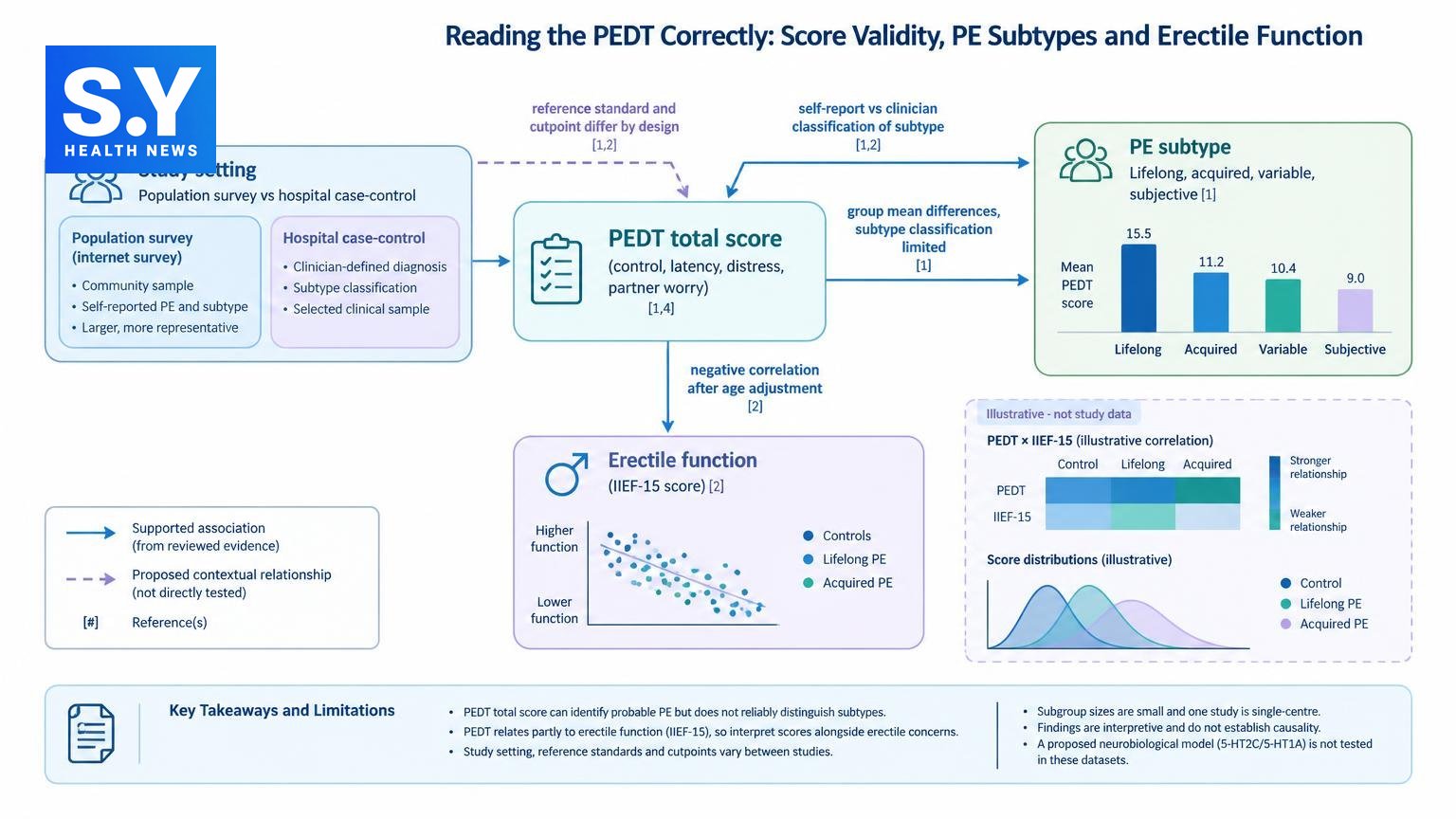
In the population survey, PEDT-defined PE prevalence was 14.6%. Mean PEDT scores differed markedly by subtype: 15.5 in lifelong PE, 11.2 in acquired PE, 10.4 in variable PE and 9.0 in subjective PE, with lifelong scores significantly higher than the others (P<0.001). The authors concluded the PEDT alone is unsuitable for subtyping PE in general-population research unless paired with a subtype-specific questionnaire.
In the Chinese case-control study, men with PE scored 14.28±3.05 on the PEDT versus 5.32±3.42 in controls, and a cutpoint above 9 yielded sensitivity of 0.875 and 0.913 for lifelong and acquired PE respectively, with specificity of 0.865 for both. Erectile function, measured with the IIEF-15, was lower in PE cases and negatively correlated with PEDT after age adjustment in both subtypes. Together the findings support the PEDT as a screening and severity signal, not a stand-alone subtype classifier.
Why This Matters
Ejaculatory disorders, including PE and delayed ejaculation, are common and carry a substantial impact on men's quality of life and relationships, according to the Fifth International Consultation on Sexual Medicine consensus review. Because PE is often raised reluctantly, a short, discreet questionnaire has obvious clinical value, and consensus guidance continues to emphasise structured evaluation and classification.[3]
But misreading a screening score has costs. If a clinician treats a PEDT total as a subtype label, subjective or variable presentations may be over-medicalised, while lifelong PE, which carries the highest symptom burden, may be blended into a heterogeneous group. If researchers use the total score as a subtype variable in community samples, effect estimates in aetiology or treatment studies can be diluted or misattributed. The distinction between statistical separation of group means and the ability to classify an individual patient is central here.
The relationship with erectile function adds a second interpretive layer. Men with PE in the Chinese study reported lower IIEF-15 scores than controls, and the negative PEDT–IIEF-15 correlation persisted after age adjustment in both lifelong and acquired PE. That does not prove that PE causes erectile difficulty or the reverse; it means PEDT interpretation should account for co-occurring erectile concerns rather than treating the two as independent silos.
What the PEDT Measures and How Thresholds Are Read
The PEDT is a self-report instrument intended to capture the core dimensions of PE: perceived lack of ejaculatory control, ejaculation with minimal stimulation, personal distress and worry about partner satisfaction. It yields a summed total score, and a commonly restated threshold scheme classifies scores of 8 or below as no PE, 9–10 as probable PE and 11 or above as established PE. These thresholds are descriptive conventions carried from the original validation literature; the secondary source that restates them here is not primary validation data.[4]
The population survey applied the ≥11 cutoff to define PEDT-PE, which explains why its prevalence figure is a questionnaire-defined estimate rather than a clinician-diagnosed one. This is a recurring source of confusion in the literature: prevalence depends on the threshold chosen and the population sampled, and comparisons across studies should check both.
The secondary instrument description also reports ROC-based sensitivity of roughly 89% and specificity of roughly 78% for the ≥11 threshold against formal diagnostic criteria. Those figures are approximate, are not tied to a named primary dataset, and should not be quoted as fixed operating characteristics across populations. They are best read as evidence that the instrument separates groups well enough for screening, not as a guarantee of individual-level diagnostic certainty.
What the Evidence Shows
Two very different designs inform the question. The Korean Internet Sexuality Survey was a population-based cross-sectional internet survey of males aged 20–59, enrolling 443 participants with a mean age of 39.3±10.1 years. Its strength is representativeness of community-dwelling men who may not present to clinics; its weakness is that both PE status and subtype were derived from self-report.
The Chinese study was a single-centre case-control comparison conducted from June 2015 to January 2016, enrolling 260 men complaining of PE who were classified as lifelong or acquired PE according to an evidence-based definition at an andrology clinic, plus 104 healthy male controls from a medical examination centre. Its strength is clinician-defined reference diagnosis; its weakness is the selected clinical sample and single-centre setting, which limit generalisation.
| Comparison | Population study (internet survey) | Hospital case-control study |
|---|---|---|
| Design and setting | Population-based cross-sectional internet survey | Single-centre andrology clinic case-control with examination-centre controls |
| Sample | 443 men aged 20–59 (mean 39.3±10.1 years) | 260 men with lifelong or acquired PE plus 104 controls without PE |
| PE definition | PEDT score ≥11 | Evidence-based definition; clinician-classified lifelong vs acquired |
| Subtypes examined | Lifelong, acquired, variable and subjective | Lifelong and acquired |
| Key PEDT result | Mean scores 15.5 lifelong, 11.2 acquired, 10.4 variable, 9.0 subjective; lifelong higher (P<0.001) | PE 14.28±3.05 vs controls 5.32±3.42; cutpoint >9 gave sensitivity 0.875/0.913, specificity 0.865/0.865 |
| Erectile function finding | Not reported | IIEF-15 lower in PE than controls; higher in lifelong (42.64±8.11) than acquired (39.43±7.84, P<0.001) |
| Main interpretive limitation | Self-reported subtype assignment; community sample | Selected clinical sample; single centre; cutpoint derived in-sample |
The population survey question was whether one total score can sort men into the four recognised PE presentations. The mean scores form a gradient from lifelong (15.5) to subjective PE (9.0), and lifelong PE was significantly higher than the other subgroups at P<0.001. The subjective PE group not only scored lowest but also reported SF-36 physical and mental component scores similar to non-PE subjects, which suggests that in a community sample subjective PE may overlap substantially with men who do not regard themselves as functionally impaired.
Critically, subgroup proportions were small: lifelong PE 2.9%, acquired PE 7.0%, variable PE 7.4% and subjective PE 3.2% of the sample. A statistically significant difference in means across groups of this size says the score captures severity differences on average; it does not establish that an individual's score reliably assigns them to the correct subtype. The authors' own conclusion was that the PEDT is not appropriate for research into the four subgroups in a general male population unless combined with an additional subtype-specific questionnaire.
The Chinese case-control data address discrimination between PE and no PE rather than among subtypes. Men with PE averaged PEDT 14.28±3.05 against 5.32±3.42 in controls, a wide gap consistent with good group-level separation. Sensitivity and specificity analyses suggested a cutpoint above 9 indicated PE in both lifelong and acquired groups, with sensitivity 0.875 for lifelong and 0.913 for acquired PE, and specificity 0.865 for both. The authors concluded the PEDT was valid for diagnosing evidence-based-defined PE.
Wait, one detail deserves attention. A cutpoint above 9 differs from the conventional ≥11 threshold, and its performance was estimated within the same sample used to derive it. Both facts matter. A lower threshold trades specificity for sensitivity, and in-sample estimation tends to flatter diagnostic performance relative to external validation. The reported sensitivity and specificity are therefore best treated as promising within this clinical population rather than as universal constants.
The Erectile Function Signal
The Chinese study measured erectile function with the IIEF-15 and found lower scores in men with PE than in controls: 41.26±8.20 versus 52.66±6.86, P<0.001. Within the PE group, men with lifelong PE had higher IIEF-15 scores (42.64±8.11) than men with acquired PE (39.43±7.84, P<0.001), which fits the clinical intuition that acquired PE more often coexists with other sexual or general health problems.
After adjusting for age, IIEF-15 remained negatively related to PEDT in lifelong PE (adjusted r=-0.225, P<0.001) and in acquired PE (adjusted r=-0.378, P<0.001). The acquired-PE correlation is modest but larger than the lifelong one. Because this is a cross-sectional correlational analysis, direction cannot be established: poorer erectile function may inflate PEDT responses, ejaculatory difficulty may dampen erectile confidence, or a shared factor may influence both.
For interpretation, the practical implication is that a high PEDT score in a man who also has erectile complaints cannot be assumed to reflect an isolated ejaculatory disorder. The correlation magnitude is also a reminder not to over-read the number: r values in the -0.22 to -0.38 range indicate a real but partial relationship, not a near-identity between ejaculatory and erectile function.
Interpretation and Limitations
Three limitations shape how much weight these findings can bear. First, the population survey used self-report for both the PEDT and subtype classification, and it was cross-sectional, so neither temporal ordering nor causal claims are possible. Second, the case-control study was single-centre with a selected clinic population and examination-centre controls, which can inflate apparent discrimination relative to unselected community screening. Third, the two studies used different PE definitions and different cutpoints, so their diagnostic estimates are not directly comparable.
There is also a conceptual issue that no single validation study can settle. The 5-HT2C hyposensitivity and 5-HT1A hypersensitivity account of primary PE is a proposed neurobiological theory, described in secondary sources rather than directly tested in these datasets. It is plausible and has influenced treatment thinking, but it should not be presented as an established mechanism for all PE, and it does not by itself justify using the PEDT as a biological proxy.
Finally, the evidence base in this packet is narrow: two primary studies and consensus or secondary descriptions. Consensus guidance notes the importance of classification and evidence-based recommendations, but consensus statements are not controlled trials. Readers should treat the current picture as informative for score interpretation, not as a definitive systematic review of PEDT performance across all populations and languages.
Practical Reading of a PEDT Score
For clinicians, a score of 11 or above is a reasonable prompt to take a fuller history covering onset, duration, situational pattern, distress and partner concerns; a score of 9–10 falls in an ambiguous band that warrants clinical exploration rather than automatic labelling; and a score of 8 or below argues against PE. Coexisting erectile difficulty should be assessed alongside, because PEDT and IIEF-15 scores move together to a moderate degree.
For researchers, the population survey's message is direct: if subgroup classification matters, pair the PEDT with a subtype-specific instrument rather than relying on the total score. For diagnostic accuracy work, report the cutpoint used, whether it was derived in the same sample, and the reference standard employed, since all three vary across the studies summarised here.
Research Outlook
What is still missing is external validation of subtype-sensitive scoring. Neither study tested whether adding items on onset and situational specificity improves individual-level classification over the total score, and neither reported longitudinal change in PEDT alongside clinician reclassification. The consensus review's emphasis on definition, classification and treatment points to the same gap: a brief screen is useful, but classification requires structured clinical information.
Future work could usefully examine PEDT performance stratified by erectile function status, since the observed PEDT–IIEF-15 correlations raise the possibility that erectile symptoms inflate PEDT totals. Until such data exist, the most defensible position is that the PEDT is a valid screening and severity indicator for PE at the group level, while subtype-specific diagnosis and interpretation of scores in men with mixed sexual complaints remain clinical tasks.
Key Takeaways
- The PEDT screens for PE with reasonable group-level accuracy: in a Chinese case-control study, PE cases averaged 14.28±3.05 versus 5.32±3.42 in controls, and a cutpoint above 9 gave sensitivity 0.875–0.913 and specificity 0.865.
- It does not reliably subtype PE. In a Korean population survey, mean scores fell from 15.5 in lifelong to 9.0 in subjective PE, but the authors concluded a subtype-specific questionnaire is needed for subgroup research.
- Subjective PE overlaps with non-PE in quality of life: SF-36 physical and mental component scores in that group resembled non-PE subjects.
- Ejaculatory and erectile function are related but distinct: IIEF-15 was lower in PE than controls and negatively correlated with PEDT after age adjustment, with adjusted r of -0.225 in lifelong and -0.378 in acquired PE.
- Use the score as one input: thresholds (≤8 no PE, 9–10 probable, ≥11 established) are conventions, and individual diagnosis still requires clinical assessment.
Questions and Answers
What does the Premature Ejaculation Diagnostic Tool measure?
The PEDT is a brief self-report instrument covering lack of ejaculatory control, ejaculation with minimal stimulation, personal distress and worry about partner satisfaction. It produces a summed score, with conventional bands of 8 or below for no PE, 9–10 for probable PE and 11 or above for established PE. These thresholds are interpretive conventions, and the PEDT is a screening measure rather than a stand-alone diagnosis.
Can PEDT scores distinguish lifelong, acquired, variable and subjective PE?
Only partially at the group level. In a Korean population survey of 443 men, mean scores were 15.5 for lifelong, 11.2 for acquired, 10.4 for variable and 9.0 for subjective PE, with lifelong significantly higher (P<0.001). However, the authors concluded the PEDT alone is not appropriate for subtyping in general-population research unless combined with a subtype-specific questionnaire, because overlapping distributions limit individual-level classification.
How accurate is the PEDT for diagnosing premature ejaculation in Chinese men?
In a single-centre case-control study of 260 men with lifelong or acquired PE and 104 controls, a PEDT cutpoint above 9 produced sensitivity of 0.875 for lifelong and 0.913 for acquired PE, with specificity of 0.865 for both. The authors judged the PEDT valid for evidence-based-defined PE. Because the cutpoint was derived in the same selected sample, these estimates should be confirmed in independent populations.
What is the relationship between PEDT scores and IIEF-15 erectile function?
In the Chinese study, men with PE had lower IIEF-15 scores (41.26±8.20) than controls (52.66±6.86, P<0.001). After age adjustment, IIEF-15 was negatively correlated with PEDT in lifelong PE (adjusted r=-0.225) and acquired PE (adjusted r=-0.378). This is a moderate association, not evidence that one condition causes the other, and it argues for assessing erectile function alongside PEDT scores.
What are the limitations of PEDT validation studies?
Key limitations include self-reported PE and subtype definitions in population surveys, selected single-centre clinic samples with case-control designs, cutpoints derived within the same sample, and differing PE definitions across studies. Most evidence is cross-sectional, so direction and causality cannot be established. The packet also relies partly on secondary instrument descriptions and consensus reviews rather than primary trials.
How should clinicians interpret a PEDT score in practice?
A score of 11 or above reasonably prompts a fuller clinical assessment, 9–10 is an ambiguous band needing exploration, and 8 or below argues against PE. Because PEDT and IIEF-15 scores correlate moderately, coexisting erectile difficulties should be evaluated rather than assumed absent. The score supports but does not replace a history covering onset, situational pattern, distress and partner concerns.
Conceptual framework: Conceptual framework: PEDT total scores relate to PE subtype distinctions and to IIEF-15 erectile function, with study setting shaping reference standards and cutpoints. Arrows show supported associations and one proposed contextual relationship; the framework is interpretive, not a tested causal model.
Academic References & Evidence
- Sang Hoon Song; Woo Seok Choi; Hwancheol Son; Jae Seung Paick. Validity of the premature ejaculation diagnostic tool in four subgroups of premature ejaculation syndrome: Data from the korean internet sexuality survey-Part 1. Sexual Health. 2014 11(1):73-80 DOI: 10.1071/SH13171.
- Validity of premature ejaculation diagnostic tool and its association with International Index of Erectile Function-15 in Chinese men with evidence-based-defined premature ejaculation. DOI: 10.4103/aja.aja_9_17.
- Contemporary consensus and emerging directions in premature and delayed ejaculation: recommendations from the 5th International Consultation on Sexual Medicine.. Sexual medicine reviews PMID: 42855438.
- Outil de diagnostic de l’éjaculation précoce (PEDT).
SANYUN Science Center explains published research on men's reproductive and sexual health, connecting scientific evidence with everyday questions while making sources and limitations clear.
Disclaimer: This article is for scientific education and research communication only. It does not provide medical advice, diagnosis, or individualized treatment recommendations, and does not endorse any medication, supplement, device, penile enlargement procedure, or other intervention. Decisions about sexual and reproductive health should be made in consultation with a qualified healthcare professional. Do not delay seeking professional care because of information in this article.
Original Content & Copyright Notice
- This article is prepared for SANYUN Science Center, drawing on published research and publicly available academic literature on men’s sexual and reproductive health. Its editorial explanations and presentation are developed for this platform.
- Copyright in the original editorial content, selection, and arrangement is reserved by SANYUN Science Center to the extent protected by applicable law. Referenced research, quotations, and third-party materials remain subject to the rights of their respective owners. This notice does not claim ownership of scientific facts or third-party research.
- Except where permitted by applicable law or an applicable license, prior written permission is required to reproduce, republish, translate, adapt, redistribute, or commercially reuse protected content. Attribution alone does not grant permission for such reuse.
- For permitted quotation or authorized reuse, clearly identify the source and retain a link to the original article.
- Source: SANYUN Science Center
- Original URL: Retain the original article URL on science.san-yun.com.
- Copyright Holder: SANYUN Science Center, for its own protected editorial content.
- Quotation, excerpts, or authorized reuse must not distort the scientific meaning, omit material limitations or disclaimers, or imply unverified medical claims, product efficacy, or endorsement by SANYUN Science Center.



