




Category: Penis Enlargement
Core Research Direction: Complications and outcomes of penile augmentation procedures (injectables, implants, and surgical grafts), including foreign-body injections, hyaluronic acid fillers, graft implantation, and silicone implants, with attention to study design and limitations.
Search Intent: What are the documented complications and outcomes of penile augmentation procedures, and how strong is the evidence behind each technique?
Platform: SANYUN Science Center
Evidence reviewed through: 2026-10-31
Executive Summary
Penile augmentation encompasses a heterogeneous set of procedures, including injected substances, implanted foreign bodies, surgical grafts and silicone implants. A narrative review published in the International Journal of Impotence Research in March 2026 synthesises the published literature on the complications and outcomes of these interventions. Its central observation is that augmentation is controversial, primarily because most men who seek it have penile dimensions within the normal range and because of the risks of severe complications. That framing sets the tone for the whole evidence base: the question is less whether augmentation can change penile size than whether the risks are proportionate to the benefit sought.[1]
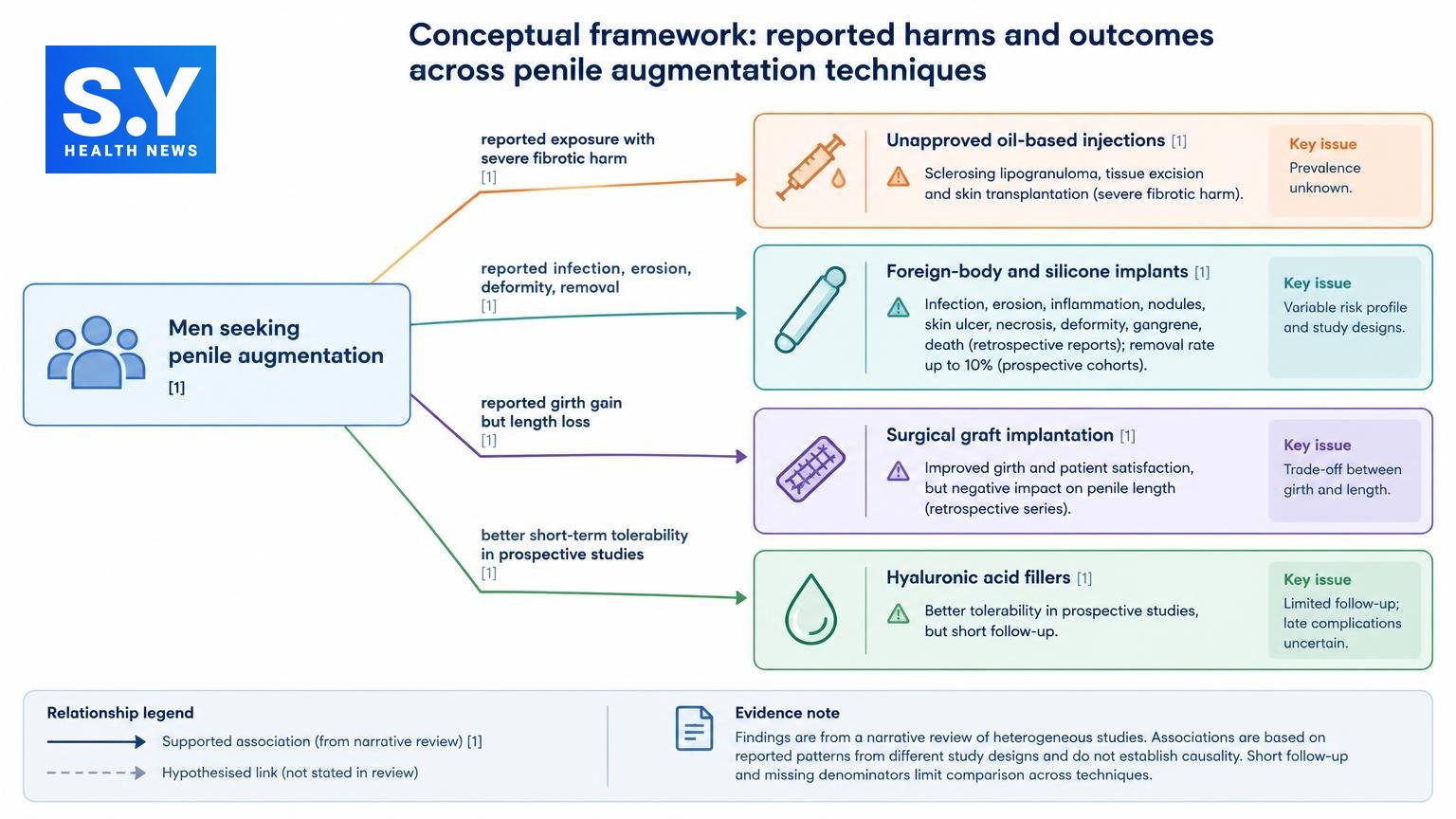
The review reports strikingly different risk profiles across technique categories, but the strength of that comparison is constrained by study design. Retrospective case series of unapproved oil-based injections describe sclerosing lipogranuloma requiring tissue excision and skin transplantation, and the prevalence of the practice is unknown. Hyaluronic acid filler injections appear better tolerated in prospective studies, though follow-up is short. Graft implantation in retrospective series improved girth and patient satisfaction but had a negative impact on length. Silicone implants in prospective cohorts carried risks of infection, erosion, seroma and necrosis, with a removal rate of up to 10%.
These findings should be read as a map of reported harms rather than a ranking of procedures. The review is narrative rather than systematic, the underlying studies vary in design and follow-up, and several key denominators are absent. Its authors conclude that a multidisciplinary approach is essential for men requesting penile augmentation and that further research is needed to manage these patients well.
Why This Matters
Men's reproductive and sexual health discussions often treat penile size as a discrete, correctable parameter. The evidence summarised in this review challenges that premise at its starting point: most men seeking augmentation already fall within the normal range. If the population seeking these procedures is largely outside the range where a size intervention would be clinically indicated, then the harm-benefit calculus shifts heavily toward avoiding unnecessary risk. The review's own framing makes this point explicitly, rather than deriving it from a measured prevalence estimate.
This matters for clinical conversations as well as for public information. A man who is considering an injectable or implant is usually weighing a cosmetic or psychological goal against a procedure whose complication profile includes tissue destruction, deformity and, in the case of foreign-body implantation, death. The review documents that spectrum. It also documents that some techniques have been studied prospectively with better tolerability, which is a genuine difference worth preserving rather than flattening into a single verdict on augmentation as a category.
The public-health dimension is equally important. Unapproved oil-based substances have been injected outside sterile conditions, and the review states that the prevalence of this practice is unknown. An unknown prevalence is not a reassurance. It means the size of the exposed population, the geographic distribution and the burden of late presentations are all unquantified in the reviewed literature, even though the individual harms are severe enough to require excision and skin grafting.
Biological and Clinical Mechanisms of Harm
The review is a clinical synthesis rather than a mechanistic study, so its descriptions of harm are at the level of clinical pattern rather than molecular pathway. Even so, the categories of injury it reports are coherent and clinically recognisable. Injected oil-based substances produce a sclerosing lipogranuloma, a chronic inflammatory and fibrotic reaction that can require tissue excision and skin transplantation. This is not a transient cosmetic side effect; it is a structural change to the penile soft tissues that can be difficult to reverse.
Foreign-body implantation produces a different pattern. The review lists pain, erosion, inflammation, nodules, skin ulcer, necrosis, penile deformity, gangrene and death in retrospective reports of implantation performed to enhance sexual pleasure. These span mechanical complications (erosion, deformity), inflammatory complications (nodules, inflammation) and vascular or infectious catastrophes (necrosis, gangrene). The range itself indicates that the implanted material and the surgical handling both contribute to risk, though the review does not attempt to separate these contributions quantitatively.
Silicone implants show a partially overlapping profile in prospective cohorts: infection, erosion, seroma and necrosis, with some severe penile deformities and a removal rate of up to 10%. Graft implantation behaves differently again. In retrospective series it improved girth and patient satisfaction but had a negative impact on penile length, a trade-off that is clinically important because length is often the dimension patients most want to preserve. Hyaluronic acid fillers, by contrast, were better tolerated in prospective studies, though the follow-up period is short, which limits conclusions about delayed complications such as migration, granuloma formation or long-term shape change.
What the Evidence Shows by Technique
The review organises its findings by material and technique, and the evidence differs in design across those categories. This matters because a prospective cohort and a retrospective case series answer different questions. The table below summarises the reported patterns and flags the design limitations the review itself implies.
| Measure / finding | Result | Population / follow-up | Limitations |
|---|---|---|---|
| According to retrospective case series summarized in this narrative review, unapproved oil-based substances injected under non-sterile conditions caused sclerosing lipogranuloma requiring complex treatments such as tissue excision and skin transplantation. | men who received penile injections of unapproved oil-based substances (retrospective case series) | Retrospective case series; sample size and follow-up not stated in this text. | |
| Retrospective reports of foreign body implantation performed to enhance sexual pleasure describe complications including pain, erosion, inflammation, nodules, skin ulcer, necrosis, penile deformity, gangrene, and death. | men with penile foreign body implantation for enhancing sexual pleasure (retrospective reports) | Retrospective reports; no pooled sample size or follow-up stated. | |
| Prospective studies of hyaluronic acid filler injections indicate better tolerability than other augmentation approaches, but with only short follow-up. | men receiving hyaluronic acid penile filler injections (prospective studies); short follow-up | Short follow-up period; studies not individually described in this text. | |
| Retrospective series of penile graft implantation reported improvement in girth and patient satisfaction, but a negative impact on penile length. | men undergoing penile graft implantation (retrospective series) | Retrospective design; no sample size or follow-up stated in this text. | |
| removal rate | 10 % (up to) | men with silicone penile implants (prospective cohorts) | Removal rate given as an upper bound; cohort sizes and follow-up not stated in this text. |
Unapproved oil-based injections are the clearest example of severe, structurally destructive harm. Retrospective case series describe injection under non-sterile conditions leading to sclerosing lipogranuloma and treatment requiring tissue excision and skin transplantation. The review does not report a denominator, and it explicitly states that the prevalence of the practice is unknown. The clinical implication is that late presentation with a fibrotic, deformed penis is a recognised pattern, and that management may be surgical and reconstructive rather than simple removal of the injected material.
Foreign-body implantation for sexual pleasure is associated with the broadest list of severe complications in the review, including pain, erosion, inflammation, nodules, skin ulcer, necrosis, penile deformity, gangrene and death. The inclusion of death in that list is a reminder that these are not uniformly minor procedures. Because the evidence comes from retrospective reports, the frequency of each complication, the contribution of operator technique and the effect of implant material cannot be estimated from the review text.
Hyaluronic acid fillers occupy a different evidentiary position. Prospective studies indicate better tolerability, which is a meaningful signal because prospective design reduces some recall and selection biases compared with retrospective series. The caveat is explicit in the review: follow-up is short. For a resorbable filler, short follow-up may capture acute injection reactions but will miss late inflammatory nodules, delayed hypersensitivity or dissatisfaction after resorption. The review does not resolve this gap.
Graft implantation illustrates the importance of outcome definition. Retrospective series reported improvement in penile girth and patient satisfaction, which sounds favourable, but the same series reported a negative impact on penile length. A procedure that trades length for girth may satisfy some patients and distress others, and patient satisfaction is a composite that can mask regret or unmet expectations. The retrospective design also means that satisfaction was not assessed against a prespecified comparator.
Silicone implants have the most concrete quantitative outcome in the review: a removal rate of up to 10% in prospective cohorts. Removal is a hard endpoint that captures both device failure and intolerable complications. The associated risks of infection, erosion, seroma and necrosis, with some severe penile deformities, mean that removal is not a benign fallback. The phrase 'up to 10%' is an upper bound rather than a pooled estimate, and the review does not provide the cohort sizes or follow-up durations needed to interpret it precisely.
Interpreting the Evidence: Design, Denomination and Confounding
The most important limitation is stated in the review's own design label. This is a narrative review, not a systematic review or meta-analysis. Narrative reviews are valuable for mapping a heterogeneous literature, but they do not prespecify search strategies, do not formally assess risk of bias, and do not pool data. Every comparison across technique categories in the review is therefore a comparison of what different study designs happened to report, not a head-to-head trial. The apparent superiority of hyaluronic acid fillers over silicone implants, for example, partly reflects the fact that the filler evidence is prospective and short-term while the implant evidence includes cohorts followed long enough to observe removal.
A second limitation is the absence of denominators. The review reports complication patterns without sample sizes, incidence rates or follow-up durations for most categories. The prevalence of unapproved oil-based injection is explicitly unknown. The removal rate for silicone implants is given as an upper bound. Without these numbers, a clinician cannot counsel an individual patient on absolute risk, and a reader cannot distinguish a complication that occurs in a small minority from one that is common. This is a gap in the reviewed literature, not a defect the review could easily repair.
A third issue is indication and selection. The review opens by noting that most men seeking augmentation have dimensions within the normal range. That means the populations in these studies are defined by patient goals rather than by a clinical deficit, and outcomes such as satisfaction and girth change are measured against subjective baselines. Selection effects are likely: men who present to specialised centres, or who seek unapproved injections, may differ systematically in expectations, mental health and prior procedures. Retrospective series are especially vulnerable to differential recall of complications and satisfaction.
Finally, the review does not separate operator and setting effects. Unapproved oil-based injections were performed in non-sterile conditions by definition in the reported cases, which conflates the substance with the setting. Graft and implant outcomes likely depend on surgical technique and device selection, neither of which is stratified in the review text. These are not reasons to dismiss the reported harms; they are reasons to avoid attributing all risk to the material alone.
Clinical Relevance and Appropriate Conversations
For clinicians, the review supports a structured, multidisciplinary approach. The authors state that such an approach is essential for men requesting penile augmentation and that further research is needed to manage these patients successfully. In practice, this means addressing the reason for the request, assessing whether penile dimensions fall within the normal range, explaining the documented complication spectrum for each technique, and being explicit about the limits of the evidence rather than presenting a single risk figure as if it were well established.
The conversation should distinguish types of harm rather than rank them by severity alone. Sclerosing lipogranuloma after oil-based injection and penile deformity after foreign-body implantation are structural and sometimes irreversible, requiring excision, reconstruction or skin grafting. Silicone implant removal is a discrete event but may follow infection, erosion or necrosis. Hyaluronic acid filler appears better tolerated in the short term but lacks long-term data. Graft surgery may improve girth while reducing length, a trade-off that should be discussed before, not after, the procedure. None of these are minor cosmetic trade-offs in the way they are sometimes marketed.
The review does not provide a decision algorithm, and one should not be inferred from it. What it provides is a defensible summary of reported harms that can anchor a shared decision-making conversation. Where a patient has already undergone an unapproved injection, the reported pattern of late fibrotic reaction suggests that specialist assessment is appropriate rather than expectant observation, though the review does not test management pathways.
Research Outlook
The review's conclusion that further research is needed is not a formality; it identifies specific gaps. Prospective studies with standardised outcome definitions and adequate follow-up are needed across all technique categories, not only for fillers. Registries or cohort studies that capture the denominator of men undergoing unapproved injections would allow prevalence and incidence to be estimated. Device-specific studies should report removal as a time-to-event outcome rather than a single percentage, and graft studies should report length and girth together with validated satisfaction and regret measures.
There is also a need for research on the psychosocial context of these requests. The review's observation that most men seeking augmentation fall within the normal range raises questions that surgical outcome studies cannot answer: what drives the request, what expectations are realistic, and which non-surgical or psychological supports are effective. These are not substitutes for safety research, but they are complementary to it. Until such evidence exists, the most defensible clinical posture is cautious, multidisciplinary and explicit about uncertainty.
Key Takeaways
- Penile augmentation is controversial in part because most men seeking it have penile dimensions within the normal range, alongside the risk of severe complications.
- Unapproved oil-based injections have caused sclerosing lipogranuloma requiring tissue excision and skin transplantation in retrospective case series; prevalence of the practice is unknown.
- Foreign-body implantation for sexual pleasure has been linked in retrospective reports to pain, erosion, inflammation, nodules, ulcer, necrosis, deformity, gangrene and death.
- Hyaluronic acid fillers appear better tolerated in prospective studies, but follow-up is short and long-term outcomes remain undefined.
- Graft implantation improved girth and satisfaction in retrospective series but had a negative impact on penile length.
- Silicone implants in prospective cohorts carried infection, erosion, seroma and necrosis risks, with severe deformity in some cases and a removal rate of up to 10%.
- The evidence base is a narrative review of heterogeneous studies, and a multidisciplinary approach with further research is recommended for men seeking these procedures.
Questions and Answers
What is penile augmentation, and why does this review describe it as controversial?
Penile augmentation refers to procedures intended to increase penile size or alter its shape, including injected substances, foreign-body implants, surgical grafts and silicone implants. The review calls it controversial primarily because most men seeking these interventions already have penile dimensions within the normal range and because the procedures carry risks of severe complications. That combination means the benefit sought is often cosmetic rather than corrective.
What are the main complications reported for each procedure type?
Retrospective series of unapproved oil-based injections describe sclerosing lipogranuloma requiring tissue excision and skin transplantation. Foreign-body implantation has been linked to pain, erosion, inflammation, nodules, skin ulcer, necrosis, deformity, gangrene and death. Hyaluronic acid fillers appear better tolerated in prospective studies with short follow-up. Graft implantation improved girth and satisfaction but reduced length. Silicone implants caused infection, erosion, seroma and necrosis, with removal in up to 10% of cases.
How strong is the evidence behind these findings?
The evidence is uneven and generally limited. The source is a narrative review rather than a systematic review or meta-analysis, and most technique categories rest on retrospective case series or short prospective cohorts. Sample sizes, follow-up durations and incidence rates are largely absent, the prevalence of unapproved oil-based injection is unknown, and the silicone removal rate is reported as an upper bound of up to 10%. These findings map reported harms but do not establish absolute risk.
Can the techniques be ranked from safest to most dangerous based on this review?
Not reliably. The review compares findings from different study designs, and the apparent tolerability of hyaluronic acid fillers partly reflects prospective design and short follow-up, while silicone implant data include longer observation of removal. Without head-to-head studies or pooled incidence data, the categories cannot be ranked. The review supports describing distinct risk patterns rather than producing an ordered safety list.
Who is most affected by these procedures, and what should they know before considering one?
The review states that most men seeking penile augmentation have penile dimensions within the normal range, so the population is defined largely by personal goals rather than a clinical deficit. Before considering a procedure, a man should understand the documented complications for the specific technique, the limits of the evidence, and the possibility of irreversible harm such as fibrosis, deformity or length loss. A multidisciplinary assessment is recommended by the review authors.
What are the main limitations of this evidence, and what research is still needed?
Key limitations include the narrative review design, reliance on retrospective series for several techniques, absent denominators and incidence rates, short follow-up for fillers, and unknown prevalence of unapproved injections. The authors recommend a multidisciplinary approach and further research. Priority gaps include prospective studies with standardised outcomes, registries for unapproved injections, time-to-event reporting for implant removal, and combined length, girth and satisfaction reporting for grafts.
Conceptual framework: Conceptual framework of the relationships discussed in this evidence review. A population of men seeking penile augmentation is linked to four technique categories, each with the harm or outcome pattern reported in the narrative review. Relations are reported associations from heterogeneous study designs, not causal effects or a tested model; short follow-up and missing denominators limit comparison across categories.
Academic References & Evidence
- Mahmood Ramazan; Louise Faurholt Øbro; Majken Højrup Wiborg; Mikkel Fode; Christian Fuglesang S. Jensen; Palle Jörn Sloth Osther; Grzegorz Fojecki. Complications of penile augmentation: A narrative review of injectables, implants, and surgical grafts. International Journal of Impotence Research. 2026 38(3):238-246 DOI: 10.1038/s41443-025-01190-8.
SANYUN Science Center explains published research on men's reproductive and sexual health, connecting scientific evidence with everyday questions while making sources and limitations clear.
Disclaimer: This article is for scientific education and research communication only. It does not provide medical advice, diagnosis, or individualized treatment recommendations, and does not endorse any medication, supplement, device, penile enlargement procedure, or other intervention. Decisions about sexual and reproductive health should be made in consultation with a qualified healthcare professional. Do not delay seeking professional care because of information in this article.
Original Content & Copyright Notice
- This article is prepared for SANYUN Science Center, drawing on published research and publicly available academic literature on men’s sexual and reproductive health. Its editorial explanations and presentation are developed for this platform.
- Copyright in the original editorial content, selection, and arrangement is reserved by SANYUN Science Center to the extent protected by applicable law. Referenced research, quotations, and third-party materials remain subject to the rights of their respective owners. This notice does not claim ownership of scientific facts or third-party research.
- Except where permitted by applicable law or an applicable license, prior written permission is required to reproduce, republish, translate, adapt, redistribute, or commercially reuse protected content. Attribution alone does not grant permission for such reuse.
- For permitted quotation or authorized reuse, clearly identify the source and retain a link to the original article.
- Source: SANYUN Science Center
- Original URL: Retain the original article URL on science.san-yun.com.
- Copyright Holder: SANYUN Science Center, for its own protected editorial content.
- Quotation, excerpts, or authorized reuse must not distort the scientific meaning, omit material limitations or disclaimers, or imply unverified medical claims, product efficacy, or endorsement by SANYUN Science Center.



