




Category: Penis Enlargement
Core Research Direction: Complications and outcomes of penile augmentation methods (injectables, foreign-body implants, and surgical grafts) in adult men, with emphasis on what retrospective and prospective evidence can and cannot establish
Search Intent: What does the published evidence show about the risks and outcomes of penile augmentation — injectable fillers, foreign-body implants, and surgical grafts — and how reliable is that evidence?
Platform: SANYUN Science Center
Evidence reviewed through: 2026-11-13
Executive Summary
Penile augmentation is a contested field of male genital surgery and cosmetic practice. A 2026 narrative review in the International Journal of Impotence Research examined complications associated with three broad categories of intervention: injected substances, foreign-body implants, and surgical grafts. Its central observation is that most men who seek penile augmentation already have penile dimensions within the normal range, and that the interventions carry risks of severe complications.[1]
The evidence summarised in the review is methodologically uneven. The most alarming harm reports derive from retrospective case series, which capture severe presentations but cannot establish incidence. Better-tolerated outcomes have been described for hyaluronic acid fillers in prospective studies, though follow-up windows were short. Silicone implants, studied in prospective cohorts, were associated with infection, erosion, seroma and necrosis, and with removal in up to 10% of cases.
Why This Matters
Penile augmentation sits at an unusual intersection of cosmetic demand and genitourinary risk. Men may pursue enlargement for psychological, relational or appearance-related reasons, often without a diagnosed functional deficit. The review's framing is therefore clinically important: the typical candidate is not a patient with an abnormally small penis but a man whose dimensions fall within population norms. That mismatch between perceived need and measured anatomy is one reason the authors describe the field as controversial.
Complications in this anatomical region are not trivial. The penis has limited tissue redundancy, a rich vascular supply and a thin skin envelope; substances or devices introduced into it can provoke granulomatous reactions, compromise blood flow or erode through tissue. In the reviewed literature, consequences ranged from nodules, pain and inflammation to skin ulceration, necrosis, penile deformity, gangrene and death. These are qualitative descriptors rather than quantified rates, but they indicate that the harm profile is severe rather than merely cosmetic.
Biological and Clinical Mechanisms Behind the Harms
The mechanisms described in the review differ by intervention type. For unapproved oil-based injectables, the reported pathway involves injection of non-medical substances in non-sterile conditions, producing sclerosing lipogranuloma — a chronic fibrotic and granulomatous reaction to retained foreign material. Because the material is not resorbed, the reaction can progress and distort tissue, and management may require excision of affected tissue and skin transplantation rather than simple drainage or observation.
For foreign-body implants placed to enhance sexual pleasure, the documented complications reflect mechanical and infectious pressures on surrounding tissue: pain, erosion, inflammation, nodules, skin ulcer, necrosis, penile deformity, gangrene and, in some reports, death. Erosion and necrosis imply that the implant or the tissue response has compromised local perfusion and integrity, which in turn can convert a reversible complication into a reconstructive problem.
For silicone implants studied prospectively, the review lists infection, erosion, seroma and necrosis, with some cases of severe penile deformity. A removal rate of up to 10% is reported. Removal is itself a clinical outcome of consequence: it indicates that the device could not be retained safely, and it exposes the patient to a second procedure in already altered tissue.
What the Evidence Shows by Intervention Type
| Intervention | Evidence base | Reported outcomes | Key limitation |
|---|---|---|---|
| Unapproved oil-based injections | Retrospective case series | Sclerosing lipogranuloma; need for tissue excision and skin transplantation; injections described as given under non-sterile conditions | Prevalence of the practice is unknown, and case series over-represent severe presentations |
| Foreign-body implants for sexual pleasure | Retrospective reports | Pain, erosion, inflammation, nodules, skin ulcer, necrosis, penile deformity, gangrene and death | Complications listed without incidence rates |
| Hyaluronic acid filler injections | Prospective studies | Better tolerated than other approaches in the reviewed reports | Follow-up period is short |
| Surgical graft implantation | Retrospective series | Improvement in penile girth and patient satisfaction; negative impact on penile length | No effect sizes provided; retrospective design |
| Silicone implants | Prospective cohorts | Infection, erosion, seroma, necrosis, severe penile deformity; removal rate up to 10% | Cohort sizes and follow-up duration not stated in the supplied review text |
The hyaluronic acid literature occupies the most favourable position in the review, but it is a relative statement rather than an endorsement. Prospective design is a genuine methodological strength compared with retrospective case series, and better tolerance was observed. However, the review explicitly notes that follow-up periods were short, which matters because filler-related complications can be delayed and because durability of any cosmetic effect is a separate question from acute tolerability.
Graft implantation presents a different trade-off. Retrospective series reported improvement in girth and in patient satisfaction, yet also a negative impact on penile length. That combination is clinically meaningful: a procedure marketed around enlargement may produce gains in one dimension at the cost of another, and the review does not supply effect sizes to indicate how large either change was. Retrospective satisfaction reporting is also vulnerable to recall and selection effects.
Interpreting the Strength of the Evidence
This is a narrative review, not a systematic review with pooled estimates. Its conclusions synthesise heterogeneous publications — retrospective case series, retrospective reports and prospective cohorts — whose designs answer different questions. Retrospective case series are useful for identifying severe harms and describing clinical course, but they cannot estimate how often those harms occur, because the denominator of treated men is unknown. The review itself states that the prevalence of unapproved penile injection is unknown, which limits any inference about population-level risk.
Several distinctions should be kept explicit. First, associations between an intervention and a complication in a case series are not incidence estimates and do not establish causation in a formal epidemiological sense, even where the biological plausibility is strong. Second, the figure of up to 10% for silicone implant removal is an upper bound as reported in the review, not a pooled rate, and it should not be read as a precise risk for an individual patient. Third, the complications listed for foreign-body implants are qualitative; the review does not attach frequencies to pain, erosion, gangrene or death.
A further limitation is publication and reporting bias. Severe complications are more likely to reach publication than uneventful courses, and satisfied patients are less likely to appear in case series of harm. Conversely, retrospective series of graft implantation that report satisfaction may under-sample dissatisfied patients. Neither direction can be corrected from the supplied evidence, so the true balance of benefits and harms across all these procedures remains uncertain.
Clinical and Practical Implications
The review's practical message is that men requesting penile augmentation warrant careful multidisciplinary assessment rather than a single-operator cosmetic transaction. The authors describe a multidisciplinary approach as essential and call for further research to manage these patients successfully. That recommendation is a professional judgement rather than a tested intervention, but it follows logically from the range of harms described — psychological, surgical, infectious and reconstructive — which no single specialty is positioned to address alone.
For clinicians, the evidence supports explicit discussion of what is not known. Patients considering unapproved injectables should understand that sclerosing lipogranuloma can require excision and skin grafting, and that the frequency of such outcomes in the wider population of users is unknown. Patients considering grafts should understand the reported trade-off between girth and length, and that satisfaction data come from retrospective series. Patients considering silicone implants should be told about infection, erosion, seroma, necrosis and the reported removal rate of up to 10%. None of these discussions constitutes a personalised recommendation; they are translations of the published literature into informed-consent content.
Research Outlook
The review's call for further research points to specific gaps rather than a general plea for more studies. Prospective, adequately followed cohorts with defined inclusion criteria would allow incidence estimation for both cosmetic and functional outcomes. Standardised outcome reporting — girth, length, satisfaction, complication severity and device removal — would make comparison across interventions possible. Population-level data on unapproved injection practices would address the acknowledged unknown prevalence and support harm-reduction planning.
Longer follow-up is particularly important for fillers. If hyaluronic acid injections are to be positioned as the better-tolerated option, that claim needs to hold beyond short observational windows and across repeated treatments. Until such data exist, the most defensible summary is that the reviewed evidence documents a serious harm profile for unapproved injections and implants, a possible dimensional trade-off for grafts, and comparatively favourable but short-term findings for hyaluronic acid fillers.
Key Takeaways
- Most men seeking penile augmentation have penile dimensions within the normal range, and the procedures carry risks of severe complications, according to the review.
- Retrospective case series link unapproved oil-based penile injections given in non-sterile conditions to sclerosing lipogranuloma requiring tissue excision and skin transplantation.
- Retrospective reports of penile foreign-body implants describe pain, erosion, inflammation, nodules, skin ulcer, necrosis, deformity, gangrene and death, without incidence data.
- Prospective studies suggest hyaluronic acid fillers are better tolerated, but follow-up is short.
- Retrospective graft series report improved girth and satisfaction but a negative impact on penile length.
- Silicone implants in prospective cohorts were associated with infection, erosion, seroma, necrosis and severe deformity, with a removal rate of up to 10%.
- The prevalence of unapproved penile injection is unknown, and a multidisciplinary approach with further research is recommended for men requesting augmentation.
Questions and Answers
What is penile augmentation and which methods does the evidence review cover?
Penile augmentation refers to procedures intended to increase penile size or appearance. The reviewed evidence covers three categories: injected substances, including unapproved oil-based materials and hyaluronic acid fillers; foreign-body implants, including silicone devices; and surgical graft implantation. The review notes that most men seeking these procedures already have penile dimensions within the normal range, and that the interventions carry risks of severe complications.
What complications are reported after unapproved penile injections?
Retrospective case series described unapproved oil-based substances injected under non-sterile conditions, producing sclerosing lipogranuloma that required complex treatment such as tissue excision and skin transplantation. The review states that the prevalence of this practice is unknown, so the frequency of these outcomes across all users cannot be estimated. Case series tend to capture the most severe presentations.
Are hyaluronic acid penile fillers safer than implants or grafts?
Prospective studies of hyaluronic acid filler injections showed better tolerance than other approaches in the review, which is a favourable relative finding. However, follow-up periods were short, so delayed complications and long-term durability remain uncertain. The review does not provide a direct head-to-head trial, and better tolerance in short prospective studies is not proof of long-term safety.
What does the evidence show about silicone penile implants and removal rates?
In prospective cohorts, silicone penile implants were associated with infection, erosion, seroma and necrosis, with some cases of severe penile deformity. The review reports an associated removal rate of up to 10%. That figure is an upper bound as summarised, not a pooled estimate, and cohort sizes and follow-up duration were not stated in the supplied text.
Do penile grafts improve size, and what is the trade-off?
Retrospective series of graft implantation reported improvement in penile girth and in patient satisfaction, but also a negative impact on penile length. The review does not provide effect sizes, so the magnitude of either change is unknown. Retrospective satisfaction data may also be affected by selection and recall bias, which limits how confidently the balance of benefits can be stated.
How strong is the evidence on penile augmentation complications overall?
The evidence comes from a narrative review of heterogeneous studies: retrospective case series, retrospective reports and some prospective cohorts. Case series identify severe harms but cannot estimate incidence because denominators are unknown, and publication bias likely favours reporting complications. The review states that the prevalence of unapproved penile injection is unknown and calls for a multidisciplinary approach and further research.
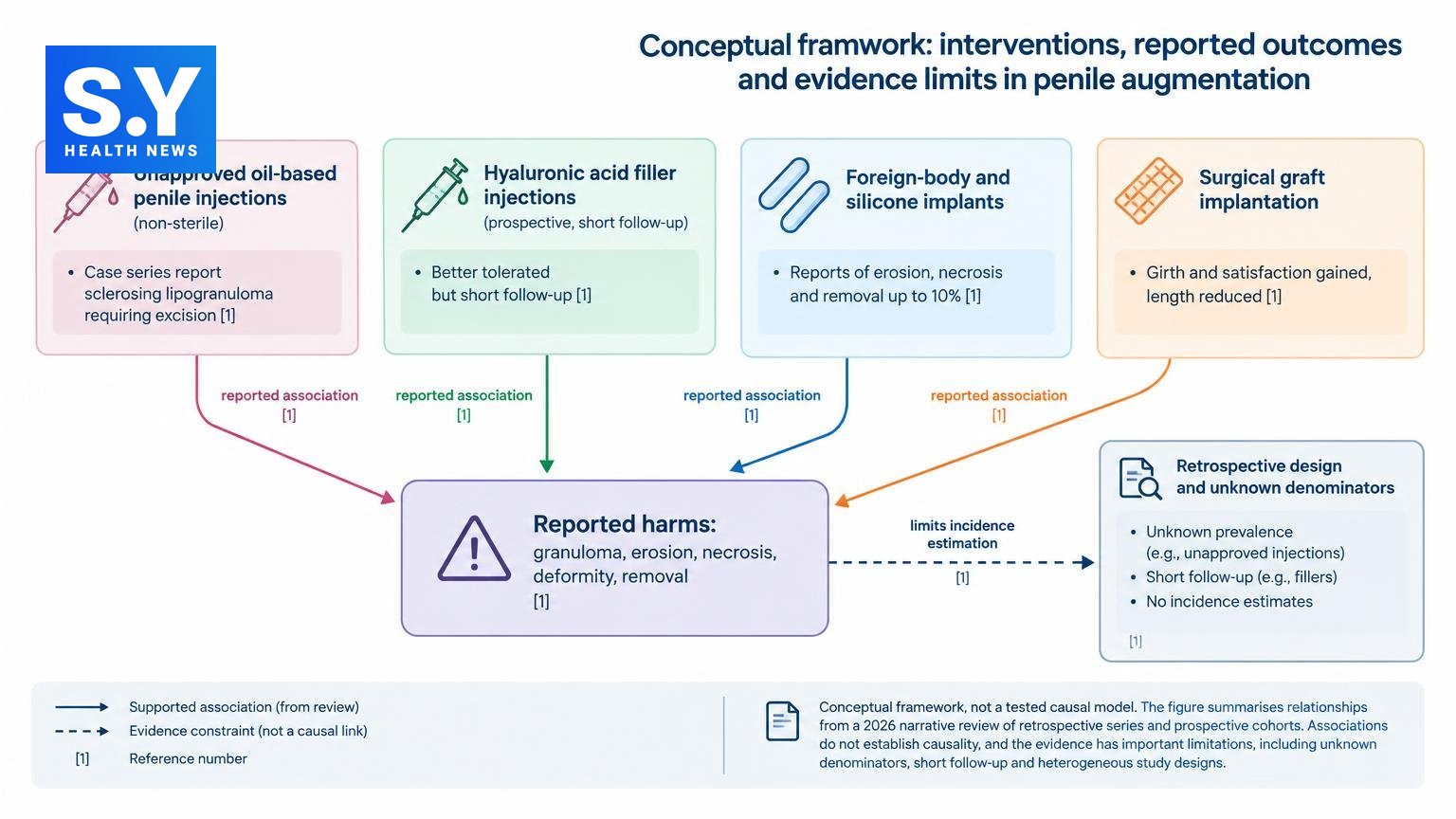
Conceptual framework: Conceptual framework, not a tested causal model. Four augmentation approaches are linked to harms reported in a 2026 narrative review of retrospective series and prospective cohorts; the dashed constraint marks unknown denominators and short follow-up that prevent incidence estimation.
Academic References & Evidence
- Mahmood Ramazan; Louise Faurholt Øbro; Majken Højrup Wiborg; Mikkel Fode; Christian Fuglesang S. Jensen; Palle Jörn Sloth Osther; Grzegorz Fojecki. Complications of penile augmentation: A narrative review of injectables, implants, and surgical grafts. International Journal of Impotence Research. 2026 38(3):238-246 DOI: 10.1038/s41443-025-01190-8.
SANYUN Science Center explains published research on men's reproductive and sexual health, connecting scientific evidence with everyday questions while making sources and limitations clear.
Disclaimer: This article is for scientific education and research communication only. It does not provide medical advice, diagnosis, or individualized treatment recommendations, and does not endorse any medication, supplement, device, penile enlargement procedure, or other intervention. Decisions about sexual and reproductive health should be made in consultation with a qualified healthcare professional. Do not delay seeking professional care because of information in this article.
Original Content & Copyright Notice
- This article is prepared for SANYUN Science Center, drawing on published research and publicly available academic literature on men’s sexual and reproductive health. Its editorial explanations and presentation are developed for this platform.
- Copyright in the original editorial content, selection, and arrangement is reserved by SANYUN Science Center to the extent protected by applicable law. Referenced research, quotations, and third-party materials remain subject to the rights of their respective owners. This notice does not claim ownership of scientific facts or third-party research.
- Except where permitted by applicable law or an applicable license, prior written permission is required to reproduce, republish, translate, adapt, redistribute, or commercially reuse protected content. Attribution alone does not grant permission for such reuse.
- For permitted quotation or authorized reuse, clearly identify the source and retain a link to the original article.
- Source: SANYUN Science Center
- Original URL: Retain the original article URL on science.san-yun.com.
- Copyright Holder: SANYUN Science Center, for its own protected editorial content.
- Quotation, excerpts, or authorized reuse must not distort the scientific meaning, omit material limitations or disclaimers, or imply unverified medical claims, product efficacy, or endorsement by SANYUN Science Center.



