




Category: Penis Enlargement
Core Research Direction: Evidence on procedural penile augmentation (hyaluronic acid filler injections and silicone sleeve implants) for adult men: what dimensional outcomes have been reported, in which populations, with what complications and study-design limitations
Search Intent: What does published clinical research actually show about penile augmentation procedures—girth and length changes, complications, and how reliable the evidence is—for adult men seeking a larger penis?
Platform: SANYUN Science Center
Evidence reviewed through: 2026-11-13
Executive Summary
Requests for procedural penile augmentation have become more visible in aesthetic and urological practice, and the two most discussed approaches are injectable fillers, typically hyaluronic acid, and subcutaneous silicone sleeve implants. The evidence base for both is thin relative to how confidently the procedures are sometimes marketed. One clinician quoted in secondary news coverage describes hyaluronic acid fillers as the safest way to enhance girth and reports performing more of them than vasectomies, but this is expert commentary in a media piece rather than outcome data.[1]
On the implant side, a manufacturer-authored summary of a 2026 systematic review reports pooled average flaccid girth and length increases drawn from historical studies of an earlier-generation silicone sleeve device, with the reviewers themselves calling for larger prospective studies and standardized long-term follow-up. That summary also states that pooled complication estimates span infection, seroma, erosion, revision and removal, with rates varying between studies and no separate pooled complication rates calculated for the current device generation.[2]
- Pooled flaccid girth increase of 3.77 cm and flaccid length increase of 2.94 cm are reported from historical studies of an earlier-generation implant, not the current product.
- A 12-patient buried-penis pilot reported average increases of 3.52 cm in flaccid dorsal length and 2.78 cm in midshaft girth, with no infections, erosions or removals during reported follow-up; these are selected reconstructive patients, not routine cosmetic patients.
- For fillers, the supplied evidence consists of clinician opinion and a media-reported survey of 500 patients over 3 years, not a formal outcome study.
Why This Matters
Penile size concerns are common and often distressing, and the internet has made augmentation offers easy to find. When procedures are promoted with dimensional numbers, patients reasonably assume those numbers describe what they can expect. The published literature does not support that assumption neatly. The most quotable figures come from pooled historical data for a device generation that has since changed, or from very small series in atypical surgical populations.
There is also a commercial dimension. Much of the implant evidence is summarized by the manufacturer rather than by an independent clinical group, and the summary itself discloses this. The filler evidence in the supplied sources is essentially journalistic. Neither situation means the procedures do not work; it means the confidence a reader should place in any single number is limited, and informed consent should reflect that.
Biological and Clinical Mechanism
Hyaluronic acid fillers are injected to add volume under the penile skin, and the intended effect is girth rather than length. Because hyaluronic acid is a temporary, resorbable material, the intervention differs fundamentally from permanent filler materials, which a quoted urologist notes can require a patient to return to the operating room. She frames these as very different interventions, implying that complication data cannot simply be carried across material types.
Subcutaneous silicone sleeve implants work differently. A pre-formed medical-grade silicone implant is positioned beneath the penile skin, with implantation performed through a scrotal approach, and the reported effect is an increase in flaccid dimensions. This is a surgical procedure with a foreign body in place, which is why the plausible complication set includes infection, seroma, implant erosion or exposure, revision surgery and implant removal.
A critical distinction for readers is that the implant is described as a cosmetic augmentation device and is explicitly not marketed as a treatment for erectile dysfunction; its intended purpose differs from inflatable or malleable penile prostheses used for ED. The two device categories are sometimes confused in popular discussion but address different problems.
What the Evidence Shows
| Intervention and study type | Population | Reported outcome | Key limitation |
|---|---|---|---|
| Silicone sleeve implant; systematic review and meta-analysis of 12 published clinical reports (2018–2026), as summarized by manufacturer | Men in studies of IMD's earlier-generation Penuma implant | Pooled average flaccid girth increase 3.77 cm (1.48 inches) | Pooled estimate derives from historical studies of a predecessor device; outcome definitions and follow-up varied |
| Silicone sleeve implant; same systematic review | Men in studies of the earlier-generation implant | Pooled average flaccid length increase 2.94 cm (1.16 inches) | Measurement methods and follow-up not described in the supplied summary |
| Silicone sleeve implant; 12-patient pilot published online July 2025 | Adults with acquired buried penis | Average flaccid dorsal length increase 3.52 cm (1.39 inches); midshaft girth 2.78 cm (1.09 inches) | Small selected reconstructive population; results not a predicted outcome for routine cosmetic patients |
| Silicone sleeve implant; same 12-patient pilot, safety | Adults with acquired buried penis | No penile infections, skin erosions or implant removals during reported follow-up | Very small sample cannot establish complication rates in broader populations |
| Silicone sleeve implant; same 12-patient pilot, patient-reported | Seven respondents of 12 participants | Improved self-confidence reported by six of seven respondents | Patient-reported, incomplete response, small subset |
| Silicone sleeve implant; pooled complications from historical studies | Men in included implant studies | Infection, seroma, erosion or exposure, revision surgery and removal evaluated; rates varied between studies | No separate pooled complication rates calculated for the current Himplant device |
| Hyaluronic acid filler injections; clinician survey reported in news coverage | 500 patients receiving penile injections over 3 years | No reported loss of penile sensation or erectile dysfunction; no emergency room visits | Secondary media report; survey design, outcome definitions and publication not described; absence of reported events does not establish safety |
Filler Injections: What Is and Is Not Known
The filler evidence supplied here is unusually difficult to evaluate. A board-certified urologist is described as having surveyed 500 patients receiving penile injections over 3 years, and she has raised concerns about long-term safety. Within that survey, patients reportedly did not report loss of penile sensation or erectile dysfunction, and no one required an emergency room visit. The media report is careful to note that this does not necessarily mean the procedure is safe for all patients.
That caution is well placed. The absence of reported events is not the same as a measured zero rate, because the method of asking about adverse events, the completeness of follow-up and the statistical precision around a zero count are all unspecified in the supplied text. A survey that finds no events in 500 patients still cannot rule out uncommon but serious complications.
The specific risks named in the coverage are filler migration, erectile dysfunction and cosmetic irregularities. These are presented as potential risks rather than observed frequencies, and no incidence figures are provided. Readers should treat them as a reasoned list of concerns, not as quantified probabilities.
One useful nuance concerns material type. A quoted urologist argues that much of the perception of penile augmentation comes from studies using permanent fillers, which behave differently and can require a return to the operating room. If that framing is correct, then permanent-filler complication literature may overstate or mischaracterize the risk profile of temporary hyaluronic acid products, just as temporary-filler data cannot vouch for permanent materials. This is an expert distinction, not a tested comparison.
Silicone Sleeve Implants: Dimensional Outcomes
The implant literature has more structure, though it comes to this review through a manufacturer-authored summary of a peer-reviewed systematic review. That review reportedly examined 12 published clinical reports of the implant technology developed by International Medical Devices, covering research published between 2018 and 2026, and documented measurable increases in flaccid penile dimensions while evaluating reported surgical outcomes. The number 12 refers to included reports, not to 12 patients.
The headline pooled figures are an average flaccid girth increase of 3.77 cm (1.48 inches) and an average flaccid length increase of 2.94 cm (1.16 inches). The supplied summary is explicit that these pooled estimates were derived from historical studies of the earlier-generation Penuma implant, the predecessor to the current Himplant device, and that newer Himplant-specific publications were evaluated separately rather than merged into the pooled analysis.
That separation matters for interpretation. A patient considering the current device is not the same population as the historical cohorts, and the surgical technique has evolved. The pooled numbers are therefore best read as documentation that measurable dimensional change has been reported with this implant lineage, not as a forecast for an individual today.
The 2025 pilot in 12 patients with adult acquired buried penis adds a different kind of data point. It reported an average 3.52 cm (1.39 inches) increase in flaccid dorsal penile length and a 2.78 cm (1.09 inches) increase in midshaft girth. The length figure exceeds the pooled estimate, but the summary explicitly states that differences in patient populations and clinical objectives mean this is not evidence of superiority or a predicted result for routine cosmetic patients.
Notably, all reported dimensional outcomes in this evidence set concern flaccid measurements. Erect length outcomes, which many patients care about most, are not described in the supplied material. That is a substantive gap rather than a minor omission.
Safety Signals and Their Limits
The review's historical pooled complication analysis included infection, seroma, implant erosion or exposure, revision surgery and implant removal. Reported rates varied between studies, and the reviewers emphasized limitations in study design, outcome definitions and follow-up. Importantly, the review did not calculate separate pooled complication rates for today's Himplant device, so the historical rates cannot be applied directly to current practice.
Against that background, the 12-patient buried-penis pilot reported no penile infections, skin erosions or implant removals during its reported follow-up. The manufacturer summary itself acknowledges that such findings are encouraging but that small studies cannot establish the complication rates expected across a broader patient population. Follow-up duration is not stated in the supplied text, which further limits interpretation.
Patient-reported outcomes are sparse. In the pilot, six of seven patients who responded to the follow-up questionnaire reported improved self-confidence. With only seven respondents out of 12 participants, and no validated instrument described, this is a signal about acceptability rather than proof of psychological benefit.
Interpretation and Limitations
Several limitations apply across this evidence base. First, the implant data arrive through a manufacturer-authored summary that discloses its commercial interest; the underlying systematic review was not supplied here, so effect estimates, heterogeneity statistics and pooled patient counts cannot be independently checked from this packet. Second, the pooled dimensional estimates apply to a predecessor device, and no pooled complication rates exist for the current generation.
Third, the newer clinical series are small and population-specific. A 12-patient reconstructive cohort with buried penis is not a cosmetic augmentation cohort, and the summary is careful to say so. Fourth, the filler evidence is secondhand: a media report describing a clinician survey, with no design details, no publication citation and no event denominators.
Fifth, the sources differ in kind. One is news and commentary; the other is a manufacturer's summary of peer-reviewed work. Neither is a prospective controlled trial of the kind that would establish expected outcomes and complication rates. A reader should also be alert to the discrepancy between marketing language, such as a stated average girth increase of one to two inches, and the more carefully bounded pooled estimates in the scientific summary.
Finally, statistical and clinical meaning diverge here. A pooled mean change describes a group average; it says nothing about the distribution of individual results, satisfaction, or whether the change was meaningful to patients. No minimal clinically important difference has been established in the supplied material.
Research Outlook
The review authors' own conclusion points in the right direction: the available studies document increased flaccid penile dimensions after implantation, but larger prospective studies with standardized long-term follow-up are needed. Standardization would need to cover measurement method, erect as well as flaccid dimensions, complication definitions, and follow-up duration, since heterogeneity in exactly these domains limited the current synthesis.
For fillers, the priority is different. What is missing is not a larger pooled estimate but basic descriptive research: a properly reported prospective cohort with defined adverse-event ascertainment, material specification and follow-up long enough to detect migration and late cosmetic problems. The expert caution that more research and more open discussion of this stigmatized topic are needed is a reasonable summary of where the field stands.
Key Takeaways
- Published implant evidence documents measurable flaccid girth and length increases, but the pooled figures come from historical studies of an earlier device generation.
- No pooled complication rates exist for the current implant generation; historical analyses tracked infection, seroma, erosion, revision and removal with rates that varied between studies.
- Small recent series report favorable short-term safety in selected patients, which cannot establish expected complication rates more broadly.
- Filler evidence in the supplied sources is limited to clinician commentary and a media-reported survey, with no quantified risk estimates.
- Erect penile dimensions and validated satisfaction outcomes are not described, leaving important questions unanswered.
Questions and Answers
How do hyaluronic acid penile fillers and silicone sleeve implants differ in how they work?
Hyaluronic acid fillers are injected under the penile skin to add temporary volume, mainly affecting girth. Silicone sleeve implants are surgical: a pre-formed medical-grade silicone implant is placed beneath the penile skin through a scrotal approach, and reported outcomes concern flaccid dimensions. The two also differ in reversibility and risk profile, and evidence from one cannot be assumed to apply to the other.
What girth and length increases have studies reported after silicone sleeve penile implantation?
A 2026 systematic review, as summarized by the manufacturer, reported pooled average flaccid girth increases of 3.77 cm and flaccid length increases of 2.94 cm. Those estimates came from historical studies of the earlier Penuma device rather than the current generation. A separate 12-patient buried-penis pilot reported 3.52 cm flaccid dorsal length and 2.78 cm midshaft girth increases, but that population is not representative of routine cosmetic patients.
How strong is the evidence that penile augmentation procedures are safe?
It is limited. The implant review tracked infection, seroma, erosion, revision and removal, but rates varied between studies and no pooled complication rates were calculated for the current device. A 12-patient pilot reported no infections, erosions or removals, which small samples cannot generalize. For fillers, the supplied evidence is a media-reported survey of 500 patients over 3 years, which cannot establish safety across all patients.
Can the silicone implant study results be applied to the current Himplant device?
Only cautiously. The pooled dimensional estimates were derived from historical studies of the earlier-generation Penuma implant, the predecessor to Himplant, and newer Himplant-specific publications were evaluated separately. Because device design and surgical technique have evolved, the pooled historical figures should be read as evidence that measurable change has been reported within this implant lineage, not as a forecast for the current product.
What are the main limitations of research on penile augmentation with fillers and implants?
The implant evidence reaches readers through a manufacturer-authored summary, with pooled data from a predecessor device and small, selected newer series. The filler evidence is secondhand media reporting of a clinician survey without described methods or quantified risk estimates. Across both, erect dimensions, validated satisfaction measures and standardized long-term follow-up are largely absent, and no prospective controlled trials are described in the supplied sources.
What should a man considering penile augmentation discuss with a clinician?
Useful conversations cover which specific product and material would be used, whether reported outcomes describe flaccid or erect dimensions, and how complication and revision rates were measured for that device generation. It is reasonable to ask about follow-up duration, who performs the procedure, and what is known versus unknown. Hyaluronic acid fillers and silicone implants are not interchangeable, and a cosmetic implant is not an erectile dysfunction treatment.
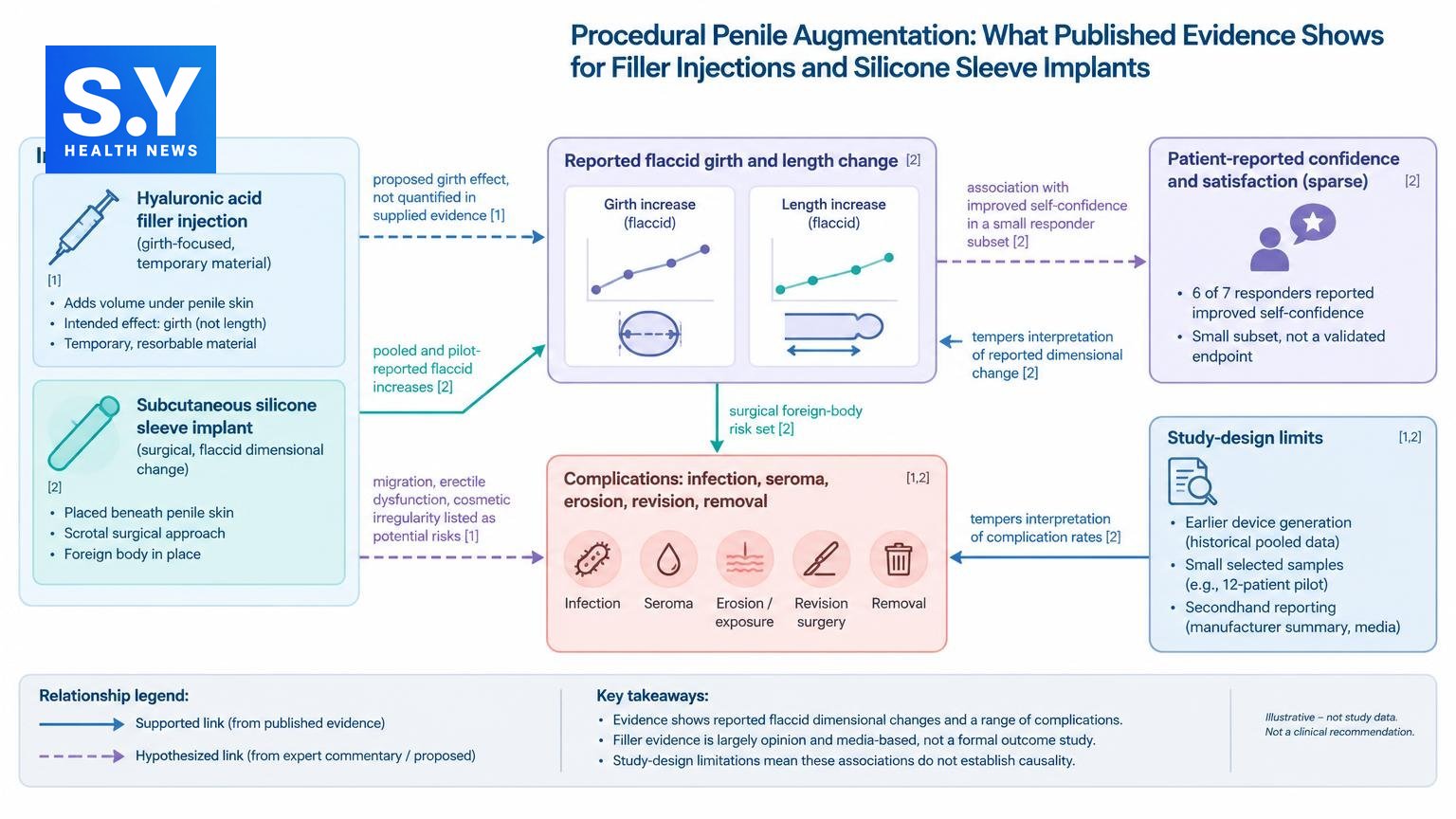
Conceptual framework: Conceptual framework: relationships between penile augmentation interventions (hyaluronic acid filler injection and silicone sleeve implantation), reported flaccid dimensional and complication outcomes, and sparse patient-reported confidence. Dimensional and safety links are reported associations from a manufacturer-summarized systematic review and small series, not causal proof; filler-related links are proposed from clinician commentary. Study-design limitations modify interpretation throughout.
Academic References & Evidence
- Patients are asking docs for bigger penises—and one urologist says enhancement procedures now outpace vasectomies | MDLinx.
- Yang H; Xiao W; Wang H; Tang G. Himplant Clinical Research | 2026 Scientific Review. International Journal of Impotence Research. 2026
SANYUN Science Center explains published research on men's reproductive and sexual health, connecting scientific evidence with everyday questions while making sources and limitations clear.
Disclaimer: This article is for scientific education and research communication only. It does not provide medical advice, diagnosis, or individualized treatment recommendations, and does not endorse any medication, supplement, device, penile enlargement procedure, or other intervention. Decisions about sexual and reproductive health should be made in consultation with a qualified healthcare professional. Do not delay seeking professional care because of information in this article.
Original Content & Copyright Notice
- This article is prepared for SANYUN Science Center, drawing on published research and publicly available academic literature on men’s sexual and reproductive health. Its editorial explanations and presentation are developed for this platform.
- Copyright in the original editorial content, selection, and arrangement is reserved by SANYUN Science Center to the extent protected by applicable law. Referenced research, quotations, and third-party materials remain subject to the rights of their respective owners. This notice does not claim ownership of scientific facts or third-party research.
- Except where permitted by applicable law or an applicable license, prior written permission is required to reproduce, republish, translate, adapt, redistribute, or commercially reuse protected content. Attribution alone does not grant permission for such reuse.
- For permitted quotation or authorized reuse, clearly identify the source and retain a link to the original article.
- Source: SANYUN Science Center
- Original URL: Retain the original article URL on science.san-yun.com.
- Copyright Holder: SANYUN Science Center, for its own protected editorial content.
- Quotation, excerpts, or authorized reuse must not distort the scientific meaning, omit material limitations or disclaimers, or imply unverified medical claims, product efficacy, or endorsement by SANYUN Science Center.



