




Category: Penis Enlargement
Core Research Direction: Evidence-based clinical guidance on penile augmentation and cosmetic penile surgery: what techniques exist (traction, exercises, fillers, grafts, flaps, phalloplasty), what the 2024 ICSM consensus recommends, and the length of follow-up data and risks that constrain those recommendations
Search Intent: What do current international expert recommendations say about whether penis enlargement surgery or non-surgical methods work, how good the evidence is, and what risks and counseling patients should expect?
Platform: SANYUN Science Center
Evidence reviewed through: 2026-11-05
Executive Summary
Penile augmentation, or penis enlargement surgery, is defined in the 2024 consensus as any technique aimed at increasing penile length or girth. The Fifth International Consultation on Sexual Medicine (ICSM 2024) produced a consensus document that organizes this field into a clinical framework, and it is the most useful current anchor for understanding what is actually recommended and what remains uncertain.[1]
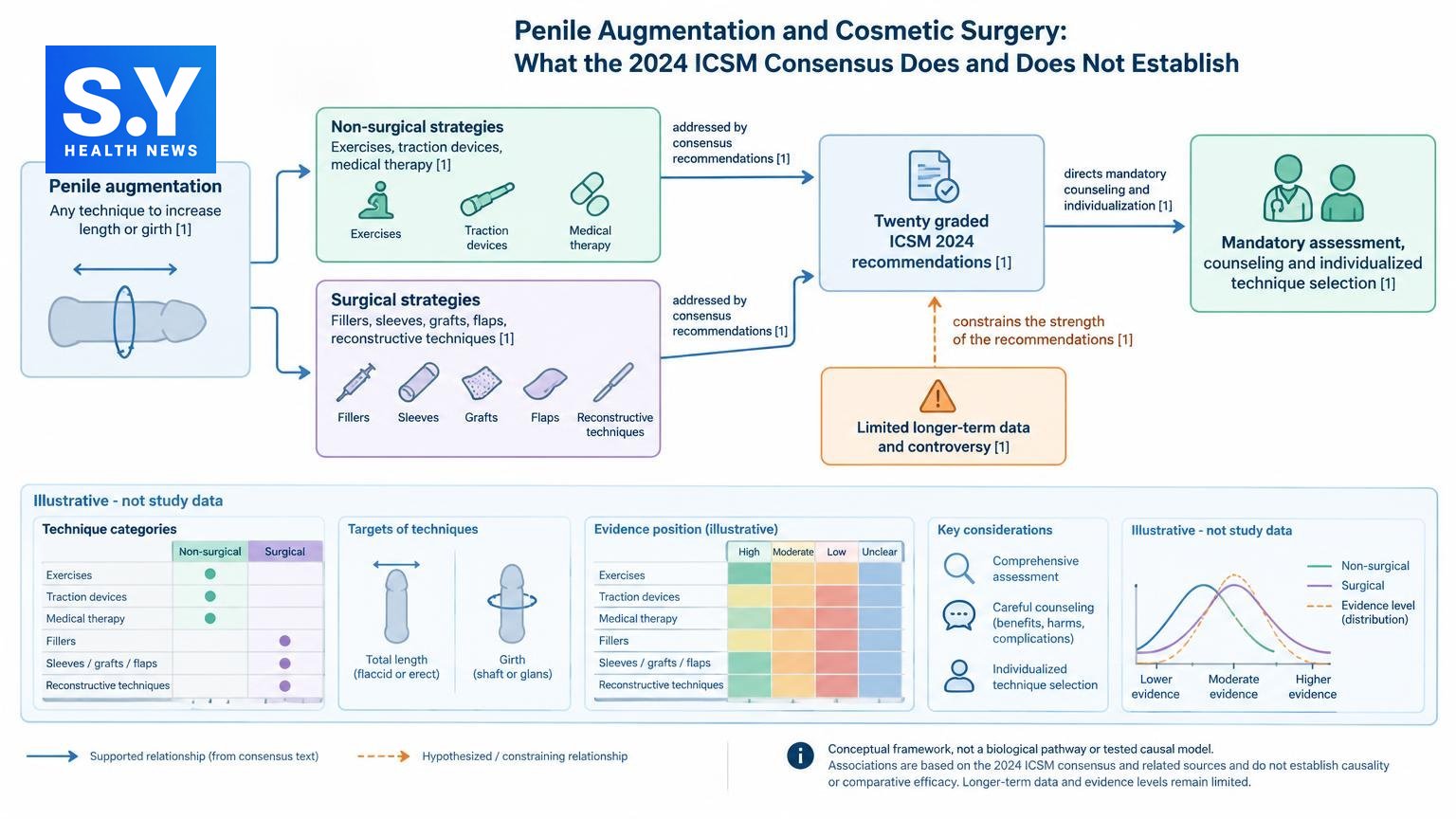
The document is broad in scope. It catalogues proposed non-surgical strategies, including penile exercises, mechanical traction devices and medical therapy, alongside surgical options such as cosmetic and reconstructive techniques, fillers, sleeves, grafts and flaps. Some techniques are framed as adding total penile length, flaccid or erect, while others add girth to the penile shaft or glans.
The central finding for readers is less about which technique wins and more about the state of the evidence. The consensus issues twenty new recommendations, each carrying a level of evidence and a grade of recommendation, and it explicitly grounds its caution in controversy and a lack of longer-term data. Comprehensive assessment and careful counseling about benefits, harms and potential complications are described as mandatory before any treatment.
- The consensus defines the field broadly, spanning physical methods, medical therapy and multiple surgical categories rather than endorsing a single approach.
- Twenty graded recommendations were produced through a literature search and a delegate review process at the 5th ICSM meeting.
- The authors describe longer-term outcome data as lacking and make pre-treatment counseling and individualized selection mandatory elements of care.
Why This Matters
Few areas of men's health carry as much commercial pressure and as little high-quality outcome data. Men seeking penile augmentation encounter a market that mixes clinical services, mechanical devices and consumer products, and the messages are often far more confident than the evidence. A consensus document that names the controversy directly is therefore more useful than a technique-by-technique promotional summary.[2]
The regulatory picture around consumer claims reinforces why clinical guidance matters. A trade commentary on US device and supplement marketing reports that the FDA treated phrases such as an increase in length and thickness, and correction of mild penis curvature, as evidence of a product's intended use in a January 8, 2024 warning letter concerning a pump and extender. That is a device-law observation from a secondary commercial source, not clinical evidence, but it illustrates how size and curvature promises sit in a contested space.
The same source notes that it found no FDA letter classifying a bare size claim as a disease claim, and none clearing one either, and argues that silence should not be read as permission. That is the source's compliance interpretation rather than an official determination, and it should be treated as context for how claims are marketed, not as evidence that any method works.
How the Consensus Was Built
The ICSM process is a consensus exercise, not a new clinical trial. The authors describe a comprehensive literature search of published work relevant to penile augmentation and enhancement, followed by presentation of a preliminary consensus to delegates at the 5th ICSM meeting, with feedback incorporated into the final document. The output is a set of recommendations intended to guide a clinical framework for penile aesthetics and augmentation.
Twenty new recommendations are provided, each with a corresponding level of evidence and grade of recommendation. Two limitations matter for interpretation. First, the available abstract does not report the search databases, dates or screening methods, so the reproducibility of the literature search cannot be assessed from the summary alone. Second, the distribution of evidence levels behind the twenty recommendations is not stated in the abstract, which means a reader cannot tell from the summary how many rest on strong versus weak underlying data.
Consensus statements occupy a specific place in the evidence hierarchy. They synthesize and interpret what exists, and they can set standards of care, but they do not generate new outcome data. When a consensus document says longer-term data are lacking, that statement reflects the state of the published literature as the panel assessed it, and it should be read as a signal about uncertainty rather than as a verdict that procedures are ineffective.
Techniques in the Consensus Framework
The consensus organizes the field into non-surgical and surgical families. Non-surgical strategies include penile exercises, mechanical traction devices and medical therapy. Surgical interventions include cosmetic and phallic reconstructive techniques and the use of fillers, sleeves, grafts and flaps. The document distinguishes techniques by their target: some aim to increase total penile length, whether flaccid or erect, while others add girth to the penile shaft or to the glans.
This taxonomy is descriptive. The available summary lists these approaches as proposed strategies and does not attach measured effect sizes to each one. That distinction is important: inclusion in a consensus framework means a technique is recognized and discussed, not that it has been shown to deliver a reliable, durable size change. Readers should resist the inference that a long list of options implies a long list of proven options.
The same caution applies to specific categories. Traction devices and penile exercises are named as physical methods, and fillers, sleeves, grafts and flaps are named as surgical augmentation materials and techniques, but the abstract does not report their comparative efficacy or their complication rates. Those numbers would be needed before any technique could be ranked against another.
| Technique category | How the consensus describes it | Target described | What the summary does not report |
|---|---|---|---|
| Penile exercises and mechanical traction devices | Named as proposed physical, non-surgical methods | Not specified in the abstract | Measured effect sizes, durability or complication rates |
| Medical therapy | Listed among proposed non-surgical strategies | Not specified in the abstract | Which agents, dosing or outcomes |
| Fillers, sleeves, grafts and flaps | Listed as surgical augmentation approaches | Girth and/or size augmentation of the shaft | Comparative efficacy and complication rates |
| Cosmetic and phallic reconstructive surgery | Listed as surgical interventions | Total penile length, flaccid or erect, or girth | Procedure-specific outcomes and follow-up duration |
What the Evidence Shows and What It Leaves Open
From the available consensus summary, the strongest conclusions are procedural and ethical rather than quantitative. The panel states that controversies and a lack of longer-term data make comprehensive assessment and careful counseling about pros, cons and potential complications mandatory before any treatment. It also recommends that surgeons be experienced in anatomy and multiple surgical techniques, and that options be individualized to the patient's condition and needs, the surgeon's expertise and local resources.
Those recommendations are meaningful even without effect sizes. They define a minimum standard of care: a thorough evaluation, an honest discussion of uncertainty, explicit acknowledgement of potential complications, and selection of a technique matched to the individual rather than to a marketing pitch. For a field where patient expectations can outrun what procedures reliably deliver, that standard is the main practical safeguard the document offers.
What the summary does not provide is equally important. It does not state measured gains in length or girth for any technique, does not quantify complication rates, and does not define how long follow-up must be to count as longer-term. The recommendation for individualized care therefore rests on expert judgment about the limits of the literature, not on a demonstrated superiority of one approach over another.
Separate commercial-intelligence reporting adds a caution about the consumer products adjacent to this clinical field. The same source reports counting 431 entries on the FDA's Sexual Enhancement and Energy Product Notifications list as of August 7, 2026, with 21 added in 2026 and almost all flagged for hidden sildenafil or tadalafil. That count is self-reported by a commercial site and the proportion described as almost all is not quantified, so it should be treated as a signal about marketplace risk rather than a research finding, and it does not establish anything about the safety or efficacy of clinical augmentation techniques.
Interpreting the Limitations
Several boundaries should be kept in view. The consensus is a synthesis with graded recommendations, and its conclusions are only as strong as the studies beneath them; the available abstract does not show how many of the twenty recommendations rest on higher-quality evidence and how many rest on expert opinion. The literature search is described as comprehensive but its operational details are not reported in the abstract, so independent replication of the search is not possible from the summary.
The phrase longer-term is used qualitatively. The panel does not numerically define the follow-up duration it considers adequate, which means the practical meaning of the gap depends on the individual studies rather than on a stated benchmark. Readers should also note that the consensus addresses penile aesthetics and augmentation broadly, covering reconstructive and cosmetic indications, and it does not present a single population or a head-to-head trial.
Finally, the consensus document should not be read as evidence of proven efficacy for any product or procedure. It is a clinical framework, and its central safety message is procedural: assess thoroughly, counsel honestly, individualize carefully and acknowledge uncertainty. The regulatory commentary discussed earlier is a marketing-law source, not a clinical one, and its hypotheses about how size and curvature claims differ are explicitly interpretive rather than established findings.
Research Outlook
The clearest research implication is straightforward. Better long-term, procedure-specific outcome data would allow future consensus panels to move beyond caution and toward comparison. Until such data accumulate, the field will continue to rely on expert recommendations that emphasize counseling and individualized selection rather than demonstrated superiority of particular techniques.
A second implication concerns how the field communicates. When a graded consensus states that controversies and limited long-term data require mandatory counseling, that statement implicitly acknowledges a gap between what patients are promised in commercial settings and what the clinical literature can support. Closing that gap requires both better studies and more disciplined public communication about what is known and what is not.
Key Takeaways
- Penile augmentation is defined as any technique aimed at increasing penile length or girth, spanning physical methods, medical therapy and multiple surgical categories.
- The 2024 ICSM consensus offers twenty recommendations with evidence levels and grades, developed through a literature search and delegate review at the 5th ICSM meeting.
- The panel cites controversy and a lack of longer-term data, making comprehensive assessment and counseling about benefits, harms and complications mandatory before treatment.
- Surgeons are advised to be experienced in anatomy and multiple techniques, with options individualized to the patient, the surgeon's expertise and local resources.
- The consensus summary does not report technique-specific effect sizes, complication rates or a defined minimum follow-up, so it supports caution rather than comparative claims.
Questions and Answers
What counts as penile augmentation or penis enlargement surgery?
The 2024 ICSM consensus defines penile augmentation, or penis enlargement surgery, as any technique aimed at enhancing penile length or girth. The category spans non-surgical approaches such as penile exercises, mechanical traction devices and medical therapy, and surgical approaches including cosmetic and reconstructive techniques, fillers, sleeves, grafts and flaps. Some target total length, others shaft or glans girth.
What does the 2024 ICSM consensus actually recommend about penile augmentation?
The consensus issues twenty recommendations with evidence levels and grades. Its clearest guidance is procedural: because of controversy and limited longer-term data, comprehensive assessment and counseling about pros, cons and potential complications are mandatory before any treatment. It also advises that surgeons be experienced in anatomy and multiple techniques and that options be individualized to patient needs, surgeon expertise and local resources.
How strong is the evidence behind penile augmentation recommendations?
The consensus is a synthesis, not a new trial. It used a literature search and delegate review, and the twenty recommendations carry levels of evidence and grades, but the available summary does not show how many rest on higher-quality data. The authors themselves cite a lack of longer-term data and controversy, which indicates that much of the guidance reflects expert judgment under uncertainty.
Does the consensus report how much length or girth specific techniques add?
No, the available summary does not report measured gains, complication rates or follow-up durations for specific techniques. It lists proposed strategies such as traction, exercises, medical therapy, fillers, sleeves, grafts and flaps, and it distinguishes length from girth targets, but it does not rank these approaches or quantify their outcomes. Readers should not infer proven effectiveness from inclusion in the framework.
What are the main limitations of the penile augmentation evidence base?
The consensus points to controversy and a lack of longer-term data, without numerically defining how long follow-up should be. The abstract does not report search databases, dates or screening methods, and it does not state the distribution of evidence levels across the twenty recommendations. Those gaps limit reproducibility and make it difficult to judge which recommendations rest on strong versus weak data.
How should men interpret consumer claims about penis enlargement devices and products?
With caution. A commercial trade source reports that the FDA treated length and curvature claims as evidence of intended use in a 2024 device warning letter, and it notes that no letter has clearly classified or cleared a bare size claim. That is compliance commentary, not clinical evidence. It supports skepticism toward marketing promises rather than any conclusion that a product or procedure works.
Conceptual framework: Conceptual framework, not a biological pathway or tested causal model. Proposed non-surgical and surgical techniques feed into twenty graded ICSM 2024 recommendations, which are constrained by limited longer-term data and direct mandatory assessment and individualized counseling. Relations are conceptual mappings supported by the consensus text; the framework does not establish comparative efficacy.
Academic References & Evidence
- Chung, Eric; Jenkins, Lawrence; Moon, Du Geon; Ziegelmann, Matthew; Deveci, Serkan; Lin, Hao Cheng; Broderick, Gregory; Seyam, Raouf; Morey, Allen; Levine, Laurence. Penile augmentation and cosmetic surgery: recommendations from the Fifth International Consultation on Sexual Medicine (ICSM 2024). 2026 14(1)
- Size and Curvature Claims Have No Safe Register.
SANYUN Science Center explains published research on men's reproductive and sexual health, connecting scientific evidence with everyday questions while making sources and limitations clear.
Disclaimer: This article is for scientific education and research communication only. It does not provide medical advice, diagnosis, or individualized treatment recommendations, and does not endorse any medication, supplement, device, penile enlargement procedure, or other intervention. Decisions about sexual and reproductive health should be made in consultation with a qualified healthcare professional. Do not delay seeking professional care because of information in this article.
Original Content & Copyright Notice
- This article is prepared for SANYUN Science Center, drawing on published research and publicly available academic literature on men’s sexual and reproductive health. Its editorial explanations and presentation are developed for this platform.
- Copyright in the original editorial content, selection, and arrangement is reserved by SANYUN Science Center to the extent protected by applicable law. Referenced research, quotations, and third-party materials remain subject to the rights of their respective owners. This notice does not claim ownership of scientific facts or third-party research.
- Except where permitted by applicable law or an applicable license, prior written permission is required to reproduce, republish, translate, adapt, redistribute, or commercially reuse protected content. Attribution alone does not grant permission for such reuse.
- For permitted quotation or authorized reuse, clearly identify the source and retain a link to the original article.
- Source: SANYUN Science Center
- Original URL: Retain the original article URL on science.san-yun.com.
- Copyright Holder: SANYUN Science Center, for its own protected editorial content.
- Quotation, excerpts, or authorized reuse must not distort the scientific meaning, omit material limitations or disclaimers, or imply unverified medical claims, product efficacy, or endorsement by SANYUN Science Center.



