




Category: Penis Enlargement
Core Research Direction: What the 2024 ICSM consensus on penile augmentation and cosmetic surgery recommends about the evidence base, techniques, and counseling requirements for penile length/girth enhancement
Search Intent: What do current international expert recommendations say about whether penile augmentation procedures work and what the evidence base and risks are?
Platform: SANYUN Science Center
Evidence reviewed through: 2026-10-31
Executive Summary
The Fifth International Consultation on Sexual Medicine (ICSM 2024) published a consensus statement on penile augmentation and cosmetic surgery intended to provide evidence-based recommendations and a clinical framework for this area of practice. The consensus defines penile augmentation, or penis enlargement surgery, as any technique aimed at enhancing penile length or girth.[1]
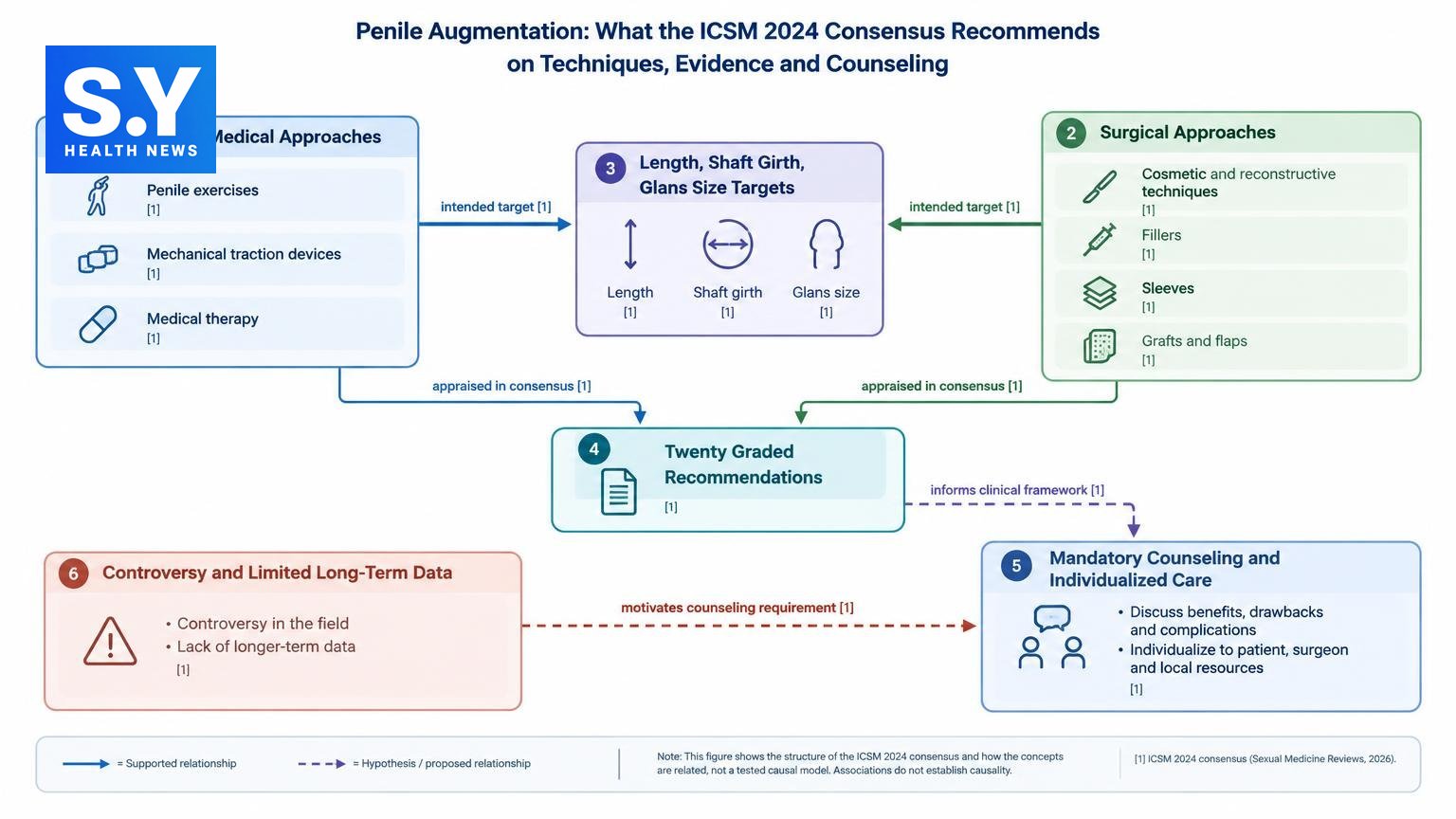
The document sets out proposed strategies in two broad families. Physical and medical approaches include various penile exercises, mechanical traction devices and medical therapy. Surgical approaches include cosmetic and phallic reconstructive techniques and the use of fillers, sleeves, grafts and flaps. Some techniques are described as increasing total penile length, either flaccid or erect, while others add to the girth of the penile shaft and/or the size of the glans.
The output is twenty new recommendations, each carrying a level of evidence and a grade of recommendation. The consensus is explicit that controversy and a lack of longer-term data mean comprehensive assessment and careful patient counseling weighing pros, cons and potential complications are mandatory before any treatment begins. The review below summarizes and interprets this published consensus; it is not a systematic review, meta-analysis or new experiment.
Readers should keep the document's timeline in mind. The consensus derives from the fifth ICSM meeting and is published in Sexual Medicine Reviews with a 2026 publication year, while the evidence summarized here was reviewed through 31 October 2026.
Why a Graded Consensus Matters in This Field
Penile augmentation is unusual in sexual medicine because the range of proposed solutions spans self-directed exercises, mechanical devices, injectable fillers and major reconstructive surgery. Grouping all of these under a single definition is not merely semantic: it means the published recommendations, rather than individual technique descriptions, are the main available source for confidence in the evidence base across the field.
A graded consensus is useful to both clinicians and patients because it attaches explicit levels of evidence and grades of recommendation to each statement. It signals where the field rests on stronger versus weaker data, and it establishes what must happen before treatment rather than only what treatment options exist. The accessible record, however, does not reproduce the grading framework or the distribution of evidence levels, so the overall certainty profile of the twenty recommendations cannot be summarized from it.
How the Consensus Was Assembled
The authors describe a comprehensive literature search to identify published literature relevant to penile augmentation or enhancement. Preliminary consensus statements were then presented to delegates attending the fifth ICSM meeting, and their feedback was incorporated into the final document.
This is a structured consensus development process, not a clinical trial and not a formal systematic review with a pre-registered protocol. The accessible record does not report the databases searched, search dates, formal inclusion criteria, or the number and selection of participating delegates. The recommendations should therefore be read as expert-informed guidance shaped by an appraisal of the literature, rather than as an independently verified pooled estimate of treatment effect.
Techniques Under Review and Their Intended Targets
The consensus divides proposed augmentation strategies into physical and medical methods on one side and surgical interventions on the other. Physical and medical methods include various penile exercises, mechanical traction devices and medical therapy. Surgical interventions include cosmetic and phallic reconstructive techniques and the use of fillers, sleeves, grafts and flaps.
Targets vary by technique. Some procedures are described as increasing total penile length, whether flaccid or erect, while others add to penile shaft girth and/or glans size. These statements describe what techniques are designed to achieve; they do not quantify gains achieved in practice. Listing a technique in the consensus indicates it belongs in the clinical conversation, not that it has demonstrated superiority in controlled comparison.
| Measure / finding | Limitations |
|---|---|
| Penile augmentation (penis enlargement surgery) is defined in the consensus as any technique aimed at enhancing penile length or girth. | Definitional statement, not an outcome measure. |
| Proposed augmentation strategies are categorized as physical/medical (penile exercises, mechanical traction devices, medical therapy) and surgical (cosmetic and phallic reconstructive techniques, fillers, sleeves, grafts, flaps). | Enumeration of proposed approaches; does not report comparative efficacy. |
What the Evidence Shows, and What It Cannot
The most transferable findings are procedural and ethical rather than quantitative. Because of controversy and a lack of longer-term data on penile augmentation and cosmetic procedures, comprehensive assessment and careful counseling about pros, cons and potential complications are mandatory before any treatment. The consensus does not present this as optional guidance; it is stated as a precondition for proceeding.
The document also addresses operator and contextual factors. Surgeons should be experienced in penile anatomy and in various surgical techniques. Surgical options should be individualized according to the patient's condition and needs, the surgeon's expertise, and local resources. This recognizes that a single standardized pathway is unlikely to fit every presentation or practice setting.
What the accessible record cannot support is any claim about magnitude of effect. It contains no measured average gain in length or girth, no comparison of efficacy between techniques, no complication rates and no follow-up durations. A graded recommendation within a consensus is not the same as a demonstrated treatment effect in a controlled study, and it should not be presented as one.
Interpreting the Recommendations Honestly
Several distinctions matter when reading this document. Expert endorsement is not evidence of causation: a technique listed among proposed strategies is not thereby proven to work. A stated level of evidence is not a guarantee of high certainty, and because the accessible record does not show how grades were distributed, readers cannot assume uniform strength across the twenty recommendations.
The consensus also implicitly acknowledges variation in clinical context. Individualization to patient condition and needs and to local resources suggests that baseline anatomy, indication and available services matter clinically, but the record does not separate outcomes by those factors. The mandatory counseling requirement is best understood as a statement about clinical process, reflecting the authors' judgment that information exchange before treatment carries real weight given acknowledged uncertainty about longer-term results.
Practical Implications for a Consultation
Applied carefully, the consensus describes a consultation structure rather than a product endorsement. Comprehensive assessment comes first. Counseling should explicitly address expected benefits, potential drawbacks and possible complications, framed against the acknowledged uncertainty about longer-term outcomes. Technical selection follows assessment and should reflect the patient's situation together with the treating surgeon's experience and local resources.
A man considering length or girth enhancement can reasonably ask whether a proposed approach is surgical or non-surgical, what level of evidence underpins the recommendation for it, and what remains unknown about long-term results. He should also understand that the consensus sets a clinical framework; the accessible record does not endorse any specific commercial device, filler product, graft material or exercise program, and it does not promise outcomes.
Research Outlook
The consensus itself identifies the gap that future work must address: continuing controversy and insufficient longer-term data on penile augmentation and cosmetic procedures. From the perspective of this review, that gap implies a need for prospective studies reporting clearly defined anatomical outcomes, standardized measurement of flaccid and erect length as well as shaft and glans girth, and follow-up long enough to characterize durability. These are the reviewer's observations about the evidence gap, not recommendations made by the consensus itself.
Until such data accumulate, the ICSM 2024 recommendations function as a framework for careful, individualized, well-counseled practice, not as a definitive answer on whether any particular technique works or how much it helps.
Key Takeaways
- The consensus defines penile augmentation as any technique aimed at enhancing penile length or girth.
- Proposed approaches range from exercises, traction devices and medical therapy to fillers, sleeves, grafts, flaps and reconstructive surgery.
- The document provides twenty new recommendations, each with a level of evidence and grade of recommendation.
- Comprehensive assessment and counseling about pros, cons and complications are stated as mandatory before any treatment.
- The consensus flags controversy and a lack of longer-term outcome data as central limits on the evidence base.
Questions and Answers
What does the ICSM 2024 consensus mean by penile augmentation?
It defines penile augmentation, or penis enlargement surgery, as any technique aimed at enhancing penile length or girth. The proposed strategies it covers include physical and medical methods such as penile exercises, mechanical traction devices and medical therapy, and surgical methods including cosmetic and reconstructive techniques, fillers, sleeves, grafts and flaps.
What are the main recommendations of the consensus document?
The document offers twenty new recommendations, each with a level of evidence and grade of recommendation. Its most prominent practical requirement is that comprehensive assessment and careful counseling about benefits, drawbacks and complications are mandatory before any treatment. It also advises that surgeons be experienced in anatomy and multiple techniques and that options be individualized to the patient, surgeon and setting.
How strong is the evidence base behind these recommendations?
The authors describe the field as marked by controversy and a lack of longer-term data. The document is a consensus built from a literature search and delegate feedback, not a trial or systematic review. The accessible record does not disclose the distribution of evidence levels across the twenty recommendations, so certainty should be assumed to vary by recommendation rather than treated as uniform.
Do the recommendations say how much length or girth a given technique adds?
No. The consensus describes what techniques are designed to target, such as flaccid or erect length and shaft or glans girth, but the accessible record contains no measured average gains, no comparative efficacy between techniques, no complication rates and no follow-up durations. Any specific numeric claim about improvement is therefore outside what this consensus summary can support.
Who are these recommendations intended for?
They address the clinical care of patients considering penile augmentation or cosmetic penile procedures, and the surgeons who provide those treatments. The consensus emphasizes individualization according to patient condition and needs, surgeon expertise and local resources, which implies variation across anatomical presentations and practice settings rather than one standard pathway for everyone.
What should a man expect from a first consultation about enhancement?
He should expect a comprehensive assessment and a detailed discussion of potential benefits, drawbacks and complications, framed around acknowledged uncertainty about long-term results. He can ask whether an approach is surgical or non-surgical, what evidence grade supports it, and what remains unknown. The consensus sets a clinical framework; the accessible record does not endorse specific products or promise outcomes.
Conceptual framework: Conceptual framework for interpreting the ICSM 2024 penile augmentation consensus. Physical/medical and surgical approach families share length, shaft girth and glans size targets; both were appraised to produce twenty graded recommendations. Acknowledged controversy and limited long-term data motivate mandatory counseling and individualized care. Relations reflect the document's descriptive structure, not tested causal or comparative effects.
Academic References & Evidence
- Chung, E.; Jenkins, L.; Moon, D. G.; Ziegelmann, M.; Deveci, S.; Lin, H. C.; Levine, L.. Penile augmentation and cosmetic surgery: recommendations from the Fifth International Consultation on Sexual Medicine (ICSM 2024). Sexual Medicine Reviews. 2026 DOI: 10.1093/sxmrev/qeaf067.
SANYUN Science Center explains published research on men's reproductive and sexual health, connecting scientific evidence with everyday questions while making sources and limitations clear.
Disclaimer: This article is for scientific education and research communication only. It does not provide medical advice, diagnosis, or individualized treatment recommendations, and does not endorse any medication, supplement, device, penile enlargement procedure, or other intervention. Decisions about sexual and reproductive health should be made in consultation with a qualified healthcare professional. Do not delay seeking professional care because of information in this article.
Original Content & Copyright Notice
- This article is prepared for SANYUN Science Center, drawing on published research and publicly available academic literature on men’s sexual and reproductive health. Its editorial explanations and presentation are developed for this platform.
- Copyright in the original editorial content, selection, and arrangement is reserved by SANYUN Science Center to the extent protected by applicable law. Referenced research, quotations, and third-party materials remain subject to the rights of their respective owners. This notice does not claim ownership of scientific facts or third-party research.
- Except where permitted by applicable law or an applicable license, prior written permission is required to reproduce, republish, translate, adapt, redistribute, or commercially reuse protected content. Attribution alone does not grant permission for such reuse.
- For permitted quotation or authorized reuse, clearly identify the source and retain a link to the original article.
- Source: SANYUN Science Center
- Original URL: Retain the original article URL on science.san-yun.com.
- Copyright Holder: SANYUN Science Center, for its own protected editorial content.
- Quotation, excerpts, or authorized reuse must not distort the scientific meaning, omit material limitations or disclaimers, or imply unverified medical claims, product efficacy, or endorsement by SANYUN Science Center.



