




Category: Penis Enlargement
Core Research Direction: Evidence-based framing of penile augmentation: what the 2024 ICSM consensus recommendations say about physical and surgical penile-length/girth techniques, their limitations and counseling requirements, contrasted with clinic-marketed gain claims for suspensory-ligament release and implants
Search Intent: What does the current international expert consensus actually recommend about penile lengthening and girth augmentation, and how well-supported are the length gains clinics advertise?
Platform: SANYUN Science Center
Evidence reviewed through: 2026-11-05
Executive Summary
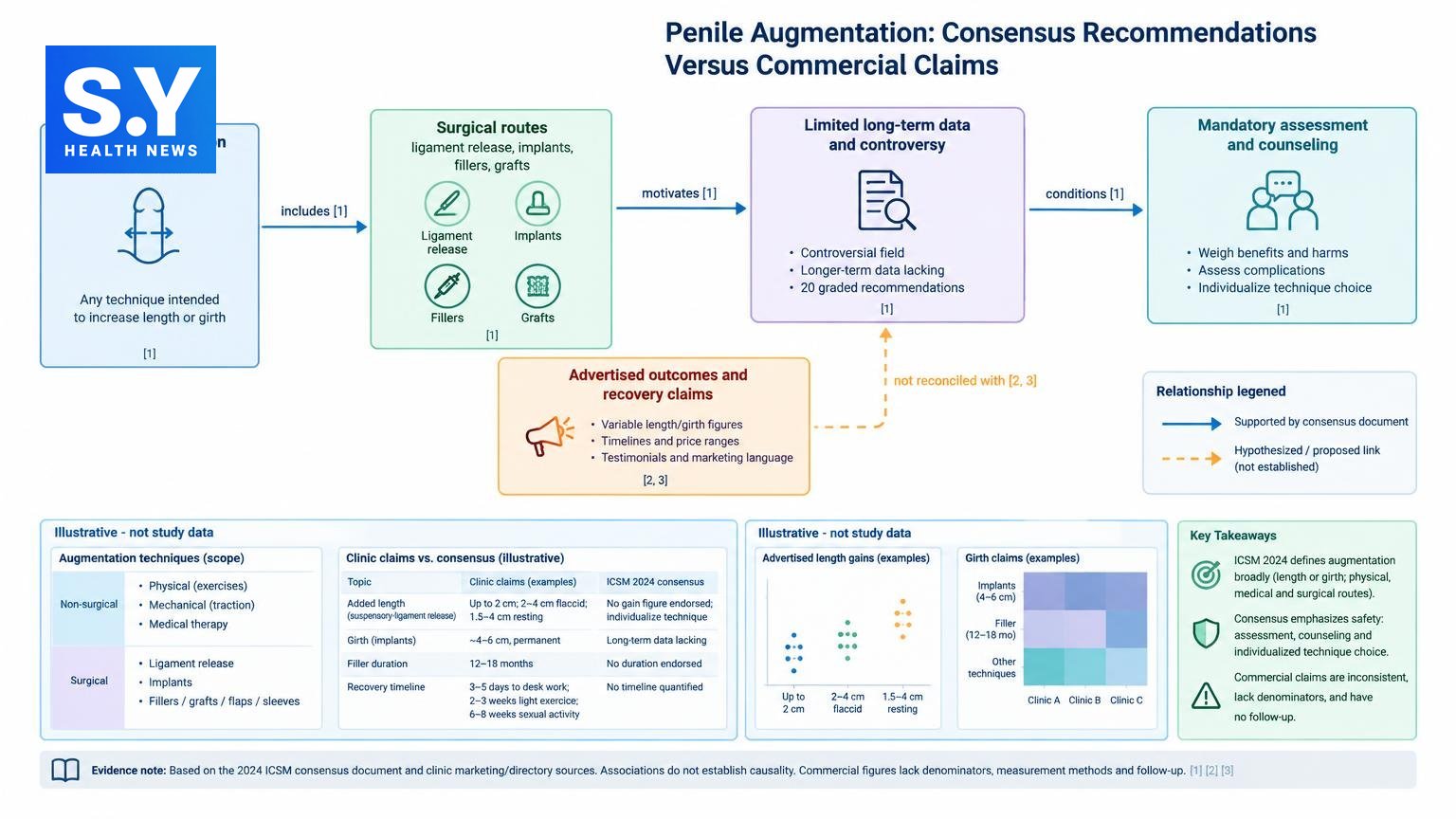
Penile augmentation covers any technique intended to increase penile length or girth, whether through physical strategies such as exercises, mechanical traction devices or medical therapy, or through surgical strategies including cosmetic and reconstructive techniques, fillers, sleeves, grafts and flaps. That scope comes from the Fifth International Consultation on Sexual Medicine (ICSM 2024) consensus, which was built from a comprehensive literature search with stakeholder feedback.[1]
The consensus delivers twenty new recommendations, each carrying a level of evidence and a grade of recommendation. Its central safety message is conditional rather than promotional: because penile augmentation and cosmetic procedures remain controversial and longer-term data are lacking, comprehensive assessment and careful counseling that weighs benefits, harms and potential complications are mandatory before any treatment. It also asks that surgeons be experienced in anatomy and multiple techniques, and that options be individualized.
The commercial material reviewed here is not a source of outcome evidence. It is clinic marketing and medical-travel directory content, dominated by testimonial quotes, advertised ranges and price listings rather than reported cohorts. Its advertised numbers do not agree with each other, and none of it substitutes for the graded, uncertainty-aware guidance of the consensus.[2][3][4][5][6]
Why This Matters
Men seeking penile enlargement are often making a decision under uncertainty, in a market where the same procedure can be described with quite different promised results. Comparing what the consensus document says with what clinics advertise is therefore not an academic exercise: it is the practical difference between a counseling conversation and a sales page.
The consensus is explicit that penile augmentation and cosmetic procedures remain controversial and that longer-term data are insufficient. In a field with that evidence base, the quality of pre-treatment assessment and counseling carries much of the safety burden. A clinic that advertises permanent gains without describing measurement methods, denominators or follow-up has not supplied the information a patient needs to judge risk.
Definitions and the Scope of Augmentation
The ICSM 2024 document treats augmentation as a family of interventions rather than a single operation. Length-directed and girth-directed techniques are grouped together, and both non-surgical (physical, mechanical, medical) and surgical routes are recognized. This breadth matters because evidence quality and risk profiles differ sharply across those routes, even though marketing often presents them as interchangeable options in one menu.
A cost-aggregation directory offers a lay summary consistent with that framing: enlargement may involve releasing the suspensory ligament for length or injecting fat or fillers for girth, typically performed as a day case of about one hour under local or general anesthesia. Such directory text is descriptive rather than clinical evidence, but it illustrates how procedures are commonly presented to prospective patients.
What the Evidence Shows: The Consensus Position
The ICSM 2024 process combined a comprehensive literature search with a staged consensus: preliminary recommendations were presented to delegates at the 5th ICSM meeting, and feedback was incorporated into the final document. The abstract does not state how many delegates contributed or how studies were selected, so the process should be read as expert consensus informed by a literature review rather than a systematic review with a published protocol.
Twenty new recommendations were issued with corresponding levels of evidence and grades of recommendation. The abstract does not report how those grades are distributed, so it is not possible from this source alone to say how many recommendations rest on high-quality evidence and how many reflect expert opinion. That distribution is the detail a clinician would need to weigh each recommendation individually.
Three requirements stand out. First, comprehensive assessment and careful counseling weighing pros, cons and potential complications are mandatory before any treatment. Second, surgeons should be experienced in anatomy and in a range of surgical techniques. Third, surgical options should be individualized to the patient's condition and needs, the surgeon's expertise and local resources. These are process and governance recommendations; they do not endorse any specific advertised gain.
Mechanistic Rationale and Its Limits
The clinical logic of suspensory-ligament release is anatomical: releasing the ligament that tethers the shaft to the pubic bone is proposed to allow more of the internal shaft to become externally visible. The consensus documents the category of such reconstructive techniques but does not, in the abstract reviewed here, quantify the resulting external length or the durability of any change. Prose should therefore separate anatomical plausibility from demonstrated outcome.
In girth procedures, fillers, grafts, flaps, sleeves and implants are all categorized as augmentation strategies. Implants in particular involve a permanent foreign body, so counseling has to address complications, revision potential and the absence of long-term outcome data rather than only the dimension of the anticipated change. The consensus's emphasis on weighing potential complications is directly relevant here.
One clinic page states that length results are permanent only if a penile extender is used consistently during the first three months of recovery. This is an unsourced mechanistic claim in marketing material, flagged in the research packet as a hypothesis rather than an established relationship, and it should be treated as such.
What Clinics Advertise, and Why the Numbers Do Not Add Up
The commercial sources are internally inconsistent. One clinic page promises up to 2 cm of added visible length from suspensory-ligament release combined with V-Y skin plasty, while elsewhere on the same site most patients are said to gain 2–4 cm in visible flaccid length. The French-language version of the page advertises 1.5–4 cm in resting length and adds that erect length generally remains unchanged. A separate clinic page again cites up to 2 cm of visible length.
None of these figures is accompanied by a study design, a denominator, a measurement method or a follow-up interval. A single named-initial testimonial reports a visible 1.8 cm gain with no erection problems. Anecdotes of this kind cannot establish typical results, complication rates or durability, and the packet explicitly records them as self-reported and unverifiable.
For girth, one clinic markets FDA-cleared silicone implants as adding roughly 4–6 cm of circumference, described as permanent, and markets hyaluronic-acid filler as lasting 12–18 months with minimal downtime. Regulatory clearance is not the same as demonstrated clinical benefit, and no outcome data are provided for either claim. The advertised recovery timeline of 3–5 days to desk work, light exercise at 2–3 weeks, sexual activity at 6–8 weeks and final result at around 3 months is likewise not tied to any reported cohort.
| Variable | What the commercial source states | What the 2024 ICSM consensus supports |
|---|---|---|
| Added visible length after suspensory-ligament release | Up to 2 cm on one page; 2–4 cm flaccid on the same site; 1.5–4 cm resting on the French page | Recommends counseling and individualized technique choice; no advertised gain figure endorsed in the abstract |
| Girth change with silicone implants | Roughly 4–6 cm of circumference, permanent | Implants fall within surgical augmentation strategies; long-term data described as lacking |
| Durability of filler | 12–18 months with minimal downtime | Fillers are categorized as an augmentation strategy; no duration endorsed in the abstract |
| Erection angle | Asserted not significantly affected by modern techniques | Not addressed in the consensus abstract reviewed |
| Recovery timeline | 3–5 days desk work; light exercise 2–3 weeks; sexual activity 6–8 weeks; final result ~3 months | Mandatory counseling must weigh complications; no timeline quantified in the abstract |
Cost and Market Context
Price information in this literature comes from marketplaces and directories, not audited billing. One medical-travel marketplace reports an average Bangkok surgical penile-lengthening price of $3,500 (119,000 THB), with a minimum of $2,000 (68,000 THB) and a maximum of $5,000 (170,000 THB), stating that its data were verified in April 2026 and based on patient requests and official offers from 13 clinics worldwide. Those are listed figures with unconfirmed inclusions and eligibility.
A separate directory lists published starting figures for Bangkok and describes an estimated trip-planning total, while cautioning that these are qualified context rather than confirmed local quotes. Such numbers are useful for understanding the commercial landscape; they say nothing about clinical outcomes or safety.
Interpretation and Limitations
The strongest available framing is a cautious one. A consensus document that issues twenty graded recommendations while simultaneously describing the field as controversial and lacking longer-term data is signaling that certainty is limited. The recommendation to make assessment and counseling mandatory is best understood as a risk-management response to that uncertainty, not as an endorsement of any particular gain.
Several specific limitations should be stated plainly. The research packet does not provide the distribution of evidence levels behind the twenty recommendations, the number or selection of delegates, or the outcome data underlying any advertised range. The commercial sources are marketing and directory pages with no study design, and some of their figures conflict with each other. Advertising language such as board certification, regulatory clearance or discreet private facilities describes service features, not verified efficacy or safety.
Complications are possible with any treatment, and the sources reviewed here provide no procedure-specific rates. A directory advises patients to ask a hospital for its complication and revision rate for this exact procedure and what aftercare is included if something goes wrong. That question is a reasonable benchmark for judging any clinic's claims, including those about permanence.
Research Outlook
The consensus itself identifies the gap: controversy and a lack of longer-term data. Progress would require prospective outcome reporting with clear measurement definitions, defined follow-up intervals, and complication and revision tracking, reported by technique rather than as a single blended category. Until such data are available, the consensus framework of mandatory assessment, counseling and individualized technique selection remains the most defensible standard described in this literature.
Key Takeaways
- ICSM 2024 defines penile augmentation broadly as any technique intended to increase length or girth, covering physical, medical and surgical routes including fillers, sleeves, grafts and flaps.
- The consensus issued twenty new recommendations with levels of evidence and grades of recommendation.
- Comprehensive assessment and careful counseling weighing benefits, harms and potential complications are mandatory before any treatment because the field is controversial and longer-term data are lacking.
- Surgeons should be experienced in anatomy and multiple techniques, and options should be individualized to the patient, surgeon expertise and local resources.
- Clinic marketing offers conflicting ranges, from up to 2 cm to 2–4 cm flaccid and 1.5–4 cm resting, without denominators, measurement methods or follow-up.
- Advertised implant girth of roughly 4–6 cm and filler duration of 12–18 months are marketing statements without cited outcome data.
- Listed Bangkok prices, averaging $3,500 with a $2,000 to $5,000 range in one marketplace, are commercial listings rather than confirmed clinical or billing data.
Questions and Answers
What does penile augmentation mean in the 2024 ICSM consensus?
It refers to any technique intended to increase penile length or girth. The consensus groups physical strategies such as exercises, mechanical traction devices and medical therapy together with surgical strategies including cosmetic and reconstructive techniques, fillers, sleeves, grafts and flaps. This is a definitional scope, not an endorsement of effectiveness for any specific method.
What are the main recommendations of the 2024 ICSM consensus on penile augmentation?
The consensus provides twenty new recommendations with levels of evidence and grades of recommendation. Key process requirements are comprehensive assessment, mandatory counseling about benefits, harms and complications, surgeons experienced in anatomy and multiple techniques, and options individualized to patient needs, surgeon expertise and local resources. The abstract does not report how many recommendations rest on high-quality evidence.
How strong is the evidence behind penile lengthening and girth augmentation?
The consensus itself describes penile augmentation and cosmetic procedures as controversial and lacking longer-term data, which is why it makes assessment and counseling mandatory. Its recommendations carry stated levels of evidence and grades, but the abstract does not state their distribution, and the commercial sources in this review provide no study design, denominators or follow-up. Evidence should be considered limited.
Do clinic-advertised length gains after suspensory ligament release match official guidance?
They do not align cleanly. One clinic page advertises up to 2 cm, while the same site elsewhere says 2–4 cm flaccid and the French version says 1.5–4 cm resting. None reports measurement method, sample size or follow-up. The ICSM consensus endorses individualized technique selection and counseling rather than any specific advertised gain, so these figures should be treated as marketing claims.
What should men ask about penile implant or filler girth augmentation before treatment?
Ask for the clinic's complication and revision rate for this specific procedure, what aftercare is included if something goes wrong, and what evidence supports advertised girth changes such as roughly 4–6 cm for implants or 12–18 months for filler. The consensus requires counseling that weighs potential complications, especially with permanent implants, and notes that longer-term data are lacking.
Why do Bangkok penile enlargement prices vary between sources?
The figures come from marketplaces and directories rather than audited billing. One marketplace reports an average of $3,500, a minimum of $2,000 and a maximum of $5,000 for surgical lengthening, stating verification in April 2026 from 13 clinics worldwide. Inclusions and eligibility are unconfirmed, and a separate directory cautions that its figures are comparison context, not final quotes.
Conceptual framework: Conceptual framework comparing the scope of penile augmentation, the 2024 ICSM consensus response to limited long-term data, and commercial outcome claims. Supported links reflect the consensus document; the dashed comparison is proposed, not a tested relationship. Marketing figures lack denominators and follow-up.
Academic References & Evidence
- Chung, Eric; Jenkins, Lawrence; Moon, Du Geon; Ziegelmann, Matthew; Deveci, Serkan; Lin, Hao Cheng; Broderick, Gregory; Seyam, Raouf; Morey, Allen; Levine, Laurence. Penile augmentation and cosmetic surgery: recommendations from the Fifth International Consultation on Sexual Medicine (ICSM 2024). 2026 14(1)
- Dr. Noppon Arunkajohnsak (Win). Penile Lengthening Surgery Bangkok – Menscape Clinic.
- Dr. Chonlatee Roekmongkolwit (Boss). Penis Enlargement Surgery Bangkok | Length & Girth |….
- Chirurgie d'Allongement du Pénis à Bangkok – Menscape Clinic.
- Anna Leonova. Allungamento chirurgico del pene a Bangkok – Costi e Pacchetti 2026.
- Penis Enlargement in Bangkok, Thailand — Compare Clinics.
SANYUN Science Center explains published research on men's reproductive and sexual health, connecting scientific evidence with everyday questions while making sources and limitations clear.
Disclaimer: This article is for scientific education and research communication only. It does not provide medical advice, diagnosis, or individualized treatment recommendations, and does not endorse any medication, supplement, device, penile enlargement procedure, or other intervention. Decisions about sexual and reproductive health should be made in consultation with a qualified healthcare professional. Do not delay seeking professional care because of information in this article.
Original Content & Copyright Notice
- This article is prepared for SANYUN Science Center, drawing on published research and publicly available academic literature on men’s sexual and reproductive health. Its editorial explanations and presentation are developed for this platform.
- Copyright in the original editorial content, selection, and arrangement is reserved by SANYUN Science Center to the extent protected by applicable law. Referenced research, quotations, and third-party materials remain subject to the rights of their respective owners. This notice does not claim ownership of scientific facts or third-party research.
- Except where permitted by applicable law or an applicable license, prior written permission is required to reproduce, republish, translate, adapt, redistribute, or commercially reuse protected content. Attribution alone does not grant permission for such reuse.
- For permitted quotation or authorized reuse, clearly identify the source and retain a link to the original article.
- Source: SANYUN Science Center
- Original URL: Retain the original article URL on science.san-yun.com.
- Copyright Holder: SANYUN Science Center, for its own protected editorial content.
- Quotation, excerpts, or authorized reuse must not distort the scientific meaning, omit material limitations or disclaimers, or imply unverified medical claims, product efficacy, or endorsement by SANYUN Science Center.



