




Category: Penis Enlargement
Core Research Direction: Penile augmentation for men with normal penile size: what surgical and injectable procedures (suspensory ligament release, autologous fat grafting, hyaluronic acid fillers, implants) actually achieve in length, girth and satisfaction, and what risks and complications are documented
Search Intent: For men concerned about penis size, which augmentation procedures have real evidence of benefit, how large and durable are the effects, and how common and serious are the harms?
Platform: SANYUN Science Center
Evidence reviewed through: 2026-11-06
Executive Summary
Penile augmentation remains a controversial area of men's health, largely because most men who seek it already measure within the normal range and because the procedures carry risks of severe complications. A 2026 narrative review of injectables, implants and surgical grafts concluded that a multidisciplinary approach is essential for men requesting augmentation and that further research is needed to manage these patients successfully.[1]
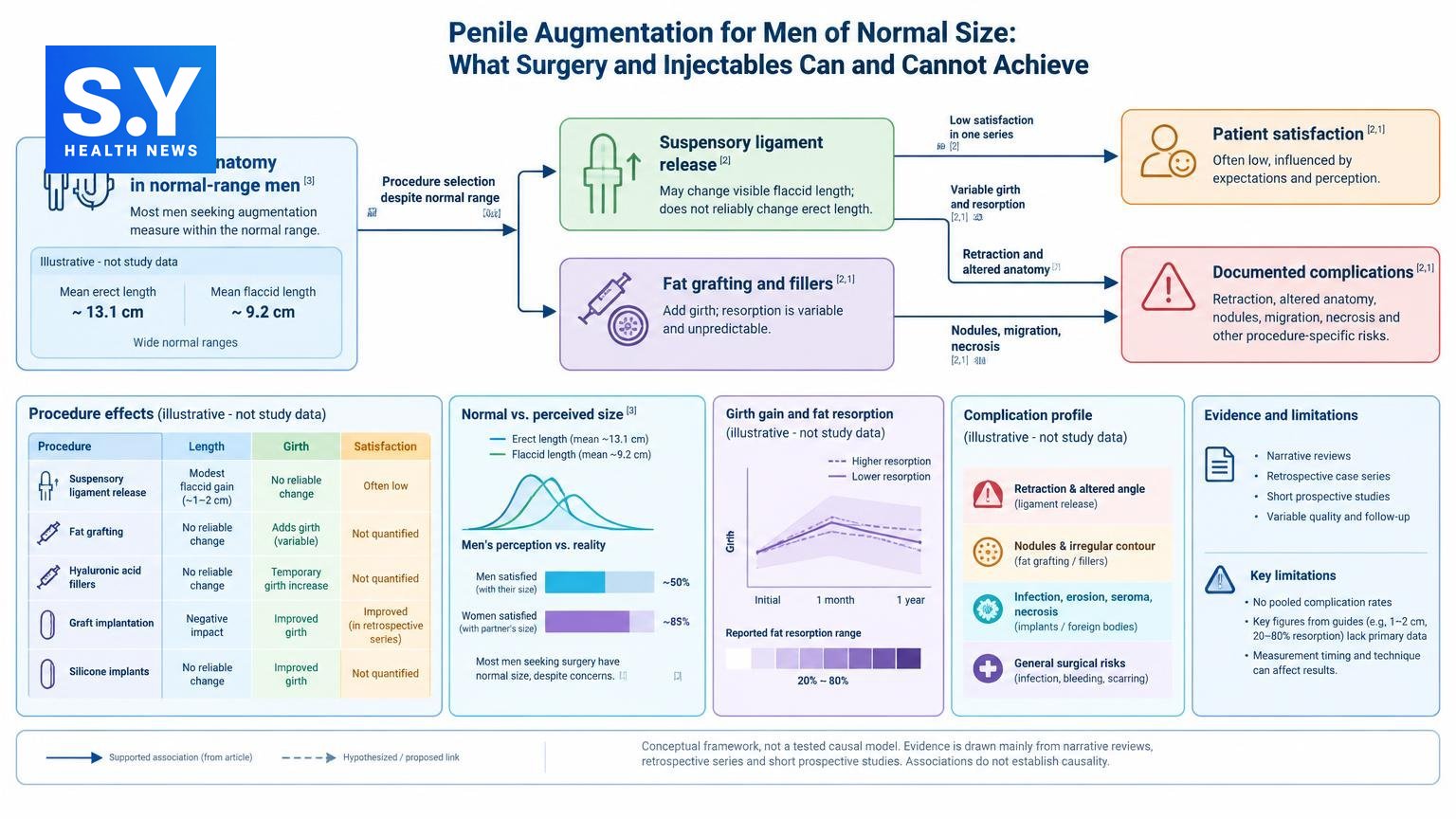
The two operations most commonly performed are suspensory ligament release, which changes visible flaccid length, and autologous fat grafting, which adds girth; neither reliably changes erect length. Published averages for ligament release are about 1–2 cm of flaccid length in study series, with wide individual variation. In one series, only about a third of men were satisfied, mainly because expectations exceeded what surgery delivers.[2]
Hyaluronic acid fillers appear better tolerated than other injectables in prospective studies, but follow-up is short. Penile graft implantation improved girth and satisfaction in retrospective series while having a negative impact on length. Silicone implants carry risks of infection, erosion, seroma and necrosis, with removal rates up to 10%.
Why This Matters: Normal Measurements and Misdirected Demand
Before evaluating any procedure, the question that matters first is whether the measurement is actually abnormal. A systematic review of clinician-measured data from up to 15,521 men found mean erect length of about 13.1 cm and mean flaccid length of about 9.2 cm, with wide normal ranges for both. Yet in a 2002 study that measured men presenting for penile lengthening surgery, most had penile size within the normal range.[3]
This mismatch between measured anatomy and perceived need is central to the augmentation literature. A large survey of more than 50,000 adults reported that only about half of men were satisfied with their own penis size, while 85% of women were satisfied with their partner's size. The gap suggests that dissatisfaction is often driven by self-perception rather than by a measurable deficit, and it explains why an operation designed to change anatomy may not resolve the concern that prompted it.
No pill, cream or supplement has evidence for permanent penile size gains. A systematic review by Marra and colleagues in 2020 concluded that in men of normal penile size, many augmentation procedures carry high complication rates and uncertain satisfaction.
Biological and Anatomical Mechanisms: What Each Procedure Changes
Understanding what a procedure can and cannot change requires distinguishing visible flaccid length from stretched and erect length. Suspensory ligament release does not lengthen the erectile bodies themselves; it changes one anatomic relationship, allowing tissue that is normally suspended internally to hang more externally. The visible result is a modest increase in flaccid appearance, while erect length, which is determined by internal structures the operation does not touch, remains largely unchanged.[4]
Autologous fat grafting adds volume under the penile skin to increase girth. Its principal limitation is biological: the body resorbs a variable proportion of injected fat. This guide reports published resorption estimates ranging from 20% to 80% across studies. Because resorption is unpredictable and sometimes uneven, the appearance in the first month is often not the appearance that remains after a year, and irregular contour or nodules may require revision.
Hyaluronic acid fillers also add girth temporarily without surgery. Their advantage is that they can be dissolved with an enzyme if the result is unsatisfactory, but they carry their own risks of irregular nodules, migration and inflammation. Graft implantation and silicone implants work through different tissue layers and carry distinct complication profiles, discussed below.
What the Evidence Shows: Length, Girth and Satisfaction
| Procedure | Reported effect | Satisfaction signal | Key documented risk |
|---|---|---|---|
| Suspensory ligament release | Published study averages about 1–2 cm flaccid length gain; erect length largely unchanged; wide individual variation | About one third satisfied in one series, attributed mainly to unmet expectations | Scar retraction that can make the penis look shorter than before; altered erection angle and skin sensation |
| Autologous fat grafting | Adds girth; injected fat resorption reported at 20–80% across studies; result not durable or predictable | Not quantified in the cited guide; uneven resorption can require revision | Irregular contour, nodules, need for revision surgery |
| Hyaluronic acid filler | Temporary girth increase; better tolerated than other injectables in prospective studies but short follow-up | Not quantified; dissolvable if unsatisfactory | Nodules, migration, inflammation |
| Graft implantation | Improved girth and satisfaction in retrospective series; negative impact on penile length | Improvement reported in retrospective series | Retrospective design limits inference; effect sizes not stated |
| Silicone implants | Prospective cohorts report risks of infection, erosion, seroma and necrosis | Severe deformities in some cases; removal rate up to 10% | Removal rate up to 10%; infection, erosion, necrosis |
Two features of this evidence deserve emphasis. First, the length figures for ligament release are study averages, not individual predictions; some men gain much less, some see little change, and some experience retraction that makes the penis appear shorter. Second, satisfaction in published surgical series is often low and expectation-dependent, which is consistent with the observation that men of normal size who are highly concerned frequently remain dissatisfied even after a technically uncomplicated procedure.
The 2026 narrative review adds an important evidence-quality dimension. Its positive findings on hyaluronic acid come from prospective studies but with short follow-up; its findings on graft implantation come from retrospective series, which cannot control for selection or reporting; and its findings on silicone implants come from prospective cohorts but describe serious harms including removal in up to 10% of cases. These designs answer different questions with different degrees of certainty, and none establishes that augmentation reliably improves erect length.
Documented Risks and Complications
Suspensory ligament release may be followed by scar retraction pulling the penis back, so some men look shorter than before surgery. Erection angle may change because the supporting ligament has been cut, and skin sensation may change. Cosmetic genital surgery also carries general surgical risks of infection, bleeding and scarring, and recovery typically requires avoiding sexual intercourse for about 4 to 6 weeks, with several months of traction or weighting to reduce retraction after ligament release.
The complications associated with unregulated or foreign-body injections are more severe. Retrospective case series describe unapproved oil-based substances injected in non-sterile conditions, producing sclerosing lipogranuloma that required complex treatment such as tissue excision and skin transplantation; the prevalence of this practice is unknown. Retrospective reports of foreign-body implantation for sexual pleasure describe pain, erosion, inflammation, nodules, skin ulcer, necrosis, penile deformity, gangrene and even death. Liquid silicone, oils or unknown substances, and procedures by non-physicians, have caused tissue necrosis and permanent deformity.
A surgeon-authored treatment page frames the practical interpretation: complication probability and importance vary with anatomy, treatment extent, medical history and technique, so risk cannot be reduced to a single generic percentage copied across every patient. The same page notes that a fixed erect-length gain cannot be guaranteed and that surgery can alter erection angle, support, scar behaviour or satisfaction without solving comparison-driven distress.
Interpretation and Limitations
The evidence base is uneven. Much of it consists of retrospective case series and narrative review rather than controlled prospective trials with long follow-up. Several key figures, including the 1–2 cm flaccid gain and the 20–80% fat resorption range, are summarized secondhand in clinic guides rather than presented with primary pooled data in the reviewed sources. The absence of pooled complication rates makes it difficult to give men numerical risk estimates, and the commercial context of some sources warrants caution.
Measurement is another limitation. Swelling and scar maturation can obscure early measurement, so long-term assessment requires standardized measurement conditions and functional review. Early firmness or asymmetry should not be mistaken for the mature result unless a specific complication is suspected. This matters because premature revision on the basis of early appearance can compound risk.
Finally, the American Urological Association has stated that fat injection for girth and suspensory ligament release in men of normal size have not been proven safe and effective. This is a policy position, not a trial result, but it reflects the same gap between popularity and evidence that runs through the literature.
Research Outlook and Clinical Implications
The 2026 narrative review calls for further research to manage patients requesting penile augmentation successfully, and its authors recommend a multidisciplinary approach. In practice, that means evaluation should begin with objective measurement and an assessment of body-image context and erectile function before any procedure is discussed. When the dominant concern is not something the procedure can change, no treatment remains a valid outcome rather than a failure of care.
For clinicians and patients, the practical implications are clear. Ligament release should be discussed as a procedure that may modestly change visible flaccid length while leaving erect length largely unchanged and carrying real risks of retraction, altered angle and sensory change. Fat grafting should be discussed as a temporary and unpredictable girth intervention with resorption that varies widely. Hyaluronic acid filler is the least invasive option but remains temporary and not risk-free. Silicone implants and unregulated injections carry the most serious documented harms.
Key Takeaways
- Most men who seek penile augmentation measure within the normal range, and mean erect length in large measurement reviews is about 13.1 cm with a wide normal range.
- Suspensory ligament release changes visible flaccid length by published averages of about 1–2 cm; it does not reliably change erect length, and some men experience retraction that makes the penis look shorter.
- Autologous fat grafting adds temporary girth, but resorption is reported at 20–80% across studies and can produce irregular contours requiring revision.
- Hyaluronic acid fillers are better tolerated than other injectables in prospective studies, but follow-up is short and risks include nodules, migration and inflammation.
- Silicone implants carry documented risks of infection, erosion, seroma and necrosis, with removal rates up to 10%.
- Unapproved oil-based injections and foreign-body implantation have caused sclerosing lipogranuloma, tissue necrosis, permanent deformity and death in retrospective reports.
- In one ligament-release series, only about one third of men were satisfied, largely because expectations exceeded what surgery can deliver.
Questions and Answers
What does suspensory ligament release actually achieve in penile length?
Suspensory ligament release changes visible flaccid length by published study averages of about 1–2 cm, with wide individual variation. It does not lengthen the erectile bodies themselves, so erect length is largely unchanged. Some men gain little or nothing, and scar retraction can make the penis look shorter than before surgery. No fixed length gain can be guaranteed for any individual.
How effective is autologous fat grafting for penile girth?
Fat grafting adds girth temporarily, but the body resorbs a variable proportion of injected fat, reported at 20–80% across studies. The result in the first month is often not the result at one year, and uneven resorption can cause nodules or irregular contour requiring revision. It is not a reliable or permanent method for increasing penile girth.
Are penile fillers safer than penile surgery?
Hyaluronic acid fillers are better tolerated than other injectables in prospective studies and can be dissolved with an enzyme if the result is unsatisfactory, so they avoid irreversible structural change. However, follow-up in those studies is short, and fillers carry risks of nodules, migration and inflammation. They are not risk-free, and they do not reliably increase erect length.
What satisfaction rates are reported after penile augmentation surgery?
Satisfaction varies and is often low relative to expectations. In one ligament-release series, only about a third of men were satisfied, mainly because expectations exceeded what surgery could deliver. A 2020 systematic review concluded that in men of normal penile size, many augmentation procedures carry high complication rates and uncertain satisfaction. These figures are study findings, not predictions for any individual.
What are the most serious documented complications of penile augmentation?
Documented complications include infection, bleeding and scarring for all genital surgery; scar retraction, altered erection angle and sensory change after ligament release; irregular fat resorption and nodules after grafting; and infection, erosion, seroma and necrosis with silicone implants, which have a removal rate up to 10%. Unapproved oil-based injections and foreign-body implantation have caused sclerosing lipogranuloma, tissue necrosis, permanent deformity and death in retrospective reports.
Do most men seeking penile enlargement actually have a normal penis size?
Yes, most men who seek penile lengthening measure within the normal range. A review of clinician-measured data from up to 15,521 men found mean erect length of about 13.1 cm with a wide normal range, and a 2002 study that measured men presenting for lengthening surgery found most were within normal limits. This is why objective measurement and assessment of body-image concerns should come before any procedure.
Conceptual framework: Conceptual framework, not a tested causal model. In men of normal penile size, suspensory ligament release and volume procedures are selected despite normal baseline measurements. Supported arrows indicate reported associations: ligament release with modest flaccid change, variable satisfaction and risk of retraction; fat grafting and fillers with unpredictable girth, resorption and complications. Evidence is drawn mainly from narrative reviews, retrospective series and short prospective studies.
Academic References & Evidence
- Mahmood Ramazan; Louise Faurholt Øbro; Majken Højrup Wiborg; Mikkel Fode; Christian Fuglesang S. Jensen; Palle Jörn Sloth Osther; Grzegorz Fojecki. Complications of penile augmentation: A narrative review of injectables, implants, and surgical grafts. International Journal of Impotence Research. 2026 38(3):238-246 DOI: 10.1038/s41443-025-01190-8.
- ผ่าตัดเพิ่มขนาด: มีวิธีไหนจริง ความเสี่ยง และข้อจำกัด.
- เพิ่มขนาดน้องชาย: ขนาดปกติ อะไรได้ผลจริง ความเสี่ยง.
- Penile Lengthening.
SANYUN Science Center explains published research on men's reproductive and sexual health, connecting scientific evidence with everyday questions while making sources and limitations clear.
Disclaimer: This article is for scientific education and research communication only. It does not provide medical advice, diagnosis, or individualized treatment recommendations, and does not endorse any medication, supplement, device, penile enlargement procedure, or other intervention. Decisions about sexual and reproductive health should be made in consultation with a qualified healthcare professional. Do not delay seeking professional care because of information in this article.
Original Content & Copyright Notice
- This article is prepared for SANYUN Science Center, drawing on published research and publicly available academic literature on men’s sexual and reproductive health. Its editorial explanations and presentation are developed for this platform.
- Copyright in the original editorial content, selection, and arrangement is reserved by SANYUN Science Center to the extent protected by applicable law. Referenced research, quotations, and third-party materials remain subject to the rights of their respective owners. This notice does not claim ownership of scientific facts or third-party research.
- Except where permitted by applicable law or an applicable license, prior written permission is required to reproduce, republish, translate, adapt, redistribute, or commercially reuse protected content. Attribution alone does not grant permission for such reuse.
- For permitted quotation or authorized reuse, clearly identify the source and retain a link to the original article.
- Source: SANYUN Science Center
- Original URL: Retain the original article URL on science.san-yun.com.
- Copyright Holder: SANYUN Science Center, for its own protected editorial content.
- Quotation, excerpts, or authorized reuse must not distort the scientific meaning, omit material limitations or disclaimers, or imply unverified medical claims, product efficacy, or endorsement by SANYUN Science Center.



