




Category: Penis Enlargement
Core Research Direction: What a Chinese expert consensus on penile augmentation surgery recommends for indications, preoperative evaluation, surgical methods, material selection, and complication prevention — and what remains without unified standards.
Search Intent: What does the current Chinese expert consensus say about who should undergo penile augmentation, how it should be evaluated and performed, and what evidence gaps and risks remain?
Platform: SANYUN Science Center
Evidence reviewed through: 2026-11-02
Executive Summary
A Chinese expert consensus on penile augmentation surgery (阴茎增粗术专家共识), published in the Chinese Journal of Andrology, was developed by the Private Plastic Surgery and Industry Branch of the China Sexology Association with input from specialists in the field. It draws on recent domestic and international literature together with Chinese clinical practice, and its stated goals are to standardize surgical indications and methods, reduce complications and improve patient satisfaction.[1]
Its definition is deliberately functional rather than anatomical. The procedure is described as an operation intended to improve penile appearance, improve sexual quality of life and reduce sexual-psychological stress. That framing places appearance and psychological wellbeing at the center of the indication, which is unusual among surgical consensus documents and matters for how the operation is judged successful.
Most importantly for readers weighing the evidence, the consensus itself acknowledges that preoperative evaluation, surgical methods and material selection for this operation were not yet governed by unified standards. The document therefore functions as a structured starting point for harmonizing practice — a professional attempt to reduce variation — rather than as a demonstration that any one approach is superior.
Why This Matters
Penile augmentation sits in an awkward evidentiary position. Demand is driven substantially by appearance concerns and sexual self-confidence rather than by a measurable functional deficit, yet the operations involved are irreversible, carry real complication risks, and are performed on tissue with limited capacity for reconstruction once compromised. When the field's own experts state that indications, assessment pathways and material choices lack unified standards, patients and clinicians are both operating with less guidance than most surgical procedures enjoy.
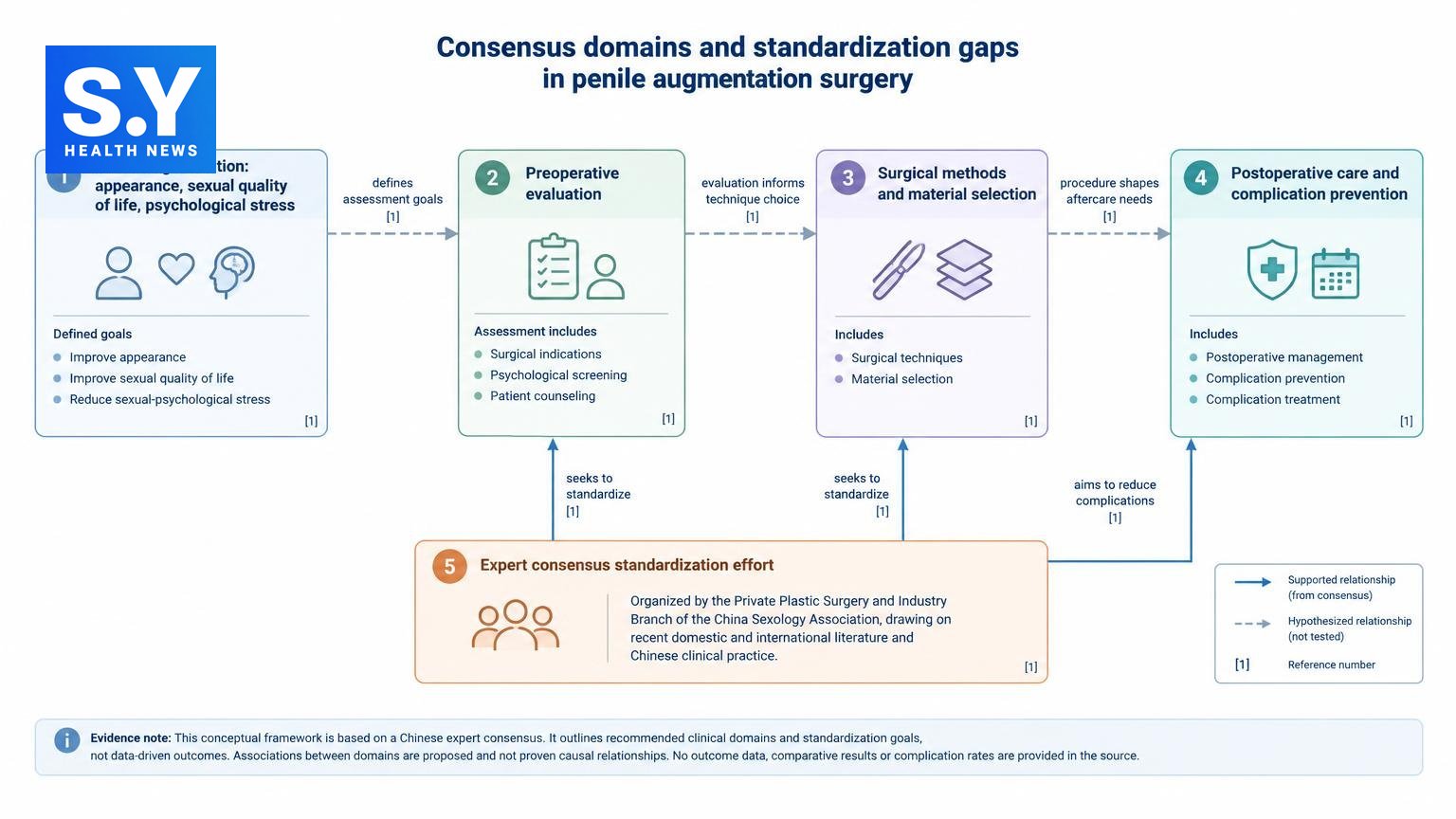
The consensus scope is broad: it addresses surgical indications, preoperative evaluation, surgical techniques, postoperative management, prevention and treatment of complications, and efficacy. Taken together, that list maps a complete clinical pathway, and the fact that each element is addressed in a single document is itself a signal that no single element had previously been settled.
For an international readership, the document is useful in two ways: as a summary of what a major national professional body considers the relevant decision points, and as an honest inventory of what the specialty still lacks. The second contribution may be the more durable one.
How the Consensus Frames the Procedure
The definitional sentence does much of the conceptual work. By naming three aims — appearance, sexual quality of life and reduction of sexual-psychological stress — the consensus establishes that the outcome of interest is experiential rather than dimensional. A millimeter change in girth is not, in this framing, the endpoint; patient-reported appearance satisfaction, sexual experience and psychological relief are.
That has an important methodological consequence. If the goal is psychosocial, then outcome assessment must include validated patient-reported measures and psychological screening, not only surgical metrics such as graft retention or wound healing. The supplied consensus text does not detail which instruments it recommends, so this is a logical implication of its stated aims rather than a documented recommendation.
The framing also raises a gatekeeping question the consensus acknowledges only implicitly through its call for standardized indications. A procedure whose primary target is appearance and psychological distress requires a way to distinguish patients who will plausibly benefit from those whose concerns reflect a body-image disorder, unrealistic expectations or a treatable psychological condition. Whether the consensus addresses this in detail cannot be determined from the supplied material, and that gap is itself worth flagging.
What the Consensus Covers
The document's scope is explicitly enumerated. It addresses who should undergo the operation (surgical indications), how patients should be assessed beforehand (preoperative evaluation), how the operation should be performed (surgical methods), what happens afterward (postoperative management), how complications should be prevented and treated, and what is known about efficacy.
| Consensus Domain | What the Domain Covers | Interpretive Significance |
|---|---|---|
| Definition and purpose | Surgery aimed at improving penile appearance, improving sexual quality of life and reducing sexual-psychological stress | Establishes an appearance- and psychology-oriented endpoint rather than a purely dimensional one |
| Surgical indications | Who should be considered for the procedure | The consensus treats indications as something requiring standardization, implying prior variation |
| Preoperative evaluation | The assessment pathway before surgery | Explicitly described as lacking unified standards at the time of writing |
| Surgical methods | Techniques used to achieve augmentation | Also described as lacking unified standards; no comparative efficacy data supplied |
| Material selection | Choice of materials used in the procedure | Named as a third domain without unified standards |
| Postoperative care and complications | Aftercare, prevention and treatment of complications | Consistent with a stated aim of reducing surgical complications |
| Efficacy | What is known about outcomes | Listed within scope; specific efficacy findings are not contained in the supplied text |
What the Evidence Shows — and What It Does Not
The supplied material is a consensus abstract, not a trial report. It contains no sample sizes, follow-up durations, complication rates, satisfaction scores or comparisons between techniques. Readers should therefore not expect, and this review does not provide, estimates of how often penile augmentation succeeds, how often it causes harm, or which method performs best.
What the consensus does establish is a professional position on the state of the field. It documents that a major national association considered the absence of unified standards for preoperative evaluation, surgical methods and material selection important enough to convene experts and produce guidance. That is a claim about the state of practice, and it is a credible one coming from the body that organized the process.
The stated rationale — standardizing indications and methods, reducing complications and improving satisfaction — reveals the consensus group's implicit theory of change. Variation in practice is assumed to drive complications and dissatisfaction, and standardization is assumed to reduce them. That is a reasonable hypothesis widely applied in surgery, but it is a hypothesis. The supplied text does not report data showing that standardization achieved these goals.
Interpretation and Limitations
Several limitations constrain how far this document can be read. First, it is an expert consensus, a genre that synthesizes opinion informed by literature and practice rather than a systematic review or a controlled comparison. Consensus documents are valuable for encoding collective judgment but are vulnerable to the biases of their participants and to gaps in the underlying literature.
Second, the supplied text describes the evidence base only generally — recent domestic and international literature combined with Chinese clinical practice. It does not specify how literature was searched, how recommendations were graded, or how disagreement among experts was resolved. These methodological details determine how much weight a consensus can bear, and without them the document should be read as expert guidance rather than as a graded evidence product.
Third, the document is context-specific. It was developed within Chinese clinical practice and published in a Chinese andrology journal, and its recommendations reflect that setting's patient population and procedural norms. Whether specific techniques, materials or thresholds translate to other health systems is a question the consensus cannot answer for them.
Fourth, and most fundamentally, the consensus states its own central problem: unified standards for evaluation, methods and materials did not exist. A document that standardizes an area previously lacking standards is a beginning, not a validation. Its recommendations should be understood as a proposed framework to be tested and revised, not as established best practice with demonstrated superiority.
There is also a structural risk specific to appearance-driven surgery. When the indication is psychological and aesthetic rather than reconstructive, satisfaction depends heavily on expectation management, patient selection and counseling quality. A consensus focused on operative technique and materials may under-specify exactly the non-surgical determinants that most influence whether patients feel their decision was right. The supplied text lists preoperative evaluation within scope but does not reveal how much emphasis it gives to psychological assessment.
Research and Practice Outlook
The most useful next step the field could take is prospective outcome measurement aligned with the consensus's own stated aims. If appearance, sexual quality of life and psychological stress are the targets, then registries and cohort studies should record validated patient-reported measures before and after surgery, alongside standardized complication reporting. Without such data, standardization remains a procedural exercise rather than an evidence-generating one.
A second priority is comparative work on techniques and materials. The consensus names material selection as an area without unified standards, which implies that multiple approaches coexist. Head-to-head or well-adjusted observational comparisons of those approaches, with adequate follow-up, would allow future consensus iterations to move from describing options to ranking them. The current document does not supply such comparisons.
A third priority concerns patient selection. Defining indications rigorously means characterizing who benefits and who does not, including patients whose concerns are better addressed through counseling or psychological care. Consensus statements can set expectations here, but only longitudinal follow-up of screened and unscreened populations can show whether those expectations hold.
For clinicians, the practical takeaway is to treat this consensus as a checklist of decision domains rather than a treatment algorithm. It identifies what must be deliberated — indication, assessment, technique, material, aftercare and complication planning — without resolving the choices within each domain. For patients, the most honest reading is that penile augmentation remains a field in the process of standardizing itself, and that any decision should be informed by that uncertainty.
Key Takeaways
- A Chinese expert consensus defines penile augmentation as surgery to improve penile appearance, improve sexual quality of life and reduce sexual-psychological stress — an appearance- and psychology-oriented endpoint.
- The consensus was organized by the Private Plastic Surgery and Industry Branch of the China Sexology Association, drawing on recent domestic and international literature and Chinese clinical practice.
- It states that preoperative evaluation, surgical methods and material selection lacked unified standards at the time of writing, which is the document's central justification.
- Its scope covers indications, preoperative evaluation, surgical methods, postoperative management, complication prevention and treatment, and efficacy.
- The document is expert consensus, not a systematic review or controlled trial; it reports no complication rates, satisfaction scores or technique comparisons in the supplied material.
- Its recommendations should be read as a proposed framework for standardization, not as validated best practice with demonstrated superiority.
Questions and Answers
What is penile augmentation surgery according to the Chinese expert consensus?
The consensus defines it as an operation intended to improve penile appearance, improve sexual quality of life and reduce sexual-psychological stress. The definition is appearance- and psychology-oriented rather than focused on a specific dimensional target, which means success is framed around patient experience and wellbeing rather than a measured increase alone.
Why did the China Sexology Association develop a consensus on penile augmentation?
The Private Plastic Surgery and Industry Branch of the China Sexology Association organized experts who combined recent domestic and international literature with Chinese clinical practice. Their stated aims were to standardize surgical indications and methods, reduce complications and improve patient satisfaction — goals that imply meaningful variation in how the operation was being performed.
Does the consensus establish unified standards for preoperative evaluation and surgical technique?
No. The consensus itself states that preoperative evaluation, surgical methods and material selection had no unified standards at the time of writing. The document is therefore an attempt to move toward standardization, not a report of standards already agreed and validated across the field.
What topics does the penile augmentation consensus cover?
Its stated scope includes surgical indications, preoperative evaluation, surgical methods, postoperative management, prevention and treatment of complications, and efficacy. Together these cover the full clinical pathway, although the supplied material does not disclose the specific recommendations made within each of these domains.
How strong is the evidence behind this penile augmentation consensus?
It is expert consensus, which synthesizes informed opinion from literature and practice rather than testing interventions against comparators. The supplied text reports no sample sizes, complication rates or technique comparisons, and does not detail how evidence was searched or graded. It should be read as expert guidance, not as a systematic review or clinical trial.
What should patients understand before considering penile augmentation surgery?
The consensus describes a field still developing unified standards for assessment, technique and materials, so variation in practice is likely. Because the stated goals are appearance and psychological wellbeing, candid discussion of expectations and complications matters. Any decision about surgery is individual and should be made with a qualified clinician familiar with the specific procedure.
Conceptual framework: Conceptual framework of the consensus's clinical domains. The defined goals of penile augmentation (appearance, sexual quality of life, psychological stress) are linked to assessment, technique and aftercare; arrows from the consensus effort indicate domains it aims to standardize where unified standards were lacking. The links between clinical domains are proposed and not tested causal relations. Based on a Chinese expert consensus; it reports no outcome data.
Academic References & Evidence
- 袁明振; 武志刚; 方丹波; 郭巍. 阴茎增粗术专家共识. 中国男科学杂志 38(4)
SANYUN Science Center explains published research on men's reproductive and sexual health, connecting scientific evidence with everyday questions while making sources and limitations clear.
Disclaimer: This article is for scientific education and research communication only. It does not provide medical advice, diagnosis, or individualized treatment recommendations, and does not endorse any medication, supplement, device, penile enlargement procedure, or other intervention. Decisions about sexual and reproductive health should be made in consultation with a qualified healthcare professional. Do not delay seeking professional care because of information in this article.
Original Content & Copyright Notice
- This article is prepared for SANYUN Science Center, drawing on published research and publicly available academic literature on men’s sexual and reproductive health. Its editorial explanations and presentation are developed for this platform.
- Copyright in the original editorial content, selection, and arrangement is reserved by SANYUN Science Center to the extent protected by applicable law. Referenced research, quotations, and third-party materials remain subject to the rights of their respective owners. This notice does not claim ownership of scientific facts or third-party research.
- Except where permitted by applicable law or an applicable license, prior written permission is required to reproduce, republish, translate, adapt, redistribute, or commercially reuse protected content. Attribution alone does not grant permission for such reuse.
- For permitted quotation or authorized reuse, clearly identify the source and retain a link to the original article.
- Source: SANYUN Science Center
- Original URL: Retain the original article URL on science.san-yun.com.
- Copyright Holder: SANYUN Science Center, for its own protected editorial content.
- Quotation, excerpts, or authorized reuse must not distort the scientific meaning, omit material limitations or disclaimers, or imply unverified medical claims, product efficacy, or endorsement by SANYUN Science Center.



