




Category: Penile Size
Core Research Direction: Evidence-based evaluation and clinical management of penile size dissatisfaction: distinguishing micropenis, buried penis, and penile dysmorphic disorder, and the varying risk/satisfaction profiles of penile enhancement procedures
Search Intent: Which men seeking penile enhancement are appropriate candidates, and what do the available procedures and professional society recommendations actually show about benefits and complications?
Platform: SANYUN Science Center
Evidence reviewed through: 2026-11-11
Executive Summary
Penile enhancement covers injections, modeling, exercises, or surgery intended to increase penile length or girth, and the available options differ substantially in evidence base, regulatory status, and complication rates. Current professional society guidance emphasizes that evaluation must first distinguish normal variation and psychological concerns from specific diagnoses such as micropenis, adult-acquired buried penis (AABP), and penile dysmorphic disorder (PDD). This review interprets a professional society summary of that guidance rather than presenting new experimental data.[1]
The most consistent message across the sourced material is that many men who believe their penis is too small have normal-sized anatomy, and that motivation assessment is central to candidacy. Men with PDD are described as unlikely to benefit from augmentation and should be referred for psychological evaluation before cosmetic intervention is considered. For men who proceed, injectable fillers are commonly used off-label, with hyaluronic acid described as having the most favorable safety profile among the three fillers discussed, while fat transfer and silicone implants carry regulatory and safety concerns.
The evidence summarized here is largely expert guidance and descriptive clinical experience. It supports careful patient selection and realistic counseling but does not provide comparative trial data, quantified complication rates, or long-term outcome measures that would allow strong claims about the superiority of one procedure over another.
Why This Matters
Dissatisfaction with penile size is a common reason men seek medical or commercial products, and the pathway to care is often indirect. Men dissatisfied with penile size may pursue enhancement products before consulting a healthcare professional, and online marketing can present exaggerated promises such as rapid multi-inch growth for products not approved by the U.S. Food and Drug Administration. This creates a clinical responsibility to ask about what patients have already tried, including self-injected substances, which can cause infection.
The stakes are asymmetric. Some options are performed off-label with recognized but incompletely quantified risks, others are not recommended by major urological bodies because of infection and necrosis concerns, and at least one approved implant is associated with higher rates of postoperative curvature and deformation even as some recipients report satisfaction. Without a structured evaluation, men may receive procedures that do not address their actual problem or may be harmed by unregulated products.
Size curiosity itself is not a disorder. The sourced material notes that general curiosity can sometimes give way to obsession and anxiety about penis size, which is a reason to treat the consultation as an opportunity for education and, where indicated, psychological assessment rather than as a transaction for a cosmetic procedure.
Biological and Clinical Mechanism: Why 'Small' Is Not One Diagnosis
The evaluation framework recommended by the Fifth International Consultation on Sexual Medicine (ICSM 2024) rests on distinguishing three presentations that can look similar to a patient but have different management. Micropenis refers to a genuinely small penis, adult-acquired buried penis (AABP) involves the penis being concealed by surrounding tissue, and penile dysmorphic disorder (PDD) is a psychological condition in which the perceived defect is disproportionate to or absent from actual anatomy. The guidance stresses that a deep understanding of these differences is important, and that treatments differ accordingly.
In PDD, the problem is not primarily anatomical, so anatomical intervention is unlikely to resolve it. The guidance states that patients with PDD are unlikely to benefit from penile augmentation or girth enhancement and should be referred for psychological evaluation and treatment before cosmetic intervention is considered. This is a clinical recommendation grounded in expert consensus rather than a comparative trial, but it follows from the logic that a procedure aimed at anatomy cannot correct a distorted body perception.
Coexisting physical conditions also shape the mechanism of dissatisfaction. Providers should take into account existing conditions such as Peyronie's disease, which may require separate treatment. Peyronie's disease involves penile curvature or deformity, and a procedure intended to increase girth or length may interact with that condition or fail to address the curvature that is driving distress.
The most basic mechanism-related fact in the source is that most men who think their penises are too small have perfectly normal-sized penises. This means that for many patients, the anatomy is within normal limits and the clinical task is to understand why the perception differs from the measurement. That understanding determines whether the patient is a candidate for observation, counseling, psychological referral, or a physical intervention.
What the Evidence Shows: Procedure by Procedure
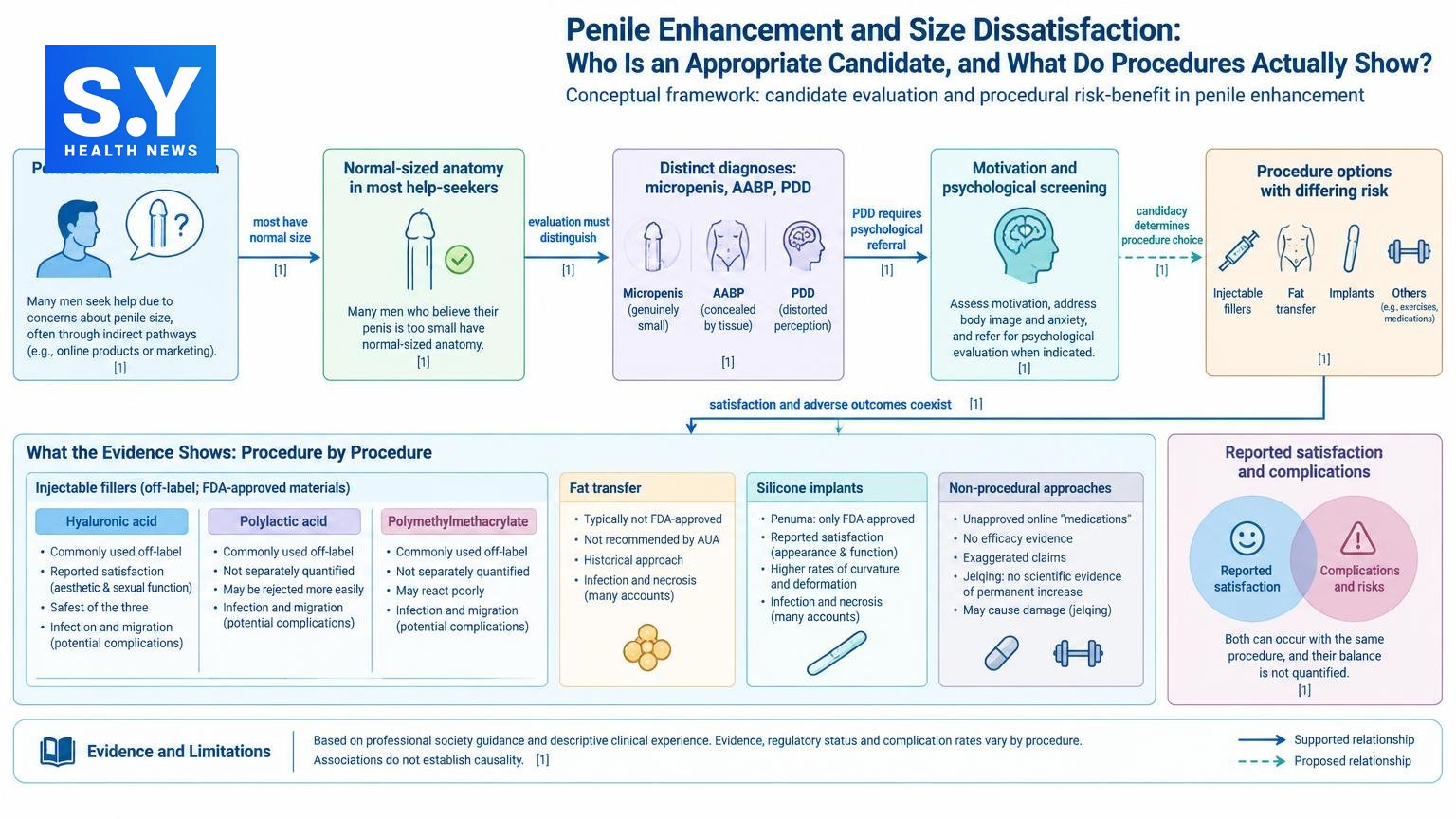
The evidence summarized in the source is best read as a map of what is known, what is uncertain, and what is not recommended. It is not a systematic review, and the source does not provide numerical complication rates, sample sizes, or follow-up durations for most procedures. The table below organizes the main options by what the source reports about their status, reported outcomes, and stated concerns.
| Procedure or product | Regulatory or guidance status | What is reported about outcomes | Main stated concerns |
|---|---|---|---|
| Hyaluronic acid injectable filler | Commonly used off-label; FDA-approved filler material | Patients have reported satisfaction with aesthetic and sexual function results | Infection and migration are potential complications; described as the safest of the three fillers discussed |
| Polylactic acid injectable filler | Commonly used off-label; FDA-approved filler material | Not separately quantified in the source | May be rejected more easily as a foreign material; infection and migration are potential complications |
| Polymethylmethacrylate injectable filler | Commonly used off-label; FDA-approved filler material | Not separately quantified in the source | May react poorly; infection and migration are potential complications |
| Fat transfer | Typically not FDA-approved; not recommended by the American Urological Association | Historical approach involving fat tissue implants under the skin | Many accounts of infection and risk of necrosis |
| Silicone implants other than Penuma | Typically not FDA-approved; not recommended by the American Urological Association | Not separately quantified in the source | Many accounts of infection and risk of necrosis |
| Penuma silicone implant | Described as the only FDA-approved silicone penile implant | Patients have reported satisfaction with appearance and function | Higher rates of postoperative penile curvature and deformation than comparators, though numerical rates are not given in the source |
| Unapproved online 'penile growth medications' | Not FDA-approved | No efficacy evidence presented; marketed with exaggerated claims | Exaggerated promises such as rapid multi-inch growth on questionable websites |
| Jelqing exercises | Not a regulated medical procedure | No scientific evidence of permanent size increase | May cause penile damage in some cases |
Injectable fillers are the most common off-label FDA-approved options for penile enhancement in the source's account. Among the three discussed, hyaluronic acid is described as the safest, with a relatively low complication rate. Patients who have received hyaluronic acid injections have reported satisfaction with both aesthetic and sexual function results. These are patient-reported satisfaction statements without a reported denominator, study design, or follow-up period, so they cannot be used to estimate the proportion of patients who are satisfied or the durability of that satisfaction.
The comparative safety statements about polylactic acid and polymethylmethacrylate are hypotheses or clinical impressions rather than quantified findings. Polylactic acid, as a foreign material, may be rejected more easily, and polymethylmethacrylate, primarily used as a bone glue, may also react poorly. Across injectable fillers, potential complications include infection and migration, but the source does not give frequencies, timing, or risk factors. The additional warning that patients may attempt to implant their own DIY filler, which can cause infection, is important because self-treatment falls outside any clinical safety net.
Fat transfer and silicone implants have a more troubled regulatory and safety profile in the sourced summary. They are practiced across North America, but they are typically not approved by the FDA and are not recommended by the American Urological Association, reflecting many accounts of infection and risk of necrosis. The only FDA-approved silicone penile implant is the Penuma, which is associated with higher rates of postoperative penile curvature and deformation. Even so, patients who have received the Penuma implant have reported satisfaction with their penis's appearance and function. The coexistence of reported satisfaction and higher rates of curvature and deformation is not a contradiction; it indicates that satisfaction and adverse outcomes can occur in the same procedure population, and that the balance between them is not quantified in the source.
Non-procedural approaches are addressed more briefly. There is no scientific evidence that jelqing permanently increases penile size, and it may cause penile damage in some cases. Ads for penile growth medications not approved by the FDA appear on questionable websites with exaggerated claims, and no efficacy evidence is presented. These are not neutral options simply because they are non-surgical; they carry opportunity costs and, in the case of jelqing and self-injection, direct physical risk.
Interpretation and Limitations
The central interpretive point is that penile enhancement is not a single intervention with a single risk-benefit profile. The source explicitly states that several procedures are available but that evidence, regulatory status, and complication rates vary. Any clinical or patient-facing discussion that treats enhancement as one category will therefore mislead. The appropriate unit of analysis is the specific procedure in the specific patient, with the specific reason for dissatisfaction.
Candidacy is the strongest and most actionable part of the evidence. Understanding a patient's motivation is described as an important part of the evaluation, and cosmetic intervention may not be appropriate for every patient. The guidance to distinguish micropenis, AABP, and PDD is the operational form of that principle. For patients with PDD, referral for psychological evaluation and treatment before cosmetic intervention is considered is the recommended path. This recommendation is expert consensus; it is not derived from a randomized trial and should be understood as a safeguard rather than a proven comparative effect.
The limitations of the underlying evidence are substantial and should be stated plainly. The source is a professional society patient-education and clinical-summary article, not a primary study or systematic review. It does not report sample sizes, follow-up durations, complication frequencies, or validated outcome measures for most procedures. The safety ranking of injectable fillers is described qualitatively, and the satisfaction reports for hyaluronic acid and Penuma lack denominators and comparison groups. The statement that most men who believe their penis is too small have normal-sized penises is an assertion without cited measurement data in the source. These gaps mean that statistical significance cannot be assessed and that clinical significance must be inferred cautiously.
Another limitation is that the source does not quantify the size increase that any procedure achieves. The counseling guidance notes that shape may not be what is desired and that length or girth may only increase by a few inches, but this vague magnitude is not supported by measurement data in the source. Patients and clinicians should not translate 'a few inches' into an expectation for a specific procedure.
Counseling should therefore cover procedure-specific complications, including potential sexual dysfunction, and should set realistic aesthetic expectations. The source also advises providers to ask about procedures found online, including unapproved or self-injected substances, because patients may not volunteer this information. These are process recommendations consistent with the broader candidacy framework rather than outcome claims.
Research and Clinical Outlook
The most recent guidance summarized here, ICSM 2024, signals that the field is consolidating around candidacy and psychological screening rather than around a single superior technique. The next step for clinical practice is to apply that framework consistently: distinguish anatomy from perception, screen for PDD, identify coexisting conditions such as Peyronie's disease, and counsel on procedure-specific risks. The next step for research would be to generate the comparative and longitudinal data that the current guidance lacks, including validated satisfaction measures, complication registries, and long-term follow-up after filler and implant procedures.
Until such data exist, the appropriate clinical posture is cautious and individualized. Men with normal anatomy and distress should not be fast-tracked to cosmetic intervention, and men who pursue procedures should be fully informed that reported satisfaction and reported adverse outcomes can coexist. The absence of evidence for jelqing and the presence of exaggerated online marketing are reasons to redirect patients toward professional evaluation rather than self-treatment.
Key Takeaways
- Penile enhancement includes injections, modeling, exercises, and surgery, and available procedures differ in evidence, regulatory status, and complication rates.
- Evaluation should distinguish micropenis, adult-acquired buried penis, and penile dysmorphic disorder, because their treatments differ.
- Most men who think their penis is too small have normal-sized penises, making motivation assessment and psychological screening central to candidacy.
- Patients with penile dysmorphic disorder are unlikely to benefit from augmentation and should be referred for psychological evaluation before cosmetic intervention is considered.
- Hyaluronic acid is described as the safest of the common injectable fillers, with patient-reported satisfaction, but infection and migration remain potential complications.
- Fat transfer and non-Penuma silicone implants are typically not FDA-approved and are not recommended by the American Urological Association because of infection and necrosis concerns.
- The Penuma implant is described as the only FDA-approved silicone penile implant; patients have reported satisfaction, but it has higher rates of postoperative curvature and deformation.
- There is no scientific evidence that jelqing permanently increases penile size, and it may cause damage; unapproved online growth products have exaggerated claims and no efficacy evidence.
Questions and Answers
What is penile enhancement and what procedures does it include?
Penile enhancement refers to interventions intended to increase penile length or girth, including injections, modeling, exercises, and surgery. The main categories discussed in current guidance are injectable fillers such as hyaluronic acid, polylactic acid, and polymethylmethacrylate; fat transfer; silicone implants, including the Penuma device; and non-procedural approaches such as jelqing. These options differ substantially in regulatory status, evidence, and complication rates.
How do micropenis, buried penis, and penile dysmorphic disorder differ when evaluating penile size concerns?
Micropenis is a genuinely small penis, adult-acquired buried penis involves concealment of the penis by surrounding tissue, and penile dysmorphic disorder is a psychological condition in which the perceived size defect is disproportionate to or absent from actual anatomy. Current guidance stresses that these are distinct diagnoses with different treatments. Patients with penile dysmorphic disorder are unlikely to benefit from augmentation and should be referred for psychological evaluation before cosmetic intervention is considered.
What does the evidence show about satisfaction and complications after injectable penile fillers?
Patients who received hyaluronic acid injections have reported satisfaction with aesthetic and sexual function results, and hyaluronic acid is described as the safest of the three common fillers with a relatively low complication rate. Polylactic acid may be rejected more easily and polymethylmethacrylate may react poorly. Potential complications across fillers include infection and migration, but the source does not provide frequencies, denominators, or follow-up data, so the strength of these comparisons is limited.
Is the Penuma silicone implant safe and effective for penile enhancement?
The Penuma implant is described as the only FDA-approved silicone penile implant, and some patients have reported satisfaction with penile appearance and function. However, it is associated with higher rates of postoperative penile curvature and deformation than comparators, and the source does not provide numerical rates, denominators, or follow-up durations. Satisfaction and adverse outcomes can coexist in the same procedure population, so the balance between benefit and risk requires individualized counseling rather than a blanket claim of safety or efficacy.
Which men are appropriate candidates for penile enhancement procedures?
Appropriate candidacy requires distinguishing normal anatomical variation and psychological concerns from specific diagnoses such as micropenis and adult-acquired buried penis, and assessing the patient's motivation. Most men who believe their penis is too small have normal-sized penises. Cosmetic intervention may not be appropriate for every patient, and those with penile dysmorphic disorder should be referred for psychological evaluation and treatment before cosmetic intervention is considered. Coexisting conditions such as Peyronie's disease also need separate consideration.
Do jelqing exercises or online penile growth products actually increase penis size?
There is no scientific evidence that jelqing permanently increases penile size, and it may cause penile damage in some cases. Products marketed as penile growth medications and not approved by the FDA appear on questionable websites with exaggerated claims of rapid growth, and no efficacy evidence is presented. Patients may also attempt self-injected DIY fillers, which can cause infection. These approaches carry risk without established benefit and should prompt professional evaluation rather than self-treatment.
Conceptual framework: Conceptual framework, not a tested causal model. The diagram summarizes relationships discussed in this evidence review of professional society guidance. It shows that most men concerned about size have normal anatomy, that micropenis, adult-acquired buried penis and penile dysmorphic disorder require different evaluation, and that procedure outcomes include both reported satisfaction and complications. Supported edges reflect stated guidance or reported observations; the proposed edge from screening to procedure choice reflects clinical reasoning rather than trial evidence. The source is expert guidance and descriptive experience, not comparative trial data.
Academic References & Evidence
SANYUN Science Center explains published research on men's reproductive and sexual health, connecting scientific evidence with everyday questions while making sources and limitations clear.
Disclaimer: This article is for scientific education and research communication only. It does not provide medical advice, diagnosis, or individualized treatment recommendations, and does not endorse any medication, supplement, device, penile enlargement procedure, or other intervention. Decisions about sexual and reproductive health should be made in consultation with a qualified healthcare professional. Do not delay seeking professional care because of information in this article.
Original Content & Copyright Notice
- This article is prepared for SANYUN Science Center, drawing on published research and publicly available academic literature on men’s sexual and reproductive health. Its editorial explanations and presentation are developed for this platform.
- Copyright in the original editorial content, selection, and arrangement is reserved by SANYUN Science Center to the extent protected by applicable law. Referenced research, quotations, and third-party materials remain subject to the rights of their respective owners. This notice does not claim ownership of scientific facts or third-party research.
- Except where permitted by applicable law or an applicable license, prior written permission is required to reproduce, republish, translate, adapt, redistribute, or commercially reuse protected content. Attribution alone does not grant permission for such reuse.
- For permitted quotation or authorized reuse, clearly identify the source and retain a link to the original article.
- Source: SANYUN Science Center
- Original URL: Retain the original article URL on science.san-yun.com.
- Copyright Holder: SANYUN Science Center, for its own protected editorial content.
- Quotation, excerpts, or authorized reuse must not distort the scientific meaning, omit material limitations or disclaimers, or imply unverified medical claims, product efficacy, or endorsement by SANYUN Science Center.



