




Category: Penis Enlargement
Core Research Direction: Guideline-level evidence on penile enhancement surgery and management of penile size complaints: what the EAU sexual and reproductive health guidelines actually support
Search Intent: Do clinical guidelines find evidence sufficient to support surgical penis enlargement for girth or length, and how should penile size complaints be assessed?
Platform: SANYUN Science Center
Evidence reviewed through: 2026-11-11
Executive Summary
Men's requests for penile girth or length enhancement surgery are increasing, yet the European Association of Urology (EAU) sexual and reproductive health panel describes the supporting evidence as lacking. In guideline discussions, panel members state that most surgical procedures for penile girth or length enhancement are experimental and should be approached with caution.[1][2]
The guideline chapter on penile abnormalities and penis dysmorphophobia was framed to support evidence-based treatment of penile size complaints and to raise awareness of these conditions. Rather than endorsing a catalogue of enlargement operations, the panel's emphasis falls on careful clinical assessment: a full medical history and precise penile measurements. This article examines what that guideline position means, what it does not establish, and where the evidence gaps remain.
Why This Matters
Penile size anxiety is a common reason for consultation, and the commercial market around enlargement is large. When a guideline panel with responsibility for sexual and reproductive health describes most enhancement procedures as experimental and calls for caution, that is a meaningful signal for clinicians and patients alike. It does not mean every procedure is futile or unsafe in every setting; it means the comparative benefit and harm profile is not established to the standard guideline panels normally require.[3]
The EAU's broader sexual and reproductive health work illustrates how the panel weighs evidence. Its 2025 update on male infertility appraised new evidence through a structured assessment searching Medline, EMBASE and the Cochrane Libraries, with recommendation strength set by balancing desirable and undesirable consequences, evidence quality including certainty of estimates, and variability in patient values and preferences. That methodological approach explains why a field with sparse controlled outcome data tends to produce cautious rather than permissive recommendations.[4]
What the Guideline Evidence Shows — and What It Does Not
The key finding is a negative one, deliberately stated. In the EAU podcast discussion accompanying the new chapter, the panel members linked rising surgical demand to a lack of evidence in this area of urology. Their conclusion follows directly: most surgical procedures for penile girth or length enhancement are experimental and should be approached with caution. That statement is expert guideline commentary rather than a pooled quantitative synthesis, so it should be read as a position on the state of the field, not as an effect estimate.
Equally important is what the same discussion does not claim. No comparative trial data, complication rates or satisfaction figures for specific enlargement techniques are presented in the available material. The guideline's stated purpose is to provide evidence-based treatment and raise awareness, not to certify any particular operation. Readers should treat any claim that a guideline "approves" a specific girth or length procedure with scepticism unless the underlying recommendation and its evidence grade are shown.
| Guideline element | What the source states | How to interpret it |
|---|---|---|
| Surgical enhancement evidence base | Most procedures for penile girth or length enhancement are described as experimental and warrant caution. | Not established as standard of care; benefit and harm remain uncertain. |
| Clinical assessment | Full medical history and precise penile measurements are emphasised. | Assessment precedes any treatment decision; measurements must be documented, not estimated. |
| Guideline aim | To provide evidence-based treatment for penile size complaints and raise awareness. | A stated intent, not evidence that such treatment is already proven. |
| Evidence quality basis | Recommendation strength reflects consequences, evidence certainty and patient values. | Cautious recommendations in low-certainty fields are expected rather than surprising. |
Assessment of Penile Size Complaints: What the Guidelines Emphasise
The most actionable part of the guideline discussion is its clinical emphasis. Clinicians are directed to take a full medical history and perform precise penile measurements when men present with size concerns. Neither source supplies a detailed measurement protocol or accuracy data, so this should be understood as a recommendation-level principle rather than a validated technique. In practice it implies documented, standardised measurement rather than reliance on a patient's estimate or a surgeon's impression, and a history that captures the onset and context of the concern.
The category name used in the guideline chapter, penis dysmorphophobia, is itself informative. It signals that the panel regards some presentations as body-image or psychological concerns rather than anatomical deficits requiring surgery. History-taking is the route by which such distinctions can begin to be made, but the supplied sources do not describe the specific psychological assessment tools or referral pathways used, so this remains a description of guideline emphasis rather than a protocol.
Interpreting the Evidence Honestly
Several limitations shape how far this guideline position can be pushed. The primary statements come from podcast discussions by panel members, not from the full guideline text, recommendation tables or evidence grades. Duplicate podcast sources repeat the same expert opinion rather than adding independent data. The sources contain no sample sizes, follow-up intervals, complication figures or patient-reported outcomes for any enhancement procedure. The conclusion that most procedures are experimental is therefore a judgement about evidence scarcity, not a meta-analytic finding.
A second limitation concerns scope. The 2025 EAU guideline summary that is available in full detail focuses on male infertility, recommending thorough urological assessment and counselling about associated health risks for infertile men and those with abnormal semen parameters. The 2026 guideline update discussion covers hypogonadism, penile curvature, priapism and ejaculation disorders, and reports removal of ineffective treatments and new options such as hyaluronic acid for Peyronie's disease. None of these address penile girth or length enhancement directly, so they should not be used to infer approval or rejection of enhancement surgery.[5]
Evidence scarcity is a recurring theme across these guideline updates, with panel members noting limited high-quality evidence in other sexual and reproductive health areas such as testosterone therapy in prostate cancer survivors and ejaculation disorders. That pattern strengthens the plausibility of the cautious stance on enhancement without adding direct evidence about it. Readers should distinguish this contextual consistency from proof.
Research and Clinical Outlook
The guideline's stated aim of evidence-based treatment and raised awareness points toward better-designed work: standardised measurement, clearly defined outcomes, adequate follow-up and honest reporting of complications. Until such data exist, the panel position is likely to remain one of caution. The 2025 methodology makes the bar explicit: recommendation strength depends on the balance of benefit and harm, certainty of estimates, and patient values. Low-certainty evidence in a field where patient values are variable naturally produces restrained guidance.
A separate planned systematic review on vasectomy and vasectomy reversal, described in July 2023 as in progress, illustrates the panel's preferred route to evidence-based recommendations. Its results are not reported in the supplied sources, and it is not a penile enhancement study, so it is relevant only as an example of process rather than as support for any surgical size procedure.[6]
Key Takeaways
- EAU guideline panel members describe most surgical procedures for penile girth or length enhancement as experimental and call for caution, in the context of increasing surgery requests and limited evidence.
- The guideline chapter aims to provide evidence-based treatment for penile size complaints and to raise awareness; this is a stated aim, not proof of benefit for any specific operation.
- Clinical assessment emphasises a full medical history and precise penile measurements, though detailed measurement protocols are not provided in the available sources.
- Recommendation strength is based on the balance of benefits and harms, evidence certainty and patient values, which explains cautious guidance in low-certainty fields.
- The supplied sources contain no quantitative outcomes, complication rates or follow-up data for enhancement procedures, so claims of proven safety or efficacy are unsupported.
Questions and Answers
What do EAU guidelines say about penile enhancement surgery for girth or length?
In EAU guideline discussions, panel members state that most surgical procedures for penile girth or length enhancement are experimental and should be approached with caution, because evidence in this area is lacking. This is a guideline position on evidence quality, not proof that every procedure fails or harms every patient.
How should a man with a penile size complaint be assessed according to EAU guidance?
The guideline discussion emphasises taking a full medical history and performing precise penile measurements. Detailed measurement protocols and accuracy data are not provided in the available sources, so this should be treated as a recommendation-level principle. Discussion of psychological and body-image concerns is implied by the guideline chapter's scope, but referral pathways are not specified.
Why does the EAU call most penile girth and length procedures experimental?
The panel links rising surgery requests to a lack of evidence in this area of urology. Without adequate controlled outcome data, benefit and harm cannot be established to the standard guideline panels use, so most enhancement procedures are labelled experimental. This reflects evidence scarcity rather than a single trial result.
Does the same guideline provide evidence about penile enlargement complication rates or outcomes?
No quantitative outcome data are available in the supplied sources. They contain no sample sizes, follow-up intervals, complication figures or satisfaction results for enhancement procedures. The caution expressed by the panel rests on absence of reliable evidence, not on reported effect estimates from a completed trial.
Can recommendations from the 2025 or 2026 EAU guideline updates be applied to penile size enhancement decisions?
Not directly. The 2025 summary available in detail addresses male infertility, including thorough urological assessment and counselling about associated health risks. The 2026 update discussion covers hypogonadism, penile curvature, priapism and ejaculation disorders, including removal of ineffective treatments and hyaluronic acid for Peyronie's disease. Those sections do not address girth or length enhancement.
What are the main limitations of relying on guideline podcast discussions about penile enlargement?
The statements come from panel members summarising guideline intent rather than from full recommendation tables or evidence grades. Duplicate sources repeat the same opinion. Evidence scarcity is also noted across other sexual and reproductive health areas, which supports the plausibility of caution but does not prove failure of specific procedures.
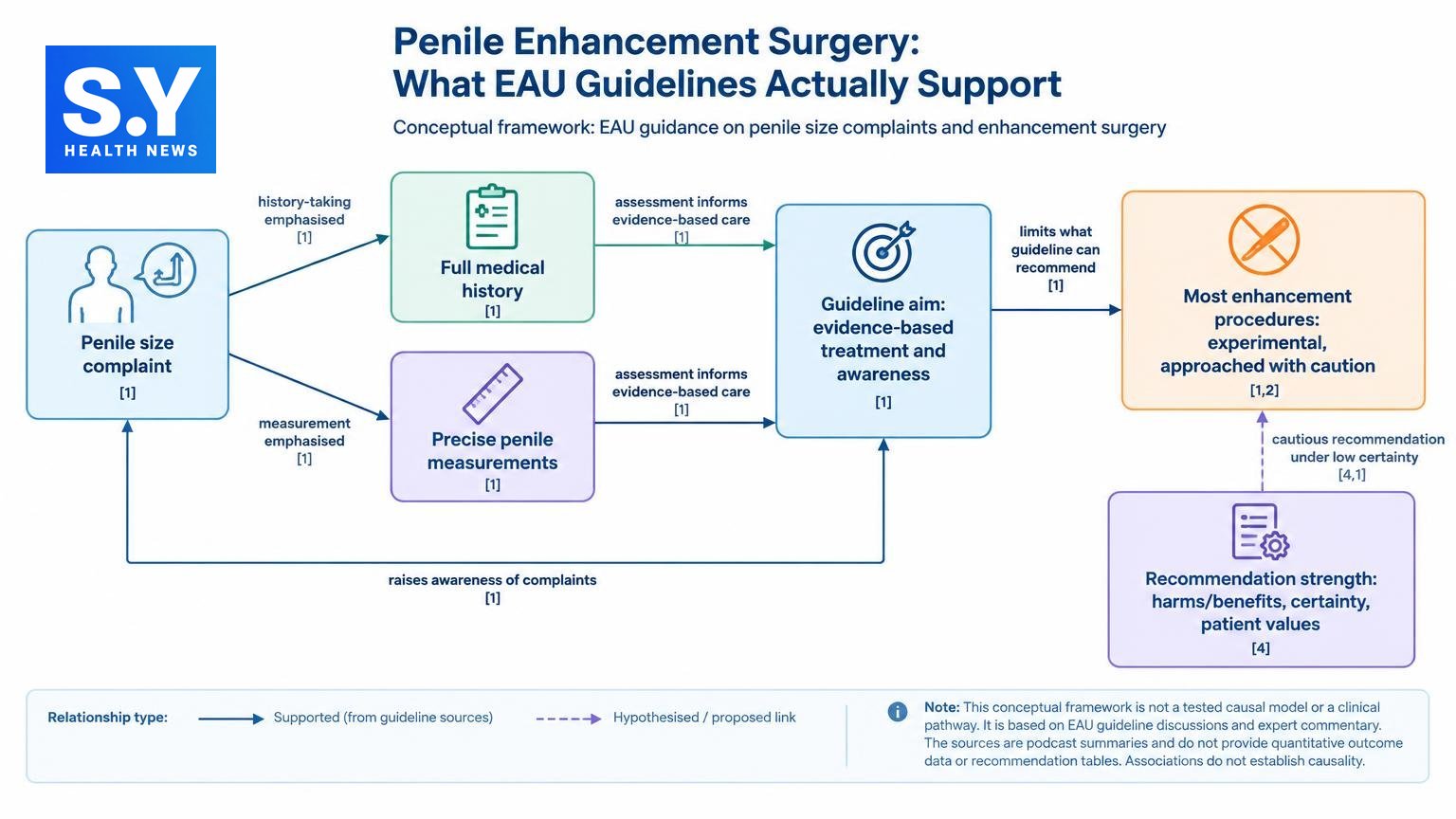
Conceptual framework: Conceptual framework, not a tested causal model or a clinical pathway. It shows how the EAU discussions connect penile size complaints to assessment by history and measurement, and how evidence scarcity keeps most enhancement procedures in experimental territory. Supported links reflect documented guideline statements; no quantitative effect is implied.
Academic References & Evidence
- Paolo Capogrosso; Marco Falcone. Dr. Capogrosso and Dr. Falcone talk about new sexual and reproductive EAU Guidelines – Uroweb.
- Paolo Capogrosso; Marco Falcone. Dr. Capogrosso and Dr. Falcone talk about new sexual and reproductive EAU Guidelines. 2023
- Dr. Capogrosso and Dr. Falcone talk about new sexual and reproductive EAU Guidelines – EAU Podcast.
- Suks Minhas; Luca Boeri; Paolo Capogrosso; Andrea Cocci; Giovanni Corona; Marij Dinkelman-Smit; Marco Falcone; Christian Fuglesang Jensen; Murat Gül; Arif Kalkanli; Ates Kadioğlu; Juan I Martinez-Salamanca; L Afonso Morgado; Giorgio I Russo; Ege Can Serefoğlu; Paolo Verze; Andrea Salonia. European Association of Urology Guidelines on Male Sexual and Reproductive Health: 2025 Update on Male Infertility. European Urology. 2025 87(5):601-616 DOI: 10.1016/j.eururo.2025.02.026.
- Paolo Capogrosso; Marij Dinkelman-Smit. 2026 update on EAU Guidelines for Sexual & Reproductive Health.
- Paolo Capogrosso; Marco Falcone. Podcast Episode. 2023
SANYUN Science Center explains published research on men's reproductive and sexual health, connecting scientific evidence with everyday questions while making sources and limitations clear.
Disclaimer: This article is for scientific education and research communication only. It does not provide medical advice, diagnosis, or individualized treatment recommendations, and does not endorse any medication, supplement, device, penile enlargement procedure, or other intervention. Decisions about sexual and reproductive health should be made in consultation with a qualified healthcare professional. Do not delay seeking professional care because of information in this article.
Original Content & Copyright Notice
- This article is prepared for SANYUN Science Center, drawing on published research and publicly available academic literature on men’s sexual and reproductive health. Its editorial explanations and presentation are developed for this platform.
- Copyright in the original editorial content, selection, and arrangement is reserved by SANYUN Science Center to the extent protected by applicable law. Referenced research, quotations, and third-party materials remain subject to the rights of their respective owners. This notice does not claim ownership of scientific facts or third-party research.
- Except where permitted by applicable law or an applicable license, prior written permission is required to reproduce, republish, translate, adapt, redistribute, or commercially reuse protected content. Attribution alone does not grant permission for such reuse.
- For permitted quotation or authorized reuse, clearly identify the source and retain a link to the original article.
- Source: SANYUN Science Center
- Original URL: Retain the original article URL on science.san-yun.com.
- Copyright Holder: SANYUN Science Center, for its own protected editorial content.
- Quotation, excerpts, or authorized reuse must not distort the scientific meaning, omit material limitations or disclaimers, or imply unverified medical claims, product efficacy, or endorsement by SANYUN Science Center.



