




Category: Penis Enlargement
Core Research Direction: Hospitality marketing pages frame penile-enlargement and male-intimate procedures as a private, high-consideration, cash-pay search pathway; however, none of the supplied sources contain primary clinical research on penile-enlargement efficacy, safety, or outcomes, so a source-bound research article cannot make clinical claims from this collection and must limit itself to describing the marketing/communication context while flagging the absence of clinical evidence.
Search Intent: Do the available sources provide any clinical evidence on the safety or effectiveness of penile enlargement, or do they only describe how clinics and marketers communicate about it?
Platform: SANYUN Science Center
Evidence reviewed through: 2026-11-06
Executive Summary
This review set out to ask whether the available sources contain clinical evidence on the safety or effectiveness of penile enlargement, or only describe how clinics and marketers communicate about it. The answer is unambiguous: the collection is entirely commercial marketing commentary and agency guidance. No source reports a clinical trial, patient cohort, complication rate, measured outcome or follow-up data for any penile-enlargement procedure.[1][2][3][4][5]
What the sources do provide is a detailed picture of the consumer communication environment. They characterize men researching penile girth enhancement as self-paying, self-directed and engaged in weeks or months of private research across forums and testimonials before contacting a clinic. They separate penile filler searches from penile lengthening searches as distinct intents. They repeatedly emphasize privacy, discretion and measured wording.
Most tellingly, one marketing source explicitly advises clinics not to publish clinical trial data or academic debate about efficacy on procedure pages, reasoning that such content attracts research-minded searchers who will not book. This editorial recommendation helps explain why commercial penile-enlargement pages may be silent on clinical evidence — and why a reader cannot treat that silence as reassurance.
Why This Matters
Penile enlargement sits at an unusual intersection: high patient concern, high out-of-pocket cost, and — in this source collection at least — a near-total absence of published clinical outcome data. A man searching for penile girth enhancement is described in the marketing literature as someone who has already spent months reading forums and watching testimonials, often after dismissing clinics whose websites felt untrustworthy. That is a person making a consequential decision in an information environment shaped largely by parties selling the service.
The stakes of getting this wrong are asymmetric. Marketing material can describe a procedure's mechanical steps, appointment logistics and pricing norms, but it cannot establish whether an intervention works, how often it causes harm, or how results compare with no treatment. The supplied sources make clear that they are not attempting to do so. Several explicitly recommend avoiding outcome guarantees and using clinician-approved, factual wording instead of dramatic claims.
The Communication Landscape the Sources Describe
The sources are consistent on one behavioral point: urologic and andrologic concerns are researched privately and often silently before any consultation. One guide states that patients with embarrassing conditions such as erectile dysfunction and urinary problems often research privately for a long time before booking. Another asserts a wide gap between symptom searches and booked consultations, attributing it to embarrassment rather than lack of concern — though neither source presents search-volume or booking data to substantiate the claim.
For penile enlargement specifically, the marketing description is more granular. The searcher is characterized as having read forum threads, watched video testimonials and rejected multiple clinic websites before arriving at a page he is willing to trust. He is described as paying out of pocket rather than through insurance, with a research period measured in weeks or months. These are the author's characterizations of consumer behavior, not findings from a measured patient sample.
The sources also treat search intent as procedure-specific. One distinguishes a man searching for penile filler, described as hyaluronic acid injection for girth, from a man searching for penile lengthening, described as possibly ligament release or traction protocols. The marketing argument is that combining these into a single enhancement page dilutes relevance. Clinically, the distinction matters too, because injections and surgical or traction-based approaches carry different risk profiles — but the sources supply no clinical detail on any of them.
| Source-Described Element | What the Source Claims | Evidence Status in This Collection |
|---|---|---|
| Searcher behavior | Men researching penile girth enhancement have done extended private research, including forums and testimonials, before contacting a clinic | Author characterization in commercial commentary; no measured sample or survey |
| Payment model | Penile-enlargement services are framed as cash-pay, with price transparency affecting website engagement | Marketing assertion; no bounce-rate or pricing data reported |
| Procedure categories | Penile filler (hyaluronic acid injection for girth) and penile lengthening (ligament release or traction) treated as separate search intents | Non-specific description; no outcomes, safety data or citations |
| Content policy | Clinics advised not to publish clinical trial data or efficacy debate on procedure pages | Editorial recommendation; explains possible absence of clinical content |
| Wording standard | Avoid guarantees about diagnoses, outcomes or timelines; use clinician-approved descriptions | Marketing guidance; no efficacy or safety data on any procedure |
| Privacy design | Private online booking that does not require describing the condition in detail | Marketing recommendation; no outcome data |
How Privacy and Tone Are Marketed as Trust Signals
A recurring theme across the sources is that discretion is not decoration but a core conversion asset. One guide recommends online scheduling that does not require patients to describe their condition in detail. Another argues that explicit privacy assurance, matter-of-fact language and content treating the symptom as a normal medical matter build trust disproportionately in this specialty. A third recommends plain language without euphemism for sensitive procedures, asserting that clinical distance and marketing gloss both make already-uncomfortable searchers feel worse.
Another source states that measured, factual messaging is stronger than dramatic messaging for urology clinic marketing in 2026. That assertion is not operationalized or measured — “stronger” is not defined — and it sits alongside the same source's recommendation to keep educational material focused on what the clinic offers rather than on clinical claims.
There is a tension worth naming. The same marketing literature that counsels calm, factual, non-sensational wording also counsels clinics to steer research-minded searchers away from their procedure pages. Factual tone and factual content are not the same thing. A page can read as measured and reassuring while containing no trial data, no complication rates and no comparison with alternatives.
One agency source frames urology marketing as a case-mix tool rather than a volume tool, asserting that demand exceeds supply and that practices should attract the right elective cases. It does not supply data supporting the demand-supply claim in its body text. For a reader, the practical implication is that commercial pages are optimized for booking decisions, not for evidence appraisal.
What the Evidence Shows — and What Is Missing
On the central question, the supplied evidence shows nothing about clinical safety or effectiveness. None of the sources reports a randomized trial, prospective cohort, retrospective series, complication registry or patient-reported outcome measure for penile enlargement. None provides a measured change in penile dimensions, a satisfaction rate, an adverse-event frequency or a follow-up interval. The procedure descriptions that do appear — hyaluronic acid injection for girth, ligament release or traction for lengthening — are one-line characterizations in a marketing article, not clinical summaries.
This is a source-selection limitation, not proof that no clinical literature exists. The collection was assembled around marketing and communication sources, and the direction note confirms that none of the supplied sources contain primary clinical research on penile-enlargement efficacy, safety or outcomes. A source-bound review cannot make clinical claims from this collection; it can only describe the marketing and communication context and flag the absence of clinical evidence.
The absence is partly explained from inside the material. One marketing source explicitly advises against publishing clinical trial data, research methodology or academic debate about efficacy, arguing that such content attracts “study” and “research” searchers who will never book. Whether or not that advice is followed widely, it demonstrates that the commercial incentive structure does not reward publishing negative or equivocal clinical findings on procedure pages.
Interpretation and Limitations
Every behavioral claim in this collection is a hypothesis or an author's characterization rather than a measured finding. The claim that embarrassment drives the gap between symptom searches and consultations is plausible but unsupported by data in the source that makes it. The claim that price transparency reduces bounce rate in cash-pay verticals is an assertion without measurement. The claim that measured messaging outperforms dramatic messaging is undefined operationally. These should be read as informed marketing opinion, not as behavioral science.
The sources are also commercially interested. Several are agency pages selling marketing services to urology practices; their descriptions of patient psychology serve a sales narrative about conversion optimization. That does not make them useless — they document how the commercial side of this field talks about patients — but it means their behavioral claims should not be generalized to patient populations without independent evidence.[6]
Finally, none of these sources was independently verified for factual accuracy by this article, and no clinical or safety review was performed. The review's conclusion is narrow and deliberate: the available collection supports claims about marketing communication and about the absence of clinical evidence, and it supports nothing about whether penile enlargement works or is safe.
Research Outlook
The practical next step for a reader is not another marketing page. It is to look for peer-reviewed clinical literature on the specific procedure named — whether injectable filler for girth or surgical lengthening — and to ask what the outcome measures were, how long patients were followed, what complications occurred and how many patients were lost to follow-up. The supplied sources cannot answer those questions, but they do show clearly which questions a clinic's own website is unlikely to answer for you.
For researchers and clinicians, the collection is a reminder that patient-facing evidence gaps and commercial content incentives can reinforce each other. A field where clinics are advised to omit trial data from service pages is a field where patients may arrive at consultations having never encountered an honest summary of what is and is not known.
Key Takeaways
- The supplied sources contain no clinical efficacy or safety data on penile enlargement; they are commercial marketing commentary and agency guidance.
- Marketing sources describe penile-girth-enhancement searchers as self-paying and privately researching for weeks or months before contacting a clinic; these are author characterizations, not measured findings.
- Penile filler and penile lengthening are treated as separate search intents, but the sources give no clinical detail on outcomes or risks for either.
- One source explicitly advises clinics not to publish clinical trial data or efficacy debate on procedure pages, which helps explain why commercial pages may omit evidence.
- Privacy, discretion and non-euphemistic wording are repeatedly recommended as trust-building tools; these are marketing recommendations without supporting outcome data.
Questions and Answers
What does the available evidence say about whether penile enlargement is safe or effective?
Nothing clinical. The supplied sources are commercial marketing commentary and agency guidance; none reports a trial, patient cohort, complication rate or measured outcome for any penile-enlargement procedure. This reflects the source selection, not proof that no clinical literature exists, but a reader cannot draw safety or efficacy conclusions from this collection.
Why might penile-enlargement clinic websites leave out clinical trial data?
One marketing source explicitly advises clinics not to publish clinical trial data, research methodology or academic debate about efficacy on procedure pages, arguing that such content attracts research-minded searchers who will not book. That is an editorial recommendation, not an empirical finding, but it illustrates a commercial incentive to omit equivocal or negative clinical findings.
How do marketing sources describe men who search for penile girth enhancement?
They characterize these men as self-paying, self-directed consumers who have spent weeks or months reading forums and watching testimonials before contacting a clinic, and who abandon websites that feel untrustworthy. These are author characterizations of consumer behavior in commercial commentary, not findings from a measured patient sample.
Are penile filler and penile lengthening the same procedure in these sources?
No. One marketing source distinguishes penile filler, described as hyaluronic acid injection for girth, from penile lengthening, described as possibly ligament release or traction protocols, and argues they need separate pages. The descriptions are non-specific marketing characterizations with no outcomes, safety data or citations attached.
How strong is the evidence behind the claim that embarrassment stops men from booking urology consultations?
Weak within this collection. One commentary asserts a wide gap between symptom searches and booked consultations and attributes it to embarrassment, but provides no search-volume or booking data. The claim is plausible and may be true, yet in these sources it remains an unsourced hypothesis rather than a measured finding.
What should a reader look for instead of a clinic marketing page on penile enlargement?
Peer-reviewed clinical literature on the specific procedure, asking what outcomes were measured, how long patients were followed, what complications occurred and how many were lost to follow-up. The supplied marketing sources cannot answer those questions and, by one source's own advice, clinic procedure pages are unlikely to either.
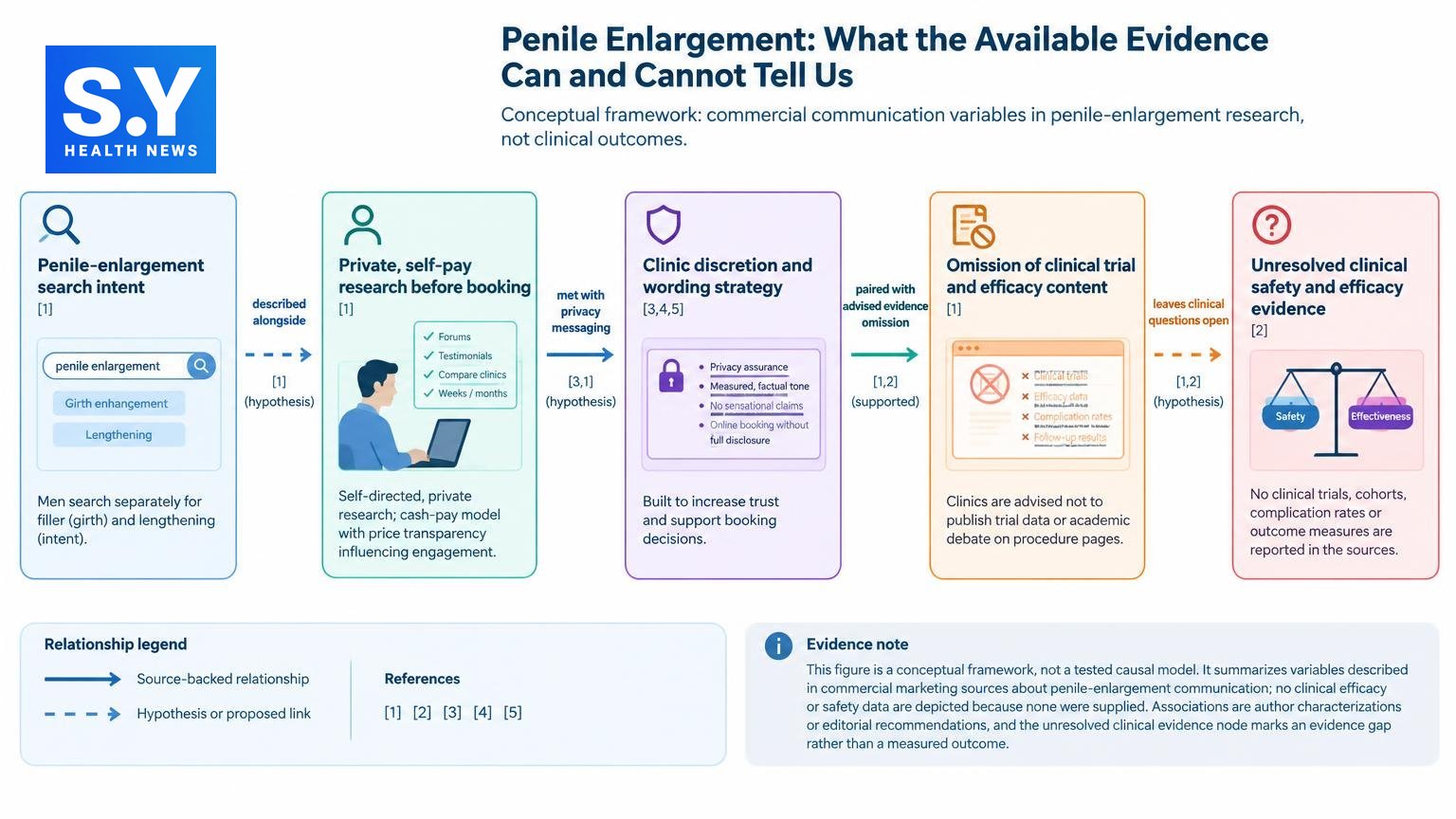
Conceptual framework: Conceptual framework, not a tested causal model. Nodes summarize variables described in commercial marketing sources about penile-enlargement communication; no clinical efficacy or safety data are depicted because none were supplied. Associations are author characterizations or editorial recommendations, and the unresolved clinical evidence node marks an evidence gap rather than a measured outcome.
Academic References & Evidence
- Todd Whitaker. Urology Website Content That Earns the Click and the Booking.
- Digital Marketing for Urology Clinics | 2026.
- Urology Practice Marketing Guide 2026 · Referrals, Men's Health & Privacy · Ichelon Consulting Group.
- Urology Marketing for Hospitals & Urologists | STYL.
- Dawood Ahmad. Urology Marketing: Get Booked Solid | Trusted Growth Partner.
- 【泌尿器科向け】患者数を伸ばすWebマーケティング施策10選|船井総合研究所.
SANYUN Science Center explains published research on men's reproductive and sexual health, connecting scientific evidence with everyday questions while making sources and limitations clear.
Disclaimer: This article is for scientific education and research communication only. It does not provide medical advice, diagnosis, or individualized treatment recommendations, and does not endorse any medication, supplement, device, penile enlargement procedure, or other intervention. Decisions about sexual and reproductive health should be made in consultation with a qualified healthcare professional. Do not delay seeking professional care because of information in this article.
Original Content & Copyright Notice
- This article is prepared for SANYUN Science Center, drawing on published research and publicly available academic literature on men’s sexual and reproductive health. Its editorial explanations and presentation are developed for this platform.
- Copyright in the original editorial content, selection, and arrangement is reserved by SANYUN Science Center to the extent protected by applicable law. Referenced research, quotations, and third-party materials remain subject to the rights of their respective owners. This notice does not claim ownership of scientific facts or third-party research.
- Except where permitted by applicable law or an applicable license, prior written permission is required to reproduce, republish, translate, adapt, redistribute, or commercially reuse protected content. Attribution alone does not grant permission for such reuse.
- For permitted quotation or authorized reuse, clearly identify the source and retain a link to the original article.
- Source: SANYUN Science Center
- Original URL: Retain the original article URL on science.san-yun.com.
- Copyright Holder: SANYUN Science Center, for its own protected editorial content.
- Quotation, excerpts, or authorized reuse must not distort the scientific meaning, omit material limitations or disclaimers, or imply unverified medical claims, product efficacy, or endorsement by SANYUN Science Center.



