




Category: Penis Enlargement
Core Research Direction: Evidence-based appraisal of penile size complaints and penile augmentation: definition and measurement standards, psychological versus anatomical causes, and current evidence on non-surgical and surgical enlargement methods
Search Intent: What does current guideline-level evidence show about whether penile enlargement methods work, how a short-penis complaint should be assessed, and who should not undergo augmentation?
Platform: SANYUN Science Center
Evidence reviewed through: 2026-11-12
Executive Summary
Requests for penile enlargement have risen markedly worldwide in recent years, yet the clinical literature remains unusually thin for a field with such high commercial visibility. European Association of Urology (EAU) guidance, summarized in a 2024 clinical news report, states there is no uniform definition of a short penis or micropenis, and that demand for enlargement far exceeds the prevalence of genuine anatomical deficiency.[1][2]
The guideline separates three distinct clinical situations: true micropenis, a complaint of shortness in a normally sized penis, and a buried penis where normal-length tissue is concealed. Accurate stretched-length measurement is the minimum diagnostic step, and men with normal size who request enlargement should be assessed for dysmorphic disorders rather than fast-tracked to procedures.
On treatment, the evidence base is limited across the board. Endocrine therapy is described as effective only before puberty; traction therapy has limited supporting evidence; vacuum pumps are not recommended for enlargement; and surgical techniques such as suspensory ligament release should be considered only after comprehensive counselling. A 2020 systematic review characterized most studies as positive in direction but low in quality, with non-standardized measurement and safety reporting.[3]
Why This Matters
The gap between anatomical prevalence and treatment demand is the central issue. Micropenis is reported in between 0.015% and 0.66% of male newborns, while dissatisfaction with penile size affects sexual function or quality of life in roughly 10% of men — a proportion that rises sharply among men seeking augmentation.
Survey data cited in the guideline illustrate the perceptual gap: 84% of female partners reported satisfaction with their partner's penile size, whereas 55% of male partners were satisfied and 45% wanted a larger penis. These figures are cited secondhand and the survey design is not described in the source text, but the direction is consistent with the clinical impression that self-perception rather than partner perception drives demand.
The consequences of getting this wrong are not trivial. The guideline notes that a subgroup of men requesting augmentation carry psychological vulnerability, including body dysmorphic disorder, may be at risk of worsening psychopathology and suicide attempts, and are unlikely to have their surgical expectations met. This is the main argument against treating enlargement as a straightforward cosmetic purchase.
Measurement and Classification: The Diagnostic Foundation
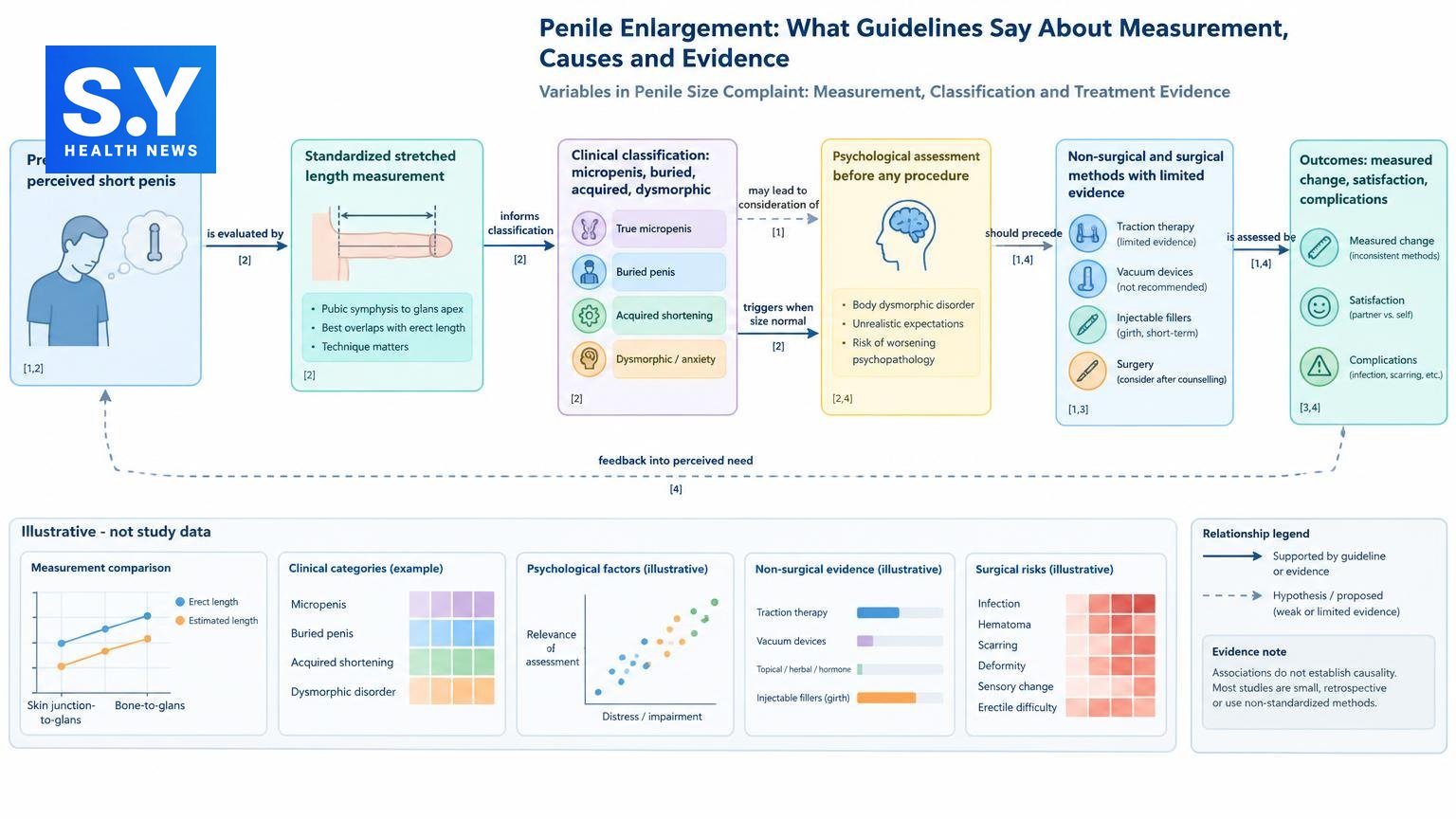
Stretched penile length (SPL) is defined as the distance between the pubic symphysis and the apex of the glans, and is described as the measurement that best overlaps with the erect penis. Micropenis is defined as an SPL more than 2.5 standard deviations below the mean for the man's age and race.
Measurement technique matters more than is often appreciated. Skin junction-to-glans tip measurement, a common surrogate, underestimates erect penile length by about 20%, whereas bone-to-glans tip measurement correlates better with erect length, particularly in men who are overweight or obese. The guideline panel treats stretched measurement as the bare minimum and advocates additional flaccid and erect measurements after intracavernosal injection before any surgical indication.
Separately, a single-author clinical commentary cites an approximate adult threshold of under 7.5 cm stretched length, while explicitly stating that this figure alone does not establish a diagnosis and that technique and clinical context matter. That caution is important: the guideline itself states there is no consensus definition of normal penile size, and no consensus on a standard measurement protocol.
| Clinical category | What it describes | Practical implication |
|---|---|---|
| True micropenis | Stretched length more than 2.5 standard deviations below the population mean for age and race, with a congenital genetic or endocrine basis | A rare anatomical-endocrinological condition, distinct from a size complaint in a normally developed penis |
| Buried or false shortness | Normal-sized penile shaft concealed by prepubic, scrotal or penile tissue, often associated with obesity | Treating the concealment is not the same as lengthening the corpora cavernosa; weight and soft-tissue factors are central |
| Acquired intrinsic shortening | Shortening of the corpora cavernosa after Peyronie's disease, prostate or bladder surgery, radiotherapy, priapism, trauma or multiple penile operations | Reconstructive logic differs from cosmetic enlargement; the underlying condition drives management |
| Penile dysmorphic disorder / small penis anxiety[4] | Distress focused on a perceived flaw in a normal-sized penis, with impairment in important areas of life | Psychological assessment is indicated; surgery is unlikely to resolve the concern and may worsen it |
Biological and Psychological Mechanisms
The anatomical side of the question is relatively well characterized. Normal genital development depends on hormonal stimulation during fetal and pubertal life; disruption of that axis, genetic syndromes, and complex malformations such as bladder exstrophy-epispadias can produce a genuinely small penis. In up to 25% of micropenis cases, the guideline notes, no definitive etiological cause is identified.
In adults, acquired shortening follows a different logic: acute loss after trauma or cancer surgery, or chronic fibrotic change involving the corpora cavernosa, as in Peyronie's disease or after radical prostatectomy and radiotherapy. Adult acquired buried penis, by contrast, involves progressive retraction and scarring of the penile dartos and surrounding tissue, with obesity as the main recognized risk factor.
The psychological side is where the evidence becomes more interpretive. Body dysmorphic disorder is defined by distress from a perceived defect that is not observable to others or appears only slight, with significant impairment in social or occupational life. Reported prevalence is 2.2% of men in the USA and 1.8% in Germany, and an estimated 3–16% of cosmetic surgery patients are expected to present with BDD, with a higher rate in men (15.3%) than women (10.9%).
A psychological commentary adds an important nuance: not every bodily dissatisfaction is a disorder, and clinical attention becomes particularly relevant when the concern occupies substantial time, drives repeated checking or avoidance, and compromises relationships, intimacy, study or work. The NICE CG31 guideline recommends specialist assessment when a person with suspected or diagnosed body dysmorphic disorder requests cosmetic procedures.
What the Evidence Shows: Non-Surgical Methods
Traction therapy is the non-surgical option with the most plausible rationale, applying controlled, prolonged stretching force. The guideline summary describes only limited evidence, and a clinical commentary reports that some studies found limited length gains after months of regular use, with results varying by device type, daily wear time, baseline measurement, adherence and follow-up. Those qualifiers matter: they describe a modest and conditional effect, not a reliable transformation.
Vacuum devices occupy a weaker position. The EAU guideline, as summarized, does not recommend vacuum pumps for penile enlargement based on current data. A commentary explains why: vacuum erection devices produce temporary engorgement and can create a temporarily larger appearance, but there is no reliable evidence of permanent lengthening. Their established role in erectile dysfunction treatment is a different indication and does not transfer to cosmetic gain.
For creams, herbal mixtures, over-the-counter hormone products and products marketed as natural penis enlargers, the commentary states plainly that no reliable evidence supports permanent enlargement. This is an absence-of-evidence statement without a described systematic search, so it should be read as a caution rather than a precise effect estimate. Testosterone and other hormones are not used to enlarge a normally developed adult penis; endocrine therapy is relevant mainly to selected pre-pubertal cases managed by pediatric specialists.
Injectable fillers for girth form a separate category. Small randomized trials and one meta-analysis report increases in circumference or diameter with hyaluronic acid, along with improved short-term satisfaction, but total participant numbers are limited, follow-up is mostly short- to medium-term, and products and injection protocols differ. A meta-analysis comparing hyaluronic acid and polylactic acid found some short-term measurement and sexual satisfaction advantages favoring hyaluronic acid, while emphasizing that long-term physical and psychological outcomes need more research.
What the Evidence Shows: Surgical Methods
Surgical options include suspensory ligament release for lengthening and various grafting or implant techniques for girth. The guideline emphasizes that such procedures should be considered only after comprehensive patient counselling. That phrasing reflects a real evidentiary problem rather than mere caution: the guideline summary notes limited evidence and the need to discuss potential risks carefully.
A commentary-level synthesis of reviews adds detail: surgical techniques are reported to increase anatomical measurements, but most studies are small, retrospective and use inconsistent measurement methods. Reported risks include infection, hematoma, wound-healing problems, scarring, deformity, sensory change, erectile difficulties and the need for reoperation. A single case report described approximately 40 degrees of new dorsolateral curvature and shortening after removal of an infected synthetic implant — a reminder that complications are real, though single cases cannot establish overall rates.
The broader methodological problem was captured by a 2020 systematic review, which found that although most studies of non-invasive and surgical methods reported positive results, study quality was low and measurement methods and safety reporting were non-standardized. This is the single most important limitation in the field: apparent positive findings coexist with weak designs, and comparative claims between techniques are difficult to sustain.
Interpretation and Limitations
Several distinctions should be kept explicit. Statistical significance in a small trial of girth change is not the same as clinically meaningful benefit or durable satisfaction. An association between filler use and short-term circumference gain does not establish long-term safety. And an absence of evidence for a method is not proof of harm, but it also cannot be converted into a promise of benefit.
The most socially salient figure in this literature is the partner-satisfaction data: 84% of women satisfied versus 55% of men. It would be easy to over-read this as evidence that enlargement is unnecessary. A more careful reading is that male self-perception diverges from partner perception in the cited survey, which supports assessing beliefs and expectations rather than assuming anatomy is the problem. The survey's sampling and design are not described in the available text, and a separate cited study found that reducing penetration depth produced a statistically significant 18% reduction in overall sexual pleasure alongside an average 15% reduction in penile length — a finding whose population and design are also not detailed.
The guideline itself flags an ethical and informational failure: several conservative and surgical treatments exist, but few patients receive clear information about their benefits and potential harms. It also notes that imaging such as penile Doppler ultrasound or MRI is not supported for routine assessment of shortness complaints, since no evidence shows the additional information improves on physical examination.
Finally, the source base for this review is itself a limitation. The core clinical framework comes from a guideline chapter and a secondary summary of it; the treatment-level details draw heavily on single-author clinical commentary that summarizes reviews and meta-analyses without reproducing their effect sizes, sample sizes or quality assessments. No independent quantitative synthesis was performed for this article.
Research Outlook
The most pressing need is methodological rather than technological: standardized measurement, defined outcome sets that include function and satisfaction alongside dimensions, and adequate safety reporting with longer follow-up. Until those exist, comparisons between traction, fillers and surgery will remain unreliable.
A second need is psychological. Screening tools for body dysmorphic disorder and penile dysmorphic disorder are available and recommended, but the field still lacks robust evidence on which men benefit from which intervention — including the possibility that some men are better served by psychological support and realistic counselling than by any procedure. The guideline's observation that some highly dissatisfied people do not gain the desired benefit from enlargement interventions points directly at this gap.
The EAU guideline was published as a summary in European Urology Focus in 2023, and a 2026 congress session addressed whether the guidance has changed. Readers should treat any claim of a dramatic recent breakthrough with scepticism until primary studies with adequate design and follow-up are available.[5][6]
Key Takeaways
- Demand for penile enlargement has risen markedly worldwide, while micropenis remains rare, reported in 0.015% to 0.66% of male newborns.
- There is no consensus definition of normal penile size; stretched length measured from the pubic bone to the glans tip correlates better with erect length than skin-junction measurement, which underestimates by about 20%.
- Normal-size men requesting enlargement should be assessed for body dysmorphic disorder; a vulnerable subgroup may worsen psychologically and is unlikely to meet surgical expectations.
- Traction has limited evidence, vacuum pumps are not recommended for enlargement, and creams, pills and unregulated injectables have no reliable evidence of permanent benefit.
- Surgery can change anatomical measurements in some reports, but studies are mostly small and retrospective, and a 2020 systematic review found low study quality with non-standardized measurement and safety reporting.
Questions and Answers
How is micropenis defined and how common is it?
The EAU guideline defines micropenis as a stretched penile length more than 2.5 standard deviations below the mean for the man's age and race, reflecting an underlying genetic or endocrine condition. Reported prevalence is 0.015% to 0.66% of male newborns, although overall population incidence is not clearly documented. Stretched length is measured from the pubic symphysis to the glans apex.
Does penile traction therapy actually increase penis length?
Evidence is limited. The EAU guideline summary describes only limited evidence for traction therapy, and a clinical commentary reports that some studies found limited length gains after months of regular use. Results varied by device type, daily wear time, baseline measurement, adherence and follow-up. Traction should not be presented as producing large or guaranteed permanent growth.
Why do men with a normal-sized penis still seek enlargement?
The EAU guideline notes that subjective dissatisfaction with penile size can impair sexual function and quality of life in about 10% of men, with a sharply higher prevalence among those seeking augmentation. In a cited survey, 84% of female partners were satisfied with their partner's size while only 55% of men were satisfied, suggesting self-perception and cultural expectations drive much of the demand.
What are the psychological risks of penile enlargement surgery?
A subgroup of men requesting augmentation has significant psychological vulnerability, including body dysmorphic disorder. The guideline states these men may be at risk of worsening psychopathology and suicide attempts, and are unlikely to achieve their surgical expectations. NICE CG31 recommends specialist assessment when someone with suspected body dysmorphic disorder requests cosmetic procedures, so psychological screening before surgery is a safety measure.
Are hyaluronic acid fillers a safe way to increase penile girth?
Small randomized trials and one meta-analysis report increases in girth and short-term satisfaction, but total participant numbers are limited, follow-up is mostly short- to medium-term, and products and protocols vary. Nodules, migration, edema and infection can occur. A meta-analysis found some short-term advantages for hyaluronic acid over polylactic acid, but long-term physical and psychological outcomes need more research.
What are the main limitations of research on penile enlargement methods?
A 2020 systematic review found that although most studies of non-invasive and surgical methods reported positive results, study quality was low and measurement methods and safety reporting were non-standardized. Many surgical studies are small and retrospective. There is no consensus definition of normal penile size, which complicates comparison across studies and makes head-to-head claims between techniques hard to sustain.
Conceptual framework: Conceptual framework: how a short-penis complaint moves through measurement, classification and psychological assessment before any enlargement method is considered. Relations between measurement and classification are supported by EAU guideline content; the link from classification to treatment is shown as proposed rather than established, because studies are few and mostly low quality. The framework is an interpretive aid, not a tested causal model.
Academic References & Evidence
- EAU-Leitlinie: Penisgrößenanomalien und Dysmorphophobie.
- Penile Size Abnormalities and Dysmorphophobia – EAU Guidelines on Sexual and Reproductive Health – Uroweb.
- Penis büyütme nedir, nasıl yapılır? Gerçekten işe yarar mı?.
- Le dimensioni del pene contano? Desiderio e immagine corporea.
- EAU Guidelines on Sexual and Reproductive Health – Uroweb.
- UROsource.
SANYUN Science Center explains published research on men's reproductive and sexual health, connecting scientific evidence with everyday questions while making sources and limitations clear.
Disclaimer: This article is for scientific education and research communication only. It does not provide medical advice, diagnosis, or individualized treatment recommendations, and does not endorse any medication, supplement, device, penile enlargement procedure, or other intervention. Decisions about sexual and reproductive health should be made in consultation with a qualified healthcare professional. Do not delay seeking professional care because of information in this article.
Original Content & Copyright Notice
- This article is prepared for SANYUN Science Center, drawing on published research and publicly available academic literature on men’s sexual and reproductive health. Its editorial explanations and presentation are developed for this platform.
- Copyright in the original editorial content, selection, and arrangement is reserved by SANYUN Science Center to the extent protected by applicable law. Referenced research, quotations, and third-party materials remain subject to the rights of their respective owners. This notice does not claim ownership of scientific facts or third-party research.
- Except where permitted by applicable law or an applicable license, prior written permission is required to reproduce, republish, translate, adapt, redistribute, or commercially reuse protected content. Attribution alone does not grant permission for such reuse.
- For permitted quotation or authorized reuse, clearly identify the source and retain a link to the original article.
- Source: SANYUN Science Center
- Original URL: Retain the original article URL on science.san-yun.com.
- Copyright Holder: SANYUN Science Center, for its own protected editorial content.
- Quotation, excerpts, or authorized reuse must not distort the scientific meaning, omit material limitations or disclaimers, or imply unverified medical claims, product efficacy, or endorsement by SANYUN Science Center.



