




Category: Penis Enlargement
Core Research Direction: What the 2023 EAU guidelines on penile size abnormalities and dysmorphophobia conclude about diagnosis, psychological screening, and the limited evidence for length/girth enhancement methods
Search Intent: Which penile enlargement treatments have real supporting evidence, and how should men with normal-sized penises who seek augmentation be assessed?
Platform: SANYUN Science Center
Evidence reviewed through: 2026-11-12
Executive Summary
The 2023 European Association of Urology guidelines on penile size abnormalities and dysmorphophobia, summarized in 2024, address a clinical area in which demand is rising but the evidence base remains weak. The guideline summary states that well-structured, high-level-evidence studies using standardized patient-reported outcome measures were lacking for penile size abnormalities and dysmorphophobia, and that a shared definition of short penis or micropenis was also lacking. These two gaps shape much of what follows.[1]
Clinically, the guidelines draw a strong line between anatomical short penis and psychological distress around a normally sized penis. Men with normal penile size who request augmentation should be referred for psychological evaluation for possible dysmorphophobic disorders. For treatment, endocrinological therapy when indicated is described as effective only in the prepubertal setting; penile traction therapy has reported acceptable outcomes but limited evidence; vacuum therapy has a limited evidence base in treatment protocols; and surgical lengthening or girth procedures have limited evidence and should be proposed only after extensive counselling.
The guideline's patient summary adds that although several conservative and surgical treatments are available, few patients receive clear information about their benefits and possible harms. The evidence cutoff for the 2023 guidelines was 1 June 2022, so newer publications are not reflected in that guideline version. The overall conclusion is that management is complex and raises considerable ethical concerns.
Why This Matters
Requests for medical and surgical treatments to increase penis size have increased dramatically worldwide, according to the guideline patient summary. Yet the same summary notes that patients often receive unclear information about benefits and harms. This combination—rising demand, commercial pressure and thin evidence—makes careful assessment important. The guideline reports that 84% of women were satisfied with their male partner's penile size, while only 55% of male partners were satisfied with their own size and 45% wanted a larger penis.[2]
The guideline also notes that subjective dissatisfaction with penile size may negatively affect sexual functioning and quality of life, impacting sexual life in about 10% of men. That figure describes the general male population, not the necessarily higher prevalence among men actively seeking augmentation. The distinction matters: a clinical encounter for short penis complaints is a selected population with different prevalence and psychological profiles than the population at large.
For clinicians, the key practical implication is that a request for enlargement is not itself a diagnosis. The guideline requires a structured pathway that separates true micropenis, acquired shortening, buried penis and body dysmorphic concerns before any treatment is discussed. Without that separation, men with normal anatomy may be exposed to procedures with limited evidence, while men with genuine pathology may be misclassified.
Definitions and the Diagnostic Pathway
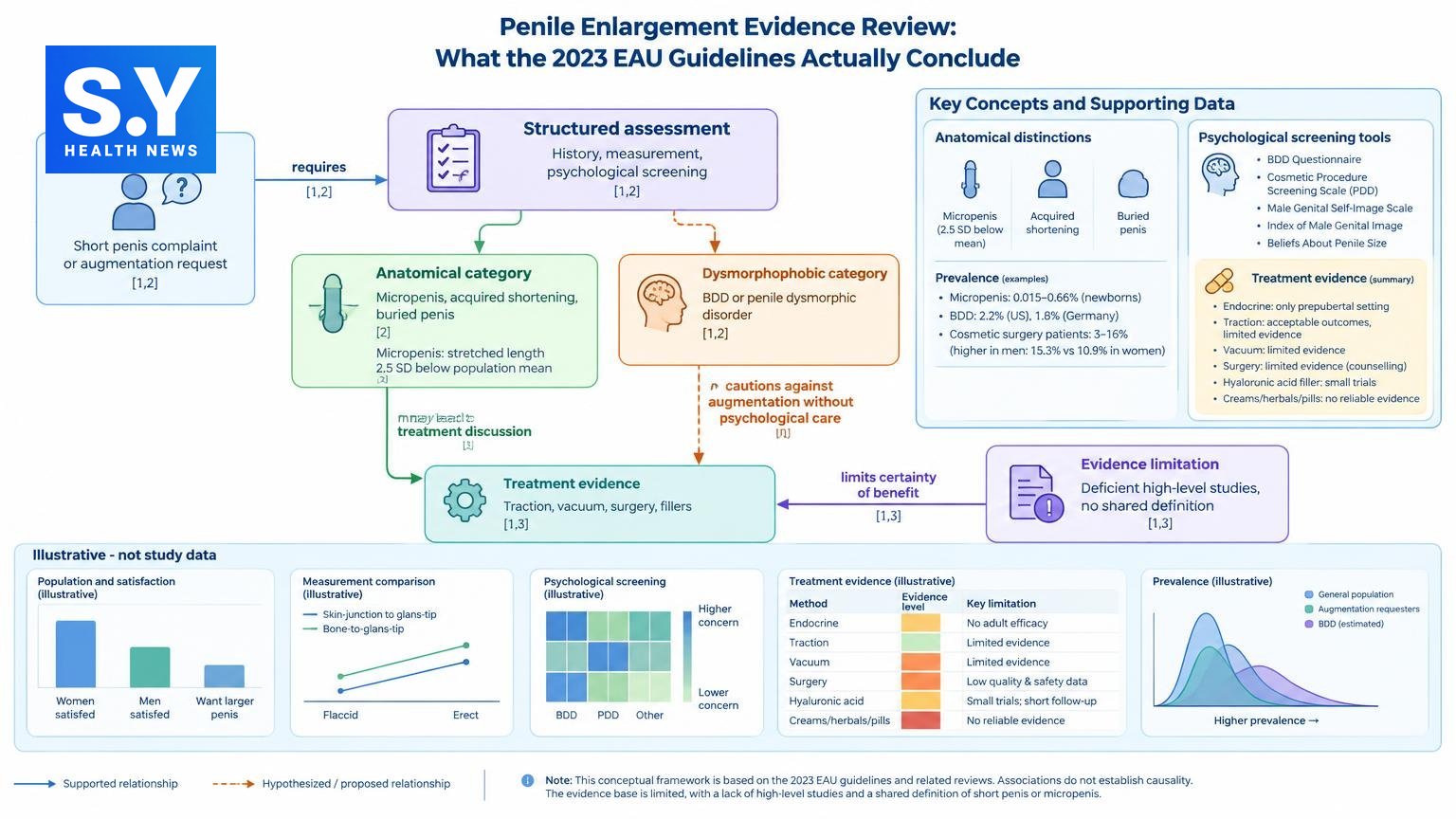
True micropenis is defined in the guideline as a congenital condition in which stretched penile length is 2.5 standard deviations below the average length for the population group, resulting from an underlying genetic or endocrine condition. This is distinct from a short penis complaint, from adult acquired buried penis, and from penile dysmorphic disorder. The guideline classifies these conditions by aetiology—congenital, acquired and dysmorphophobic—and states that this categorization is compulsory.
Epidemiological studies cited in the guideline report that between 0.015% and 0.66% of male newborns have a micropenis, although the guideline notes that overall incidence in the male population is not clearly documented. Adult acquired buried penis has an unknown exact prevalence, and its incidence appears to be increasing alongside rising obesity prevalence, which is its main risk factor. Body dysmorphic disorder prevalence is reported as 2.2% of men in the USA and 1.8% in Germany, and 3–16% of cosmetic surgery patients are expected to have BDD, with a higher rate in men (15.3%) than in women (10.9%).
Measurement is central to the diagnostic pathway. The guideline notes that skin-junction-to-glans-tip stretched length, used as a surrogate, underestimates erect penile length by about 20%. Bone-to-glans-tip measurement appears to correlate better with erect penile length, especially in overweight or obese males. The guideline also states that imaging has a lack of evidence for routine use in patients complaining of penile shortness; penile Doppler ultrasound or MRI may provide additional anatomical data, but there is no evidence that this information justifies routine use.
Psychological Screening: The Central Recommendation
The guideline's most clinically consequential recommendation for men with normal-sized penises is that those seeking penile augmentation should be referred for psychological evaluation for potential dysmorphophobic disorders. The guideline describes a subgroup of men requesting penile augmentation who have strong psychological vulnerability, including body dysmorphic disorder. This subgroup may be at increased risk of worsening psychopathology and suicide attempts, and is described as unlikely to achieve their expectations of surgery. That statement is framed with uncertainty—'may be at risk'—and should be read as a clinical caution rather than a quantified risk estimate.
Screening tools mentioned in the guideline include the Body Dysmorphic Disorder Questionnaire and the Cosmetic Procedure Screening Scale for Penile Dysmorphic Disorder, as well as the Male Genital Self-Image Scale and the Index of Male Genital Image. Beliefs About Penile Size captures beliefs about penis size and internal psychological processes. The guideline states that evidence on BDD/PDD and differential diagnosis—including personality disorders and obsessive-compulsive, psychotic or emotional spectrum disorders—should be assessed by an accredited mental health expert.
What the Evidence Shows for Enlargement Methods
The guideline's treatment summary is cautious across every modality. Endocrinological therapies, when indicated, are described as effective only in the prepubertal setting; this means they are not a route to adult penile enlargement. Vacuum therapy has a limited evidence base in treatment protocols, while penile traction therapy has reported acceptable outcomes. Surgical techniques to enhance penile length and girth have limited evidence and should be proposed only after extensive patient counselling.
| Method | Guideline position | Key evidence limitation |
|---|---|---|
| Endocrinological therapy (when indicated) | Effective only in the prepubertal setting | Not applicable to adult penile enlargement; no adult efficacy reported in the guideline summary |
| Penile traction therapy | Acceptable outcomes reported | Limited evidence base in treatment protocols; effect magnitude and follow-up not reported in the guideline summary |
| Vacuum therapy | Limited evidence base in treatment protocols | Guideline does not endorse as an evidence-based enlargement treatment |
| Surgical length and girth enhancement[3] | Limited evidence; propose only after extensive counselling | Study quality, measurement standardization and safety reporting described as deficient |
| Hyaluronic acid filler (girth) | Reported in small randomized trials and one meta-analysis | Small total participants; short- to medium-term follow-up; heterogeneous products and injection protocols |
| Creams, herbal products, over-the-counter pills | No reliable evidence of permanent enlargement | Negative-evidence statement without systematic search description |
A narrative clinical review adds detail consistent with the guideline's caution. It reports that some studies show limited length increase after months of regular traction device use, but results vary by device type, daily wear time, baseline measurement, adherence and follow-up duration. Vacuum erection devices are described as producing temporary engorgement, swelling and a larger appearance, with no reliable evidence for permanent lengthening.
For girth, the same review reports that small randomized trials and one meta-analysis found increases in circumference measurements and improved short-term patient satisfaction with hyaluronic acid fillers, but total participants were limited and follow-up was mostly short- to medium-term with heterogeneous products and injection protocols. A meta-analysis comparing hyaluronic acid and polylactic acid found some short-term measurement and sexual satisfaction results favoring hyaluronic acid, but emphasized the need for more research on long-term physical and psychological outcomes.
For surgery, the review notes that existing reviews report surgical techniques can increase anatomical measurements, but most studies are small, retrospective and use differing measurement methods. It also cites a 2020 systematic review finding that although most studies of non-invasive and surgical methods reported positive results, study quality was low and measurement methods and safety reporting were non-standardized. This is a secondary citation; the systematic review itself is not supplied in the packet, so its methods cannot be independently checked here.
Safety information for implants and injectables comes largely from case reports and retrospective series. A 2025 complication review cited by the narrative article lists seroma, infection, distal flaring and erosion, capsular contracture, curvature and shortening as main device-related problems with the Penuma implant, and notes that long-term outcome and satisfaction data are limited and largely retrospective. A single case report describes a new approximately 40-degree dorsolateral curvature and shortening after removal of an infected Penuma implant; single cases cannot establish complication rates, but they show the harms are not merely theoretical.
The narrative review also warns that silicone oil, paraffin, petroleum jelly, mineral oil, cosmetic oils, mercury or any substance of unknown origin should not be injected into the penis, citing risks of tissue necrosis, granuloma, chronic inflammation, lymphoedema, infection, ulceration, migration, deformity and loss of sexual function. It states that testosterone and other hormones are not used to enlarge normal penile size in adult men.
Interpretation and Limitations
The central limitation is the evidence base itself. The guideline summary explicitly describes well-structured high-level-evidence studies with standardized patient-reported outcome measures as deficient, and a shared definition of short penis or micropenis as lacking. This means that statements about traction, vacuum therapy and surgery rest on heterogeneous, often low-quality studies rather than on consistent randomized evidence. The guideline's recommendations are therefore best read as cautious clinical guidance, not as proof of efficacy.
A second limitation is the distinction between statistical and clinical meaning. A measured increase in stretched length or girth does not automatically translate into improved sexual function, quality of life or satisfaction. The guideline emphasizes a personalized management plan and extensive counselling, which reflects that outcomes depend on baseline anatomy, expectations and psychological factors. The narrative review notes that the same technique can produce different results across individuals because of baseline size, pubic fat, tissue properties, erection quality, diabetes, smoking, expectation realism, product standards and clinician experience. Those factors are described qualitatively, not quantified.
A third limitation concerns generalizability. Prevalence figures such as 84% partner satisfaction, 55% male satisfaction and 45% desire for a larger penis come from cited survey data whose sample size and methodology are not given in the guideline excerpt. The 10% figure for impact on sexual life is an estimate from cited studies with denominators not stated. The body dysmorphic disorder figures are country-specific. These numbers are useful for context but should not be treated as precise population parameters.
A fourth limitation is the evidence cutoff. The 2023 guideline's evidence base was cut off on 1 June 2022, and later publications—including the 2025 complication review and the 2026 EAU congress session listed in the packet—are not part of the 2023 guideline synthesis. The 2026 congress session is a scheduled educational event, not a new study, and does not by itself change the evidence. Readers should treat this review as a summary of the 2023 guideline position rather than a current-year update.[4][5][6]
Research Outlook
The guideline's own conclusion points toward what is needed: a structured diagnostic and therapeutic pathway, standardized measurement, validated patient-reported outcome measures and better psychological screening. The absence of a shared definition of short penis or micropenis is a foundational problem, because without a normative definition, studies cannot be compared and prevalence cannot be estimated reliably. Future research would need to standardize measurement technique, report outcomes by baseline category and follow patients long enough to capture durability and late complications.
The ethical dimension is also part of the research agenda. The guideline describes management as complex with considerable ethical concerns, particularly around psychological well-being. That framing suggests that future studies should include psychological outcomes and not only anatomical measurements, and that informed consent processes should be studied as part of care quality. Until such evidence exists, the guideline's emphasis on psychological evaluation before augmentation and extensive counselling before surgery remains the most defensible clinical position.
Key Takeaways
- The 2023 EAU guideline summary states that well-structured high-level-evidence studies with standardized patient-reported outcome measures were lacking for penile size abnormalities and dysmorphophobia, and that a shared definition of short penis or micropenis was also lacking.
- Men with normal penile size who seek penile augmentation should be referred for psychological evaluation for possible dysmorphophobic disorders.
- Endocrinological therapy when indicated is effective only in the prepubertal setting; it is not an adult enlargement treatment.
- Penile traction therapy has reported acceptable outcomes but limited evidence; vacuum therapy has a limited evidence base in treatment protocols; surgical lengthening and girth procedures have limited evidence and should be proposed only after extensive counselling.
- Measurement matters: skin-junction-to-glans-tip stretched length underestimates erect length by about 20%, while bone-to-glans-tip measurement correlates better with erect length, especially in overweight or obese males.
- The guideline's evidence cutoff was 1 June 2022; later publications and the scheduled 2026 EAU congress session are outside the 2023 guideline synthesis.
Questions and Answers
What is the difference between micropenis and penile dysmorphic disorder?
True micropenis is a congenital condition in which stretched penile length is 2.5 standard deviations below the average for the population group and results from an underlying genetic or endocrine condition. Penile dysmorphic disorder is a shorthand concept for body dysmorphic disorder focused on a perceived flaw in a normal-sized or normal-shaped penis, causing significant distress or impairment. The guideline treats them as distinct categories requiring different management.
What did the 2023 EAU guidelines conclude about evidence for penile enlargement treatments?
The guideline summary states that well-structured high-level-evidence studies with standardized patient-reported outcome measures were lacking. Endocrinological therapy when indicated works only in the prepubertal setting; traction therapy has reported acceptable outcomes but limited evidence; vacuum therapy has a limited evidence base; and surgical techniques have limited evidence and should be proposed only after extensive counselling. Few patients receive clear information about benefits and harms.
Why should men with a normal-sized penis seeking augmentation have psychological evaluation?
The guideline recommends referral for psychological evaluation for possible dysmorphophobic disorders in men with normal penile size who seek augmentation. It describes a subgroup with strong psychological vulnerability, including body dysmorphic disorder, who may be at risk of worsening psychopathology and suicide attempts and are unlikely to meet surgical expectations. Screening tools and assessment by an accredited mental health expert are part of the recommended pathway.
How strong is the evidence for hyaluronic acid fillers for penile girth enhancement?
A narrative clinical review reports that small randomized trials and one meta-analysis found increases in circumference and improved short-term satisfaction with hyaluronic acid fillers. However, total participants were limited, follow-up was mostly short- to medium-term, and products and injection protocols were heterogeneous. A meta-analysis comparing hyaluronic acid and polylactic acid found some short-term results favoring hyaluronic acid but emphasized the need for more long-term physical and psychological outcome research.
What are the limitations of the 2023 EAU penile size guideline?
The guideline summary itself states that high-level-evidence studies with standardized patient-reported outcome measures were deficient and that a shared definition of short penis or micropenis was lacking. The evidence cutoff was 1 June 2022, so later publications are not included. Many prevalence figures come from cited surveys whose sample sizes and methods are not detailed in the excerpt, and statements about psychological risk are framed with uncertainty rather than quantified.
How is penile length measured in the EAU guideline assessment?
The guideline considers stretched penile length measurement the bare minimum, using either skin-junction-to-glans-tip or bone-to-glans-tip technique. Skin-junction-to-glans-tip stretched length underestimates erect length by about 20%, while bone-to-glans-tip measurement correlates better with erect length, especially in overweight or obese males. Flaccid and erect measurements and girth assessment may add useful information, and imaging is not supported for routine use.
Conceptual framework: Conceptual framework. The figure maps the article's central question—how to separate anatomical short penis from dysmorphophobic concern before discussing enlargement—and shows that treatment evidence is constrained by deficient high-level studies and the absence of a shared definition. Relations marked as supported reflect the guideline's explicit statements; the link from dysmorphophobic categorization to caution against augmentation is shown as a proposed caution, not a tested causal effect. This is an explanatory framework, not a tested causal model or original research.
Academic References & Evidence
- Falcone, M; Bettocchi, C; Carvalho, J; Ricou, M; Boeri, L; Capogrosso, P; Cocci, A; Corona, G; Gül, M; Hatzichristodoulou, G; Jones, TH; Kadioğlu, A; Kalkanli, A; Martinez-Salamanca, JI; Milenkovic, U; Morgado, LA; Russo, GI; Serefoğlu, EC; Tharakan, T; Verze, P; Minhas, S; Salonia, A. European Association of Urology Guidelines on Penile Size Abnormalities and Dysmorphophobia: Summary of the 2023 Guidelines.. European urology focus. 2024 10(3):432-441 DOI: 10.1016/j.euf.2023.08.012.
- Penile Size Abnormalities and Dysmorphophobia – EAU Guidelines on Sexual and Reproductive Health – Uroweb. EAU Guidelines on Sexual and Reproductive Health (Uroweb)
- Taner Çavumirza. Penis büyütme nedir, nasıl yapılır? Gerçekten işe yarar mı?.
- UROsource.
- EAU-Leitlinie: Penisgrößenanomalien und Dysmorphophobie.
- EAU Guidelines on Sexual and Reproductive Health – Uroweb.
SANYUN Science Center explains published research on men's reproductive and sexual health, connecting scientific evidence with everyday questions while making sources and limitations clear.
Disclaimer: This article is for scientific education and research communication only. It does not provide medical advice, diagnosis, or individualized treatment recommendations, and does not endorse any medication, supplement, device, penile enlargement procedure, or other intervention. Decisions about sexual and reproductive health should be made in consultation with a qualified healthcare professional. Do not delay seeking professional care because of information in this article.
Original Content & Copyright Notice
- This article is prepared for SANYUN Science Center, drawing on published research and publicly available academic literature on men’s sexual and reproductive health. Its editorial explanations and presentation are developed for this platform.
- Copyright in the original editorial content, selection, and arrangement is reserved by SANYUN Science Center to the extent protected by applicable law. Referenced research, quotations, and third-party materials remain subject to the rights of their respective owners. This notice does not claim ownership of scientific facts or third-party research.
- Except where permitted by applicable law or an applicable license, prior written permission is required to reproduce, republish, translate, adapt, redistribute, or commercially reuse protected content. Attribution alone does not grant permission for such reuse.
- For permitted quotation or authorized reuse, clearly identify the source and retain a link to the original article.
- Source: SANYUN Science Center
- Original URL: Retain the original article URL on science.san-yun.com.
- Copyright Holder: SANYUN Science Center, for its own protected editorial content.
- Quotation, excerpts, or authorized reuse must not distort the scientific meaning, omit material limitations or disclaimers, or imply unverified medical claims, product efficacy, or endorsement by SANYUN Science Center.



