




Category: Penile Size
Core Research Direction: What does the peer-reviewed and clinical-guidance evidence say about whether penile size can be increased (pills, pumps, exercises/traction, surgery, injections), and how does penile dysmorphic disorder / small penis syndrome complicate the demand for enlargement in men with normal measured size?
Search Intent: For adult men concerned about penis size, which enlargement methods have any real supporting evidence, what are their limits and risks, and when is the underlying issue body-image perception rather than anatomy?
Platform: SANYUN Science Center
Evidence reviewed through: 2026-11-09
Executive Summary
Demand for penile enlargement is common, but the men who seek it most persistently usually measure within the normal range. A widely cited systematic review of more than 15,000 men reports a mean erect length of 13.12 cm and a mean flaccid length of 9.16 cm, and the same review is repeatedly used to show how many men misjudge what "average" means.[1][2]
Across the sources reviewed here, the evidence for non-surgical enlargement is weak or absent. No exercise, supplement or diet has been shown to change penile size, and there is insufficient scientific evidence to support non-surgical methods more broadly. Vacuum pumps enlarge the penis only temporarily and can damage elastic tissue. Traction devices have the most published support of any non-surgical option, with small studies reporting gains of roughly 1–3 cm, but the devices are burdensome, uncomfortable and require daily wear for months.[3][4]
Surgical and injectable options exist, but the evidence base is thin. Cutting the suspensory ligament may make the penis appear longer without changing true length and can destabilise erections; at best, surgery may achieve slight girth gains or apparent size increases while true length is unchanged. Injectable augmentation is a rising trend with little scientific attention despite serious complication risk. The most striking finding is psychological: men with penile dysmorphic disorder who undergo enlargement surgery report satisfaction rates of only 27–35%.
Why the Question Keeps Being Asked
Size anxiety is not rare, and it is not confined to men with an anatomical problem. Clinical sources describe men who have stopped dating, avoided changing rooms or declined travel because of shared accommodation. One urologist's account describes a patient who measured in the 98th percentile yet told the clinician he knew he would measure again within an hour. That disconnect is the core of the clinical problem: reassurance about size does not resolve the distress, because the distress is not really about the measurement.[5]
Commercial pressure amplifies the demand. Pills, creams, pumps and weight systems are marketed with testimonials and questionable before-and-after photographs, and supplements in some jurisdictions do not require pre-market proof of safety or effectiveness. A consistent message across the clinically grounded sources is that supply follows anxiety rather than evidence.[6]
Understanding what separates normal variation from a genuine disorder changes what a man should do next. Measuring within a clinician's office, using standardised technique, is a starting point — not because a number fixes the fear, but because it distinguishes a rare anatomical condition from a perception problem that needs a different kind of care.
Defining Normal, Small and Abnormal
Estimates converge on a similar range. A cited review of over 15,000 men places mean erect length at 13.12 cm and mean flaccid length at 9.16 cm, while another account puts mean erect length near 13.1 cm with mean erect circumference near 11.7 cm. Clinical patient education sets a typical erect length at about 13 cm or more. Flaccid size varies enormously and does not reliably predict erect size, which is one reason self-comparison in changing rooms is misleading.
Micropenis is a separate and rare diagnosis. One source defines it as more than 2.5 standard deviations below the mean (roughly under 7 cm erect), affecting fewer than 0.6% of men and usually identified in childhood. A second source uses an erect threshold under about 7.5 cm. The slight difference in cutoff reflects different measurement conventions, but both identify a genuinely rare anatomical condition that warrants specialist assessment rather than cosmetic treatment.
What the Evidence Shows, Method by Method
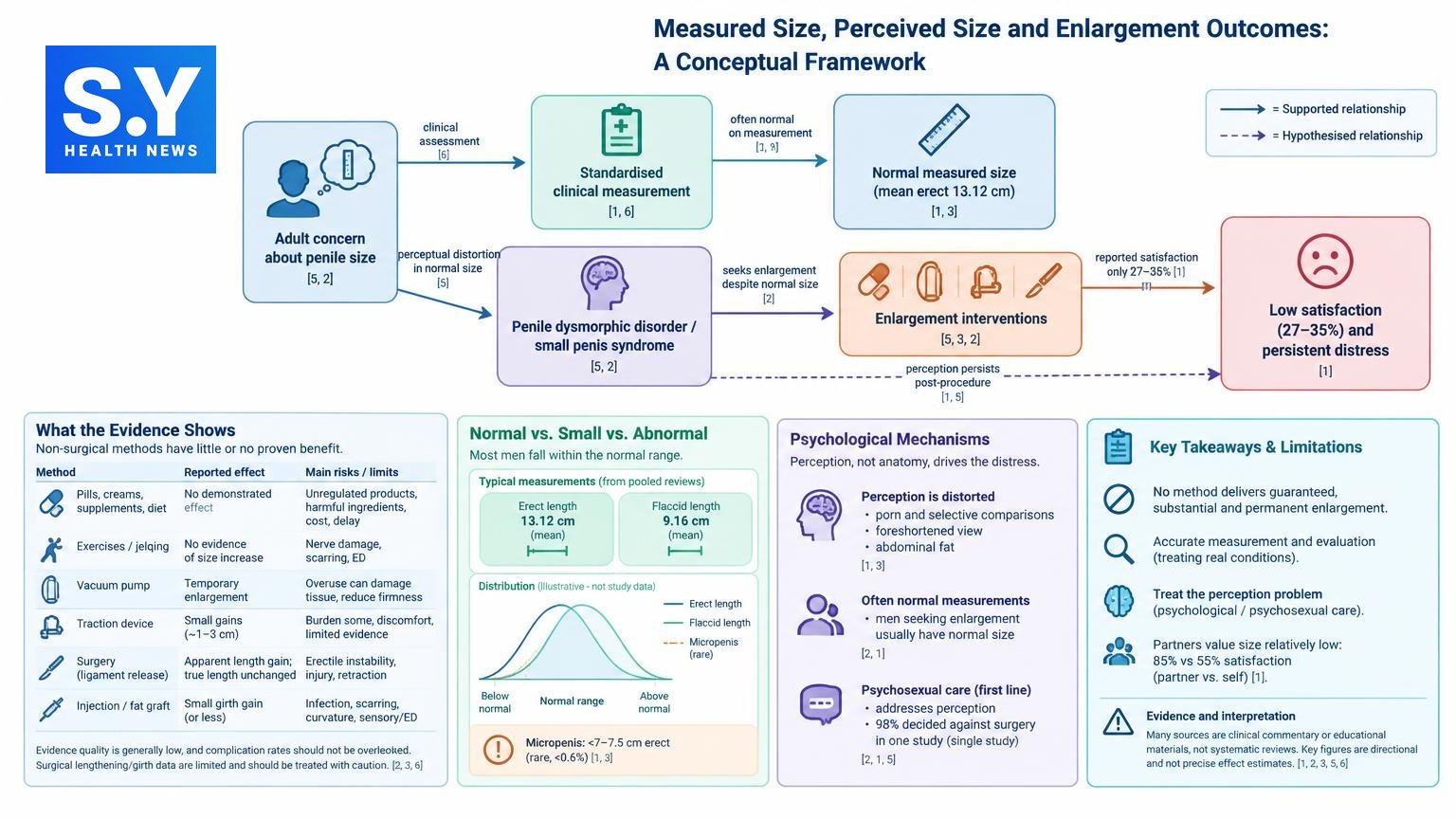
The pattern across methods is that interventions fall into three tiers: no credible benefit, temporary or modest benefit with meaningful burden, and invasive procedures with thin evidence and real harms. The table below summarises this using only the findings reported in the reviewed sources.
| Method | Reported effect | Evidence quality | Main risks and burdens |
|---|---|---|---|
| Pills, creams, supplements and diet | No demonstrated effect on penile size; no reliable evidence of permanent size increase | Insufficient scientific support; unregulated products can contain undeclared ingredients | Cost, delay, possible harmful or unlabelled ingredients |
| Jelqing and manual exercises | No scientific evidence of size increase | Not supported | Nerve damage, scarring and erectile dysfunction reported with aggressive practice |
| Vacuum pump | Temporary apparent enlargement, mainly used for erectile dysfunction | Little evidence for size change | Overuse can damage elastic tissue and reduce erection firmness |
| Traction (extender) device | Small studies report gains of about half an inch to nearly 2 inches (roughly 1–3 cm) | Small studies; judged insufficient to attribute efficacy; more safety data needed | Uncomfortable; requires at least 4–6 hours daily for many months |
| Suspensory ligament release | Penis may appear longer because more hangs, but true length is unchanged | Limited evidence; outcomes vary | Erectile instability, injury during sex, possible ligament re-growth and retraction |
| Fat injection or grafting for girth | At best slight girth increase; fat may be reabsorbed or uneven | Low-quality published evidence; complication rates should not be overlooked | Irregular shape, curvature, infection, scarring, sensory or erectile problems |
| Injectable agents for girth | Rising trend with little scientific attention | Insufficient; serious complication risk reported | Deformity, hardness, infection and permanent damage, especially in unverified settings |
Systematic reviews are described as consistently underscoring that complication rates for girth augmentation should not be overlooked, and one clinical source states that published data on surgical lengthening and girth procedures remain limited enough that any advertised centimetre figure should be treated cautiously. Another states plainly that study quality on penile augmentation procedures published over the past decade remains low.
Hormonal treatment belongs to a different discussion. When endocrine therapy is indicated, it is effective only before puberty; it is not an adult enlargement option. That distinction matters because some online marketing blurs it.
Psychological Mechanisms: Small Penis Syndrome and Penile Dysmorphic Disorder
Small penis syndrome, described within penile-focused body dysmorphic disorder, is characterised as a perceptual problem rather than an anatomical one. The distress is real and can be disabling, but it is linked to how size is perceived, not to measured size. The literature is described as consistently showing that men requesting augmentation surgery usually have normal dimensions.
This framing explains the surgery satisfaction data. Men with penile dysmorphic disorder who undergo enlargement report satisfaction rates of only 27–35%, with most remaining distressed and some feeling worse. Clinicians describe the obsession relocating after surgery — to scars, asymmetry, appearance when flaccid, or a new fixation on girth once length is addressed.
Structured psychological management is the recommended initial approach when measured size is normal. One cited study reported that after structured counselling, 98% of men with normal penises who had been seeking enlargement decided against surgery — although this is a single study whose design, sample size and follow-up are not detailed in the source. Psychosexual work is described as so far the only recognised and effective treatment for small penis syndrome, targeting the perception rather than the anatomy.
Contextual factors such as pornography featuring selected outliers, the foreshortened view when looking down at one's own body, and abdominal fat that buries the visible shaft all feed the misperception. These are not merely reassuring talking points; they are reasons the raw comparison data a man holds are systematically distorted.
Interpretation and Limitations
Several cautions apply to this body of evidence. The most specific figures in the reviewed sources — including the 27–35% satisfaction range, the 98% counselling figure and the 85% versus 55% partner-versus-self satisfaction comparison — are reported without naming the underlying studies or their designs and sample sizes in the text itself. They should be read as directional signals from secondary clinical commentary rather than as precise, independently verified effect estimates.
Several of the sources are clinician-authored or commercial explainers rather than systematic reviews; publication in an educational article does not make a claim a research finding. Where reviews are referenced, full identifiers are not always supplied, so the reported complication rates cannot be quantified here. The traction-device gains of roughly 1–3 cm come from small studies, and one clinical source explicitly judges the level of evidence insufficient to attribute efficacy.
Two documents in the packet appear to reproduce the same syndicated patient-education content, and several facts derive from a commercial men's-health blog with an interest in selling a training product. Those facts — particularly the pelvic floor and firmness claims — should not be presented as evidence that penile size increases. The cited randomised trial concerns erectile function, not size, and the reported 40% figure applies to that outcome in a specific trial population.[7]
There is also definitional inconsistency: the micropenis cutoff appears as roughly 7 cm in one source and 7.5 cm in another. This is a real methodological issue in the literature, not a trivial discrepancy, and it argues for measurement by a clinician using a standardised technique before any diagnosis is applied.
What Might Actually Help, Within Evidence Limits
No method has been shown to deliver guaranteed, substantial and permanent enlargement. The honest options are narrower than the market suggests. One is accurate assessment, including proper measurement and evaluation for conditions such as Peyronie's disease or hormonal factors. A second is treating the perception problem when measurements are normal, through psychological or psychosexual care.
For visibility rather than true size, reducing abdominal fat can reveal more of an existing shaft, since a fat pad at the base can bury part of it. Improving erection firmness — for example through pelvic floor training, which has randomised trial support for erectile dysfunction — may make an erection present closer to full capacity. Neither changes penile anatomy, and the firmness claims come from an unreferenced commercial source with self-report limitations.
Partners are consistently described as weighting size relatively low: in cited studies, 85% of women reported satisfaction with their partner's size versus 55% of men satisfied with their own. This gap is one of the most useful pieces of context for a man deciding whether to pursue an intervention — though it comes from self-report and from studies not fully identified in the reviewed text.
Research Outlook
The field needs better-designed studies before surgical and injectable techniques can be assessed properly. Existing work is characterised by low study quality over the past decade, small samples for traction devices, and insufficient follow-up to judge long-term safety. Standardising the micropenis threshold and reporting outcomes with validated psychological measures, not just dimensions, would make future trials far more informative.
For now, the evidence supports a clear clinical sequence: measure carefully, identify genuine anatomical or endocrine conditions, and when size is normal but distress is high, treat the distress first and counsel against irreversible procedures. Men whose concerns are dismissed or, conversely, exploited by unproven products are both poorly served. Neither pattern is justified by the evidence reviewed here.
Key Takeaways
- Most men requesting enlargement measure within the normal range; mean erect length in a pooled review of more than 15,000 men is 13.12 cm.
- No exercise, supplement, cream or diet has demonstrated an effect on penile size; aggressive jelqing has been linked to nerve damage, scarring and erectile dysfunction.
- Vacuum pumps give temporary enlargement and can damage elastic tissue with overuse; traction devices have limited, small-study support for gains of roughly 1–3 cm but demand 4–6 hours of daily wear for months.
- Surgery may achieve slight girth or apparent flaccid size gains but not true length; suspensory ligament release can destabilise erections, and injectable augmentation carries serious complication risk with little scientific study.
- Men with penile dysmorphic disorder report satisfaction after enlargement surgery of only 27–35%, and psychosexual work is described as the only recognised effective treatment for small penis syndrome.
- Micropenis (roughly under 7–7.5 cm erect, in under 0.6% of men) is a genuine diagnosis requiring specialist care and is distinct from size dissatisfaction with normal anatomy.
Questions and Answers
What is the average erect penis size according to pooled research?
A systematic review pooling measurements from more than 15,000 men found a mean erect length of 13.12 cm and a mean flaccid length of 9.16 cm. A related summary reports mean erect circumference near 11.7 cm. These are averages, not targets: natural variation is wide, and flaccid size does not reliably predict erect size.
Do penis enlargement pills, pumps or exercises actually work?
No. There is insufficient scientific evidence to support non-surgical enlargement methods, and no exercise, supplement or diet has been shown to change size. Pumps enlarge the penis only temporarily and can reduce erection firmness with overuse. Jelqing has no demonstrated benefit and has been linked to nerve damage, scarring and erectile dysfunction.
Do penile traction devices increase length, and what are the downsides?
Traction devices have the most published support of any non-surgical method. Small studies report gains of about half an inch to nearly 2 inches (roughly 1–3 cm), but one clinical source judges the evidence insufficient to attribute efficacy. Use can be uncomfortable and requires at least 4–6 hours daily for many months.
Why does penile enlargement surgery often fail to satisfy men with penile dysmorphic disorder?
Men with penile dysmorphic disorder who undergo enlargement report satisfaction rates of only 27–35%, and most remain distressed. The condition is perceptual, so the focus tends to shift after surgery to scars, asymmetry, flaccid appearance or girth. Psychosexual work, which addresses the perception rather than the anatomy, is described as the recognised effective treatment.
How is micropenis defined and how common is it?
Micropenis is defined as penile length more than 2.5 standard deviations below the mean, roughly under 7 cm erect in one source and about 7.5 cm in another, reflecting differing measurement conventions. It affects fewer than 0.6% of men and is usually identified in childhood. It requires specialist assessment and is distinct from size dissatisfaction with normal anatomy.
When should a man worried about penis size see a professional rather than buy a product?
When concern persists despite a normal measurement, causes checking or measuring for an hour or more daily, leads to avoiding intimacy or undressing, or damages work and social life, an assessment is warranted. If size is normal, guidance recommends psychological evaluation first, since structured support is the recommended initial management when dimensions are within normal limits.
Conceptual framework: Conceptual framework, not a tested causal model. It summarises relationships described in clinician-authored and educational sources: men seeking enlargement often measure within normal range, penile dysmorphic disorder is perceptual, and reported satisfaction after enlargement in this group is low. The dashed conceptual link from perception to persistent distress after procedures is an interpretive hypothesis.
Academic References & Evidence
- How to Make Your Penis Bigger — A Urologist's Honest Answer | GGO Med.
- Peut-on vraiment agrandir son pénis ?.
- Productos para el agrandamiento del pene: ¿funcionan?.
- How to Get a Bigger Penis: What Science Actually Says.
- Small Penis Syndrome: Micropenis Criteria and What Helps.
- Penis Büyütme Yöntemleri Nelerdir? Gerçekçi Bilgi ve Mevzuat Çerçevesi.
- Productos para el agrandamiento del pene: ¿funcionan?.
SANYUN Science Center explains published research on men's reproductive and sexual health, connecting scientific evidence with everyday questions while making sources and limitations clear.
Disclaimer: This article is for scientific education and research communication only. It does not provide medical advice, diagnosis, or individualized treatment recommendations, and does not endorse any medication, supplement, device, penile enlargement procedure, or other intervention. Decisions about sexual and reproductive health should be made in consultation with a qualified healthcare professional. Do not delay seeking professional care because of information in this article.
Original Content & Copyright Notice
- This article is prepared for SANYUN Science Center, drawing on published research and publicly available academic literature on men’s sexual and reproductive health. Its editorial explanations and presentation are developed for this platform.
- Copyright in the original editorial content, selection, and arrangement is reserved by SANYUN Science Center to the extent protected by applicable law. Referenced research, quotations, and third-party materials remain subject to the rights of their respective owners. This notice does not claim ownership of scientific facts or third-party research.
- Except where permitted by applicable law or an applicable license, prior written permission is required to reproduce, republish, translate, adapt, redistribute, or commercially reuse protected content. Attribution alone does not grant permission for such reuse.
- For permitted quotation or authorized reuse, clearly identify the source and retain a link to the original article.
- Source: SANYUN Science Center
- Original URL: Retain the original article URL on science.san-yun.com.
- Copyright Holder: SANYUN Science Center, for its own protected editorial content.
- Quotation, excerpts, or authorized reuse must not distort the scientific meaning, omit material limitations or disclaimers, or imply unverified medical claims, product efficacy, or endorsement by SANYUN Science Center.



