




Category: Penis Enlargement
Core Research Direction: Evidence-based review of penile enlargement: what clinical guidelines say about diagnosis (true micropenis vs. small-penis anxiety vs. buried penis), the limited and heterogeneous evidence for traction, vacuum, surgical and injectable thickening procedures, and the psychological screening that should precede any intervention
Search Intent: In adult men who are dissatisfied with their penile size, what do current clinical guidelines and the underlying literature actually support for 'penile enlargement', and what are the diagnostic and psychological caveats?
Platform: SANYUN Science Center
Evidence reviewed through: 2026-11-20
Executive Summary
Requests for penile enlargement are far more common than the anatomical conditions that could justify them. European Association of Urology (EAU) guidance describes micropenis as a congenital condition defined by a stretched penile length more than 2.5 standard deviations below the population mean for age and race, and epidemiological studies place it in 0.015% to 0.66% of male newborns. Against that, the guideline reports that dissatisfaction with penile size affects sexual life in about 10% of men overall, and that demand for augmentation procedures is high worldwide.[1]
The guideline's central contribution is diagnostic rather than procedural. It separates true micropenis, the complaint of a short penis, adult acquired buried penis, and body dysmorphic disorder or small-penis anxiety, and it strongly recommends screening for body dysmorphic disorder in men with a normal-sized penis who complain of shortness. EAU panel members describe most surgical procedures for penile girth or length enhancement as experimental and advise caution. This review examines the diagnostic framework, the measurement problems, the heterogeneous interventional literature and the psychological screening that should precede any procedure.[2]
Why This Matters
The gap between anatomy and perception is the defining feature of this field. In guideline-cited survey data, 84% of female partners reported satisfaction with their male partner's penile size, while 55% of male partners were satisfied and 45% said they would like a larger penis. The same guideline proposes that high demand for augmentation is partly explained by pornography exposure and an altered perception of normal size, although that attribution is a proposed explanation rather than an established causal pathway.
That asymmetry matters clinically because the men most likely to seek surgery are not necessarily the men with the smallest anatomy. The guideline notes that a subgroup requesting penile augmentation, usually surgery, show strong psychological vulnerability including body dysmorphic disorder, may be at risk of worsening psychopathology and suicide attempts, and are unlikely to achieve their surgical expectations. Among cosmetic surgery patients generally, 3% to 16% are expected to have body dysmorphic disorder, with a higher expected rate in men (15.3%) than in women (10.9%).
Diagnostic Categories and the Measurement Problem
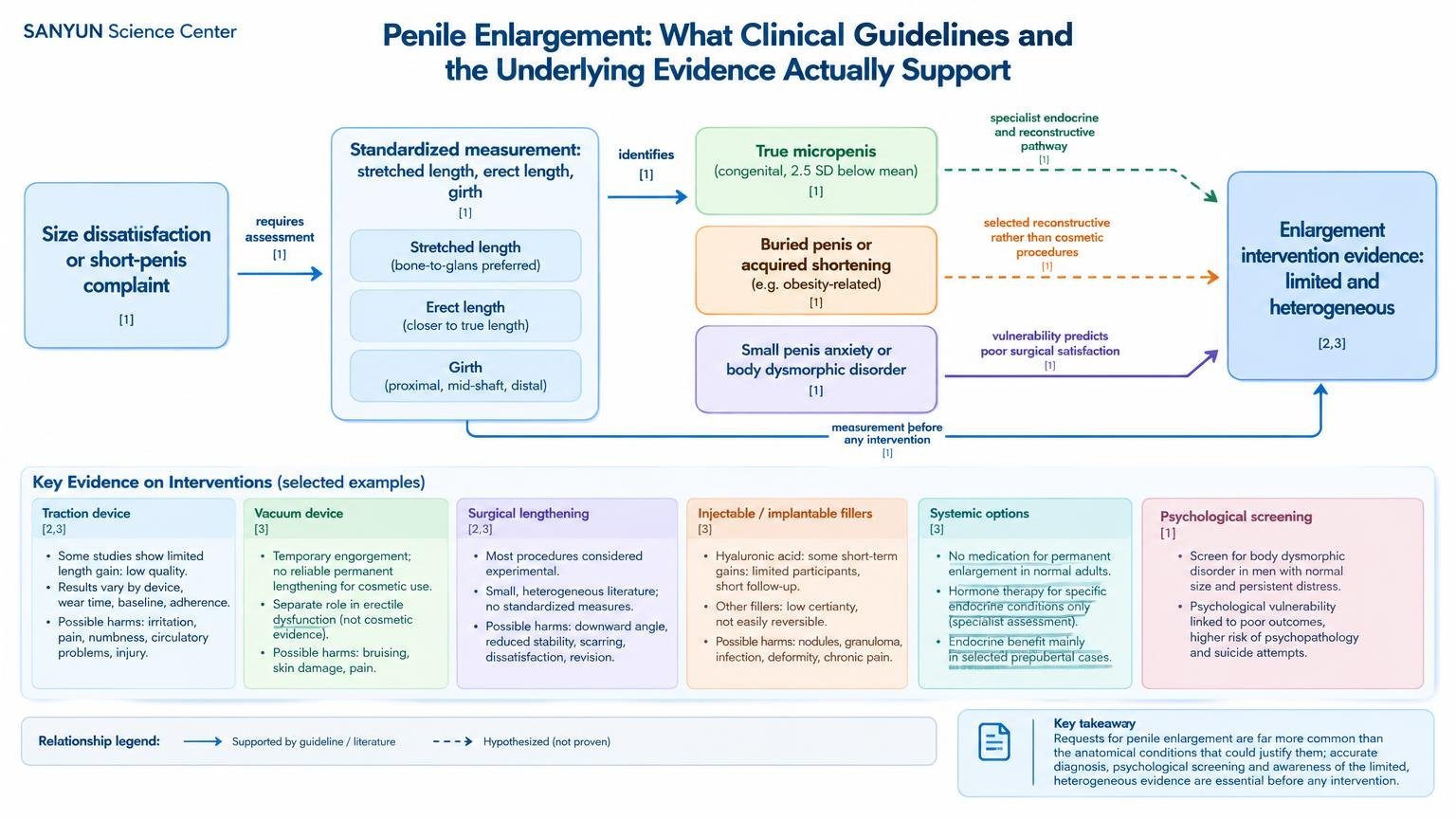
The guideline's classification is the foundation for everything that follows. True micropenis is congenital, reflects an underlying genetic or endocrine condition, and is distinct from the complaint of a short penis and from adult acquired buried penis, in which a normally sized penis is functionally and visibly concealed by prepubic, scrotal or penile tissue. Adult acquired buried penis is associated with obesity as its main risk factor; exact prevalence is unknown, but incidence appears to be rising alongside obesity, and the condition is commonly associated with erectile and voiding dysfunction, hygiene difficulty and poor quality of life.
Measurement is mandatory but not standardized. The guideline states that accurate measurement of the penile shaft is a mandatory step in assessing a complaint of short penis, yet there is no consensus definition of normal penile size because assessment and reporting methods vary so widely across studies. Stretched penile length is regarded as the closest surrogate for the erect penis, but skin-junction-to-tip measurement clearly underestimates erect length by about 20%, whereas bone-to-glans-tip measurement correlates better with erect length, particularly in overweight or obese men.
Practically, this means a man can be told he is "small" by a measurement technique that systematically under-reads him, especially if he carries excess pubic fat. The guideline advocates the stretched measurement as a bare minimum, with additional flaccid and erect measurements where feasible, and girth recorded at proximal, mid-shaft and distal sites. Routine penile Doppler ultrasound or MRI is not supported: the guideline found no evidence that imaging adds enough to physical examination to justify its routine use in this scenario, which is an evidence gap rather than proof that imaging has no value.
Flaccid length fluctuates through the day with temperature and stress, which is why clinician-authored patient guidance emphasizes bone-pressed stretched measurement from the pubic bone to the glans tip as the more meaningful clinical assessment. That is consistent with the guideline's preference for bone-to-glans-tip correlation with erect length.[3]
What the Interventional Evidence Shows
The evidence base for enlargement interventions is thin and heterogeneous, and the guideline is explicit about that. EAU panel members state that evidence in this field is lacking and that most surgical procedures for penile girth or length enhancement are experimental and should be approached with caution. A 2020 systematic review cited in clinician-authored patient guidance found that most studies of non-invasive and surgical enhancement reported favorable results, but were of low quality with non-standardized measurement and safety reporting, which limits any head-to-head comparison of techniques.
Traction devices apply controlled, prolonged stretching force. The patient-education source reports that some studies describe limited length gain after months of regular use, with results varying by device type, daily wear time, baseline measurement, adherence and follow-up, and it explicitly rejects the idea that these devices produce large permanent growth. Skin irritation, pain, numbness, circulatory problems and injury from incorrect use are described as possible harms. These are clinician narrative summaries, not pooled trial estimates, and the supplied material does not include effect sizes, confidence intervals or standardized safety rates.
Vacuum devices draw blood into the penis, producing temporary engorgement and a larger appearance. The patient-education source states there is no reliable evidence of permanent penile lengthening from vacuum therapy for cosmetic purposes, while noting that vacuum devices have a separate, established role in erectile dysfunction treatment. Excessive pressure or prolonged use may cause bruising, skin damage and pain. The distinction matters: a device licensed for erectile dysfunction is not thereby validated as a cosmetic enlargement method.
Surgical lengthening most often refers to division of the suspensory ligament. The patient-education source explains that releasing this ligament can increase visible flaccid length, but does not guarantee equivalent gain in erect length, and may produce a downward erection angle, reduced stability, scarring and dissatisfaction. Fat removal, V-Y or Z-plasty and scrotoplasty may improve visible length in selected patients without changing true cavernosal length. Reconstructive procedures after Peyronie's disease, trauma or pelvic cancer surgery address a different clinical problem from cosmetic augmentation.
Injectable and implant-based thickening deserves separate scrutiny because the marketing is often confident and the follow-up data often are not. Hyaluronic acid is the most studied temporary or semi-permanent filler, with small randomized trials and a meta-analysis reporting circumference or diameter increases and short-term satisfaction gains; total participant numbers are limited, follow-up is mostly short to medium term, and products and injection protocols vary. Its theoretical advantage is that an appropriate product can be degraded with hyaluronidase, which does not make it risk-free. Nodules, irregularity, migration, oedema, infection, foreskin problems and rarely serious tissue complications can occur.
Poly-lactic acid aims to stimulate collagen and has been reported to increase thickness in some studies, but its mechanism and complication profile differ from hyaluronic acid, with nodules, firmness, granuloma and chronic inflammation possible, and it cannot be easily reversed enzymatically. Permanent materials such as PMMA, calcium hydroxylapatite and polyacrylamide hydrogel can produce foreign-body reaction, nodules, granuloma, chronic pain and deformity, and removal can require extensive surgery, skin grafting or reconstruction. Autologous fat can be absorbed unevenly or necrose, causing asymmetry, nodules, calcification, infection and rarely fat embolism; long-term results are inconsistent.
Unregulated injections are the clearest safety hazard. Silicone oil, paraffin, petroleum jelly, mineral oils, mercury and any substance of unknown origin should not be injected into the penis, because they can cause tissue necrosis, granuloma, chronic inflammation, lymphoedema, infection, ulceration, migration, deformity and loss of sexual function. Regulatory clearance for a product in another anatomical site does not automatically authorize penile injection, and the product, lot and labeled indication should be verified before any procedure.
For the systemic options, no medication has been shown to permanently enlarge a normally developed adult penis, and hormone therapy is reserved for specific endocrine conditions under specialist assessment. The guideline likewise indicates that endocrinological treatment benefit is mainly confined to selected prepubertal cases.
| Approach | Evidence status in supplied sources | Main limitations reported | Relevant harms described |
|---|---|---|---|
| Traction device | Some studies report limited length gain with months of regular use; described as having a limited evidence base. | Results vary by device, wear time, baseline size, adherence and follow-up; no pooled effect estimates supplied. | Irritation, pain, numbness, circulatory problems, injury from incorrect use. |
| Vacuum device | Temporary engorgement; no reliable evidence of permanent lengthening for cosmetic purposes. | Separate, established role in erectile dysfunction does not establish cosmetic efficacy. | Bruising, skin damage and pain with excessive pressure or prolonged use. |
| Suspensory ligament release | Most surgical length and girth procedures described by EAU panel members as experimental. | Visible flaccid gain does not guarantee erect gain; small, retrospective and methodologically heterogeneous literature. | Downward erection angle, reduced stability, scarring, dissatisfaction, need for revision. |
| Hyaluronic acid injection | Most studied temporary filler; small randomized trials and a meta-analysis report circumference gains and short-term satisfaction. | Limited total participants, mostly short-to-medium follow-up, heterogeneous products and protocols. | Nodules, irregularity, migration, oedema, infection, foreskin problems, rare serious tissue complications. |
| Permanent or semi-permanent fillers | Used in some countries and centres; low certainty in the guideline's framing. | Not easily reversible; foreign-body reaction and removal can require reconstruction. | Nodules, granuloma, chronic pain, deformity, chronic inflammation. |
| Autologous fat transfer | Long-term results described as inconsistent; not accepted as a standard proven method. | Uneven absorption or necrosis; no standardized outcome reporting. | Asymmetry, nodules, calcification, infection, rarely fat embolism. |
| Unregulated injections (silicone oil, paraffin, unknown substances) | Should not be used; serious harm documented. | No legitimate indication; difficult or impossible to remove safely. | Tissue necrosis, granuloma, lymphoedema, infection, ulceration, migration, deformity, loss of sexual function. |
Psychological Screening Before Any Intervention
The guideline's strongest procedural message is psychological, not surgical. It strongly recommends inquiring about body dysmorphic disorder or penile dysmorphic disorder in patients with a normal-sized penis who complain of short penile size. It distinguishes body dysmorphic disorder, in which distress arises from a perceived defect not observable to others, from small penis anxiety, meaning excessive anxiety about a normal-sized penis; small penis anxiety is not a DSM-5 category, but men with it may be at risk of body dysmorphic disorder.
Screening tools named in the guideline include the Body Dysmorphic Disorder Questionnaire and the Cosmetic Procedure Screening Scale for Penile Dysmorphic Disorder, plus the Male Genital Self-Image Scale and Index of Male Genital Image for genital perception and satisfaction. The Beliefs About Penile Size questionnaire captures beliefs and internal psychological processes. The guideline states that suspected body dysmorphic disorder, comorbid psychopathology and differential diagnosis across personality, obsessive-compulsive, psychotic and emotional disorders should be assessed by an accredited mental health expert.
Two instruments proposed specifically for augmentation assessment are weaker than they sound. The Augmentation Phalloplasty Patient Selection and Satisfaction Inventory is a five-item questionnaire for assessment and counselling, and the Beliefs About Penile Size is a ten-item audit and outcome tool. Both failed to correlate with penile size, and lack of objective validation has restricted their use, so they cannot substitute for a proper clinical and psychological evaluation.
The guideline also emphasizes a full medical and sexual history, screening for causes such as phimosis, priapism, hypospadias, penile trauma, penile cancer, prostate cancer and Peyronie's disease, and validated psychosexual measures for sexual function, distress, satisfaction and relationship satisfaction. Panel commentary reinforces the same priorities: full medical history and precise penile measurements before any discussion of intervention.
Interpretation and Limitations
Several cautions apply to this review. The EAU chapter is a clinical practice guideline that grades evidence and issues recommendations; it is not itself an experimental dataset, and its summary statements inherit the limits of the cited primary studies. The expectation that 3% to 16% of cosmetic surgery patients have body dysmorphic disorder is a guideline-cited range whose primary methods are not detailed in the supplied text. The proposed role of pornography and altered size perception in driving demand is an explanatory hypothesis, not a demonstrated causal mechanism.
The interventional material comes largely from clinician-authored patient education, including the 2020 systematic review it cites secondhand, rather than from the primary trials themselves. No effect sizes, confidence intervals, complication rates or standardized follow-up durations are available in the supplied sources, so this review cannot rank techniques by measured benefit. Statements that traction produces limited gain or that hyaluronic acid improves circumference should be read as narrative summaries of a low-quality and heterogeneous literature.
A further limitation is the absence of long-term psychological and functional outcome data. The guideline notes that some men do not achieve reasonable satisfaction or emotional adjustment after augmentation, underlining that invasive procedures will not benefit men with certain psychopathological conditions. Whether screening changes outcomes is a reasonable hypothesis, but the supplied material does not provide trial evidence that it does.
Research Outlook
The field needs standardized measurement and reporting before it can produce comparable results. The guideline identifies the absence of a consensus definition of normal penile size as a core problem, and the podcast commentary frames the new chapter as an attempt to provide evidence-based treatment and raise awareness of these conditions, which is a stated aim rather than a demonstrated outcome.
Priorities implied by the evidence include prospective studies with bone-pressed stretched and erect measurements, predefined girth sites, validated psychosexual instruments, adequate follow-up and transparent complication reporting. For buried penis, standardized classification remains unsettled, with multiple systems proposed based on clinical presentation and required surgery. For injectables, the key questions are durability, reversibility and the management of nodules and migration, not single-session photographs.
Key Takeaways
- True micropenis is a congenital condition defined by stretched penile length more than 2.5 standard deviations below the mean for age and race, and reported in 0.015% to 0.66% of male newborns; it is not the same as dissatisfaction with a normal penis.
- Accurate measurement is mandatory but unstandardized; skin-junction-to-tip stretched measurement underestimates erect length by about 20%, while bone-to-glans-tip measurement correlates better, especially in overweight or obese men.
- The guideline strongly recommends screening for body dysmorphic disorder in men with a normal-sized penis who complain of shortness, because a vulnerable subgroup may worsen psychologically and is unlikely to be satisfied by surgery.
- EAU panel members describe most surgical girth and length procedures as experimental and advise caution; traction may offer limited length gain, vacuum devices offer temporary engorgement without reliable permanent lengthening, and injectable thickening carries reversible and irreversible risks.
- Unregulated penile injections of silicone oil, paraffin or unknown substances can cause necrosis, granuloma, infection and loss of sexual function, and no medication has been shown to permanently enlarge a normally developed adult penis.
Questions and Answers
What is the difference between true micropenis, buried penis and small penis anxiety?
True micropenis is a congenital condition in which stretched penile length is more than 2.5 standard deviations below the mean for age and race, usually reflecting a genetic or endocrine cause. Adult acquired buried penis is a normally sized penis concealed by prepubic, scrotal or penile tissue, often with obesity as the main risk factor. Small penis anxiety is excessive anxiety about a normal-sized penis and may overlap with body dysmorphic disorder.
How should penile length be measured when a man complains of a short penis?
The guideline treats accurate shaft measurement as mandatory but notes no consensus definition of normal size. Stretched length is the closest surrogate for the erect penis. Skin-junction-to-tip measurement underestimates erect length by about 20%, whereas bone-to-glans-tip measurement correlates better, particularly in overweight or obese men. Flaccid and erect measurements and girth at several sites add information, and routine imaging is not supported.
Does penile traction or a vacuum device permanently enlarge the penis?
The available narrative evidence is limited. Traction devices may produce limited length gain after months of regular use, but results vary by device, wear time, baseline size and adherence, and harms include irritation, pain and numbness. Vacuum devices produce temporary engorgement, with no reliable evidence of permanent cosmetic lengthening; their established role is in erectile dysfunction treatment.
How strong is the evidence for surgical penile enlargement and injectable thickening?
Weak and heterogeneous. EAU panel members describe most surgical girth and length procedures as experimental and advise caution, and a cited 2020 systematic review found mostly favorable reports from low-quality studies with non-standardized measurement and safety reporting. Hyaluronic acid has the most studied injectable profile, with small trials and a meta-analysis reporting circumference gains and short-term satisfaction, but limited participants and mostly short-to-medium follow-up.
Why is psychological screening recommended before penile enlargement surgery?
The guideline strongly recommends screening for body dysmorphic disorder in men with a normal-sized penis who complain of shortness. A subgroup requesting augmentation shows strong psychological vulnerability, may be at risk of worsening psychopathology and suicide attempts, and is unlikely to meet surgical expectations. Assessment by an accredited mental health expert is advised when body dysmorphic disorder or comorbid psychopathology is suspected.
Which penile enlargement practices carry the clearest safety warnings?
Unregulated injections carry the clearest warnings: silicone oil, paraffin, petroleum jelly, mineral oils, mercury and substances of unknown origin can cause tissue necrosis, granuloma, chronic inflammation, lymphoedema, infection, ulceration, migration, deformity and loss of sexual function. Permanent fillers and implants can also cause foreign-body reactions and may be difficult to remove, and no medication has been shown to permanently enlarge a normally developed adult penis.
Conceptual framework: Conceptual framework. A size complaint is assessed by standardized stretched, erect and girth measurement, which separates true micropenis, buried or acquired shortening, and small-penis anxiety or body dysmorphic disorder; psychological vulnerability is linked to poor surgical satisfaction, and intervention evidence remains limited and heterogeneous. Relationships are conceptual, not a tested causal model or physiological pathway.
Academic References & Evidence
- Penile Size Abnormalities and Dysmorphophobia – EAU Guidelines on Sexual and Reproductive Health – Uroweb.
- Paolo Capogrosso; Marco Falcone. Dr. Capogrosso and Dr. Falcone talk about new sexual and reproductive EAU Guidelines – EAU Podcast.
- Taner Çavumirza. Penis büyütme nedir, nasıl yapılır? Gerçekten işe yarar mı?.
SANYUN Science Center explains published research on men's reproductive and sexual health, connecting scientific evidence with everyday questions while making sources and limitations clear.
Disclaimer: This article is for scientific education and research communication only. It does not provide medical advice, diagnosis, or individualized treatment recommendations, and does not endorse any medication, supplement, device, penile enlargement procedure, or other intervention. Decisions about sexual and reproductive health should be made in consultation with a qualified healthcare professional. Do not delay seeking professional care because of information in this article.
Original Content & Copyright Notice
- This article is prepared for SANYUN Science Center, drawing on published research and publicly available academic literature on men’s sexual and reproductive health. Its editorial explanations and presentation are developed for this platform.
- Copyright in the original editorial content, selection, and arrangement is reserved by SANYUN Science Center to the extent protected by applicable law. Referenced research, quotations, and third-party materials remain subject to the rights of their respective owners. This notice does not claim ownership of scientific facts or third-party research.
- Except where permitted by applicable law or an applicable license, prior written permission is required to reproduce, republish, translate, adapt, redistribute, or commercially reuse protected content. Attribution alone does not grant permission for such reuse.
- For permitted quotation or authorized reuse, clearly identify the source and retain a link to the original article.
- Source: SANYUN Science Center
- Original URL: Retain the original article URL on science.san-yun.com.
- Copyright Holder: SANYUN Science Center, for its own protected editorial content.
- Quotation, excerpts, or authorized reuse must not distort the scientific meaning, omit material limitations or disclaimers, or imply unverified medical claims, product efficacy, or endorsement by SANYUN Science Center.



