




Category: Penis Enlargement
Core Research Direction: Evidence-based framing of penile enlargement/augmentation: what clinical consensus (ICSM 2024) actually supports across physical, mechanical and surgical techniques, and how marketing of unproven enlargement methods exploits size anxiety — with attention to length/girth outcomes, complications, and long-term data gaps.
Search Intent: What does current clinical consensus evidence actually say about whether penile enlargement techniques work, how safe they are, and why unproven methods are marketed to men worried about penis size?
Platform: SANYUN Science Center
Evidence reviewed through: 2026-11-04
Executive Summary
Two publications from the Fifth International Consultation on Sexual Medicine (ICSM 2024) frame the current clinical conversation about penile enlargement. One provides consensus recommendations on penile augmentation and cosmetic surgery, defining the field as any technique aimed at enhancing penile length or girth and cataloguing proposed physical and surgical strategies. The other examines the ethical and economic context, stating that false advertising has exploited men's anxiety about penis size and that advertising of enlargement techniques preys on these anxieties without evidence supporting efficacy.[1][2]
The augmentation consensus provides twenty recommendations with levels of evidence and grades, yet explicitly acknowledges controversy and a lack of longer-term data. It makes comprehensive assessment and careful counselling about pros, cons and potential complications mandatory before any treatment. Together, the two reviews describe a field in which patient demand and commercial messaging outpace the controlled outcome data needed to justify many procedures.
Why This Matters: Demand, Anxiety and Commercial Pressure
Penile size concerns are common enough that an entire commercial ecosystem has formed around them. The ethics review describes an internet-based industry promoting and dispensing dietary supplements and warns that liberal, unfettered marketing has spread products that at best do not deliver the desired result and at worst are adulterated and threaten individual and public health. The internet has aided sexual health education but has also promoted non-evidence-based information that can contribute to sexual dysfunctions.
Access barriers compound the problem. The review identifies lack of health-plan coverage, lack of trained professionals, and costs of exams and treatments as impediments to sexual healthcare in many parts of the world. When credible clinical pathways are hard to reach, commercially motivated alternatives fill the vacuum, and men may encounter persuasive claims before they encounter balanced counselling.
Defining the Interventions: Physical, Mechanical, Medical and Surgical
The ICSM augmentation review defines penile augmentation or penis enlargement surgery as any technique aimed at enhancing penile length or girth. It lists proposed strategies spanning physical methods such as various penile exercises, mechanical traction devices and medical therapy, alongside surgical interventions including cosmetic and phallic reconstructive techniques and the use of fillers, sleeves, grafts and flaps to augment penile size. The same review notes that some male enhancement surgical techniques can increase total penile length, either flaccid or erect, while others add to the penile shaft's girth and/or glans size.
That enumeration is descriptive, not comparative. The supplied consensus text does not report effect magnitudes, responder rates or head-to-head outcomes for exercises, traction, medical therapy, fillers, grafts or flaps. This is a crucial distinction for readers: a technique appearing in a consensus document as a proposed strategy does not mean the consensus endorses it as effective for a given patient or that it has been validated in controlled trials. The document's own language about controversy and missing long-term data reinforces that caution.
Biological and Clinical Mechanism: What Is Being Altered
Penile size has flaccid and erect dimensions, and the augmentation consensus distinguishes techniques intended to increase total length from those intended to add shaft girth or glans size. Surgical approaches may involve reconstruction, fillers, sleeves, grafts or flaps, each acting through a different anatomical route. Non-surgical approaches such as traction devices or exercises propose mechanical tissue changes. The ICSM documents do not provide a detailed mechanistic evidence synthesis, so the precise tissue-level effects, durability and reversibility of many techniques should be treated as incompletely characterised rather than established.
What the Evidence Shows: Consensus Recommendations and Their Constraints
The augmentation consensus is the most structured current guidance in the supplied material. It provides twenty new recommendations with corresponding levels of evidence and grades of recommendation, developed through a comprehensive literature search and presented for delegate feedback at the fifth ICSM meeting. Those features make it a consensus product intended to guide a clinical framework in penile aesthetics and augmentation.
The recommendations carry two explicit constraints. First, the authors state that controversy and lack of longer-term data regarding penile augmentation and cosmetic procedures make comprehensive assessment and careful patient counselling about pros, cons and potential complications mandatory before embarking on any treatment. Second, they recommend that surgeons be experienced in anatomy and various surgical techniques and that surgical options be individualised based on patient conditions and needs, surgeon expertise and local resources. These are consensus judgments about appropriate care, not measured effect sizes.
The ethics review adds a population-level conclusion: doctors should inform patients of the risks of non-evidence-based practices, and the International Society of Sexual Medicine should produce evidence-based information accessible to the general public and work toward solutions to existing economic barriers. This is a recommendation for clinical communication and public education, not a trial result.
| Intervention category | Examples in the consensus | What the consensus text reports | Evidence constraint |
|---|---|---|---|
| Physical methods | Penile exercises, mechanical traction devices | Listed as proposed strategies; no outcome magnitudes given | No comparative efficacy reported in the supplied text; mechanisms not detailed |
| Medical therapy | Medical therapy | Listed as a proposed strategy | No agent, dose, duration or efficacy result supplied |
| Fillers, sleeves, grafts, flaps | Use to augment penile size | Listed as surgical interventions; girth and/or glans effects described qualitatively | No long-term durability or complication rates in the supplied text |
| Cosmetic and reconstructive surgery | Phallic reconstructive techniques | Described as capable of increasing total penile length, flaccid or erect | Consensus notes controversy and lack of longer-term data |
| Commercial supplements | Internet-promoted dietary supplements | Flagged as a consumer-protection concern | Described as at best ineffective and at worst adulterated; no health-benefit evidence presented |
Safety and Complications: What Can Be Said Responsibly
Both consensus documents place complications and the limits of evidence at the centre of their messages. The augmentation review makes counselling about potential complications mandatory before any treatment, and it ties that requirement to the field's controversies and lack of longer-term data. The ethics review warns that liberal marketing has spread products that at worst are adulterated and threaten individual and public health. The supplied material does not provide a pooled complication rate for particular procedures, so readers should avoid converting these warnings into numerical risk estimates.
For clinical practice, the implication is procedural rather than probabilistic: assess thoroughly, counsely explicitly about uncertainty, and disclose that durability and long-term outcomes remain inadequately characterised. The consensus does not support promising a specific result to any individual, and it does not present a hierarchy showing one technique as proven superior to another.
Interpretation and Limitations: How Strong Is the Evidence?
The supplied evidence is best described as consensus guidance plus a narrative ethical-economic review. The ethics review was conducted as a narrative review through wide searches in PubMed, Google and relevant global websites, without a described formal pooling or risk-of-bias assessment. The augmentation review likewise reports a comprehensive literature search and twenty graded recommendations, but the supplied text does not detail study-level results, sample sizes or the evidence grade for each recommendation. These are not systematic reviews with meta-analysis in the material available here.
Several specific gaps follow. The consensus describes intended effects of surgical techniques, such as increasing flaccid or erect length or adding girth and glans size, but supplies no magnitude, responder proportion or durability data in the passages available. The assertion that enlargement advertising lacks efficacy evidence is an interpretive claim about the evidence base rather than a measured outcome. The warning that some products may be adulterated is not accompanied in the supplied text by rates of adulteration or a list of tested products. Readers should distinguish the considered judgments of experts from statistically quantified findings.
Research Outlook and Appropriate Counselling
The roadmap implied by the consensus documents has three components. Clinical services should prioritise comprehensive assessment, individualised planning and explicit discussion of uncertainty and complications. Public information should counter non-evidence-based claims with accessible, balanced content, as the ethics review recommends. And the field needs longer-term data on outcomes and complications to move beyond controversy. None of these is a promise of a new therapy; they are indications of where the evidence infrastructure is thin.
For men concerned about size, the clinically honest position is that some techniques are performed and some can alter measured dimensions, but the quality and durability of benefit remain debated in the consensus itself. A conversation with a qualified clinician should cover expectations, alternatives, the risk of regret, and the difference between anatomical change and satisfaction. Commercial marketing that avoids those subjects is a warning sign rather than a substitute for evidence.
Key Takeaways
- The ICSM 2024 augmentation consensus defines penile enlargement as any technique aimed at enhancing penile length or girth and lists physical, mechanical, medical and surgical approaches.
- It provides twenty graded recommendations but explicitly acknowledges controversy and lack of longer-term data, making comprehensive assessment and careful counselling mandatory.
- The companion ethics review states that false advertising has exploited size anxiety and that enlargement advertising lacks evidence of efficacy.
- It also flags an internet-based supplement industry whose products at best fail to deliver the desired result and at worst are adulterated and pose a public health threat.
- Both reviews are consensus and narrative documents, not systematic reviews with pooled outcomes, so effect sizes and comparative safety remain incompletely characterised.
Questions and Answers
What does the ICSM 2024 consensus define as penile enlargement or augmentation?
The ICSM 2024 augmentation review defines penile augmentation or penis enlargement surgery as any technique aimed at enhancing penile length or girth. It lists physical methods such as penile exercises, mechanical traction devices and medical therapy, and surgical interventions including cosmetic and reconstructive techniques, fillers, sleeves, grafts and flaps. The definition is broad and descriptive rather than an endorsement of efficacy for each approach.
What are the main conclusions of the ICSM 2024 penile augmentation recommendations?
The consensus provides twenty recommendations with evidence levels and grades and frames a clinical approach to penile aesthetics. Its central safety message is that controversy and lack of longer-term data make comprehensive assessment and careful counselling about pros, cons and complications mandatory before treatment. It also urges individualised surgical planning by experienced surgeons based on patient needs and local resources. The supplied text does not report comparative effect sizes.
How strong is the evidence behind current penile enlargement guidance?
The available evidence is consensus guidance supplemented by a narrative ethical and economic review, not a systematic review with meta-analysis. The augmentation document reports twenty graded recommendations but the supplied text does not detail study-level results or magnitudes. The ethics review used broad narrative searches in PubMed, Google and global websites. Readers should treat the recommendations as expert judgments informed by a heterogeneous and limited literature base.
Why does marketing of penis enlargement products exploit anxiety about size?
The ethics review states that false advertising has exploited men's anxiety about penis size and that advertising of techniques claimed to produce enlargement preys on those anxieties without evidence supporting efficacy. It also describes an internet-based supplement industry whose products at best do not deliver the desired result and at worst are adulterated and threaten health. Access barriers such as cost and lack of trained professionals can make commercial claims harder to challenge.
What are the limitations and risks of penile enlargement procedures according to the consensus?
The consensus explicitly acknowledges controversy and a lack of longer-term data on penile augmentation and cosmetic procedures. It makes counselling about potential complications mandatory and emphasises experienced surgeons and individualised planning. The supplied material does not provide pooled complication rates or durability figures for specific procedures, so numerical risk estimates should not be inferred from these reviews. The ethics review separately warns that some marketed products may be adulterated.
What should someone concerned about penis size understand before considering enlargement?
According to the ICSM documents, a balanced clinical conversation should cover the uncertainty in the field, the lack of long-term outcome data, potential complications and the difference between anatomical change and personal satisfaction. The consensus makes such counselling mandatory before any treatment and recommends individualised evaluation. Marketing that promises specific enlargement results without discussing these limits is inconsistent with the consensus position on evidence-based care.
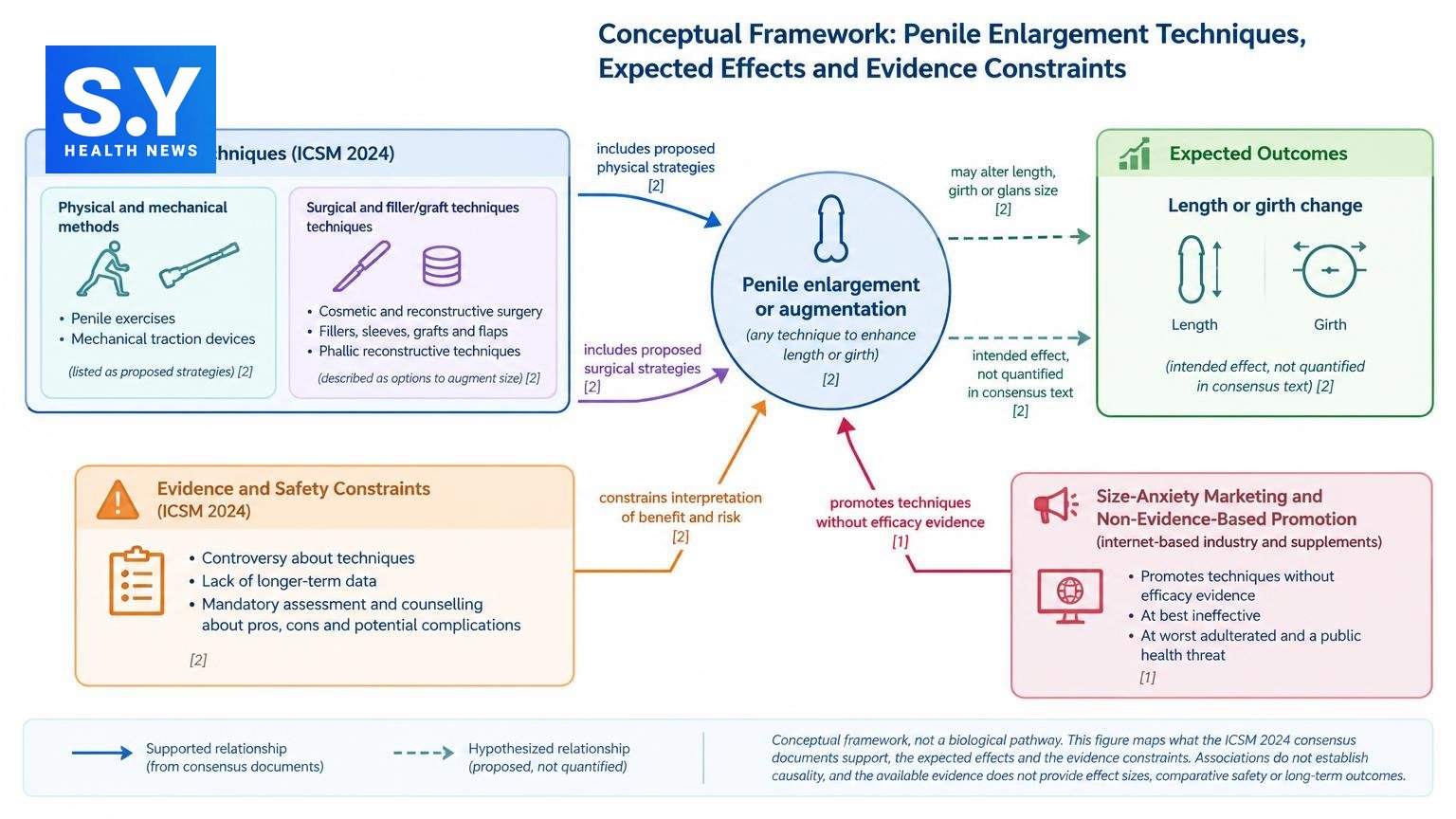
Conceptual framework: Conceptual framework, not a biological pathway. This evidence review of ICSM 2024 consensus documents maps proposed physical and surgical enlargement techniques to expected length or girth outcomes, with controversy, limited long-term data and exploitative marketing shown as constraints. Supported links are descriptive consensus statements; the physical-technique-to-outcome link is proposed rather than quantified. The framework does not model causal pathways or claim tested mediation.
Academic References & Evidence
- Sidney Glina. The ethical and economic aspects … | Archive ouverte UNIGE. Sexual medicine reviews. 2025 13(4):471–482 DOI: 10.1093/sxmrev/qeaf028.
- Chung, Eric; Jenkins, Lawrence; Moon, Du Geon; Ziegelmann, Matthew; Deveci, Serkan; Lin, Hao Cheng; Broderick, Gregory; Seyam, Raouf; Morey, Allen; Levine, Laurence. Penile augmentation and cosmetic surgery: recommendations from the Fifth International Consultation on Sexual Medicine (ICSM 2024). 2026 14(1)
SANYUN Science Center explains published research on men's reproductive and sexual health, connecting scientific evidence with everyday questions while making sources and limitations clear.
Disclaimer: This article is for scientific education and research communication only. It does not provide medical advice, diagnosis, or individualized treatment recommendations, and does not endorse any medication, supplement, device, penile enlargement procedure, or other intervention. Decisions about sexual and reproductive health should be made in consultation with a qualified healthcare professional. Do not delay seeking professional care because of information in this article.
Original Content & Copyright Notice
- This article is prepared for SANYUN Science Center, drawing on published research and publicly available academic literature on men’s sexual and reproductive health. Its editorial explanations and presentation are developed for this platform.
- Copyright in the original editorial content, selection, and arrangement is reserved by SANYUN Science Center to the extent protected by applicable law. Referenced research, quotations, and third-party materials remain subject to the rights of their respective owners. This notice does not claim ownership of scientific facts or third-party research.
- Except where permitted by applicable law or an applicable license, prior written permission is required to reproduce, republish, translate, adapt, redistribute, or commercially reuse protected content. Attribution alone does not grant permission for such reuse.
- For permitted quotation or authorized reuse, clearly identify the source and retain a link to the original article.
- Source: SANYUN Science Center
- Original URL: Retain the original article URL on science.san-yun.com.
- Copyright Holder: SANYUN Science Center, for its own protected editorial content.
- Quotation, excerpts, or authorized reuse must not distort the scientific meaning, omit material limitations or disclaimers, or imply unverified medical claims, product efficacy, or endorsement by SANYUN Science Center.



