




Category: Penis Enlargement
Core Research Direction: Major complications of genital (penile/scrotal) enlargement surgery: a retrospective case series of corrective management outcomes in men presenting 2002–2016
Search Intent: What major complications have been reported after penile and scrotal enlargement procedures, and what happens to affected men after corrective surgery?
Platform: SANYUN Science Center
Evidence reviewed through: 2026-11-08
Executive Summary
Cosmetic genital enlargement surgery aims to increase penile length and/or girth for cosmetic rather than functional reasons, yet the published evidence base for these procedures is thin and uneven. A conference abstract by authors reporting a single-institution experience described eight men who presented between 2002 and 2016 with complications after penile and/or scrotal enlargement procedures. The authors characterized prior literature as reporting only minor complications in a small percentage of patients but stated that they continued to see and treat major complications in their own practice.[1]
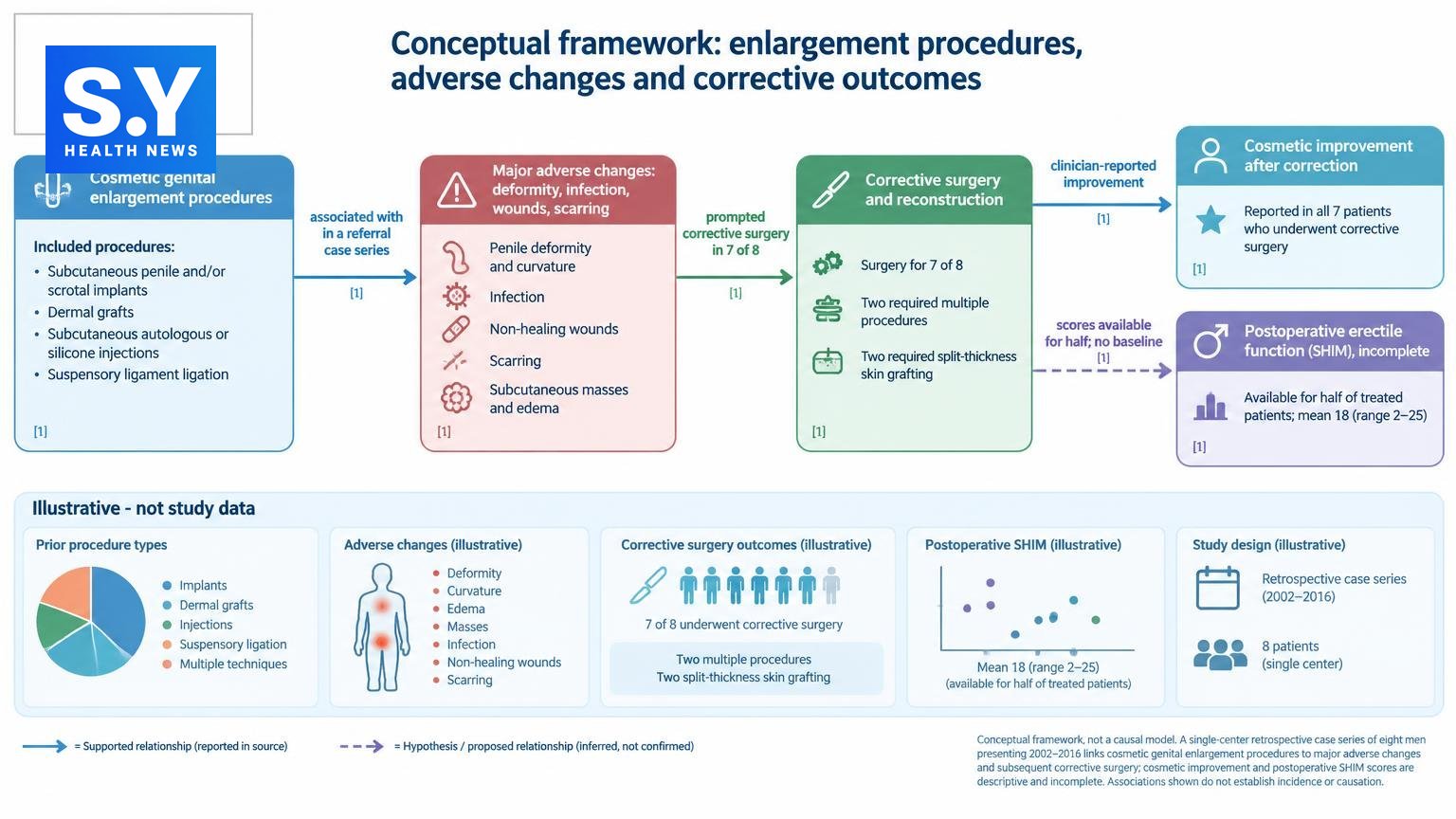
In that series, the mean age was 49 years (range 29–70). Prior procedures included subcutaneous penile and/or scrotal implants, dermal grafts, subcutaneous autologous or silicone injections, and suspensory ligament ligation; three patients had undergone multiple techniques. All patients who had received a subcutaneous penile implant had it removed before presentation. Reported adverse changes included sexually disabling penile deformity, curvature, edema, subcutaneous masses, infection, non-healing wounds and scarring.
Seven of the eight patients underwent corrective surgery; two required multiple procedures and two required split-thickness skin grafting. All seven were reported to have improved cosmetic appearance. Postoperative Sexual Health Inventory for Men (SHIM) scores were available for only half of the treated patients, with a mean of 18 (range 2–25). The authors concluded that penile and scrotal enhancement surgery can be associated with major disabling complications causing deformity and functional compromise in men with previously normal anatomy, and cited the Sexual Medicine Society of North America position that these surgeries should be considered experimental.
Why This Matters
Genital enlargement surgery sits at an uncomfortable intersection of cosmetic demand, limited high-quality evidence and potentially irreversible harm. The stated objective is cosmetic augmentation of length and/or girth, not correction of a functional deficit. When procedures in this category go wrong, the consequences described in the case series are not trivial: sexually disabling deformity, curvature, infection, non-healing wounds and scarring can affect body image, sexual function and everyday comfort in men whose anatomy was previously normal.
The authors' contrasting observation is important for how the evidence is read. They note that recent reports, as they characterize them, describe only minor complications in a small percentage of patients, but their own referral experience involved major complications requiring corrective surgery. That divergence may reflect differences in case mix, referral pathways, procedure types or follow-up, and it cannot be resolved by a single small series. It does, however, underscore that favorable complication rates reported by operating centers and the experience of reconstructive or referral clinicians may not describe the same population.
Study Design and What Was Measured
The report is a retrospective review of a prospectively maintained institutional database, conducted under Institutional Review Board approval, covering all patients who presented with complications of genital enlargement surgery between 2002 and 2016. This is a case series design: it selects patients by the outcome of interest (presenting with a complication) and describes them. It does not follow a defined cohort of all men who underwent such surgery, so it cannot estimate how often complications occur.
Eight patients were identified, with a mean age of 49 years (range 29–70). The exposure of interest was prior genital enlargement surgery, comprising subcutaneous penile and/or scrotal implants, dermal grafts, subcutaneous autologous or silicone injections, and suspensory ligament ligation; three patients had undergone multiple of these techniques. The outcomes described were adverse anatomical and clinical changes, the corrective procedures performed, cosmetic appearance after correction, and available postoperative erectile function scores.
| Variable | Source-grounded definition | Interpretation |
|---|---|---|
| Study design | Retrospective review of a prospectively maintained database of patients presenting with complications of genital enlargement surgery, 2002–2016, under IRB approval | Case series; selects on the outcome, so it cannot estimate complication incidence or compare techniques |
| Patients identified | Eight patients; mean age 49 years (range 29–70) | Very small, single-center sample; findings are descriptive |
| Prior enlargement procedures | Subcutaneous penile and/or scrotal implants, dermal grafts, subcutaneous autologous or silicone injections, suspensory ligament ligation; three patients had multiple techniques | Heterogeneous exposures; specific technique-to-complication links were not reported |
| Adverse changes | Sexually disabling penile deformity, curvature, edema, subcutaneous masses, infection, non-healing wounds, scarring | Qualitative list without per-complication frequencies |
| Corrective surgery | Seven of eight underwent corrective surgery; two required multiple procedures and two required split-thickness skin grafting | Most patients needed operative reconstruction; a minority needed staged or graft-based repair |
| Cosmetic outcome | Cosmetic appearance improved in all seven patients who underwent corrective surgery, as assessed by the authors | Subjective clinician-assessed endpoint; no validated cosmetic scale reported |
| Postoperative SHIM score | Available for half of the correctively treated patients; mean 18 (range 2–25) | Incomplete and without reported preoperative baseline; wide range suggests heterogeneous erectile outcomes |
Biological and Clinical Mechanisms of Harm
The case series does not test mechanisms, but the reported adverse changes map onto plausible pathways of surgical and foreign-body injury. Subcutaneous implants and injected materials create a permanent foreign-body interface in thin, mobile genital skin. Infection, non-healing wounds and subcutaneous masses are consistent with foreign-body colonization or inflammatory reaction, impaired wound healing, and material migration or extrusion. All patients who had received a subcutaneous penile implant had it removed before presentation, which is consistent with implant-related problems severe enough to require explantation, although the source does not specify counts, timing or reasons for removal.
Deformity, curvature and scarring can arise from fibrosis, contracture or tissue loss after infection or graft procedures. Suspensory ligament ligation, listed among prior procedures, is a technique intended to alter penile suspensory support; the source does not describe its specific complications, and this review does not infer a mechanism beyond what was reported. Dermal grafts and autologous or silicone injections add further variables: graft survival, cyst formation, granulomatous reaction and material dispersion are recognized concerns in soft-tissue augmentation generally, but this series does not attribute complications to individual techniques.
The functional dimension is captured only partially. SHIM scores after corrective surgery were available for half of the seven treated patients, with a mean of 18 (range 2–25). A mean score in this range may fall within mild-to-moderate erectile dysfunction categorization on common SHIM bands, though the source does not provide interpretation, baseline or timing. Because scores were available for only half of treated patients and no preoperative scores were reported, the data cannot show whether corrective surgery improved, preserved or worsened erectile function. The wide range is a reminder that group means can conceal very different individual outcomes.
What the Evidence Shows, and What It Does Not
The central finding is descriptive: major, sometimes disabling complications were observed in men who had undergone cosmetic penile and/or scrotal enlargement procedures, and most required corrective surgery. Reported adverse changes included sexually disabling penile deformity, curvature, edema, subcutaneous masses, infection, non-healing wounds and scarring. Seven patients underwent corrective surgery, two needed multiple procedures and two needed split-thickness skin grafting. Cosmetic appearance improved in all seven, according to the authors.
What the evidence does not show is equally important. Eight patients over roughly 14 years at one institution cannot establish incidence, prevalence or relative risk. There is no denominator of all patients who underwent these procedures, no comparison group managed differently, and no standardized prospective outcome assessment across all patients. The report does not quantify how many patients had each adverse change, how many had each prior procedure, or how complications were distributed by technique. It also does not report preoperative sexual function, so the SHIM data cannot be interpreted as change.
The authors' own conclusion is appropriately cautious in scope: penile and scrotal enhancement surgery can be associated with major disabling complications leading to deformity and functional compromise in men with prior normal anatomy. That is an association observed in a selected referral series, not proof that any specific procedure causes harm at a particular rate. The statement that such surgeries should be considered experimental, attributed to the Sexual Medicine Society of North America, is cited secondhand in the source and is a professional position rather than a finding of this series.
Interpretation and Limitations
Several limitations constrain interpretation. The sample is very small (eight patients), drawn from a single institution, and selected because patients presented with complications; referral centers may see more severe cases than community practice. The design is retrospective, even though the underlying database was prospectively maintained, and the report is a conference abstract rather than a full-length peer-reviewed article. Outcome assessment appears clinician-reported; cosmetic improvement is a subjective endpoint without a validated scale, and SHIM data are incomplete and lack a baseline.
There is also heterogeneity that the small sample cannot unpack. Prior procedures included implants, dermal grafts, autologous or silicone injections and suspensory ligament ligation, with three patients having undergone multiple techniques. Complication profiles may differ substantially across these exposures, but the source reports only an aggregate list of adverse changes. The absence of a comparison group means the series cannot say whether corrective surgery is superior to any alternative management, nor can it separate the effects of surgery from natural history or co-interventions.
Finally, the report is dated within its stated window (presentations from 2002 to 2016) and should not be presented as a new or current-year study. Its value lies in documenting a recognisable pattern of severe harm and reconstructive need, not in providing contemporary incidence estimates. Readers should treat the findings as a signal that warrants fuller prospective registration and standardized outcome capture, not as a definitive safety profile.
Research and Clinical Outlook
The obvious next step is a properly designed cohort or registry that enrolls all patients undergoing specified genital enlargement procedures, records technique and materials, and follows standardized cosmetic, functional and patient-reported outcomes with predefined complications. Such a design could estimate incidence and identify technique-specific risks. Until then, clinicians counseling men considering these procedures should discuss the possibility of major deformity, infection, non-healing wounds, scarring and the need for corrective surgery, as the authors themselves recommend.
For reconstructive practice, the series suggests that corrective surgery can be complex: two of seven patients needed multiple procedures and two needed split-thickness skin grafting, while cosmetic improvement was reported in all seven. However, the functional picture remains uncertain because SHIM data were available for only half of treated patients and no baseline was given. Future reports should include preoperative and postoperative erectile function, validated cosmetic assessment and longer follow-up so that men and clinicians can weigh benefits against the real possibility of needing further surgery.
Key Takeaways
- A single-center case series identified eight men (mean age 49 years, range 29–70) who presented between 2002 and 2016 with complications after penile and/or scrotal enlargement procedures.
- Reported adverse changes included sexually disabling penile deformity, curvature, edema, subcutaneous masses, infection, non-healing wounds and scarring.
- Seven of eight patients underwent corrective surgery; two required multiple procedures and two required split-thickness skin grafting, and cosmetic improvement was reported in all seven.
- Postoperative SHIM scores were available for only half of treated patients (mean 18, range 2–25) and no preoperative baseline was reported, so functional change cannot be determined.
- Because the series selects patients who presented with complications and lacks a denominator, it cannot estimate how often these complications occur; it supports the authors' call for patient awareness and describes these surgeries, per the cited society position, as experimental.
Questions and Answers
What complications have been reported after penile and scrotal enlargement surgery?
A single-center case series of eight men presenting between 2002 and 2016 reported sexually disabling penile deformity, curvature, edema, subcutaneous masses, infection, non-healing wounds and scarring after procedures that included implants, dermal grafts, autologous or silicone injections and suspensory ligament ligation. All patients who had received a subcutaneous penile implant had it removed before presentation. The series is descriptive and does not give frequencies for each complication.
What happened to men who had corrective surgery for genital enlargement complications?
Seven of the eight patients underwent corrective surgery. Two required multiple procedures and two required split-thickness skin grafting. All seven were reported to have improved cosmetic appearance. Postoperative SHIM scores were available for only half of the treated patients, with a mean of 18 (range 2–25), so erectile function outcomes remain incompletely characterized and cannot be compared with a preoperative baseline.
How strong is the evidence that penile enlargement surgery causes major complications?
The evidence is limited. It comes from a retrospective single-center case series of eight patients who presented with complications, reported in a conference abstract, without a denominator of all operated patients or a comparison group. It shows that major complications can occur and can require complex reconstruction, but it cannot estimate incidence, prove causation for a specific technique, or represent all men undergoing these procedures.
Do the sexual function scores after corrective genital surgery show recovery?
They cannot show recovery. Postoperative SHIM scores were available for only half of the seven correctively treated patients, with a mean of 18 (range 2–25), and no preoperative SHIM baseline was reported. Without paired before-and-after scores and complete follow-up, the data cannot indicate whether erectile function improved, was preserved or worsened after corrective surgery.
What are the limitations of the 2002–2016 genital enlargement complication case series?
Key limitations include a very small sample of eight patients, single-center referral selection, retrospective design, and publication as a conference abstract. Outcomes are largely clinician-reported, cosmetic improvement is subjective, per-complication frequencies are not given, and SHIM data are incomplete without a baseline. The series therefore documents severe harm but cannot establish incidence, compare techniques or define the safety profile of these procedures.
What should men considering penile or scrotal enlargement surgery know about risks?
The authors advise that patients should be aware of the risks of major disabling complications, including deformity, curvature, infection, non-healing wounds and scarring, and that corrective surgery may be needed. They also cite the Sexual Medicine Society of North America position that these surgeries should be considered experimental. This is general risk information from a small case series, not personalized medical advice; individual decisions should be discussed with a qualified clinician.
Conceptual framework: Conceptual framework, not a causal model. A single-center retrospective case series of eight men presenting 2002–2016 links cosmetic genital enlargement procedures to major adverse changes and subsequent corrective surgery; cosmetic improvement and postoperative SHIM scores are descriptive and incomplete. Associations shown do not establish incidence or causation.
Academic References & Evidence
- MP79-16 COMPLICATIONS OF GENITAL ENLARGEMENT SURGERY | Journal of Urology. Journal of Urology DOI: 10.1016/j.juro.2017.02.2500.
SANYUN Science Center explains published research on men's reproductive and sexual health, connecting scientific evidence with everyday questions while making sources and limitations clear.
Disclaimer: This article is for scientific education and research communication only. It does not provide medical advice, diagnosis, or individualized treatment recommendations, and does not endorse any medication, supplement, device, penile enlargement procedure, or other intervention. Decisions about sexual and reproductive health should be made in consultation with a qualified healthcare professional. Do not delay seeking professional care because of information in this article.
Original Content & Copyright Notice
- This article is prepared for SANYUN Science Center, drawing on published research and publicly available academic literature on men’s sexual and reproductive health. Its editorial explanations and presentation are developed for this platform.
- Copyright in the original editorial content, selection, and arrangement is reserved by SANYUN Science Center to the extent protected by applicable law. Referenced research, quotations, and third-party materials remain subject to the rights of their respective owners. This notice does not claim ownership of scientific facts or third-party research.
- Except where permitted by applicable law or an applicable license, prior written permission is required to reproduce, republish, translate, adapt, redistribute, or commercially reuse protected content. Attribution alone does not grant permission for such reuse.
- For permitted quotation or authorized reuse, clearly identify the source and retain a link to the original article.
- Source: SANYUN Science Center
- Original URL: Retain the original article URL on science.san-yun.com.
- Copyright Holder: SANYUN Science Center, for its own protected editorial content.
- Quotation, excerpts, or authorized reuse must not distort the scientific meaning, omit material limitations or disclaimers, or imply unverified medical claims, product efficacy, or endorsement by SANYUN Science Center.



