




Category: Penis Enlargement
Core Research Direction: Evidence base and clinical guidance for penile size complaints and penile enhancement surgery: what urology guidelines say about surgical girth/length procedures, their experimental status, and the diagnostic steps (history, precise measurement) for men presenting with penis dysmorphophobia
Search Intent: What do current urology guideline experts say about the evidence for penile girth and length enhancement surgery in men with penile size complaints, and how should these men be assessed?
Platform: SANYUN Science Center
Evidence reviewed through: 2026-11-21
Executive Summary
The European Association of Urology (EAU) sexual and reproductive health guidelines now include a dedicated chapter on penile abnormalities and penis dysmorphophobia. In an EAU educational podcast, two guideline panel members, Dr. Paolo Capogrosso and Dr. Marco Falcone, described this new chapter and the clinical problem it addresses. Their central message is sobering: requests for penile enhancement surgery are increasing, but the evidence base for most surgical procedures intended to increase penile girth or length is weak, and such procedures should be regarded as experimental and approached with caution.[1]
The panel members also emphasised a clinical process that precedes any treatment decision. Men who present with penile size complaints should undergo a full medical history and precise penile measurements. The stated aim of the guideline chapter is to provide evidence-based treatment for these patients and to raise awareness of the conditions. Those points are recommendations and stated objectives rather than results of a new trial, and they do not establish that any particular enhancement operation is effective or safe.
This article is an evidence review of guideline commentary, not a new study or a systematic review performed by this publication. It explains what the EAU panel said, how guideline methodology frames recommendation strength, and which questions the available sources cannot answer. The 2025 EAU guideline summary reports that its recommendations were built on an updated systematic review of research published from 2021 through 2024 in Medline, EMBASE and the Cochrane Libraries, and that recommendation strength reflected trade-offs between benefits and harms, evidence quality, and patient values and preferences. That methodology provides the scaffolding for the cautious position on enhancement surgery.[2]
Why This Matters
Penile size concerns sit at an awkward intersection of urology, psychology and commercial medicine. A man who is distressed about his penile size may seek a surgical solution, and clinicians may face pressure to offer one. The guideline experts describe the opposite of an expanding evidence base: they describe rising surgical requests amid a lack of evidence. When procedures are performed in that environment, men may be exposed to operations whose benefits are uncertain and whose risks are not well characterised in high-quality studies. The guideline position therefore has practical consequences for informed consent and for the standards a clinician should apply before recommending surgery.
The distinction between a size complaint and a measured abnormality is also central. A complaint is a patient-reported concern; an abnormality requires clinical assessment. The experts' emphasis on full history and precise measurement implies that clinicians should not move directly from a request for enlargement to an operation. The guideline chapter's stated aim of increasing awareness further suggests that some men may be seeking surgery for concerns that have not been properly assessed or explained.
What the Guideline Experts Said
The EAU podcast description identifies a new guidelines chapter on penile abnormalities and penis dysmorphophobia. This is the first reported element and frames the topic as a recognised clinical domain rather than a purely cosmetic request. The same source records that, with an increase in surgery requests, the experts discuss the lack of evidence in this field and conclude that most surgical procedures for penile girth or length enhancement are experimental and should be approached with caution. That statement is an expert guideline summary, not a quantitative systematic review result, and the podcast does not provide effect sizes, complication rates or trial counts.
The practical assessment message is equally direct. The experts emphasise taking a full medical history and conducting precise penile measurements. The stated aim of the new guidelines is to provide evidence-based treatment to patients with penile size complaints and to increase awareness of these conditions. The words evidence-based and awareness matter: the guidance seeks to raise the standard of care, not to endorse a procedure. None of these statements reports an outcome from a trial, and the podcast does not describe which measurement technique was used or how precise measurement should be performed.
How the Guideline Weighs Evidence
Understanding why the panel calls most enhancement operations experimental requires attention to how the EAU grades recommendations. The 2025 EAU sexual and reproductive health guideline summary reports that its panel conducted an updated systematic review of new research published from 2021 to 2024 in Medline, EMBASE and the Cochrane Libraries. It further reports that each recommendation's strength was evaluated on three factors: trade-offs between benefits and drawbacks of different approaches, the quality and reliability of the available evidence, and diverse patient preferences and values. The same three-factor framing appears in the parallel 2025 male infertility guideline summary.[3]
That framework does not itself say anything specific about penile enhancement. It does, however, explain what an experimental label implies. When evidence quality is low, the trade-offs between benefit and harm are uncertain, and patient preferences vary, a guideline panel cannot issue a strong recommendation for a procedure. The EAU commentary on penile size complaints is consistent with that logic: the experts describe a lack of evidence rather than a disputed but supported intervention. An experimental designation is not a promise that a procedure will later be proven; it is a statement that the current evidence is insufficient to establish benefit.
The 2026 EAU guideline update discussions add context about evidence limits across sexual and reproductive health. A written summary of the 2026 podcast episode states that key changes included removal of ineffective treatments and updates to conservative management strategies, and that challenges related to limited high-quality evidence are emphasised. No efficacy data or trial results are given in that summary. These points are not specific to penile enhancement, but they reinforce that guideline panels are willing to remove treatments when evidence does not support them, and that the field as a whole struggles with high-quality evidence.[4][5]
The Diagnostic Steps: History and Measurement
The guideline experts' assessment recommendation has two components. The first is a full medical history. The podcast does not itemise what that history should include, and the sources supplied for this review do not provide a checklist. It is therefore not possible to state from these sources which symptoms, prior treatments, psychological factors or relationship concerns the guideline intends clinicians to cover. What can be said is that the experts place history-taking before any treatment decision and treat it as a necessary component of evidence-based care.
The second component is precise penile measurement. Again, the podcast does not specify the measurement method, the device, the erect versus flaccid condition, or the reference values that should be used. The word precise indicates that measurement is meant to be standardised and repeatable rather than approximate. Because no numerical thresholds are supplied, this review cannot state what measured length or girth should be considered normal or abnormal. That gap is an important limitation: the guidance commentary establishes the principle of measurement without giving the operational detail needed to apply it uniformly. A separate discussion of how penile enlargement evidence is measured and what published studies report is available in a linked review of measurement approaches.
The clinical logic of measuring is straightforward even though the details are not supplied. Measurement creates an objective anchor against which a complaint can be discussed. It also allows a clinician to distinguish a concern about size from a measurable abnormality and to document a baseline if any intervention is considered. The guideline experts do not claim that measurement alone resolves distress, and this review does not either. What the sources support is the priority of measurement in the assessment pathway, not a claim that measurement constitutes treatment.
| Concept | What the guideline sources state | What remains unclear |
|---|---|---|
| Guideline chapter | A new EAU chapter covers penile abnormalities and penis dysmorphophobia. | The full text, evidence tables and recommendation grades are not available in the supplied sources. |
| Surgical evidence status | Most surgical procedures for penile girth or length enhancement are described as experimental and should be approached with caution. | No effect sizes, trial counts or complication rates are reported in the commentary. |
| Assessment | A full medical history and precise penile measurements are emphasised. | The specific history items, measurement method and reference values are not described. |
| Guideline aim | The new chapter aims to provide evidence-based treatment for penile size complaints and raise awareness. | This is a stated aim, not an evaluated outcome. |
| Evidence review base | The 2025 EAU guideline summary reports a systematic review of 2021-2024 publications in Medline, EMBASE and Cochrane Libraries. | The review's specific findings on penile enhancement procedures are not reported in the supplied summary. |
| Recommendation grading | Strength reflects benefits-versus-drawbacks trade-offs, evidence quality and patient values and preferences. | The strength grade assigned to any specific enhancement recommendation is not stated in the supplied sources. |
Interpretation and Limitations
The strongest conclusion this evidence supports is a negative one about the evidence base, not a positive claim about any operation. The EAU panel members describe most girth and length enhancement procedures as experimental. That means the available research is insufficient to establish that these operations reliably deliver meaningful benefit, and it means the risk-benefit balance cannot be confidently stated. It does not mean that every procedure is ineffective, and the sources do not permit a procedure-by-procedure verdict. Reading the experimental label as a blanket proof of failure would overstate the evidence just as much as reading it as a green light would.
Several limitations deserve emphasis. The primary source is a short educational podcast with two guideline panel members. It reports expert commentary and guideline direction; it does not report primary data. The 2025 guideline summary describes methodology and broad findings for hypogonadism, erectile dysfunction, premature ejaculation and Peyronie's disease, but the supplied abstract does not report the penile dysmorphophobia chapter's outcome data. The 2026 update summaries likewise describe changes and challenges rather than trial results. No source in this packet gives sample sizes, effect estimates, confidence intervals or complication rates for penile enhancement surgery.
There is also a conceptual limitation around the term penis dysmorphophobia. The sources identify it as part of the new chapter title but do not define diagnostic criteria, prevalence or treatment. This review therefore cannot say how dysmorphophobia should be diagnosed or distinguished from body image concerns, nor can it state what psychological interventions are recommended. Those are evidence gaps, not omissions that should be filled by assumption. The guideline commentary also does not address the commercial drivers of rising surgery requests, although it notes the increase itself.
Finally, the sources do not establish causation between any treatment and improved satisfaction, function or measured size. The guideline's aim to provide evidence-based treatment is a statement of intent. The absence of reported outcome data means this review cannot present a comparative table of surgical results, and it does not. Any discussion of expected gains would require evidence that these sources do not contain.
What This Means for Clinical Conversations
For clinicians, the guideline commentary supports a sequence: listen to the concern, take a full history, measure precisely, and discuss the evidence limits before considering any procedure. The experts' emphasis on caution implies that a man requesting enhancement surgery should be told that most such operations are experimental. That conversation should include the absence of high-quality evidence, not only the technical details of an operation. The sources do not provide a script or a consent checklist, so the content of that discussion must be adapted to the individual while preserving the guideline's caution.
For patients and readers, the practical message is to treat claims of proven penile enlargement with scepticism. The EAU panel's position is not that size concerns are trivial; it is that the treatments offered for them have not been adequately validated. A man who is distressed should be able to ask what is known, what is uncertain and what the alternatives are. A broader review of what clinical guidelines and the underlying evidence support for penile enlargement is available through the linked evidence analysis.
Research Outlook
The sources point to a need for better evidence rather than to a specific new trial. The 2025 guideline update searched literature published from 2021 to 2024, which indicates that the panel is actively reviewing new research. The 2026 update discussions describe removal of ineffective treatments and updates to conservative management, showing that the guideline process can revise practice when evidence changes. Whether that process will produce stronger evidence for penile girth or length enhancement is not stated in any supplied source. The field's experimental label will change only if adequately designed studies report reproducible benefit and acceptable risk.
The 2026 update summary also emphasises limited high-quality evidence in other areas of sexual and reproductive health, including testosterone therapy in prostate cancer survivors and treatment options for ejaculation disorders. That pattern suggests the evidence problem is not unique to penile enhancement. It does not, however, provide any new data on enhancement surgery, and readers should not interpret the broader discussion as support for these procedures.
Key Takeaways
- The EAU sexual and reproductive health guidelines now include a chapter on penile abnormalities and penis dysmorphophobia, described by panel members Capogrosso and Falcone.
- Amid increasing surgery requests, the guideline experts describe a lack of evidence and state that most penile girth or length enhancement procedures are experimental and should be approached with caution.
- Assessment should include a full medical history and precise penile measurements, although the sources do not specify measurement technique or reference values.
- The guideline chapter's stated aim is evidence-based treatment for penile size complaints and greater awareness of these conditions; this is an objective, not a reported outcome.
- The 2025 guideline methodology used a systematic review of 2021-2024 publications and graded recommendations on benefits, harms, evidence quality and patient values.
- The supplied sources provide no effect sizes, complication rates or trial counts for enhancement surgery, so no claim of proven benefit can be made.
Questions and Answers
What do EAU guidelines say about penile enlargement surgery?
EAU guideline panel members describe most surgical procedures for penile girth or length enhancement as experimental and advise caution, citing a lack of evidence despite rising surgery requests. The guidelines also emphasise a full medical history and precise penile measurements for men with size complaints. This is expert guideline commentary, not a trial result, and the sources give no effect sizes or complication rates.
Why do doctors measure the penis before discussing enlargement?
The EAU experts emphasise precise penile measurements as part of assessment, alongside a full medical history. Measurement provides an objective anchor for discussing a size complaint and distinguishes a concern from a measured abnormality. However, the sources do not specify the measurement method, erect or flaccid conditions, or reference values, so the precise protocol remains unclear.
What is penis dysmorphophobia in the new EAU guideline chapter?
The new EAU chapter title pairs penile abnormalities with penis dysmorphophobia, indicating that persistent distress about penile size is recognised as a clinical issue. The supplied sources do not define diagnostic criteria, prevalence or psychological treatment. The chapter's stated aim is evidence-based treatment and greater awareness. Readers should not assume that the term implies a specific diagnosis or that surgery is the recommended response.
How strong is the evidence for penile girth and length enhancement procedures?
The evidence is described as lacking by the guideline panel, which calls most girth or length enhancement procedures experimental. The 2025 EAU guideline summary reports a systematic review of 2021-2024 publications in major databases, but it does not report specific enhancement outcomes. No effect sizes, trial counts or complication rates are supplied. The strength of any recommendation depends on benefits, harms, evidence quality and patient values.
What should a man with penile size concerns expect at a urology consultation?
Based on the EAU commentary, he should expect a full medical history and precise penile measurement before any treatment discussion. The clinician should explain that most enhancement operations are considered experimental and that high-quality evidence is limited. The sources do not provide a detailed assessment checklist or psychological protocol, so the exact content of the consultation will vary.
Did the 2026 EAU update change guidance on penile enhancement surgery?
The supplied 2026 update summaries discuss removal of ineffective treatments, conservative management updates and limited high-quality evidence in several sexual health areas, but they do not report specific new guidance on penile enhancement surgery. The 2026 material should not be read as a new trial or as evidence that enhancement procedures are effective. Specific chapter changes are not detailed in the available sources.
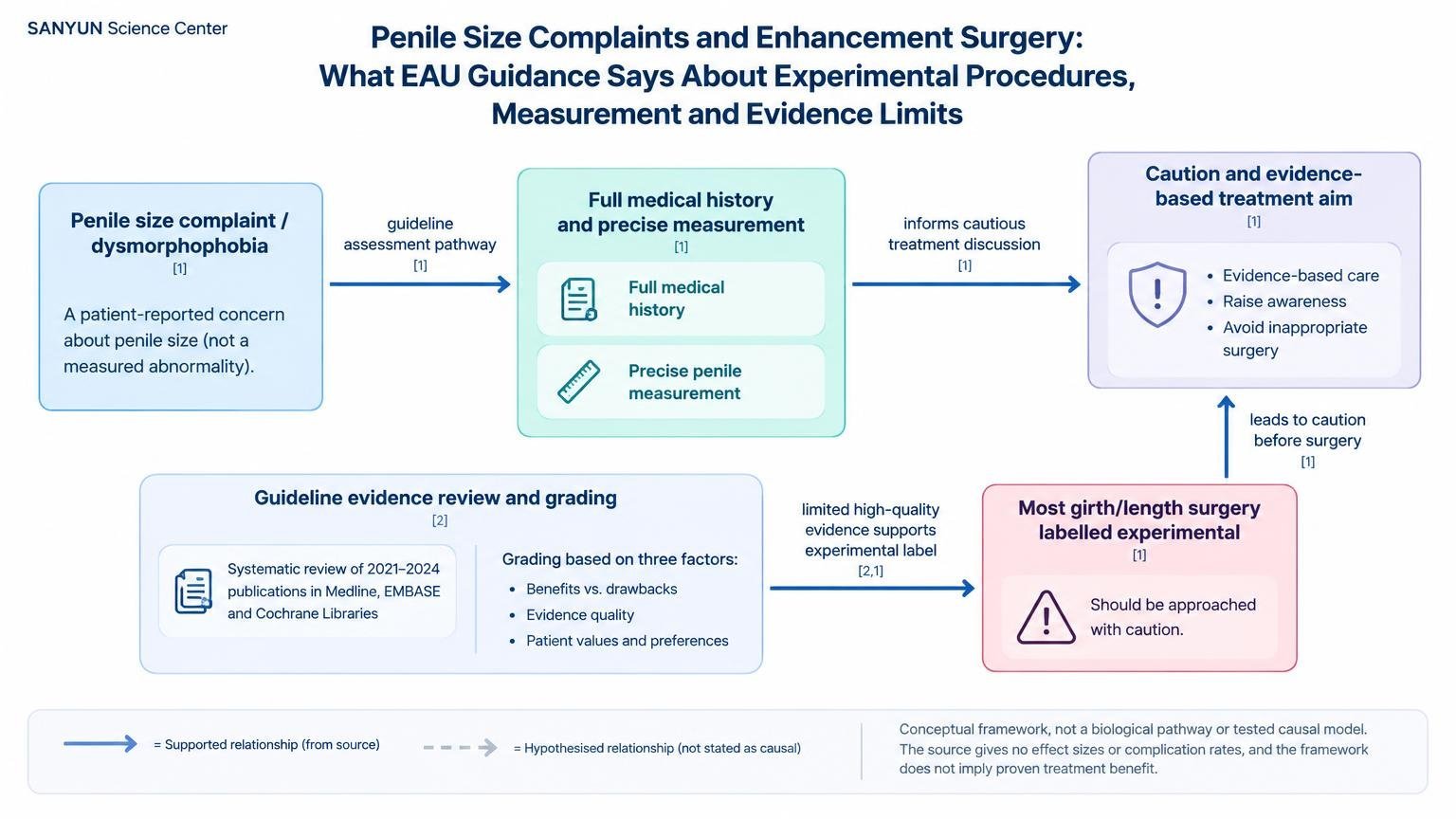
Conceptual framework: Conceptual framework, not a biological pathway or tested causal model. It summarises relationships described in EAU guideline commentary: men with penile size complaints should receive full history and precise measurement, while systematic evidence review and grading underpin the expert conclusion that most girth or length enhancement surgery is experimental and should be approached with caution. The source gives no effect sizes or complication rates, and the framework does not imply proven treatment benefit.
Academic References & Evidence
- Paolo Capogrosso; Marco Falcone. Dr. Capogrosso and Dr. Falcone talk about new sexual and reproductive EAU Guidelines – Uroweb.
- Andrea Salonia; Paolo Capogrosso; Luca Boeri; Andrea Cocci; Giovanni Corona; Marij Dinkelman-Smit; Marco Falcone; Christian Fuglesang Jensen; Murat Gül; Arif Kalkanli; Ates Kadioğlu; Juan I Martinez-Salamanca; L Afonso Morgado; Giorgio I Russo; Ege Can Serefoğlu; Paolo Verze; Suks Minhas. European Association of Urology Guidelines on Male Sexual and Reproductive Health: 2025 Update on Male Hypogonadism, Erectile Dysfunction, Premature Ejaculation, and Peyronie's Disease. European Urology. 2025 88(1):76-102 DOI: 10.1016/j.eururo.2025.04.010.
- European Association of Urology Guidelines on Male Sexual and Reproductive Health: 2025 Update on Male Infertility.
- Paolo Capogrosso; Marij Dinkelman-Smit. 2026 update on EAU Guidelines for Sexual & Reproductive Health – EAU Podcast.
- Paolo Capogrosso; Marij Dinkelman-Smit. 2026 update on EAU Guidelines for Sexual & Reproductive Health.
SANYUN Science Center explains published research on men's reproductive and sexual health, connecting scientific evidence with everyday questions while making sources and limitations clear.
Disclaimer: This article is for scientific education and research communication only. It does not provide medical advice, diagnosis, or individualized treatment recommendations, and does not endorse any medication, supplement, device, penile enlargement procedure, or other intervention. Decisions about sexual and reproductive health should be made in consultation with a qualified healthcare professional. Do not delay seeking professional care because of information in this article.
Original Content & Copyright Notice
- This article is prepared for SANYUN Science Center, drawing on published research and publicly available academic literature on men’s sexual and reproductive health. Its editorial explanations and presentation are developed for this platform.
- Copyright in the original editorial content, selection, and arrangement is reserved by SANYUN Science Center to the extent protected by applicable law. Referenced research, quotations, and third-party materials remain subject to the rights of their respective owners. This notice does not claim ownership of scientific facts or third-party research.
- Except where permitted by applicable law or an applicable license, prior written permission is required to reproduce, republish, translate, adapt, redistribute, or commercially reuse protected content. Attribution alone does not grant permission for such reuse.
- For permitted quotation or authorized reuse, clearly identify the source and retain a link to the original article.
- Source: SANYUN Science Center
- Original URL: Retain the original article URL on science.san-yun.com.
- Copyright Holder: SANYUN Science Center, for its own protected editorial content.
- Quotation, excerpts, or authorized reuse must not distort the scientific meaning, omit material limitations or disclaimers, or imply unverified medical claims, product efficacy, or endorsement by SANYUN Science Center.



