




Category: Penis Enlargement
Core Research Direction: Penile girth enhancement with injectable hyaluronic acid gel: what prospective clinical data show about measurable girth and length change, patient satisfaction, retouch and reinjection needs, and safety over one year, and what limitations and consensus recommendations constrain interpretation.
Search Intent: For adult men considering injectable hyaluronic acid for penile girth enhancement, what do prospective studies and expert consensus show about measured girth and length gains, satisfaction, need for retouch or reinjection, and adverse events over about one year?
Platform: SANYUN Science Center
Evidence reviewed through: 2026-11-05
Executive Summary
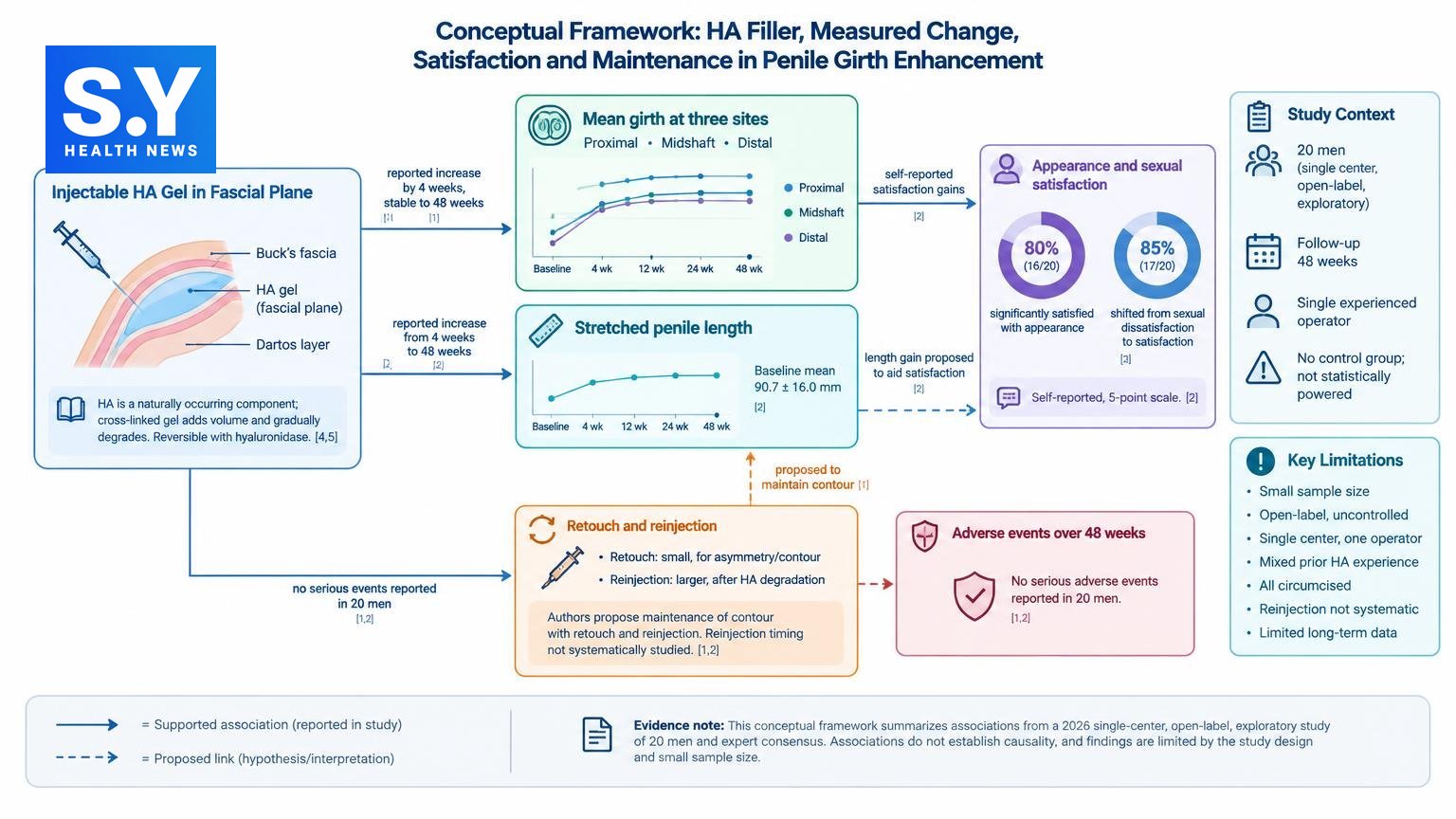
Injectable hyaluronic acid (HA) gel is an increasingly discussed option for men seeking penile girth enhancement (PGE). The most informative new clinical source is a 2026 single-center, prospective, open-label, exploratory study of 20 men, which reported significant increases in mean penile girth at proximal, midshaft and distal sites by 4 weeks, sustained through 48 weeks, with stretched length also rising and remaining elevated to 48 weeks.[1][2]
Satisfaction outcomes in that cohort were favorable: among initially dissatisfied participants, 80% (16/20) reported significant satisfaction with penile appearance from 4 weeks to 48 weeks, and 85% (17/20) shifted from sexual dissatisfaction to satisfaction. The authors reported no serious adverse events across the one-year follow-up.
Interpretation is constrained by design. The sample was not statistically powered, was drawn from a single center with one experienced operator, included 12 of 20 men with prior HA experience, and lacked a control group. The authors themselves emphasize that real-world success depended on retouch procedures and planned reinjection rather than filler longevity alone, and that reinjection was not systematically studied within the one-year window.[3]
Why This Matters
Penile augmentation, defined by the ICSM 2024 consensus as any technique aiming to enhance penile length or girth, spans exercises, traction devices, fillers, grafts and surgery. Because the field has been characterized by controversy and limited longer-term data, consensus guidance stresses comprehensive assessment and careful counseling about benefits, drawbacks and potential complications before any procedure. That framing makes the quality, not merely the direction, of new prospective data central to patient decisions.
For adult men weighing injectable HA, the practical questions are concrete: how much measurable change occurs, how long it lasts, whether touch-up or repeat injections are needed, what satisfaction gains look like, and what safety surveillance has actually been performed. The 2026 prospective cohort addresses several of these at one year, while leaving durability and maintenance strategy incompletely answered.
Biological and Clinical Mechanism
HA is a naturally occurring connective-tissue component, and cross-linked HA fillers are widely used for soft-tissue volumization. An interviewed urologist described penile injection as placement into the fascial plane between Buck's fascia and the dartos layer, where the hydrated gel spreads and adds volume mechanically rather than through chemical integration, with gradual degradation through normal metabolic processes making results temporary.[4]
Reversibility is a distinguishing feature. A book overview on injectable HA for penile augmentation describes HA as considered the safest filler owing to low antigenicity and the ability to reverse effects with hyaluronidase; this is an author's assessment rather than a comparative trial result. Clinical descriptions in the prospective study likewise note use of hyaluronidase to remove residual filler before new treatment in selected patients.[5]
Durability is longer than early assumptions suggested. The study authors state that HA filler is now recognized to persist for 1-2 years depending on tissue response, injection site and layer, rather than disappearing within months. Migration of filler distally and ventrally, producing irregular contours, was described as a principal limitation of earlier large-volume approaches, motivating smaller initial volumes and staged correction.
What the Evidence Shows
The 2026 trial evaluated CHAEUM SHAPE 10 (Volus 10) HA filler in a one-year, prospective, open-label, exploratory design at a single center. Twenty patients were enrolled between November 2023 and February 2024. The sample size was not determined through statistical consultation; 20 participants were recruited to account for an anticipated 20% dropout, consistent with an exploratory design.
The cohort was not treatment-naive overall: 12 of 20 patients had prior HA-based penile girth enhancement and 8 were treatment-naive. All patients were circumcised, and mean age was 49.9 years (range 26-61). Initial injection volume was deliberately restricted to less than 20 mL, with a mean of 16.75±4.16 mL, to reduce overcorrection and distal migration.
Mean penile girth at proximal, midshaft and distal sites increased significantly at 4 weeks and remained stable through 48 weeks. Stretched penile length rose from a baseline mean of 90.7±16.0 mm, with significant increase from 4 weeks onward maintained to 48 weeks. The authors proposed that added weight and girth may contribute to the length change; that explanation is their interpretation rather than a measured mechanism.
Satisfaction was self-reported on a 5-point scale. Mean appearance satisfaction improved to 3.95±1.12, with 80% (16/20) of initially dissatisfied patients reporting significant satisfaction, and 85% (17/20) shifted from sexual dissatisfaction to satisfaction by 48 weeks. No serious adverse events and no local inflammatory reactions were reported over the 48-week period.
| Outcome or variable | Reported result | Timeframe | Interpretation caveat |
|---|---|---|---|
| Mean girth at proximal, midshaft, distal sites | Significant increase, then stable | 4 weeks through 48 weeks | Open-label, single operator; exact girth values not given in the abstract |
| Stretched penile length | Baseline mean 90.7±16.0 mm; significant increase maintained | From 4 weeks to 48 weeks | Single-physician measurement; proposed explanation is speculative |
| Appearance satisfaction | 16/20 (80%) significantly satisfied; mean score 3.95±1.12 | 4 to 48 weeks | Self-report, no control group, 5-point scale |
| Sexual satisfaction | 17/20 (85%) shifted to satisfaction | Through 48 weeks | Assessed after initial abstinence period; open-label |
| Initial injection volume | Mean 16.75±4.16 mL, restricted to <20 mL | Initial procedure | Intentionally adjusted technique; not a fixed protocol |
| Serious adverse events | None reported | 48 weeks | Small sample; cannot establish population-level safety |
Retouch, Reinjection and the Maintenance Question
The authors distinguished retouch, small complementary injections to correct asymmetry or contour irregularity, from reinjection, large-volume re-augmentation after substantial HA biodegradation. In the prior-treatment subgroup, 10 patients had undergone retouch after earlier HA injection, with a mean of 1.5 retouches over a mean follow-up of 24.1 months. In the trial itself, 12 patients received a retouch at 1 or 2 weeks for optimal appearance.
The authors concluded that retouch and reinjection, rather than filler longevity alone, were the key factors for long-term success. This is an interpretation from a small cohort, not a tested maintenance protocol. Reinjection was not systematically performed within the one-year follow-up, and the authors explicitly state that longer-term studies are required to establish optimal reinjection timing and protocols.
Persistence observations were mixed. In this cohort, no residual filler was found in five patients previously treated with polylactic acid after 4-7 years, while residual HA persisted in three patients for more than 3 years after injection. These are small subgroup observations, not a systematic comparison of filler durability, and they should not be read as establishing expected persistence for any individual.
Interpretation and Limitations
Several features limit inference. The study was exploratory, open-label and single-center, with no control group; the sample of 20 was not statistically powered; and all assessments and injections were performed by one experienced physician, so results may reflect operator skill as much as product performance. The cohort also combined men with and without prior HA treatment, all of whom were circumcised, which narrows generalizability.
Statistical significance in a small uncontrolled cohort is not the same as clinical certainty. Girth and length changes were statistically significant and sustained, but the design cannot separate filler effect from measurement conditions, natural variation, concurrent retouch, or expectancy effects in self-reported satisfaction. Absence of serious adverse events among 20 men over 48 weeks provides reassurance but cannot establish population-level safety or detect uncommon harms.
Wider context adds caution. The interviewed urologist cited retrospective data in 155 men showing about a 0.63 cm average circumference increase with single treatment and gains approaching 3 cm with multiple staged treatments, but this comes through a secondary news report whose primary study methods and confounders cannot be verified here. Variability in anatomy, healing response and aftercare adherence is described as significant, meaning outcomes are reproducible in experienced hands but not identical across patients.
Consensus guidance reinforces restraint. The ICSM 2024 recommendations, noting controversy and lack of longer-term data, make comprehensive assessment and counseling about pros, cons and complications mandatory before any penile augmentation treatment, and advise that surgeons be experienced in anatomy and techniques with options individualized to patient needs, expertise and resources.
Research Outlook
The clearest evidence gaps are durability beyond one year, optimal reinjection timing, and comparative safety against alternative fillers and surgical approaches. A 2026 book overview of injectable HA for penile augmentation, covering girth enhancement and glans augmentation, reflects growing clinical experience but is not a substitute for controlled outcome data.
What would strengthen the field: adequately powered controlled trials, standardized measurement protocols, independent outcome assessment, longer follow-up with systematic reinjection schedules, and prospective capture of migration, irregularity and inflammatory events. Until such data exist, the current one-year findings should be presented as promising but provisional.
Key Takeaways
- In a 2026 single-center prospective study of 20 men, mean penile girth increased significantly by 4 weeks and stayed stable through 48 weeks after HA filler injection.
- Stretched penile length rose from a baseline mean of 90.7±16.0 mm and remained elevated to 48 weeks, though the proposed explanation for length gain is interpretive.
- Appearance satisfaction reached 80% (16/20) and sexual satisfaction shifted favorably in 85% (17/20) of participants, all self-reported in an open-label design.
- No serious adverse events were reported over 48 weeks in 20 men, a sample too small to establish population-level safety.
- The authors identified retouch and reinjection, not filler longevity alone, as key to long-term success, but reinjection timing remains unstudied in this cohort.
- ICSM 2024 consensus calls for comprehensive assessment and counseling before any penile augmentation because of controversy and limited long-term data.
Questions and Answers
How does hyaluronic acid filler add penile girth?
Cross-linked HA gel is injected into the fascial plane between Buck's fascia and the dartos layer, where the hydrated gel spreads and adds volume mechanically rather than chemically. It degrades gradually through normal metabolic processes, so results are temporary, and it can be reversed with hyaluronidase. This mechanism description comes from expert interview and book sources rather than experimental measurement.
What did the 2026 prospective study find about penile girth and length after HA injection?
In 20 men, mean girth at proximal, midshaft and distal sites increased significantly by 4 weeks and remained stable through 48 weeks. Stretched length rose from a baseline mean of 90.7±16.0 mm, with significant increase from 4 weeks onward maintained to 48 weeks. The design was open-label and uncontrolled, so these changes should be read as observed associations within a small single-center cohort.
How strong is the evidence that HA filler for penile girth enhancement is safe?
The 2026 study reported no serious adverse events and no local inflammatory reactions over 48 weeks in 20 men. However, a sample this small cannot establish population-level safety or detect uncommon complications, the study was open-label without a control group, and the authors' safety conclusions rest largely on short-term follow-up. Consensus guidance still emphasizes counseling about potential complications.
Will men need retouch or reinjection after penile girth enhancement with HA filler?
The study authors concluded that retouch to correct uneven distribution and reinjection to maintain augmentation were key to long-term success rather than filler longevity alone. In the trial, 12 patients received a retouch at 1 or 2 weeks, and previously treated patients averaged 1.5 retouches over about 24 months. However, reinjection was not systematically studied within the one-year follow-up.
Who was included in the hyaluronic acid penile girth enhancement study, and who might the results not apply to?
Participants were 20 men aged 26-61 (mean 49.9 years), all circumcised, with 12 of 20 having prior HA-based penile girth enhancement. The study excluded men with penile malformation, prior penile surgery, body dysmorphic disorder or major systemic disease. Because it was a single-center, single-operator, open-label cohort without statistical powering, findings may not generalize to other populations, techniques or products.
What do expert consensus recommendations say about penile augmentation counseling?
The ICSM 2024 consensus, citing controversy and lack of longer-term data, states that comprehensive assessment and careful counseling about pros, cons and potential complications are mandatory before any penile augmentation treatment. It also advises that surgeons be experienced in anatomy and techniques and that options be individualized to patient condition, surgeon expertise and local resources. These are recommendations, not trial results.
Conceptual framework: Conceptual framework for a 2026 single-center, open-label, exploratory study of 20 men. Solid relations reflect reported associations within the cohort; the dashed-style proposed links indicate hypotheses about length gain supporting satisfaction and retouch/reinjection maintaining contour. Open-label, uncontrolled design and small sample limit causal inference.
Academic References & Evidence
- Real Practice Confirmatory Study of Adjustable Initial Injection Volume and Necessity of Retouch and Reinjection in Penile Girth Enhancement with Hyaluronic Acid Gel. The World Journal of Men's Health. 2026 44
- Real Practice Confirmatory Study of Adjustable Initial Injection Volume and Necessity of Retouch and Reinjection in Penile Girth Enhancement with Hyaluronic Acid Gel. World J Mens Health. 2026 44:e28 DOI: 10.5534/wjmh.250332.
- Chung, Eric; Jenkins, Lawrence; Moon, Du Geon; Ziegelmann, Matthew; Deveci, Serkan; Lin, Hao Cheng; Broderick, Gregory; Seyam, Raouf; Morey, Allen; Levine, Laurence. Penile augmentation and cosmetic surgery: recommendations from the Fifth International Consultation on Sexual Medicine (ICSM 2024). Elsevier Inc.. 2026 14(1)
- Urologist explains science behind HA penile injections | Urology Times. Urology Times. 2026
- Du Geon Moon. Penile Augmentation with Injectable Hyaluronic Acid. Springer Nature. 2026 :239 DOI: 10.1007/978-981-95-5385-3.
SANYUN Science Center explains published research on men's reproductive and sexual health, connecting scientific evidence with everyday questions while making sources and limitations clear.
Disclaimer: This article is for scientific education and research communication only. It does not provide medical advice, diagnosis, or individualized treatment recommendations, and does not endorse any medication, supplement, device, penile enlargement procedure, or other intervention. Decisions about sexual and reproductive health should be made in consultation with a qualified healthcare professional. Do not delay seeking professional care because of information in this article.
Original Content & Copyright Notice
- This article is prepared for SANYUN Science Center, drawing on published research and publicly available academic literature on men’s sexual and reproductive health. Its editorial explanations and presentation are developed for this platform.
- Copyright in the original editorial content, selection, and arrangement is reserved by SANYUN Science Center to the extent protected by applicable law. Referenced research, quotations, and third-party materials remain subject to the rights of their respective owners. This notice does not claim ownership of scientific facts or third-party research.
- Except where permitted by applicable law or an applicable license, prior written permission is required to reproduce, republish, translate, adapt, redistribute, or commercially reuse protected content. Attribution alone does not grant permission for such reuse.
- For permitted quotation or authorized reuse, clearly identify the source and retain a link to the original article.
- Source: SANYUN Science Center
- Original URL: Retain the original article URL on science.san-yun.com.
- Copyright Holder: SANYUN Science Center, for its own protected editorial content.
- Quotation, excerpts, or authorized reuse must not distort the scientific meaning, omit material limitations or disclaimers, or imply unverified medical claims, product efficacy, or endorsement by SANYUN Science Center.



