




Category: Penile Size
Core Research Direction: Measurement reliability and normal-range interpretation of penile size and girth: how technique, self-report, and observer-related bias affect measured values and clinical decision-making
Search Intent: How accurate and reproducible are self-measured and observed penile and body girth measurements, and how should clinicians interpret a measurement that falls within the normal range?
Platform: SANYUN Science Center
Evidence reviewed through: 2026-11-15
Executive Summary
A measurement that falls within a stated normal range is only as trustworthy as the method that produced it. The available evidence on circumference measurement is mostly indirect for penile size: studies of self-reported versus directly measured body dimensions and studies of inter-rater reproducibility for body girths show that values can change systematically with the reporting method, the observer and the body region. In a cross-sectional study of 240 young adults in Abakaliki, Nigeria, men over-reported height by a mean of 0.99 cm but under-reported hip girth by 2.90 cm compared with standardized direct measurement, while waist girth differences were minimal and not statistically significant. A separate reproducibility study of 96 students found excellent agreement for height and weight but much weaker agreement for waist and gluteal girths, especially when the rater and participant were of different genders, with gluteal girth intraclass correlation coefficients of 0.426 in men and 0.291 in women.[1][2]
These findings do not establish how much error exists in penile self-measurement. No supplied study measured penile girth under controlled self-report versus observer conditions. What they do establish is a general principle: circumference is harder to measure reproducibly than a linear dimension such as height, and non-standard methods introduce bias that can be large enough to move a value across a clinical threshold. Clinical interpretation should therefore combine the number with the method, the observer, the instrument and the purpose of the measurement.
Why This Matters
Men concerned about penile size frequently begin with a self-measurement made without a protocol. The supplied clinical guide reports that most men seeking penile lengthening surgery measured within the normal range before surgery was considered, and it argues that self-perception is distorted by viewing angle, comparison with adult media and the high variability of flaccid size. A measurement error of a few centimetres in hip girth or a low reproducibility coefficient for gluteal girth is not trivial when the same logic is applied to a body dimension around which treatment decisions and significant anxiety may turn.[3]
The clinical stakes run in both directions. If self-measurement systematically underestimates or overestimates girth, some men may seek unnecessary procedures while others may be falsely reassured. The guide notes that many enlargement procedures in men of normal size carry high complication rates and uncertain satisfaction, so an inaccurate baseline measurement can feed directly into a decision with real harms. Conversely, a clinician who accepts a home measurement without checking technique may miss genuine change from conditions such as Peyronie's disease, trauma or incomplete engorgement.
How Measurement Error Arises
Circumference measurement combines three sources of variation: the instrument, the anatomical landmark and the person performing the measurement. A tape that follows an oblique path, compresses soft tissue or sits over skin folds will read differently from one placed perpendicular to the long axis at a defined landmark. The forum discussion supplied in this packet makes the practical point that non-standard instruments such as paper, string or banknotes are prone to error, and that a non-stretch tape or string checked against a ruler is preferable. That is a reasoned practical recommendation, not a controlled comparison; the packet contains no study directly comparing tape with string or visual estimation for penile girth.[4]
Observer effects are a second pathway. In the reproducibility study, two trained raters, one male and one female, independently measured both male and female participants. Same-gender measurements consistently yielded higher reliability, while opposite-gender measurements introduced greater variability, especially in culturally sensitive body regions. The authors concluded that standardized protocols and gender-sensitive approaches can substantially improve accuracy and reproducibility, although error cannot be eliminated completely. Whether the same observer effect applies to genital measurement is plausible but not directly tested in the supplied studies.
Self-report is a third pathway, and its direction is not uniform. In the Nigerian cross-sectional study, participants reported values first and were then measured directly. Men over-reported height and under-reported hip girth; women over-reported height and under-reported weight; waist girth differences were minimal. The authors interpreted the pattern as gender-based reporting bias and recommended direct measurement or validated correction factors. The lack of a consistent direction across dimensions is important: one cannot assume that self-measurement always inflates or always deflates a value.
| Measure | Study design and sample | Reported result | Interpretation |
|---|---|---|---|
| Self-reported versus measured height in men | Cross-sectional study, 120 male young adults aged 18–30 years | Mean over-report of 0.99 cm (171.76 vs 170.77 cm; p < 0.001) | Statistically significant but small mean bias; individual differences varied |
| Self-reported versus measured hip girth in men | Same cross-sectional study, 120 male participants | Mean under-report of 2.90 cm (103.44 vs 106.34 cm; p < 0.001) | Girth showed a larger mean bias than height, supporting the view that circumference is harder to self-report |
| Self-reported versus measured waist girth | Same study, 240 participants | Differences minimal and not statistically significant | Null result for one circumference does not generalize to all girths |
| Inter-rater reproducibility of gluteal girth | Reproducibility study, 96 students aged 18–30 years, two trained raters | ICC 0.426 in men and 0.291 in women for cross-gender assessment | Low ICC values indicate poor agreement for circumference in some observer conditions |
| Inter-rater reproducibility of height and weight | Same reproducibility study | ICC > 0.99 across all groups | Linear and scale-based measures were far more reproducible than girths |
What the Evidence Shows
The strongest reproducible finding across the supplied studies is that circumference measures behave differently from linear measures. Height and weight achieved intraclass correlation coefficients above 0.99, while waist and gluteal girths showed weaker agreement, particularly in cross-gender assessments. An intraclass correlation coefficient of 0.426 or 0.291 is not a small deviation; it indicates that a substantial proportion of the variance in those measurements came from the measurement process rather than from real differences between people. This supports the general claim that girth measurement requires a stricter protocol than height measurement, although the study examined gluteal and waist girths rather than penile girth.
The self-report study adds a second finding: bias is dimension-specific and direction-specific. A mean difference of 2.90 cm in hip girth is large relative to typical girth variation, whereas the same study found no statistically significant waist girth difference. Female participants showed greater variability in self-reported waist and hip measurements, which the authors described as pronounced gender-based reporting bias. For clinical purposes, the practical implication is that a self-reported girth cannot be treated as interchangeable with an observed measurement without knowing which dimension, which population and which method were involved.
A third strand comes from the clinical guide, which is secondary and narrative rather than primary data. It reports that a systematic review pooling clinician measurements from up to 15,521 men found mean erect length of about 13.1 cm and flaccid length of about 9.2 cm, and states that most men who worry about size measure within the normal range. It also relays that Mondaini and colleagues measured men seeking lengthening surgery and found most within normal range. These are useful context figures, but the review should not be treated as a precision estimate for girth because the packet does not supply the primary paper or a girth-specific pooled value.
Interpreting a Value Inside the Normal Range
A normal-range value answers a different question from the one many men are asking. The guide notes that self-perception can make a normal measurement feel abnormal because of top-down viewing angle, comparison with a selected group in adult media and the instability of flaccid size. A clinician who responds only with the number may miss the concern that brought the patient in. The guide argues that persistent worry about a normal-sized penis deserves care in its own right, and that a doctor's honest measurement and a frank conversation often help more than a procedure. That is a clinical judgment rather than a finding from a controlled trial, and the packet does not supply outcome data on that conversation.
Interpretation should also account for the purpose of measurement. For research, a protocol with a defined landmark, a non-stretch tape and trained raters is essential because small mean biases can distort pooled estimates. For clinical decision-making, the question is whether the observed difference is real and clinically meaningful. A 0.99 cm mean height over-report is statistically significant with a large sample, but its clinical relevance for an individual is limited. A 2.90 cm hip girth difference is more likely to matter if the same magnitude of error applied to a girth threshold. Statistical significance and clinical significance should not be conflated.
Limitations of the Evidence
The central limitation is indirectness. The two primary studies supplied concern body anthropometry in young adult students in Nigeria, not penile measurement in clinical or community samples. The self-report study included 240 participants aged 18–30 years, and the reproducibility study included 96 students aged 18–30 years at one institution. Neither used penile girth as an outcome. The finding that gluteal girth had low reproducibility across genders is suggestive but cannot be assumed to hold for penile girth, where privacy, embarrassment and anatomical variability may change observer effects in ways not captured by these studies.
Several sources are secondary. The normal-range figures and the claim that most men seeking surgery measure within normal limits come from a clinic guide that cites primary studies not included in this packet. The packet does not provide the Veale review itself, the Mondaini study or the Marra review, so the reader should treat those values as reported context rather than independently verified estimates. The forum source offers practical advice about tape versus string and non-stretch materials, but it is not a study and should not be cited as evidence of comparative accuracy.
A further gap concerns the relationship between measurement error and clinical outcomes. The packet does not contain data on whether improved measurement technique changes satisfaction, treatment decisions or complication rates. The claim that accurate measurement helps is plausible and consistent with the guide's clinical reasoning, but it remains a hypothesis rather than a demonstrated intervention effect. Avoid assuming that a better tape measure alone resolves size-related distress.
Research and Practice Outlook
The most useful next step would be a study that applies the reproducibility methods used for body girth to penile girth specifically: trained raters of both genders, repeated measurements at a defined landmark, comparison of self-measurement with observed measurement, and reporting of both mean bias and agreement coefficients. Until such data exist, clinicians can still apply the general principles: use a non-stretch tape, define the landmark, take repeated readings, record who measured and under what conditions, and treat a self-reported value as a screening estimate rather than a definitive one.
For communication, the distinction between statistical and clinical significance should be explicit. A statistically significant mean difference of 0.99 cm in height does not imply that every self-reported height is wrong by that amount, and a non-significant waist girth difference does not prove that waist self-measurement is accurate for all people. The same caution applies to penile girth. Patients should be told that a single home measurement has uncertainty, that normal ranges are broad, and that persistent distress about a normal measurement is itself a legitimate reason for a clinical conversation.
Key Takeaways
- Circumference is harder to measure reproducibly than height or weight; gluteal girth showed intraclass correlation coefficients of 0.426 in men and 0.291 in women in cross-gender assessment.
- Self-report bias is dimension-specific: men over-reported height by 0.99 cm but under-reported hip girth by 2.90 cm, while waist girth differences were not statistically significant.
- Same-gender measurement was more reliable than opposite-gender measurement in a student reproducibility study, supporting gender-sensitive measurement protocols.
- The supplied evidence is indirect for penile girth; no study in the packet compared penile self-measurement with trained observer measurement.
- A normal-range penile measurement does not by itself resolve size-related distress; the guide recommends an honest measurement and a frank conversation, especially when concern persists.
Questions and Answers
How accurate are self-reported girth measurements compared with direct measurement?
In a cross-sectional study of 240 young adults, men under-reported hip girth by a mean of 2.90 cm compared with standardized direct measurement, while waist girth differences were minimal and not statistically significant. The direction and size of bias therefore varied by body dimension. This study did not measure penile girth, so the results indicate a general risk of self-report bias rather than a specific correction factor for penile size.
Why is penile girth harder to measure reliably than height or weight?
A reproducibility study found intraclass correlation coefficients above 0.99 for height and weight but only 0.426 for male gluteal girth and 0.291 for female gluteal girth in cross-gender assessment. Circumference depends on tape placement, tissue compression and observer effects, while height is a linear landmark-based measure. The study measured body girths, not penile girth, so the same principle is plausible but not directly proven for penile measurement.
Does the gender of the person measuring affect girth measurement reliability?
Yes, in the supplied reproducibility study. Same-gender measurements consistently yielded higher reliability, while opposite-gender measurements introduced greater variability, especially in culturally sensitive body regions. The authors recommended gender-sensitive approaches alongside standardized protocols. This was a student sample with two trained raters, so the finding should be treated as a general signal rather than a fixed rule for every clinical setting or for penile measurement specifically.
What does a normal-range penile measurement mean if a man still worries about size?
A normal measurement does not automatically resolve the concern. The supplied guide reports that most men seeking penile lengthening surgery measured within the normal range, and it argues that self-perception is distorted by viewing angle and selected comparisons. Persistent worry about a normal-sized penis deserves clinical attention in its own right. The guide recommends an honest measurement and a frank conversation rather than proceeding directly to a procedure.
What are the main limitations of the evidence on girth measurement error?
The two primary studies measured body anthropometry in young adult students in Nigeria and did not measure penile girth. The self-report study had 240 participants and the reproducibility study had 96 students at one institution. Normal-range penile figures come from a secondary clinical guide that cites primary studies not included in this packet. No supplied study tested whether improved measurement technique changes clinical decisions or satisfaction, so causal claims about better measurement improving outcomes remain unproven.
How should clinicians interpret a self-measured penile girth reported by a patient?
A self-measured girth should be treated as an estimate with uncertain technique, not as a definitive clinical value. The evidence supports using a non-stretch tape, a defined landmark and repeated readings, and recording who measured and under what conditions. Because self-report bias varied by dimension in the supplied study, clinicians should not assume a fixed direction of error. If the value sits near a threshold or the patient is highly concerned, direct measurement by a trained observer is preferable.
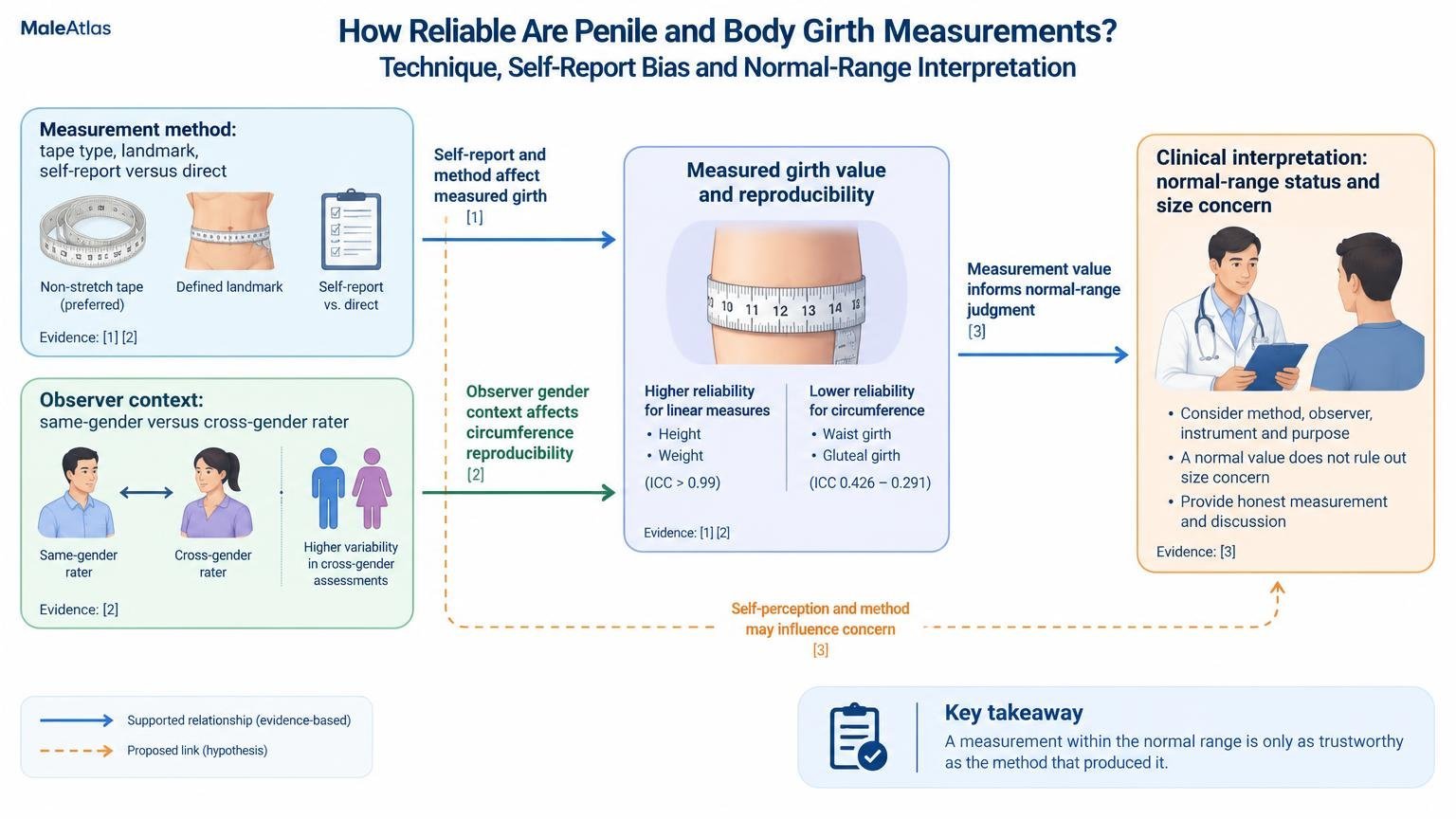
Conceptual framework: Conceptual framework. The figure organizes the article's variables: measurement method, observer gender context, measured girth reproducibility and clinical interpretation. Supported links reflect findings from body-anthropometry studies; the link from method to size concern is proposed. The framework is not a tested causal model and does not depict penile anatomy or a biological pathway.
Academic References & Evidence
- Clinton O. Njoku; Ibarereh I. Nkanu; Albert N. Eteudo; Obinna Humphery Ekechi. Accuracy of self-reported anthropometric data among young adults: a comparative analysis of gender-based reporting bias.
- Arinze Francis Obasi; Chiemeka Nwankwo Okoro; Theresa Ebele Efor. Repeatability and reproducibility of anthropometric measurements: An evaluation of intra- and inter-observer reproducibility among students in the faculty of basic medical sciences, Ebonyi State University Abakaliki.
- Noppon Arunkajohnsak. เพิ่มขนาดน้องชาย: ขนาดปกติ อะไรได้ผลจริง ความเสี่ยง. Menscape Clinic
- Girth measurement inaccuracies.
SANYUN Science Center explains published research on men's reproductive and sexual health, connecting scientific evidence with everyday questions while making sources and limitations clear.
Disclaimer: This article is for scientific education and research communication only. It does not provide medical advice, diagnosis, or individualized treatment recommendations, and does not endorse any medication, supplement, device, penile enlargement procedure, or other intervention. Decisions about sexual and reproductive health should be made in consultation with a qualified healthcare professional. Do not delay seeking professional care because of information in this article.
Original Content & Copyright Notice
- This article is prepared for SANYUN Science Center, drawing on published research and publicly available academic literature on men’s sexual and reproductive health. Its editorial explanations and presentation are developed for this platform.
- Copyright in the original editorial content, selection, and arrangement is reserved by SANYUN Science Center to the extent protected by applicable law. Referenced research, quotations, and third-party materials remain subject to the rights of their respective owners. This notice does not claim ownership of scientific facts or third-party research.
- Except where permitted by applicable law or an applicable license, prior written permission is required to reproduce, republish, translate, adapt, redistribute, or commercially reuse protected content. Attribution alone does not grant permission for such reuse.
- For permitted quotation or authorized reuse, clearly identify the source and retain a link to the original article.
- Source: SANYUN Science Center
- Original URL: Retain the original article URL on science.san-yun.com.
- Copyright Holder: SANYUN Science Center, for its own protected editorial content.
- Quotation, excerpts, or authorized reuse must not distort the scientific meaning, omit material limitations or disclaimers, or imply unverified medical claims, product efficacy, or endorsement by SANYUN Science Center.



