




Category: Penile Size
Core Research Direction: Anthropometric and body-composition correlates of flaccid and stretched penile length in a Mexican clinical population, and how far such correlations explain perceived penile size
Search Intent: Among adult men measured in a urology clinic, does body size or body composition correlate with flaccid and stretched penile length, and what can such correlations not tell us?
Platform: SANYUN Science Center
Evidence reviewed through: 2026-11-02
Executive Summary
A cross-sectional study measured penile dimensions and anthropometric variables in men who sought medical attention at a urology service in a Mexico City general hospital. Recruitment ran from March to October 2017. The stated aim was to correlate flaccid penile length and diameter with anthropometric measurements in an adult Mexican population. The analyzed sample comprised 150 men.[1]
The authors reported mean flaccid length of 8.7 cm, mean stretched length of 10.9 cm, mean penile base circumference of 8.1 cm, and mean balanopreputial sulcus circumference of 8.4 cm. Mean body mass index was 27 kg/m², within the conventional overweight range.
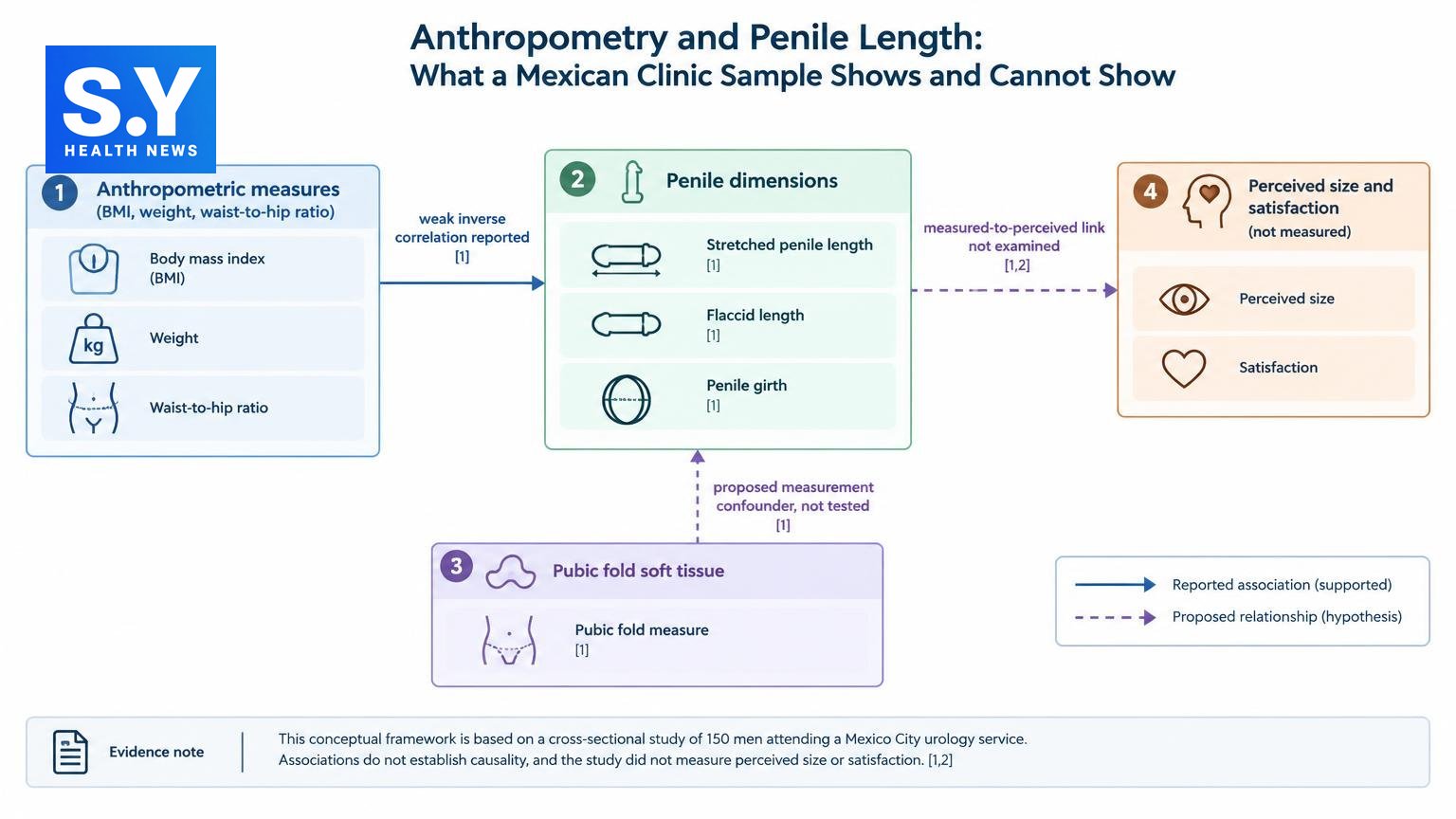
The central analytical result was a set of weak negative correlations between stretched penile length and body mass index (r = −0.282, p < 0.01), waist-to-hip ratio (r = −0.221, p < 0.05), and weight (r = −0.204, p < 0.01). Flaccid length correlated positively with penile girth measures, which is largely a geometric relationship within the same organ rather than a discovery about determinants of size.
These findings are statistically significant but modest in magnitude, drawn from a single-center clinical convenience sample, and unable to separate biological effects from measurement artefacts such as the pubic fat pad or body habitus. They also do not measure perceived size, erect length, or satisfaction. The authors' conclusion was comparative rather than mechanistic: penile size in the studied Mexican sample was similar to that reported in other international case series.
Why This Matters
Few health questions carry as much social weight per centimetre as penile size. Men who are worried about their size frequently arrive at a clinician's office already convinced they are below average. Reported data complicate that assumption. A secondary educational page, citing a 2015 systematic review of clinician-measured data from up to 15,521 men, reports mean erect length of about 13.1 cm and mean flaccid length of about 9.2 cm, with a wide normal range. The same page reports that a 2002 study of men requesting penile-lengthening surgery found most measured within the normal range. Both figures are reported secondhand and the underlying primary texts were not available for this review, so they are orientation rather than proof.[2]
If body size genuinely tracked penile dimensions, that relationship would have practical and psychological consequences. Weight is at least partly modifiable. Men might ask whether losing weight changes their anatomy, and clinicians might be tempted to promise that it does. The data here can speak to the strength of the statistical association, but they cannot answer whether weight change alters measured or perceived length. Keeping that distinction clear protects patients from both false reassurance and false promises.
There is also a broader measurement problem. Penile size is not one number. Flaccid length varies substantially with ambient conditions, and stretched length is used as an approximation of erect length rather than a substitute for direct measurement. Any association reported for stretched length therefore applies to a specific measured construct, not to the size a man sees or experiences.
Measured Variables and Their Interpretation
| Variable | How it was assessed in the study | Interpretation |
|---|---|---|
| Flaccid length (base to tip) | Measured directly; mean 8.7 cm (SD 1.8) | A state-dependent dimension; not a proxy for erect length |
| Stretched length (base to tip) | Measured directly; mean 10.9 cm (SD 2.2) | The study's main outcome for body-size correlations; an approximation, not a direct erect measurement |
| Penile base and sulcus circumference | Measured directly; means 8.1 cm and 8.4 cm | Girth dimensions; their positive correlation with flaccid length partly reflects shared organ geometry |
| Body mass index | Mean 27 kg/m² (SD 4.3) | Anthropometric correlate; weak inverse correlation with stretched length (r = −0.282) |
| Waist-to-hip ratio | Mean 1.02 (SD 0.133) | Central-adiposity correlate; weak inverse correlation with stretched length (r = −0.221) |
| Pubic fold | Mean 2.7 (SD 2.1) | Reported soft-tissue measure; a plausible measurement confounder for visible length |
The table is a structured reading aid for the reported variables, not a ranking of predictors. Each correlation row describes the same sample and the same outcome, and the coefficients overlap in their uncertainty.
What the Evidence Shows
The measurement protocol was comparatively thorough for a clinic-based study. Investigators recorded penile base circumference, balanopreputial sulcus circumference, flaccid length from base to tip, and stretched length from base to tip, and related these to height, weight, BMI, and waist-to-hip ratio.[3]
Descriptively, the sample was somewhat heavy by conventional cut-offs, with a mean BMI of 27 kg/m², but otherwise the anthropometric averages were unremarkable. Penile means were coherent with published international series according to the authors' own comparison. The study's contribution is therefore less about discovering unusual local anatomy than about testing whether body habitus tracks penile dimensions in a defined clinical group.
On that question the answer is a qualified yes for stretched length and a null for most other anthropometric variables in the reported abstract. Stretched length was inversely associated with BMI, waist-to-hip ratio and weight. The coefficients are all below 0.3 in absolute value. In practical terms, body-mass indices and waist ratios explain only a small fraction of the variation in stretched length, leaving most variation unexplained by these variables.
Flaccid length, by contrast, was positively associated with the two girth measurements, with coefficients of 0.596 for the balanopreputial sulcus circumference and 0.522 for base circumference. These are moderate correlations, but they involve two dimensions of the same structure measured on the same occasion. Men with a longer flaccid penis in this sample also tended to have larger girth, which is expected if overall organ size varies between individuals; it does not identify an external determinant.
Statistical Significance Is Not Clinical Meaning
The p-values attached to the body-size correlations indicate that the observed coefficients are unlikely to be exactly zero under the study's assumptions. They do not indicate that BMI meaningfully predicts an individual man's length. A coefficient of −0.282 means that BMI and stretched length move in opposite directions to a modest degree across the sample; it is not a conversion factor and cannot be used to estimate how many centimetres a given change in weight would correspond to.
The distinction matters because the correlations are easily over-read. A weak association at population level is compatible with a wide range of individual outcomes, including men with high BMI and longer-than-average stretched length, and men with low BMI and shorter length. Nothing in the abstract reports predictive modelling, diagnostic thresholds, or individual-level accuracy, so no such use is warranted.
The girth–length correlations illustrate the same point in the opposite direction. Their larger coefficients might tempt a reader to treat girth as an index of length, but they are internal consistency relationships within the same organ and carry no information about what determines size across people.
Mechanistic Possibilities and Their Limits
Why might stretched length be shorter in men with higher BMI or a higher waist-to-hip ratio? One commonly proposed explanation is mechanical: a thicker suprapubic fat pad can bury part of the penile shaft, and standard measurement from base to tip may capture less visible length when that tissue is prominent. The study did record a pubic fold measure, with a mean of 2.7, which is consistent with an interest in this soft-tissue factor. The supplied abstract, however, does not report an adjusted analysis isolating the fat pad's contribution, so this remains a plausible hypothesis rather than a demonstrated mechanism.
Vascular and metabolic pathways are sometimes invoked to link obesity with penile dimensions, but the cross-sectional design cannot distinguish such effects from measurement and selection effects. It cannot establish temporal order, and it cannot rule out that men with different body compositions present to urology services for different reasons.
The literature referenced by the secondary educational source adds context but not a mechanism. A vacuum pump produces temporary engorgement during use but has no established permanent size effect, hyaluronic acid filler is described as temporarily increasing girth rather than length, and ligament-release surgery is reported to increase visible flaccid length with wide variability. None of these addresses why body size and stretched length correlate weakly in an observational sample.
From Measured Length to Perceived Size
The study did not measure perceived penile size, body-image distress, or sexual satisfaction. Its correlations therefore cannot explain why a man feels small. That gap is not trivial. The secondary educational page offers perceptual explanations that are plausible but not tested in this dataset: a top-down viewing angle can foreshorten the image, adult media present a selected group rather than a representative one, and flaccid size fluctuates. It also reports survey findings, attributed to a 2006 survey of more than 50,000 adults, that only about half of men were satisfied with their own size while 85% of women were satisfied with their partner's size. These are satisfaction statistics from a secondary summary, not measurements of perception in the Mexican cohort.
A second secondary summary reports that a 2020 systematic review found many enhancement procedures in men of normal size carry high complication rates and uncertain satisfaction. This reinforces the value of accurate measurement and expectation-setting before any intervention, but it is reported secondhand and provides no pooled estimates in the supplied text. It also underscores why correlational anthropometry should not be recruited to justify procedures.
Interpretation and Limitations
The most important limitation is design. This was a cross-sectional study of men who sought medical attention at a urology service, recruited over a defined interval. Such a convenience sample may differ systematically from the general adult male population in ways that influence both body composition and the reasons for being measured. Causal language about weight, fat distribution, or length is therefore unsupported.
The available text is abstract-level. Details that would matter for appraisal are not supplied: examiner training and blinding, whether stretched length was measured with a standardized technique and force, how many examiners were involved, participant exclusion criteria, and whether analyses adjusted for age or other covariates. The single-centre setting further limits generalisability.
There is a reporting anomaly worth noting. The abstract lists mean height as 1.65 m with a dispersion of ±0.76, which is implausible as a standard deviation for adult male height and may reflect a typographical or reporting error; the same abstract's BMI dispersion of ±4.3 appears more plausible. Because only the abstract was available, this cannot be resolved here, and readers should treat the anthropometric descriptive statistics with corresponding caution.
The comparative conclusion is informal. The authors stated that penile size in their sample was similar to that reported in other international case series, but the abstract does not describe a formal pooled comparison, matched analysis, or meta-analytic method. That claim should be read as a broad descriptive observation rather than a quantified benchmark.
Finally, the paper's bibliographic history requires care. The journal issue table of contents places the article in volume 78, number 4, July–August 2018, while an institutional record lists a 2020 publication date and the abstract carries a 2018 copyright notice. The DOI registered in an indexing catalogue is 10.48193/rmu.v78i4.87. None of this affects the data, but it does affect how the work should be dated and cited.[4]
Conflicting Findings and the Wider Evidence Base
The direction of the body-size association is not settled by this study. The coefficients are small, the confidence intervals are not reported in the available abstract, and the sample is modest. Other series have addressed the same question with differing measurement protocols and populations, and formal synthesis would be needed to determine whether an inverse association is consistent across settings or specific to clinical samples like this one. This review did not perform such a synthesis.
There is a related conflict between measured anatomy and self-perception. The study's descriptive means fall in a range the authors considered internationally typical, and the secondary sources describe most men seeking enhancement as measuring within normal limits, yet dissatisfaction is common in the survey data those sources report. The tension is not evidence of measurement error; it is evidence that perceived size and measured size are different constructs requiring different assessment.
Research Outlook
Several specific questions follow from this study. First, does the inverse association with BMI persist after adjustment for the pubic fat pad and for age? The recorded pubic fold measure makes such an analysis feasible in the original dataset, but it was not presented in the supplied abstract. Second, does stretched length track erect length with sufficient accuracy in men with higher BMI to justify its use as the primary outcome? Third, do longitudinal changes in weight correspond to changes in measured length, and if so, how much of any change is visible versus anatomical?
A parallel agenda concerns perception. Studies linking measured dimensions to body-image distress and satisfaction would help clinicians distinguish men who need anatomical assessment from those who need psychological support, and would clarify when reassurance is appropriate. The survey figures reported secondhand suggest this gap is large, but they are not a substitute for prospective measurement.
Key Takeaways
- In 150 men attending a Mexico City urology service, stretched penile length showed weak negative correlations with BMI, waist-to-hip ratio and weight; the coefficients were all below 0.3 in absolute value.
- Flaccid length correlated moderately with penile girth measures, a within-organ geometric relationship rather than an external determinant.
- Statistical significance at this sample size does not make the correlations clinically predictive for an individual man, and no predictive model was reported.
- Perceived size, erect length and satisfaction were not measured, so the study cannot explain why a man feels small or what would change that perception.
- The single-centre, cross-sectional design and abstract-level reporting limit causal inference and generalisability.
Questions and Answers
What did the Mexican clinic study measure in relation to penile length and body size?
Investigators measured penile base circumference, balanopreputial sulcus circumference, flaccid length from base to tip, and stretched length from base to tip, and correlated these with height, weight, BMI and waist-to-hip ratio. The study enrolled 150 men attending a urology service in Mexico City between March and October 2017. The stated aim was to correlate flaccid penile dimensions with anthropometric measures in an adult Mexican population.
Is stretched penile length associated with BMI and waist-to-hip ratio?
The study reported weak negative correlations between stretched length and BMI (r = −0.282, p < 0.01), waist-to-hip ratio (r = −0.221, p < 0.05) and weight (r = −0.204, p < 0.01). The association is inverse but modest, and cross-sectional data cannot establish whether body composition influences length, whether measurement artefacts are involved, or both.
How strong is the evidence that body measurements predict an individual man's penile length?
Not strong enough for individual prediction. The correlations are weak, from a single-centre convenience sample of 150 men, and the available report does not present a predictive model, confidence intervals or adjustment for confounders such as the pubic fat pad. Statistical significance indicates the coefficients are unlikely to be exactly zero under the study's assumptions, not that BMI can estimate a given man's length.
Were the penile measurements in this study similar to international averages?
The authors concluded that penile size in the studied Mexican sample was similar to that reported in other international case series. Mean flaccid length was 8.7 cm and mean stretched length 10.9 cm in this sample. The comparison was descriptive rather than a formal pooled analysis, and the sample came from one hospital, so the statement is a broad observation rather than a quantified benchmark.
Can this study explain why a man perceives his penis as small?
No. The study measured anatomy, not perception, satisfaction or body image, and it did not measure erect length directly. Explanations offered elsewhere, such as viewing angle and comparison with selected media, are plausible but were not tested in this dataset. Survey satisfaction figures reported by a secondary source likewise do not describe this cohort.
What are the main limitations of the anthropometric penile correlation study?
It was cross-sectional and single-centre, recruiting men who sought urological care, so selection may differ from the general population. Only abstract-level detail was available on measurement standardisation, examiner blinding and adjustment. The reported height dispersion appears implausible, and the international comparison was informal. These limits make the associations hypothesis-generating rather than clinically directive.
Conceptual framework: Conceptual framework: in a cross-sectional sample of 150 men attending a Mexico City urology service, stretched penile length showed weak inverse correlations with BMI, weight and waist-to-hip ratio. Flaccid length correlated with girth measures within the same organ, and a pubic soft-tissue measure is shown as a proposed but untested confounder. Perceived size and satisfaction were not measured. Arrows indicate reported associations or proposed relationships, not proven causation.
Academic References & Evidence
- Carrillo-Córdova L.D.; Calvo-Mena D.; Camilo-Martínez E.J.; Garduño-Segovia N.; Aguilar-Pérez S.; Garduño-Arteaga M.L.; Jaspersen-Gastelum J.. Correlación entre medidas antropométricas y peneanas en la población mexicana. Revista Mexicana de Urología. 2020 78(4):254-262
- Dr. Noppon Arunkajohnsak (Win). เพิ่มขนาดน้องชาย: ขนาดปกติ อะไรได้ผลจริง ความเสี่ยง. 2026
- Carrillo Cordova L; Calvo Mena D; Garduño Segovia N. Correlación entre medidas antropométricas y peneanas en la población mexicana. Revista Mexicana de Urología. 2018 78(4) DOI: 10.48193/rmu.v78i4.87.
- Luis Daniel Carrillo Cordova; Daniel Calvo Mena; Noe Garduño Segovia; Samuel Aguilar-Perez; Mateo Leopoldo Garduño-Arteaga; Jorge Jaspersen-Gastelum. Vol. 78 Núm. 4 (2018): Julio – Agosto. Revista Mexicana de Urología. 2018 78(4)
SANYUN Science Center explains published research on men's reproductive and sexual health, connecting scientific evidence with everyday questions while making sources and limitations clear.
Disclaimer: This article is for scientific education and research communication only. It does not provide medical advice, diagnosis, or individualized treatment recommendations, and does not endorse any medication, supplement, device, penile enlargement procedure, or other intervention. Decisions about sexual and reproductive health should be made in consultation with a qualified healthcare professional. Do not delay seeking professional care because of information in this article.
Original Content & Copyright Notice
- This article is prepared for SANYUN Science Center, drawing on published research and publicly available academic literature on men’s sexual and reproductive health. Its editorial explanations and presentation are developed for this platform.
- Copyright in the original editorial content, selection, and arrangement is reserved by SANYUN Science Center to the extent protected by applicable law. Referenced research, quotations, and third-party materials remain subject to the rights of their respective owners. This notice does not claim ownership of scientific facts or third-party research.
- Except where permitted by applicable law or an applicable license, prior written permission is required to reproduce, republish, translate, adapt, redistribute, or commercially reuse protected content. Attribution alone does not grant permission for such reuse.
- For permitted quotation or authorized reuse, clearly identify the source and retain a link to the original article.
- Source: SANYUN Science Center
- Original URL: Retain the original article URL on science.san-yun.com.
- Copyright Holder: SANYUN Science Center, for its own protected editorial content.
- Quotation, excerpts, or authorized reuse must not distort the scientific meaning, omit material limitations or disclaimers, or imply unverified medical claims, product efficacy, or endorsement by SANYUN Science Center.



