




Category: Research-Programs
Core Research Direction: NO–cGMP pharmacology, oxidative stress, antioxidant nutrition, and indication-specific care
Search Intent: penis enlargement vs erectile dysfunction, PDE5 inhibitors, antioxidant nutrition erectile function, penile health
Platform: SANYUN® — A Biomechanics-Driven, Multidisciplinary Male Health Technology Research Program.
Article Type: Evidence-Informed Integrative Clinical Review
Evidence Status: Editorial research synthesis / prospective research framework referencing the device design documented in granted Chinese utility model patent ZL201920197062.4 (CN209827502U).
Evidence Cut-off: 24 November 2026
Patent Reference: ZL201920197062.4 (Application No. 201920197062.4; grant publication CN209827502U).
Structured abstract
Clinical question. How should penile length concerns, erectile dysfunction, tissue aging, oxidative stress and antioxidant nutrition be integrated without conflating their mechanisms or outcomes?
Method. This evidence-informed review synthesizes 2026 sexual-medicine guidance, traction studies and redox-related erectile-function literature.
Key finding. Mechanical traction addresses a different physiological and clinical question from PDE5 inhibition, cardiometabolic treatment and dietary supplementation.
Interpretation. Some interventions can improve erectile-function measures, but that does not mean they cause anatomical penile enlargement or extend biological ‘sexual lifespan.’
Conclusion. Indication-specific pathways and transparent evidence grading are essential for scientific credibility.
SANYUN scientific mechanism figure
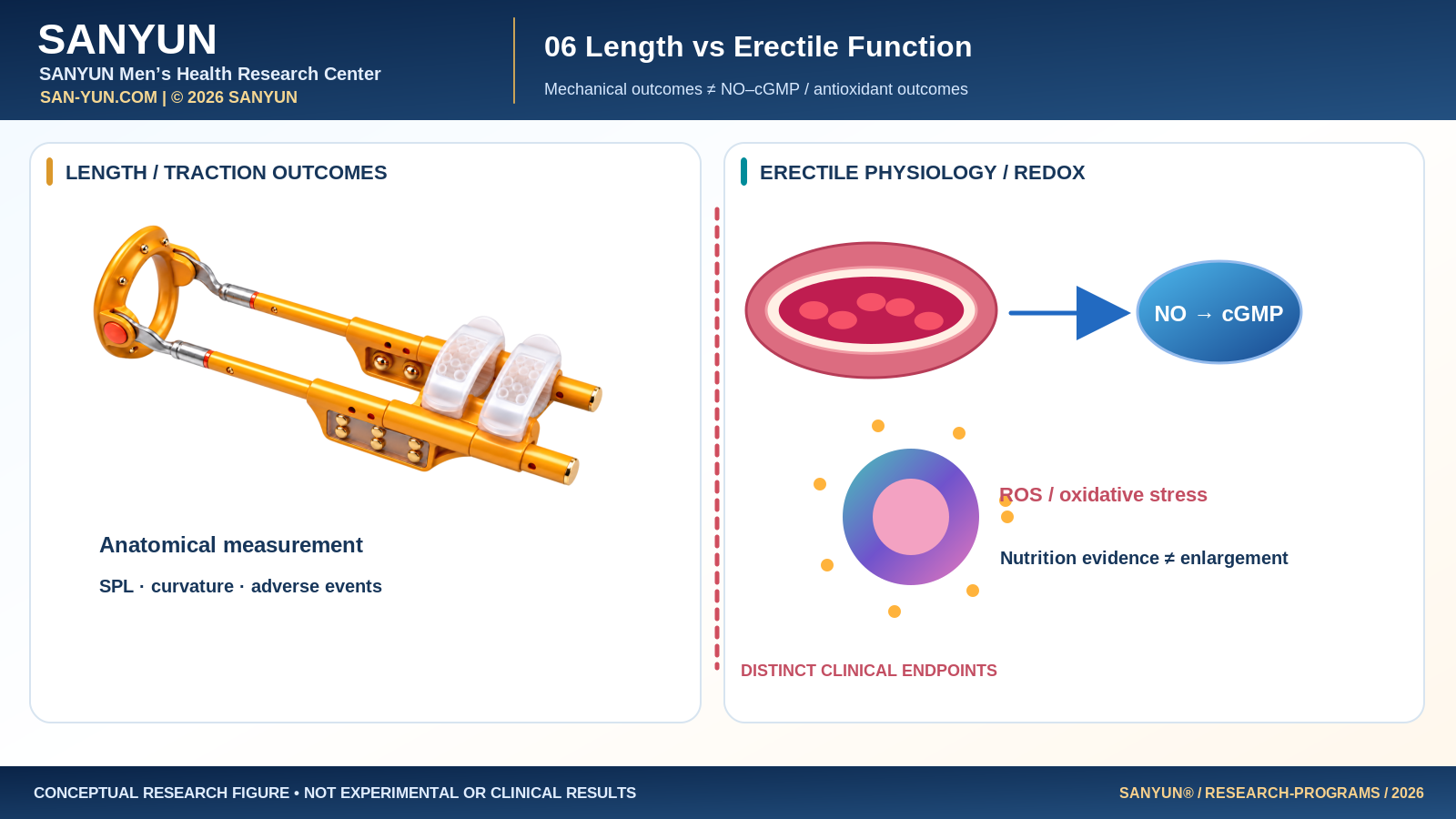
Figure 6. Antioxidant and erectile-function findings do not establish penile tissue growth or efficacy of SANYUN devices. © 2026 SANYUN. Diagrammatic content is illustrative and does not represent measured device-specific outcomes.
1. Define the clinical problem before recommending a technology
The phrase ‘short penis’ can refer to several distinct situations: congenital micropenis, a normal-sized penis perceived as inadequate, acquired apparent shortening, post-surgical changes, buried penis or deformity associated with Peyronie’s disease. These should not be grouped into a single treatment target. Assessment typically begins with clinical history, standardized physical measurements and investigation of relevant functional or psychological distress. Professional evaluation helps distinguish genuine anatomical pathology from ordinary biological variation.
A systematic review by Veale and colleagues pooled measurements from up to 15,521 men to construct penile-size nomograms. Such population data are useful for counseling, not for defining an ideal or mandatory size. The EAU guidance on penile-size abnormalities emphasizes appropriate measurement, psychosocial assessment and cautious selection of treatment, offering only a weak recommendation to consider traction for lengthening. The 2026 international sexual-medicine consensus similarly highlights limitations in augmentation evidence and the importance of patient selection. An October 2026 systematic review pooled a 2.20 cm flaccid-length change across seven studies of augmentation interventions but reported substantial heterogeneity (I² = 81.7%); this pooled, mixed-procedure estimate must not be attributed to penile traction alone or to SANYUN. Interpretation must distinguish study design, intervention type and measurement state.
The SANYUN-associated device patent concerns a mechanically adjustable extender; it does not document a drug formulation or an approved therapeutic regimen. Describing it as a combined pharmacological therapy without additional technology or clinical evidence would misrepresent the invention.
2. Penile length and erectile function are biologically distinct outcomes
Penile length is an anatomical measurement that depends on measurement state and technique. Erectile function concerns the ability to achieve or maintain sufficient rigidity, influenced by vascular, neurological, endocrine and psychological factors. A man can have normal dimensions and erectile dysfunction, or a length concern without erectile dysfunction. A trial that improves erection questionnaire scores cannot legitimately be used to claim tissue enlargement; a change in stretched length does not necessarily mean improved penetration, satisfaction or relationship quality.
The NO–sGC–cGMP pathway is a well-established regulator of cavernosal smooth-muscle relaxation. Neuronal and endothelial nitric oxide contributes to activation of soluble guanylate cyclase, raising cGMP and downstream signaling. PDE5 degrades cGMP; inhibiting PDE5 can improve erectile response when clinically appropriate. These pharmacological mechanisms target erection physiology, not post-pubertal anatomical penile growth.
The EAU erectile dysfunction guidance discusses PDE5 inhibitors as central evidence-based pharmacological options, while tailoring treatment to contraindications, comorbidities and patient preferences. Traction and drug treatment should not be positioned as interchangeable first-line therapies.
3. Oxidative stress: a credible mechanism, but not an enlargement shortcut
Oxidative stress occurs when reactive oxygen and nitrogen chemistry exceeds the capacity of protective systems to maintain appropriate redox balance. In endothelial tissues, excess superoxide may diminish NO bioavailability, while diabetes, smoking, hypertension, obesity and other cardiometabolic disorders can worsen vascular function. Reviews by Kaltsas and colleagues and subsequent authors describe links among NADPH oxidase, mitochondrial ROS, uncoupled eNOS, inflammation and erectile dysfunction.
These relationships are relevant to the research question of healthy sexual function across adulthood. They do not establish that reducing ROS increases penile anatomical length. Moreover, ROS are also normal signaling intermediates; a simplistic goal of eliminating all oxidative signaling is not physiologically sound. Nutrition, exercise, smoking cessation and cardiometabolic management require their own evidence base and should not be repurposed as unsupported product efficacy claims.
4. What randomized antioxidant evidence actually shows
A systematic review and meta-analysis of 23 double-blind, placebo-controlled trials including 1,583 men reported an average improvement in the erectile-function domain of the International Index of Erectile Function (IIEF-EF) of 5.5 points (95% CI 3.7–7.3) with antioxidant supplementation versus placebo. However, the included products, populations and protocols were heterogeneous, and aggregate findings cannot guarantee effectiveness for a particular supplement or patient. A separate systematic review highlighted limited effects of antioxidant-only approaches. These conclusions concern erectile function, not penile length or traction-device effectiveness.
| Intervention or evidence | Primary target | Permissible evidence statement | Unsupported extrapolation |
|---|---|---|---|
| Penile traction studies | Selected length/deformity outcomes | Some devices have shown length or curvature benefit in selected cohorts | All extenders produce a guaranteed enlargement |
| PDE5 inhibitors | Erectile response | Pharmacological support for indicated ED patients | Structural penile growth |
| Antioxidant trials | Erectile function in heterogeneous populations | Some pooled IIEF-EF improvements reported | Measurable anatomical penis enlargement |
| Tourmaline material claims | Physical material properties | Spectral or polarization measurements may be tested | Proven male-health or lengthening therapy |
| Healthy lifestyle | Cardiometabolic health | Supports broader vascular health management | Device-specific efficacy or ‘sexual lifespan’ extension |
5. Multimodal care should be evidence-driven, not modality-driven
‘Combination treatment’ becomes clinically meaningful only when the diagnosis, intervention sequence and interaction risks are defined. In Peyronie’s disease, clinical guidance discusses traction within appropriately selected conservative or multimodal strategies. In erectile dysfunction, pharmacological and lifestyle pathways often take precedence, with specialized treatments as indicated. For congenital or developmental micropenis, the endocrine considerations differ fundamentally and require specialist management. The prohibition against extrapolating testosterone-related developmental treatment to normal adult penile enlargement is especially important.
A trial that examines traction as an adjunct to medically indicated ED care should use clear factorial or controlled designs if it aims to attribute outcomes to individual components. Likewise, nutrition studies should control supplement composition and co-interventions. If a research manuscript mentions antioxidants, readers should know precisely whether the statement reflects a mechanistic review, pooled human clinical evidence, or a novel hypothesis.
6. Patient-centered outcomes, expectations and dignity
Not every desire for a longer penis represents a medical disorder. Evidence-based clinical communication should normalize variation, assess distress without ridicule, and avoid exploiting anxiety. Researchers should measure satisfaction, quality of life, sexual function and adverse events separately from anatomical measurements. The goal is a scientifically accurate discussion of health, agency and realistic benefits rather than a claim that anatomy determines masculinity or ‘sexual longevity.’
Research conclusion. SANYUN can build a strong multidisciplinary knowledge program by examining mechanical intervention alongside vascular and redox science, while keeping their respective evidence chains distinct. No reviewed antioxidant or drug study establishes SANYUN-induced penile enlargement.
Evidence hierarchy and claim boundaries
| Claim or theme | Evidence anchor | Limit of inference |
|---|---|---|
| Traction for size | EAU size guidance | Weak recommendation, heterogeneous studies |
| NO and oxidative stress in ED | Kaltsas et al. 2024 | Mechanism for erection, not size |
| Antioxidant trials in ED | 23-trial meta-analysis | IIEF-EF outcomes; not enlargement |
| Clinical ED pathways | EAU ED guideline | Disease-specific standard of care |
Academic references and evidence
- European Association of Urology. Guidelines on Sexual and Reproductive Health: Penile Size Abnormalities and Dysmorphophobia. Current online chapter, accessed November 2026. https://uroweb.org/guidelines/sexual-and-reproductive-health/chapter/penile-size-abnormalities-and-dysmorphophobia
- European Association of Urology. Guidelines on Sexual and Reproductive Health: Management of Erectile Dysfunction. Current online chapter, accessed November 2026. https://uroweb.org/guidelines/sexual-and-reproductive-health/chapter/management-of-erectile-dysfunction
- Fifth International Consultation on Sexual Medicine (ICSM 2024). Penile augmentation and cosmetic surgery: recommendations. Sexual Medicine Reviews. 2026;14(1):qeaf067. doi:10.1093/sxmrev/qeaf067. https://doi.org/10.1093/sxmrev/qeaf067
- The outcomes of non-surgical and surgical penile augmentation procedures: a systematic review and meta-analysis. Int J Impot Res. Published 16 October 2026. PMID:42888184. https://pubmed.ncbi.nlm.nih.gov/42888184/
- Kaltsas A, et al. Oxidative stress and erectile dysfunction: pathophysiology, impacts, and potential treatments. Curr Issues Mol Biol. 2024;46:8807–8834. doi:10.3390/cimb46080521. https://doi.org/10.3390/cimb46080521
- Antioxidant supplementation for erectile dysfunction: systematic review and meta-analysis of double-blind, randomized, placebo-controlled trials. World J Mens Health. doi:10.5534/wjmh.230280. PMID:38772539. https://doi.org/10.5534/wjmh.230280
- Effect of antioxidants supplementation on erectile dysfunction: a systematic review and meta-analysis of randomized controlled trials. Sex Med Rev. 2022;10(4):754–763. PMID:35246405. https://pubmed.ncbi.nlm.nih.gov/35246405/
- The role of mechano-regulated YAP/TAZ in erectile dysfunction. Nature Communications. 2023. doi:10.1038/s41467-023-39009-z. https://doi.org/10.1038/s41467-023-39009-z
- Veale D, et al. Am I normal? A systematic review and construction of nomograms for flaccid and erect penis length and circumference in up to 15,521 men. BJU Int. 2015;115:978–986. doi:10.1111/bju.13010. https://doi.org/10.1111/bju.13010
Related research in the SANYUN series
- Mechanotransduction and Extracellular Matrix Remodeling During Penile Tissue Traction
- Penile Traction, Microcirculation, and Neurovascular Safety: A Translational Framework
- Clinical Evaluation of a Dual-Spring Penile Traction Device: A Trial Protocol Framework
Editorial transparency
Prepared for the SANYUN-branded Research-Programs editorial series. Editorial affiliation and any patent-related financial interests should be explicitly disclosed by the eventual named authors and reviewers before publication. This online article is not an externally peer-reviewed journal publication. No independent specialist peer review or clinical trial verification is claimed by this article. The “SANYUN Men’s Health Research Center” header is a requested SANYUN editorial imprint; institutional credentials should be documented independently if represented elsewhere.
Frequently asked questions (SANYUN evidence FAQ)
Can treatments for erectile dysfunction increase penis size?
Erection quality and anatomical size are different outcomes. PDE5 inhibitors address erectile physiology and should not be described as proven methods of adult penile growth.
Is a normal-sized penis the same as micropenis?
No. Micropenis is a clinical diagnosis requiring age- and context-appropriate professional assessment. Concern about normal variation is not itself proof of a developmental disorder.
What does the evidence say about penile traction for lengthening?
Current guidelines allow cautious consideration of traction in selected contexts but describe important evidence limitations. Results from specific devices are not automatically applicable to SANYUN.
Do antioxidant supplements enlarge penile tissue?
No established clinical evidence shows that antioxidant supplementation increases anatomical penile length. Research largely evaluates erectile-function scores or vascular biology.
How is nitric oxide involved in erectile function?
Nitric oxide activates soluble guanylate cyclase and cGMP signaling to support cavernosal smooth-muscle relaxation. The pathway is about erection physiology rather than structural enlargement.
Does oxidative stress shorten sexual lifespan?
Oxidative stress contributes to aspects of vascular and sexual-health pathology, but ‘sexual lifespan extension’ is not a validated effect of a specific supplement or SANYUN device.
How should SANYUN discuss multimodal male health responsibly?
Separate indications, evidence types, clinical endpoints, product-specific data and untested hypotheses. Use clinician-guided care pathways rather than implying that all modalities share one proven outcome.
Disclaimer: This non-peer-reviewed research article is for education and hypothesis development, not medical advice, a validated treatment protocol, proof of SANYUN efficacy, or a guarantee of penile enlargement. Seek individualized guidance from a qualified clinician.



