




Category: Penile Size
Core Research Direction: Measurement technique and observer variability in penile length assessment: how accurately stretched-flaccid measurements (suprapubic-skin-to-tip vs pubic-bone-to-tip vs girth) predict erect size in adult men undergoing Doppler ultrasound
Search Intent: How closely do stretched or flaccid penile measurements match erect size, and does the choice of landmark (skin junction versus pubic bone) and observer change the result?
Platform: SANYUN Science Center
Evidence reviewed through: 2026-11-12
Executive Summary
Clinicians and researchers regularly need a trustworthy estimate of erect penile size, but the erect state is not always available in clinic. A multi-observer study of 201 adult men undergoing dynamic penile Doppler ultrasound compared stretched-flaccid and erect measurements directly, using the erect value as the reference standard.[1]
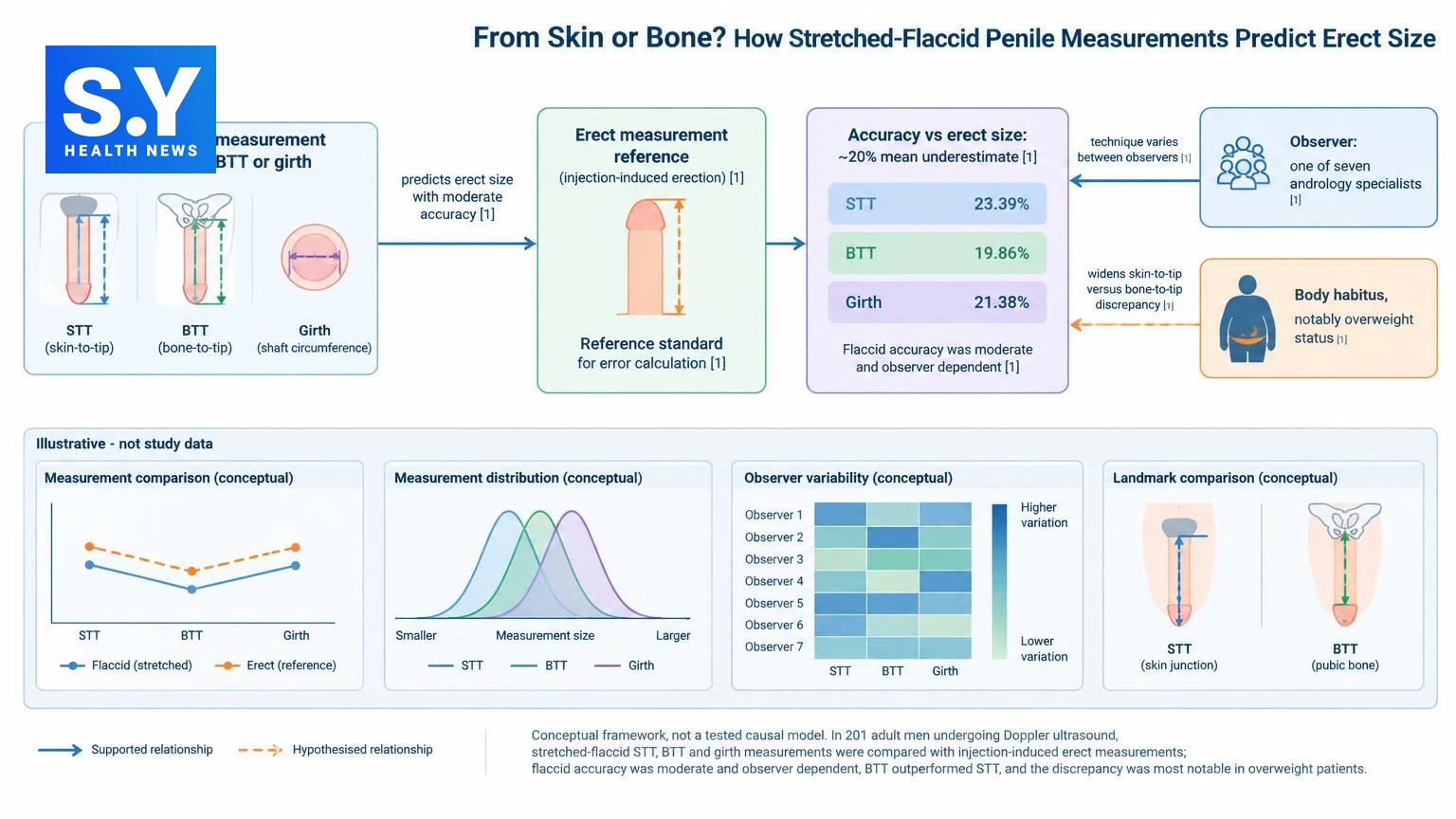
Three parameters were recorded in both states: shaft circumference, length from the suprapubic skin to the glans tip (STT), and length from the pubic bone to the glans tip (BTT). Stretched-flaccid assessment underestimated erect size by roughly 20% on average — 23.39% for STT, 19.86% for BTT and 21.38% for circumference.
The authors concluded that flaccid measurements were only moderately accurate and significantly observer dependent. Anchoring at the pubic bone was more accurate and reliable than the skin junction, with the discrepancy most pronounced in overweight patients.
Why This Matters
Penile size data inform urology, andrology, reconstructive planning and patient counselling, yet the best measurement technique has not been settled. The literature is inconsistent: some small studies reported good correlation between stretched and erect length, while others found substantial variability, and much published work has used the skin-junction landmark rather than the pubic bone.
For readers, the practical issue is not curiosity alone. A man concerned about his size may be reassured or wrongly alarmed by a number that depends heavily on where the tape starts and who is holding it. Understanding how much of a measurement is anatomy and how much is method is therefore clinically relevant.
How the Study Was Constructed
The study enrolled men who achieved a full erection during dynamic penile Doppler ultrasound, performed either to investigate sexual dysfunction or because objective penile measurement was sought. Men with penile scarring, curvature or congenital abnormality were excluded, which matters because these conditions can distort both anatomy and measurement.
In total, 201 adult men with a mean age of 49.4 years took part. Each was measured by one of seven andrology specialists in a private, air-conditioned room held at 21 °C — a detail that limits temperature-related flaccid variation but does not eliminate it. Three measurements were taken in the stretched flaccid state, then repeated after full erection was induced by intracavernosal injection.
The design has an important strength: the erect measurement served as an internal reference for the same man, so comparisons were within-person rather than across different populations. The trade-off is that the sample was a selected clinical group, and the erect state was pharmacologically induced rather than spontaneous.
Biological and Technical Mechanisms Behind the Gap
Why should stretched flaccid length fall short of erect length at all? Stretching approximates the penile tissues' extensibility, but erection is not merely elongation — it involves vascular engorgement that changes the geometry and rigidity of the shaft. The study's finding of a consistent mean underestimate across all three parameters suggests a systematic, directional bias rather than random error alone.
The landmark effect has a plausible mechanical explanation. The suprapubic skin junction moves with body habitus, so in men with more suprapubic fat the skin-based tape may start further from the fixed pubic bone, shortening the recorded distance. This is consistent with the authors' observation that the STT-versus-BTT discrepancy was most notable in overweight patients.
Observer dependency is a separate source of error. With seven specialists measuring across the cohort, technique — tape tension, glans definition, placement of the zero point — can vary between individuals even under standardised room conditions. The study reports this variability without quantifying each observer's contribution in the available summary.
| Measurement approach | Reference standard used | Reported mean underestimate | Key interpretive point |
|---|---|---|---|
| Stretched-flaccid skin-to-tip (STT) length | Fully erect length after intracavernosal injection | 23.39% | Most commonly reported landmark in prior literature, but the least accurate of the three in this study |
| Stretched-flaccid pubic-bone-to-tip (BTT) length | Fully erect length after intracavernosal injection | 19.86% | More accurate and reliable than STT; discrepancy most notable in overweight patients |
| Stretched-flaccid shaft circumference | Erect circumference | 21.38% | Girth has been less well studied than length and also underestimated the erect state |
| Observer variation | Erect measurements as reference (per observer) | Reported as significant, not numerically specified in the summary | Flaccid accuracy was observer dependent, supporting the need for standardised technique |
What the Evidence Shows
The central result is a consistent directional bias. When the penis was assessed in the stretched and flaccid state, the mean result underestimated the erect measurement by about 20%. The three estimates clustered closely — STT at 23.39%, BTT at 19.86% and circumference at 21.38% — which suggests that no single flaccid parameter escaped the problem.
Accuracy, however, is not the same as agreement. A systematic underestimate of this size means a single stretched-flaccid reading cannot be treated as interchangeable with an erect reading, even if group averages can be corrected. The authors characterised flaccid measurements as only moderately accurate at predicting erect size.
The technique comparison is the study's most actionable finding. Measuring from the pubic bone to the tip of the glans was more accurate and reliable than measuring from the skin junction. Because most published data have used the skin-junction landmark, some historical size figures may carry a technique-related downward bias, particularly in men with more suprapubic fat.
The study also found flaccid measurements were significantly observer dependent. This means two clinicians measuring the same man may not produce the same number. Standardising the landmark is one lever; standardising the observers' technique is another.
What This Means Against the Broader Literature
These findings sit within a conflicting evidence base. Some earlier, smaller studies reported good correlation between stretched penile length and erect size; others found significant variability. The present study, with 201 men and multiple observers, supports the variability side of that divide — but it does so in a clinical population undergoing Doppler ultrasound, not in a general-population sample.
For context on typical values, a secondary clinical guide cites a systematic review of clinician measurements in up to 15,521 men reporting a mean erect length of about 13.1 cm and a flaccid length of about 9.2 cm, with a wide normal range. Those figures come from a commercial patient-education source rather than the original review and cannot be independently verified from the material summarised here, so they should be treated as approximate background rather than a benchmark.[2]
The same guide notes that most men seeking penile lengthening surgery measured within the normal range in published work, and that a systematic review of enlargement interventions in normal-sized men reported high complication rates and uncertain satisfaction. These are secondary assertions, useful for framing why accurate measurement matters, but not primary evidence from the study under review.
Interpretation and Limitations
Several limitations temper the conclusions. The sample was a selected clinical population undergoing Doppler ultrasound for sexual dysfunction or objective measurement, with a mean age of 49.4 years — older than many general-population samples. Results may not generalise to younger men or to routine primary-care settings.
The erect reference was induced by intracavernosal injection rather than achieved spontaneously. While this produces a full erection suitable for ultrasound assessment, it is not identical to a naturally occurring erection, and the degree of rigidity may differ. The available summary also reports observer dependency as significant without supplying per-observer error figures, limiting how precisely we can attribute variance.
Body weight is discussed as a modifier of the landmark discrepancy, but the summary does not report body mass index thresholds or adjusted analyses. The claim that BTT is more accurate in overweight patients is therefore a reported observation rather than a quantified, dose-response relationship.
Finally, this is a measurement study, not an intervention trial. It cannot say whether correcting for the ~20% underestimate improves clinical decision-making or patient satisfaction, only that the raw numbers differ systematically.
Research and Clinical Outlook
The clearest implication is procedural. Studies and clinics reporting penile length should specify the landmark used, and bone-anchored measurement appears preferable when an accurate estimate of erect size is the goal. Reporting observer identity or training, and ideally inter-observer reliability statistics, would make future results more comparable.
Open questions remain. How much of the residual error reflects true tissue behaviour versus measurement noise? Do correction factors derived from a Doppler population transfer to other groups? And does a more accurate, bone-anchored measurement change what men are told in counselling? The existing study supports the direction of these questions but does not answer them.
Key Takeaways
- Stretched-flaccid measurements underestimated erect size by roughly 20% on average across length and girth.
- Pubic-bone-to-tip length was more accurate and reliable than suprapubic-skin-to-tip length, with the gap most notable in overweight men.
- Flaccid accuracy was only moderate and significantly observer dependent, so who measures and how matters.
- The findings come from 201 men in a Doppler ultrasound clinic, so generalisation to other populations should be cautious.
Questions and Answers
What is the difference between skin-to-tip and bone-to-tip penile length measurement?
Skin-to-tip (STT) measures from the suprapubic skin junction to the glans tip; bone-to-tip (BTT) measures from the pubic bone to the glans tip. The study found BTT more accurate and reliable against erect size, with the discrepancy most notable in overweight patients — a plausible consequence of suprapubic fat moving the skin reference point.
How accurate are stretched-flaccid penile measurements compared with erect size?
In the 201-man study, stretched-flaccid assessment underestimated erect size by about 20% on average: 23.39% for skin-to-tip length, 19.86% for bone-to-tip length and 21.38% for circumference. The authors described flaccid measurements as only moderately accurate at predicting erect size, so a single stretched reading should not be treated as interchangeable with an erect measurement.
How strong is the evidence that pubic-bone measurement is better than skin-junction measurement?
It is moderate, single-study evidence. The comparison was within-person, using the erect measurement as reference, in 201 men measured by seven specialists — a reasonably robust design for a measurement question. However, the sample was a selected Doppler clinic population, the erect state was injection-induced, and the summary does not provide per-observer reliability statistics.
Does observer variation affect penile length measurement?
Yes. The study reported that flaccid measurements were significantly observer dependent even with seven andrology specialists working in a controlled 21 °C room. That means the same man could receive different readings depending on technique and the person holding the tape — an argument for standardised landmarks and training rather than relying on a single flaccid value.
What are the limitations of this penile measurement study?
It enrolled a clinical population undergoing Doppler ultrasound, with a mean age of 49.4 years, so younger and general-population men may differ. Erect reference measurements were induced by intracavernosal injection rather than spontaneous erection. The overweight-patient finding is reported without BMI thresholds or adjusted analyses, and the summary does not quantify observer-specific error.
Should men worry if their flaccid or stretched measurement seems smaller than expected?
Not necessarily. Stretched-flaccid readings systematically underestimate erect size by about 20% in this clinical study, and flaccid size varies with temperature and other factors. Measurement method and observer also matter. Persistent concern about size is worth discussing with a clinician, who can measure consistently and address the concern itself rather than relying on a single self-measurement.
Conceptual framework: Conceptual framework, not a tested causal model. In 201 adult men undergoing Doppler ultrasound, stretched-flaccid STT, BTT and girth measurements were compared with injection-induced erect measurements; flaccid accuracy was moderate and observer dependent, BTT outperformed STT, and the discrepancy was most notable in overweight patients.
Academic References & Evidence
- Mohamad Habous; Gordon Muir; Tarek Soliman; Mohammed Farag; Ben Williamson; Saleh Binsaleh; Waleed Elhadek; Saad Mahmoud; Hussein Ibrahim; Osama Abdelwahab; Ziad Abdelrahman; Mohamed Abdelkader; Lawrence C Jenkins; John P. Mulhall. Outcomes of variation in technique and variation in accuracy of measurement in penile length measurement – International Journal of Impotence Research. International Journal of Impotence Research. 2018 30:21–26 DOI: 10.1038/s41443-017-0013-3.
- เพิ่มขนาดน้องชาย: ขนาดปกติ อะไรได้ผลจริง ความเสี่ยง.
SANYUN Science Center explains published research on men's reproductive and sexual health, connecting scientific evidence with everyday questions while making sources and limitations clear.
Disclaimer: This article is for scientific education and research communication only. It does not provide medical advice, diagnosis, or individualized treatment recommendations, and does not endorse any medication, supplement, device, penile enlargement procedure, or other intervention. Decisions about sexual and reproductive health should be made in consultation with a qualified healthcare professional. Do not delay seeking professional care because of information in this article.
Original Content & Copyright Notice
- This article is prepared for SANYUN Science Center, drawing on published research and publicly available academic literature on men’s sexual and reproductive health. Its editorial explanations and presentation are developed for this platform.
- Copyright in the original editorial content, selection, and arrangement is reserved by SANYUN Science Center to the extent protected by applicable law. Referenced research, quotations, and third-party materials remain subject to the rights of their respective owners. This notice does not claim ownership of scientific facts or third-party research.
- Except where permitted by applicable law or an applicable license, prior written permission is required to reproduce, republish, translate, adapt, redistribute, or commercially reuse protected content. Attribution alone does not grant permission for such reuse.
- For permitted quotation or authorized reuse, clearly identify the source and retain a link to the original article.
- Source: SANYUN Science Center
- Original URL: Retain the original article URL on science.san-yun.com.
- Copyright Holder: SANYUN Science Center, for its own protected editorial content.
- Quotation, excerpts, or authorized reuse must not distort the scientific meaning, omit material limitations or disclaimers, or imply unverified medical claims, product efficacy, or endorsement by SANYUN Science Center.



