




Category: Penile Size
Core Research Direction: How measurement technique and observer variation affect penile length accuracy, and what this means for interpreting penile-size data in men concerned about size
Search Intent: How accurate are different penile length measurement methods, and does technique or the observer change the measured result?
Platform: SANYUN Science Center
Evidence reviewed through: 2026-11-07
Executive Summary
How long a penis measures depends partly on how it is measured. A multicenter, multi-observer study of adult men published in 2018 directly compared measurement techniques and observers against a common reference, and its findings are a useful anchor for interpreting almost any penile-size number a man may encounter.[1]
The study enrolled 201 adult men (mean age 49.4 years) who achieved full erection during dynamic penile Doppler ultrasound, either for diagnosis of sexual dysfunction or because they wanted an objective measurement. Men with penile scarring, curvature, or congenital abnormality were excluded. Seven andrology specialists took the measurements in a private room kept at 21 °C.
Each man had three parameters recorded twice: shaft circumference, length from suprapubic skin to distal glans (skin-to-tip, STT), and length from pubis to distal glans (bone-to-tip, BTT). The three were first recorded in the stretched flaccid state, then repeated in the fully erect state after intracavernosal injection induced full erection. Flaccid accuracy was then analysed against the erect measurements as the reference, both for the whole group and per observer.
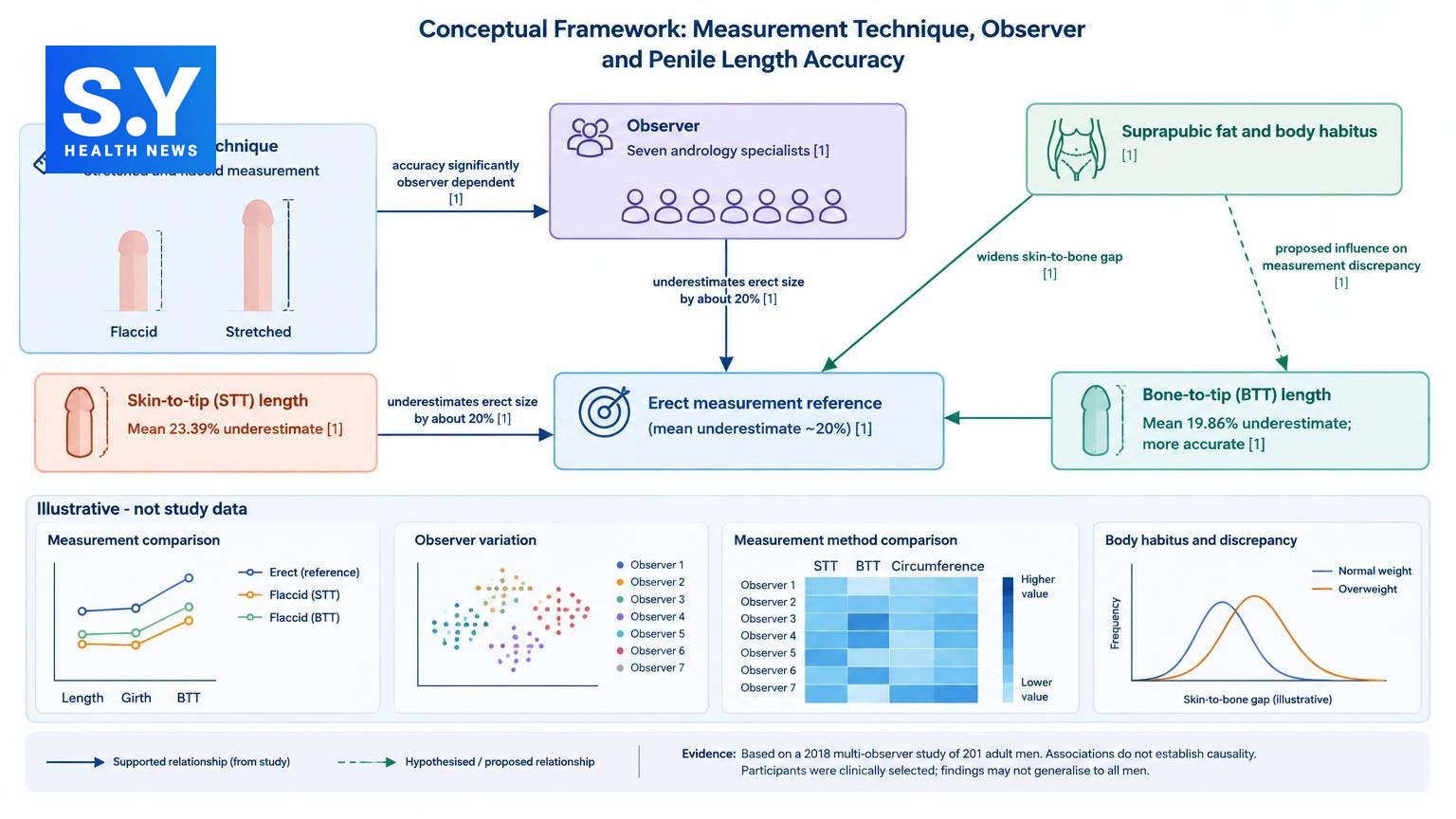
Stretched and flaccid assessment underestimated the erect measurement by a mean of roughly 20%: 23.39% for STT length, 19.86% for BTT length, and 21.38% for circumference. The authors described flaccid measurements as only moderately accurate for predicting erect size, and significantly observer dependent. Bone-to-tip length was the more accurate and reliable approach, with the discrepancy most notable in overweight patients.
For a man worried about his size, the practical implication is that an unstandardised number, especially one taken while flaccid, carries substantial uncertainty. It is not a reliable basis for self-diagnosis, comparison, or decisions about procedures. A clinician-recorded bone-to-tip measurement, interpreted against population reference ranges and the wide normal range, is a more defensible starting point.[2]
Why Measurement Error Matters in Penile-Size Medicine
Accurate data on erect penile size matter across several disciplines that work with male patients, yet remarkably little evidence existed on the best technique for measuring length. Much of the published literature reports length measured from the penopenile skin junction to the glans tip rather than from the pubic bone to the tip. That distinction is not trivial: if the skin reference point differs between studies, between clinicians, or between a clinic and a man measuring himself at home, the numbers are not directly comparable.
Prior small studies on stretched penile length had disagreed. Some suggested a good correlation with erect length; others showed significant variability. Small samples and inconsistent methods can both contribute to that disagreement, and a single-clinic, single-observer design cannot separate true biological variation from measurement noise. The multi-observer, technique-comparison design of the 2018 study was intended to address exactly that gap.
This matters clinically because the man who presents with concern about size typically arrives with a number already in mind, often self-measured or recalled from an informal comparison. Evidence on penile-size measurement accuracy lets clinicians treat that number as a starting hypothesis rather than a fact, and explains why an in-clinic measurement can genuinely change the conversation.
The Two Reference Points: Skin-to-Tip and Bone-to-Tip
The core technical problem is where the ruler starts. Skin-to-tip measurement begins at the junction between the penile shaft and the suprapubic skin. Bone-to-tip measurement begins at the pubic bone, which requires pressing the ruler through the suprapubic fat pad until the bone is felt. The two points coincide only approximately, and the gap between them widens with the thickness of the fat pad overlying the pubis.
This anatomy explains the study's most practical finding: bone-to-tip measurement was more accurate and reliable than skin-to-tip measurement, and the discrepancy between them was most notable in overweight patients. A visible-appearing shortening in a man with a thicker suprapubic fat pad may therefore partly reflect where the ruler begins rather than any change in the underlying structure. That is a measurement and visibility issue, not evidence that weight loss changes penile size itself.
| Measured variable | Reference point | Mean underestimate of erect value | Main interpretive point |
|---|---|---|---|
| Skin-to-tip (STT) length | Suprapubic skin junction to glans tip | 23.39% | Common in published data; more sensitive to suprapubic fat |
| Bone-to-tip (BTT) length | Pubic bone to glans tip | 19.86% | Preferred technique; more accurate and reliable |
| Shaft circumference (girth) | Penile shaft | 21.38% | Flaccid girth also underestimates erect girth |
| Observer effect | Seven andrology specialists | Not quantified in abstract | Accuracy significantly observer dependent |
The table summarises the three reported parameters and the observer dimension. The percentages are mean underestimates across the whole sample, so they describe a central tendency rather than any individual man's expected error. An individual's flaccid-versus-erect difference may be smaller or larger than these averages, which is one reason a single flaccid reading cannot substitute for an erect reference.
Observer Variation: The Same Penis, Different Numbers
The study's second key finding is that flaccid measurements were significantly observer dependent. Even within a controlled setting, using a fixed room temperature and a defined protocol, which of the seven andrology specialists took the measurement influenced the result. This is a recognizable pattern in clinical anthropometry: consistency between observers requires standardised landmarks, positioning, and tension, and small departures from protocol accumulate into meaningful differences.
Observer dependence has a direct implication for interpreting any published penile-size figure. A number reported from one clinic, one examiner, or one technique should not be read as a universal property of the man measured. It is a product of the measurement conditions. This is a limitation of the evidence base itself, not merely of individual studies, and it argues for caution when comparing values across sources that used different reference points.
The design does not tell us why observers differed. Plausible contributors include how firmly the ruler was pressed to the pubic bone, where exactly the skin junction was judged to lie, how the glans was aligned, and how much stretch was applied to the flaccid penis. Those are hypotheses about mechanism rather than findings demonstrated by the study, and they should not be presented as established causes of observer variation.
What the Evidence Shows and What It Does Not
The strongest supported claims are comparative and internal to the study. Against an erect reference, stretched and flaccid assessment underestimated erect size by roughly a fifth. Bone-to-tip measurement outperformed skin-to-tip measurement. Accuracy varied significantly by observer. These findings are consistent with a broader message: technique and examiner are part of the measurement, not incidental details.
What the study does not provide is a general-population reference range. Participants were men who achieved full erection during Doppler ultrasound for sexual-dysfunction assessment or because they wanted an objective measurement. Men with scarring, curvature, or congenital abnormality were excluded. The sample is therefore clinically selected, and its mean age of 49.4 years should not be assumed to represent younger men or men without sexual concerns.
Nor does the study establish a causal relationship between any variable and true penile size. It characterises measurement performance. The erect measurement was treated as the reference standard, which is a pragmatic choice but not a perfect gold standard. Interpreting flaccid accuracy against it assumes that erect measurement itself is the more valid target, and that assumption, while reasonable, is a design decision rather than a proven biological hierarchy.
Finally, statistical significance and clinical importance are not identical here. A statistically significant observer effect tells us that differences exist; it does not by itself tell us how large those differences are for an individual patient. The abstract reports the direction and the group-level underestimates but not per-observer effect sizes, so the practical magnitude of observer variation for any one man remains uncertain from this source alone.
Applying This to Men Concerned About Size
The evidence supports a simple interpretive rule: an unstandardised flaccid measurement is a weak estimate of erect size. Because flaccid assessment underestimated erect measurements by a mean of about 20% in this cohort, and because accuracy depended on the observer, a self-taken flaccid number should be treated as provisional rather than definitive. It is also behaviourally variable: flaccid size shifts with temperature, stress, and time of day, which further undermines informal comparison.
Published guidance aimed at men concerned about size reports that most men who worry measure within the normal range. That claim comes from a commercial clinical guide summarising published literature rather than from new peer-reviewed data, so it should be presented with that provenance attached. It nonetheless aligns with the measurement-accuracy literature in one respect: the number a worried man carries is often not a well-standardised one.
The same guide reports that a 2020 systematic review concluded that, in men of normal size, many penile-enhancement procedures carry high complication rates and uncertain satisfaction, and that ligamentolysis increases visible flaccid length by published averages of about 1–2 cm with wide individual variation and some men showing little change. These are secondary summaries; the primary review and surgical studies are not included in this packet, so they should be treated as contextual rather than as independently verified findings here.
The guide also states that no pill, cream, or supplement has evidence of causing permanent size increase, that online-shared manual stretching techniques lack evidence of benefit but have reports of injury including capillary rupture, fibrosis, and curvature, and that vacuum pumps produce temporary erection and have a role in erectile dysfunction care without permanently increasing size. These are guide-level statements, useful for orienting a conversation but not a substitute for primary evidence.
A related point concerns dissatisfaction after procedures. The guide reports that hyaluronic acid filler temporarily increases girth without surgery, can be dissolved if unsatisfying, and requires re-injection as it degrades. Together with the procedural cautions above, this supports a clinical sequence in which accurate measurement and expectation-setting come before any intervention, not after.
Research Outlook and Evidence Gaps
Several gaps follow directly from the evidence reviewed. The study does not quantify per-observer variation in a way that would let a clinic predict how much two examiners might differ. It does not report whether standardised training or a written measurement protocol reduces observer dependence, although that is a plausible next question. And it does not examine how measurement accuracy affects a man's satisfaction with the clinical encounter, which is the outcome that matters most for the worried patient.
There is also the question of reference standards. Using erect measurement as the reference is practical, but consistency across future studies would require agreement on technique, landmarks, temperature, and observer training. Without that agreement, pooled comparisons and reference ranges will continue to inherit the measurement error documented here. The wider guideline literature on penile-size measurement, referenced by later work, reflects this recognised need for standardisation.
For now, the defensible interpretation is modest: technique and observer materially affect measured penile length; bone-to-tip is the preferred approach; and flaccid values underestimate erect size on average. None of this establishes that any measurement method changes penile size itself, and none of it justifies claims about interventions. It does mean that any single number deserves a question about how it was obtained.
Key Takeaways
- In a 2018 multi-observer study of 201 adult men, stretched and flaccid assessment underestimated erect measurement by a mean of about 20%: STT length 23.39%, BTT length 19.86%, and circumference 21.38%.
- Bone-to-tip measurement was more accurate and reliable than skin-to-tip measurement, and the discrepancy was most notable in overweight patients.
- Flaccid measurement accuracy was significantly observer dependent, with measurements taken by seven andrology specialists in a controlled 21 °C room.
- The sample was clinically selected, and the study characterises measurement performance rather than establishing causes of penile size.
- Guide-level sources report that most men who worry measure in the normal range and that no pill, cream, or supplement has evidence of permanent size increase; these are secondary summaries, not new research.
Questions and Answers
Why do flaccid and stretched penile measurements underestimate erect size?
In the 2018 multi-observer study, stretched and flaccid assessment underestimated the erect reference by a mean of roughly 20%: 23.39% for skin-to-tip length, 19.86% for bone-to-tip length, and 21.38% for circumference. This suggests flaccid values are only moderately accurate predictors of erect size, so a flaccid number should be treated as provisional rather than definitive.
Does it matter who measures penile length?
Yes, according to the study. Flaccid measurements were significantly observer dependent even though seven andrology specialists measured in a controlled 21 °C room with a defined protocol. The abstract does not report per-observer effect sizes, so the practical size of the variation for an individual man remains uncertain.
Is bone-to-tip or skin-to-tip penile measurement more accurate?
Bone-to-tip measurement, starting at the pubic bone, was more accurate and reliable than skin-to-tip measurement, which starts at the suprapubic skin junction. The discrepancy between them was most notable in overweight patients, consistent with the suprapubic fat pad affecting where a skin-based ruler begins.
How strong is the evidence on penile length measurement technique?
The main evidence here is a prospective multi-observer study of 201 adult men published in 2018. It directly compared techniques against an erect reference, but the sample was clinically selected from men undergoing Doppler ultrasound, and erect measurement as the reference standard is a design choice rather than a perfect gold standard.
Can I trust a self-measured flaccid penile length?
A self-taken flaccid measurement is a weak estimate of erect size. In the study, flaccid assessment underestimated erect measurement by about 20% on average, accuracy depended on the observer, and flaccid size varies with temperature and situation. A clinician-recorded bone-to-tip measurement is a more defensible starting point for any discussion.
What does penile-size measurement error mean for men worried about size?
It means the number a man carries may reflect technique rather than anatomy. Published guidance reports that most men who worry measure within the normal range, though that comes from a commercial clinic guide summarising literature rather than new peer-reviewed data. Accurate measurement and expectation-setting should precede any consideration of procedures.
Conceptual framework: Conceptual framework: how measurement technique, observer and suprapubic fat relate to penile length accuracy. Based on a 2018 multi-observer study of 201 adult men; supported and proposed relations are distinguished. Not a tested causal model.
Academic References & Evidence
- Mohamad Habous; Waleed Elhadek; Saad Mahmoud; Hussein Ibrahim; Ziad Abdelrahman; Mohamed Abdelkader; Gordon Muir; Tarek Soliman; Osama Abdelwahab; Mohammed Farag; Ben Williamson; Saleh Binsaleh; Lawrence C Jenkins; John P. Mulhall. Outcomes of variation in technique and variation in accuracy of measurement in penile length measurement – International Journal of Impotence Research. International Journal of Impotence Research. 2018 30:21–26 DOI: 10.1038/s41443-017-0013-3.
- เพิ่มขนาดน้องชาย: ขนาดปกติ อะไรได้ผลจริง ความเสี่ยง.
SANYUN Science Center explains published research on men's reproductive and sexual health, connecting scientific evidence with everyday questions while making sources and limitations clear.
Disclaimer: This article is for scientific education and research communication only. It does not provide medical advice, diagnosis, or individualized treatment recommendations, and does not endorse any medication, supplement, device, penile enlargement procedure, or other intervention. Decisions about sexual and reproductive health should be made in consultation with a qualified healthcare professional. Do not delay seeking professional care because of information in this article.
Original Content & Copyright Notice
- This article is prepared for SANYUN Science Center, drawing on published research and publicly available academic literature on men’s sexual and reproductive health. Its editorial explanations and presentation are developed for this platform.
- Copyright in the original editorial content, selection, and arrangement is reserved by SANYUN Science Center to the extent protected by applicable law. Referenced research, quotations, and third-party materials remain subject to the rights of their respective owners. This notice does not claim ownership of scientific facts or third-party research.
- Except where permitted by applicable law or an applicable license, prior written permission is required to reproduce, republish, translate, adapt, redistribute, or commercially reuse protected content. Attribution alone does not grant permission for such reuse.
- For permitted quotation or authorized reuse, clearly identify the source and retain a link to the original article.
- Source: SANYUN Science Center
- Original URL: Retain the original article URL on science.san-yun.com.
- Copyright Holder: SANYUN Science Center, for its own protected editorial content.
- Quotation, excerpts, or authorized reuse must not distort the scientific meaning, omit material limitations or disclaimers, or imply unverified medical claims, product efficacy, or endorsement by SANYUN Science Center.



