




Category: Penile Size
Core Research Direction: How penile length is defined and measured in adult men — flaccid vs stretched vs erect measurement, reported Chinese adult reference ranges, and why measurement method limits any single 'normal' cutoff
Search Intent: What penile length ranges and averages have been reported for adult men, and how does the measurement method (flaccid, stretched, erect) change what counts as 'normal'?
Platform: SANYUN Science Center
Evidence reviewed through: 2026-10-31
Executive Summary
Questions about what penile length is 'normal' usually assume a single number exists. The available sources reviewed here instead show that the number depends heavily on how it is obtained. One consumer health explainer gives a flaccid range of 4.5 to 8.8 cm with a mean of 6.5 cm for Chinese men aged 18 to 45, while a medical information platform gives a flaccid range of 4.1 to 12 cm with a mean near 5.0 cm for generally normal Chinese adult men.[1][2]
Both sources also report erect figures: approximately 13 cm as a mean for Chinese adult men in one, and 10.7 to 16.5 cm with a mean of 13.0 cm in the other. Neither cites a primary study, sample size or measurement protocol for these numbers, and both are secondary summaries. The evidence base for any precise cutoff is therefore thin, and the sources themselves caution against strict application.
The more defensible conclusion is methodological: measurement conditions, body habitus and the erection state being measured all shift the recorded value, so a threshold acquired under one method cannot be transferred to another without validation.
Why Measurement Method Matters More Than the Number
Penile length is not a fixed anatomical constant in the way height is. It changes with temperature, arousal, time of day and the position of surrounding tissue. The reviewed explainer specifies room temperature of 18 °C, a standing posture, the penis lifted to 90° to the body, and a rigid ruler placed along the upper surface from the pubic symphysis to the tip of the glans. Every one of those details is a variable that another protocol may handle differently.
Suprapubic fat is a concrete example. The source notes that in men with obesity, abdominal fat can bury part of the penis so that it appears shorter, and recommends pushing the fat back during measurement. This is a measurement artefact rather than a change in the organ itself, and it means two men with identical anatomy can record different lengths depending on body composition and technique.
The two sources describe different measurement sequences. One platform proposes measuring flaccid length and diameter with a tape measure first, then inducing erection through fantasy or massage and measuring again once the erection angle exceeds 90°. The other treats stretched length as a proxy, pulling the glans forward until it will not extend further and asserting that this approximates erect length.
That stretched-to-erect equivalence is asserted, not demonstrated. The source provides no comparative data, no correlation coefficients and no description of examiner training or repeat measurements. Where such a proxy is used clinically, its justification has to come from validation studies that these sources do not supply.
What the Reported Ranges Actually Show
| Measure / finding | Result | Population / follow-up | Limitations |
|---|---|---|---|
| flaccid penile length; transverse diameter; mid-shaft circumference | 4.5–8.8; mean 6.5; 2.5; 8 cm | Chinese men aged 18–45 years (as stated) | No primary study, sample size, sampling method or measurement protocol given; unattributed secondary aggregation. |
| stretched flaccid length threshold | ≥8 cm | Threshold and stretched–erect equivalence stated without source, sample or validation; measurement conditions (temperature, examiner, repetition) unspecified. | |
| mean erect penile length | ~15; ~13 cm | US adult men; Chinese adult men (as stated) | Unattributed figures; no study, sample size or measurement protocol cited; cannot be treated as verified estimates. |
| flaccid penile length | 4.9–8.6; mean 6.55 cm | 1000 normal adult men (as stated); n=1000 | Single unattributed survey; no source citation, geographic setting, age range, or measurement method. |
| flaccid length; diameter | 4.1–12, mean ~5.0; 2.1–3.0, mean 2.6 cm | Chinese normal adult men (as stated) | Unattributed summary statistics; no study citation, sampling method or measurement protocol; wide range suggests heterogeneous methods. |
| erect penile length | 10.7–16.5; mean 13.0; SD 1.3 cm | Chinese normal adult men (as stated) | Unattributed mean and SD without citation, sample size or indication of how erection was achieved or measured. |
The flaccid figures diverge in a way that is itself informative. One source gives 4.5 to 8.8 cm with a mean of 6.5 cm; the other gives 4.1 to 12 cm with a mean near 5.0 cm. A range extending to 12 cm alongside a mean of 5.0 cm implies a strongly right-skewed distribution, which could reflect genuine variation, mixed measurement conditions, or simply imprecise aggregation. Without the underlying data, none of these explanations can be distinguished.
A separate figure in the first source reports a survey of 1000 normal adult men with a flaccid range of 4.9 to 8.6 cm and a mean of 6.55 cm. This is the only statement in the packet that names a sample size, yet it still lacks a citation, a geographic setting, an age range and a stated measurement method. It is a more specific claim, not necessarily a more reliable one.
The erect estimates converge more closely. One source states approximately 13 cm for Chinese adult men and approximately 15 cm for US adult men; the other gives 10.7 to 16.5 cm with a mean of 13.0 cm and a standard deviation of 1.3 cm. Convergence between two unattributed figures is weak corroboration, because both may derive from the same underlying summaries or from common informal sources rather than independent measurement.
The packet also contains a height-based formula attributed to an 'International Men's Health Organization (MTD)' said to draw on nearly 30 years of research, computing normal length as (height − 105) × 0.618 / 3.14 in centimetres. The organisation, its research basis and any validation of the formula are undocumented. It should be read as an unverified proposal rather than an established predictive rule, and it is not supported by the other figures in these sources.
Thresholds, Definitions and Their Limits
Thresholds in the sources are inconsistent and sometimes composite. The stretched-length method labels 8 cm or more as normal. A separate statement holds that abnormal penile development requires adult length under 5 cm together with testicular volume under 8 mL and, especially, absent secondary sex characteristics — meaning length alone does not define a disorder in that account.
The second source takes a different route, framing values below the normal range as a preliminary indication of a micropenis-like condition possibly linked to congenital testicular hypoplasia, bilateral cryptorchidism or pituitary hypofunction, and values clearly above the range as possibly linked to congenital adrenal hyperplasia, precocious puberty or Leydig cell tumour. These aetiological associations are offered without cited evidence, and the 'normal range' is never operationally defined.
Notably, the same source that supplies the ranges also warns that erect length and width vary between individuals and may be affected by measurement method, so the stated numerical standards should not be applied strictly to define abnormality. That caution is the most methodologically sound statement in the packet, and it undercuts any use of these figures as diagnostic cutoffs.
Individual and ethnic variation is acknowledged in general terms, with penile size described as differing by ethnicity and among individuals much as height and build do. No comparative data accompany these statements, so they function as background framing rather than evidence about the size of any between-group difference.
Interpretation and Limitations
The central limitation is provenance. Every quantitative claim in this packet comes from consumer-facing secondary sources — a health explainer article and a medical information platform Q&A — rather than from peer-reviewed measurement studies. No sample size, sampling frame, examiner protocol, temperature control or statistical method is reported for the headline ranges, and the one figure with a stated sample size of 1000 still lacks a citation.
This matters for interpretation in a specific way. A reported mean is not a normal range, and a range is not a threshold. Even if the erect mean of 13.0 cm with a standard deviation of 1.3 cm were accurate, a mean and standard deviation describe a distribution; they do not identify where pathology begins. Deciding that requires clinical criteria, not a percentile chosen from a secondary summary.
There is also a mismatch between what men believe and what the figures suggest. One survey reported in the explainer found that nearly 70% of respondents cared very much about penis size, nearly 20% wished for an instant enlargement remedy, and nearly 60% believed the penis should be 14 to 18 cm long. The survey population, sample size and design are not given, but the gap between the desired 14–18 cm belief and the reported erect mean near 13 cm is a recurring theme in size concerns.
The sources also place length in a broader functional context. One states that erect length is only one reference indicator of sexual quality of life, alongside rigidity, duration, ability to ejaculate and individual orgasm threshold. Another suggests that men who can complete intercourse without problems such as premature ejaculation need no special treatment, while inability to complete intercourse or presence of erectile dysfunction or premature ejaculation warrants clinical evaluation. These are practical suggestions without a cited evidence base, and 'normal completion of intercourse' is not defined.
Research Outlook
What would move this topic forward is not another range but transparent method. Studies would need to state the erection state measured, the induction method for erect length, the instrument used, ambient temperature, whether suprapubic fat was displaced, examiner training, and inter-observer reliability. None of that is available in the reviewed sources, which is why the ranges they report cannot be pooled or compared head to head.
The stretched-length proxy deserves particular scrutiny. Its clinical convenience depends on a correlation with erect length that the source asserts but does not quantify. Future work would need to report that correlation in the same men under standardised conditions before the proxy can be relied upon for thresholds, and before the 8 cm cutoff can be interpreted.
Finally, the aetiological claims linking out-of-range length to endocrine or testicular conditions need sourced clinical criteria rather than broad associative statements. Until then, they remain hypotheses that should inform clinical questioning, not diagnostic rules.
Key Takeaways
- Reported flaccid ranges for Chinese adult men differ substantially between sources — 4.5 to 8.8 cm with a mean of 6.5 cm in one, and 4.1 to 12 cm with a mean near 5.0 cm in the other — and neither cites a primary study.
- Erect estimates cluster nearer together at approximately 13 cm, but convergence between two unattributed secondary figures is weak corroboration rather than independent confirmation.
- Measurement conditions — room temperature, posture, instrument, displacement of suprapubic fat, and whether erection was induced — change the recorded value and limit transfer of any single cutoff.
- The stretched-length equivalence to erect length and the 8 cm 'normal' threshold are asserted without validation data in the reviewed source.
- Composite criteria requiring length under 5 cm together with testicular volume under 8 mL and absent secondary sex characteristics imply that length alone does not define a disorder in that account.
- One source explicitly cautions that the stated numerical standards should not be applied strictly to define abnormality, a caution consistent with the missing methodological detail across the packet.
Questions and Answers
What is the difference between flaccid, stretched and erect penile length measurement?
Flaccid length is measured while the penis is unaroused, typically with a rigid ruler from the pubic symphysis to the glans tip. Stretched length is obtained by pulling the glans forward until it will not extend further, and the reviewed source asserts this approximates erect length without providing validation data. Erect length is measured after erection is induced, with one platform specifying measurement once the erection angle exceeds 90°.
What penile length ranges have been reported for Chinese adult men?
One source gives a flaccid range of 4.5 to 8.8 cm with a mean of 6.5 cm for men aged 18 to 45, and approximately 13 cm as the mean erect length. Another gives a flaccid range of 4.1 to 12 cm with a mean near 5.0 cm, and erect length of 10.7 to 16.5 cm with a mean of 13.0 cm and a standard deviation of 1.3 cm.
How strong is the evidence behind these reported averages?
Weak. Both sources are consumer-facing secondary summaries rather than peer-reviewed measurement studies. They do not cite primary studies, sample sizes or measurement protocols for the headline ranges. Only one statement names a sample — a survey of 1000 normal adult men with a flaccid mean of 6.55 cm — and even that lacks a citation, setting, age range and stated method.
Why can't a single 'normal' cutoff be applied reliably?
Because recorded length depends on method and context. Temperature, posture, instrument, whether suprapubic fat is displaced, and whether erection was induced all shift the value. One source explicitly cautions that the stated standards should not be applied strictly to define abnormality. Diagnostic criteria in the other source are composite, requiring length under 5 cm together with testicular volume under 8 mL and absent secondary sex characteristics.
How do body habitus and measurement conditions affect the recorded length?
The reviewed explainer notes that abdominal fat in men with obesity can bury part of the penis so it appears shorter, and recommends pushing the fat back during measurement. It also specifies room temperature of 18 °C, a standing posture and the penis lifted to 90° to the body. These are measurement conditions rather than changes in the organ, and they can produce different readings in men with similar anatomy.
Does penile length determine sexual function or the need for treatment?
The sources treat length as one factor among several. One states that erect length is only one reference indicator of sexual quality of life, alongside rigidity, duration, ejaculation and individual orgasm threshold. Another suggests men who can complete intercourse without issues such as premature ejaculation need no special treatment, while inability to complete intercourse or presence of erectile dysfunction or premature ejaculation warrants clinical evaluation. These are practical suggestions without a cited evidence base.
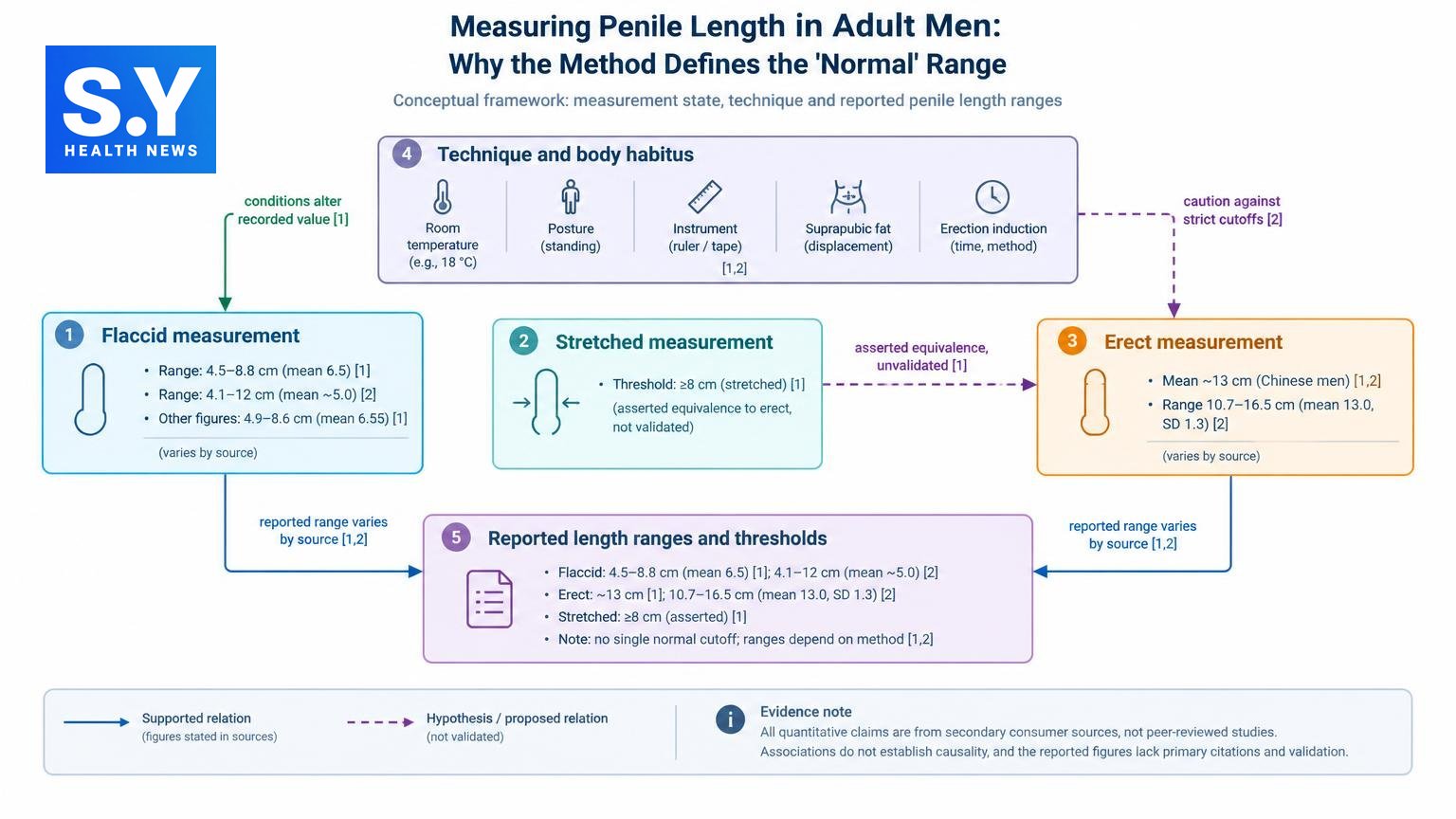
Conceptual framework: Conceptual framework of the variables discussed in this evidence review: flaccid, stretched and erect measurement states, technique and body habitus factors, and the reported length ranges and thresholds they inform. Relations shown as supported reflect figures stated in the reviewed secondary sources; the stretched-to-erect equivalence is shown as a proposed relation because validation data were not supplied. The framework is an interpretive aid, not a tested causal model, and its underlying figures lack primary citations.
Academic References & Evidence
SANYUN Science Center explains published research on men's reproductive and sexual health, connecting scientific evidence with everyday questions while making sources and limitations clear.
Disclaimer: This article is for scientific education and research communication only. It does not provide medical advice, diagnosis, or individualized treatment recommendations, and does not endorse any medication, supplement, device, penile enlargement procedure, or other intervention. Decisions about sexual and reproductive health should be made in consultation with a qualified healthcare professional. Do not delay seeking professional care because of information in this article.
Original Content & Copyright Notice
- This article is prepared for SANYUN Science Center, drawing on published research and publicly available academic literature on men’s sexual and reproductive health. Its editorial explanations and presentation are developed for this platform.
- Copyright in the original editorial content, selection, and arrangement is reserved by SANYUN Science Center to the extent protected by applicable law. Referenced research, quotations, and third-party materials remain subject to the rights of their respective owners. This notice does not claim ownership of scientific facts or third-party research.
- Except where permitted by applicable law or an applicable license, prior written permission is required to reproduce, republish, translate, adapt, redistribute, or commercially reuse protected content. Attribution alone does not grant permission for such reuse.
- For permitted quotation or authorized reuse, clearly identify the source and retain a link to the original article.
- Source: SANYUN Science Center
- Original URL: Retain the original article URL on science.san-yun.com.
- Copyright Holder: SANYUN Science Center, for its own protected editorial content.
- Quotation, excerpts, or authorized reuse must not distort the scientific meaning, omit material limitations or disclaimers, or imply unverified medical claims, product efficacy, or endorsement by SANYUN Science Center.



