




Category: Penis Enlargement
Core Research Direction: Evidence on penile-lengthening procedures performed with or around penile prosthesis implantation — documented length outcomes, associated techniques, complications, and the low quality of supporting study designs
Search Intent: In men receiving a penile prosthesis, which lengthening techniques have reported measured penile length gains, and how reliable and safe is that evidence?
Platform: SANYUN Science Center
Evidence reviewed through: 2026-11-14
Executive Summary
Penile shortening is described as the most prevalent long-term complaint and cause of dissatisfaction after successful placement of an inflatable or malleable penile prosthesis, and reported patient disappointment after prosthesis surgery ranges from 0% to 28%, attributed to perceived length loss, diminished sensation, and the appearance and malpositioning of device components.[1]
A contemporary systematic review examined pre-operative, intra-operative and post-operative strategies intended to preserve, restore or increase penile length in men receiving a prosthesis. Its central conclusion is cautious: lengthening procedures can be combined with prosthesis insertion, but they carry significant risk, require extensive counseling, and offer limited and uncertain average postoperative length recovery.
The most striking numbers in the review are large: sliding technique and multiple-slit technique series each report mean gains of about 3.1 cm, a modified tunica expansion series reports an estimated 3.3 cm, and subcoronal approaches report between 0.6 cm and 2.8 cm. These figures should be read as single-group observations from predominantly small, single-operator series rather than as comparative evidence of superiority.
Why This Matters
Prosthesis surgery is positioned in the literature as a standard treatment for erectile dysfunction after maximum medical therapy fails, yet the operation solves rigidity while leaving length concerns largely untouched. For many men, the perceived loss of length becomes the dominant source of dissatisfaction even when the device functions.
Two contextual problems complicate care. First, men who seek lengthening often overestimate what a normal penile length is, which makes pre-surgical measurement and expectation-setting essential. Second, experts have no agreed-upon lengthening procedure or optimal timing, so recommendations vary between surgeons and centers.
The topic also suffers from conceptual confusion. The review distinguishes procedures that genuinely increase corpora cavernosa length from penile restoration procedures that only straighten a shortened side, for example plaque incision or partial excision with grafting. Procedures that merely change the perception of length are not equivalents of true elongation.
Biological and Clinical Mechanism
One proposed explanation for length loss is that long-standing erectile dysfunction reduces penile elasticity, allowing the dartos fascia to tether onto the underlying tunica albuginea and shorten the erect penis. This remains a suggested mechanism rather than an established causal pathway, but it underpins techniques that release dartos attachments or expand the tunica.
Pre-operative assessment is framed as a required step rather than an optional one: a pharmacologically induced erection and a stretched penile length measurement are recommended to establish realistic surgical expectations. These measurements also provide the baseline against which reported gains are judged, which matters because the review notes that length outcomes are analyzed inconsistently across studies.
The surgical logic differs by technique family. Cavernosal sparing avoids or minimizes dilation of the corpora on the reasoning that preserved tissue maintains length and spontaneous tumescence sensation. Subcoronal degloving releases dartos tethering and exposes the entire shaft. Sliding, modified sliding and multiple-slit techniques create tunical incisions that allow the corporal bodies to separate and lengthen, with or without grafts. Tunica expansion procedures intentionally upsize prosthesis cylinders and then make many small mesh-pattern tunical incisions to redistribute tension and increase length and girth.
What the Evidence Shows
The review searched PubMed for English-language studies published between March 2013 and March 2023. From 152 initial records, 29 were duplicates, 123 abstracts and titles were screened, and 18 articles met inclusion because they reported new subjective or objective penile length outcomes. Most retrieved papers were reviews without original data or were not specific to prosthesis surgery.
| Approach | Reported length outcome | Population and design | Notable safety signals |
|---|---|---|---|
| Cavernosal sparing without dilation | Greater length than dilation at immediate, 3-month and 6-month assessments (10.2 vs 8.5 cm; 10.1 vs 8.3 cm; 10.0 vs 8.0 cm); activated prosthesis length not obtained | 100 men undergoing inflatable prosthesis; observational comparison | Review states strong evidence is lacking; described as mainly for men wanting spontaneous tumescence sensation |
| Subcoronal degloving with reconstruction (Peyronie's disease and severe shortening) | Mean 2.8 cm gain | 23 patients; single series | 20% decreased glans sensitivity; 15% residual curvature; 90% satisfaction |
| Subcoronal prosthesis placement with selective reconstruction | Mean 0.6 cm gain; no measured length loss | 200 patients; single-surgeon series | None grafted; 24% tunical plication and 22% relaxing incisions among those with concurrent disease |
| Sliding technique with grafts | Mean 3.2 cm gain at mean 37-month follow-up (initial series of 3 patients also reported 3.2 cm) | 28 patients (7 malleable, 21 inflatable); single group | One patient (3.5%) required transfusion; one malleable device infection requiring removal |
| Modified sliding technique (MoST) | Mean 3.1 cm gain | 143 patients (133 malleable, 10 inflatable); median 9.7-month follow-up | Glans necrosis is described as the most feared complication of this technique family |
| Multiple-slit technique (MuST) | Mean 3.1 cm gain | 138 patients (103 malleable, 35 inflatable); median 15.2 months | One major glans necrosis complication; no device explantation for infection |
| Modified tunica expansion procedure | Estimated intraoperative gain of 3.3 cm | 416 patients (361 malleable, 55 inflatable; 287 with concurrent Peyronie's disease); mean 12-month follow-up | Postoperative hematoma 20%; temporary partial glans numbness 4%; temporary anorgasmia up to 4 months 7%; prosthesis infection 0.2% |
The spread of reported gains is wide, from 0.6 cm after subcoronal implantation with selective reconstruction to an estimated 3.3 cm intraoperative gain with a modified tunica expansion procedure. These numbers are not directly comparable: some are postoperative measurements, one is explicitly an estimated intraoperative gain, and one series did not obtain activated prosthesis length at all.
Safety signals are not trivial. In the modified tunica expansion series of 416 patients, postoperative hematoma occurred in 20%, temporary partial glans numbness in 4%, and temporary anorgasmia lasting up to four months in 7%, with prosthesis infection in 0.2%. A separate report of 21 patients with glans necrosis after advanced prosthesis techniques found that 7 (33%) had undergone sliding-technique or MoST lengthening, and 7 (33%) had extensive urethral and neurovascular bundle mobilization that the authors believed compromised distal circulation.
Penile traction therapy has moved into the pre-operative setting, including a device developed for use before prosthesis implantation. The review's table lists mean gains of 1.5 cm with traction therapy alone, 1.9 cm when combined with collagenase injections, and 0.8 to 3.5 cm with vacuum erection devices depending on protocol. Postoperative inflation protocols are listed with a 1 cm gain. These are adjunct strategies rather than surgical elongation, and the table summarizes heterogeneous protocols.
Interpretation and Limitations
The review's own appraisal is blunt: study quality over the prior decade remains low, efficacy and safety evidence is lacking, and most evidence comes from observational designs with non-standardized methods, heterogeneous populations and single-surgeon experience. No expert consensus exists on which procedure to choose or when to perform it, and length outcomes are analyzed inconsistently across studies, as are satisfaction and safety outcomes.
Several specific limitations deserve emphasis. Many series are single-group and non-comparative, so a reported gain cannot be attributed to the technique rather than to measurement practice, baseline characteristics or natural variation. The largest gains come from the most technically demanding procedures, which are also the procedures with the most serious complication signals, so selection by surgeon experience may confound both benefit and harm.
Measurement is a further problem. Some outcomes are postoperative measurements, one is an estimated intraoperative gain, and the cavernosal sparing comparison did not obtain activated prosthesis length. Any single figure in this literature should therefore be treated as a within-series observation with wide uncertainty, not as an expected result for an individual patient.
The review is also bounded by its methods: a PubMed-only search, English-language restriction, and inclusion criteria requiring new patient-reported length outcomes. Relevant safety reports without such outcomes could have been excluded. The review itself describes its conclusions as requiring caution, and its statement that complications can be managed does not extend to a claim that any technique is proven superior.
Clinical and Practical Implications
For counseling, the review supports a structured conversation rather than a promise. Men should be told that lengthening procedures can be combined with prosthesis insertion, that the average recovery of length is limited, that significant risk exists, and that the evidence base is weak. Baseline measurement with induced erection and stretched length is a reasonable anchor for that discussion.
The glans necrosis literature adds a practical safety dimension. The cited authors recommended that when signs of impending glans necrosis appear, typically a dusky glans within 24 hours after surgery, immediate prosthesis removal may prevent progression. This is a recommendation based on case experience rather than a controlled demonstration of benefit, but it reinforces the intensity of postoperative monitoring these procedures require.
The review also cautions against conflating true elongation with straightening or perception. Procedures that correct curvature by lengthening a shortened side do not necessarily increase total penile length, and the field has historically used the term lengthening loosely. Clear terminology matters when consenting patients and when comparing published results.
Research Outlook
The most obvious need is comparative, standardized outcome measurement: consistent baseline stretched length, defined postoperative measurement conditions including activated device length, and uniform reporting of complications and satisfaction. Without that, the field will continue to produce single-operator series with impressive numbers that cannot be pooled or compared.
Newer developments, including pre-operative traction therapy and tunica expansion or auxetic expansion strategies, are described in the review as notable updates rather than as established standards. Their introduction should be evaluated with the same scrutiny that the review applies to older techniques, particularly regarding glans perfusion, device infection and long-term durability.
Key Takeaways
- Penile shortening is the leading long-term complaint after prosthesis placement, and disappointment attributed to perceived length loss is reported in 0% to 28% of patients.
- Reported mean gains range from 0.6 cm after subcoronal prosthesis placement with selective reconstruction to an estimated 3.3 cm intraoperative gain with a modified tunica expansion procedure, across non-comparable single-group series.
- Sliding, modified sliding and multiple-slit techniques each report about 3.1 cm mean gain, but carry glans necrosis concerns and come from small, mostly single-surgeon cohorts.
- The evidence base is predominantly observational, heterogeneous and non-standardized, with no expert consensus on procedure selection or timing.
- Pre-operative measurement and extensive counseling, including explicit discussion of limited expected recovery and significant risk, are central to appropriate care.
Questions and Answers
What is penile lengthening with a penile prosthesis, and why is it done?
It refers to pre-operative, intra-operative or post-operative techniques intended to preserve, restore or increase penile length in men receiving an inflatable or malleable penile prosthesis. It is done because penile shortening is the most prevalent long-term complaint and cause of dissatisfaction after successful prosthesis placement, with disappointment attributed to perceived length loss reported in 0% to 28% of patients.
How much length gain do lengthening procedures with penile prosthesis actually report?
Reported mean gains vary widely by technique and measurement. Subcoronal placement with selective reconstruction reported 0.6 cm, a sliding technique series reported 3.2 cm, modified sliding and multiple-slit series each reported 3.1 cm, and a modified tunica expansion series reported an estimated 3.3 cm intraoperative gain. These are single-group observations, not head-to-head comparisons, and some were not standardized postoperative measurements.
How strong is the evidence for penile lengthening surgery combined with prosthesis implantation?
It is weak. The review concludes that study quality over the prior decade remains low, efficacy and safety evidence is lacking, and most studies are observational with non-standardized methods, heterogeneous populations and single-surgeon experience. There is no expert consensus on which procedure to use or when, and length and satisfaction outcomes are reported inconsistently across studies.
What complications are reported with sliding technique and tunica expansion lengthening procedures?
In a 21-patient series of glans necrosis after advanced prosthesis techniques, 7 (33%) had undergone sliding or modified sliding procedures and 7 (33%) had extensive urethral and neurovascular bundle mobilization believed to compromise distal circulation. A modified tunica expansion series of 416 patients reported 20% postoperative hematoma, 4% temporary partial glans numbness, 7% temporary anorgasmia up to four months and 0.2% prosthesis infection.
Who might be considered for penile lengthening at the time of prosthesis, and what should they be told?
The review describes candidates including men with perceived shortening, Peyronie's disease with severe shortening, and corporal fibrosis. Counseling should state that lengthening can be combined with prosthesis insertion but carries significant risk and limited average length recovery, and that baseline measurement with induced erection and stretched length is needed to set realistic expectations. Men seeking lengthening often overestimate normal length.
Do vacuum devices or traction therapy increase penile length before prosthesis surgery?
The review's summary table lists mean gains of 1.5 cm with penile traction therapy, 1.9 cm when combined with collagenase injections, and 0.8 to 3.5 cm with vacuum erection devices depending on protocol. These are adjunct strategies summarized from heterogeneous protocols, including a device developed for pre-operative use before prosthesis implantation, and they should not be read as standardized or comparative results.
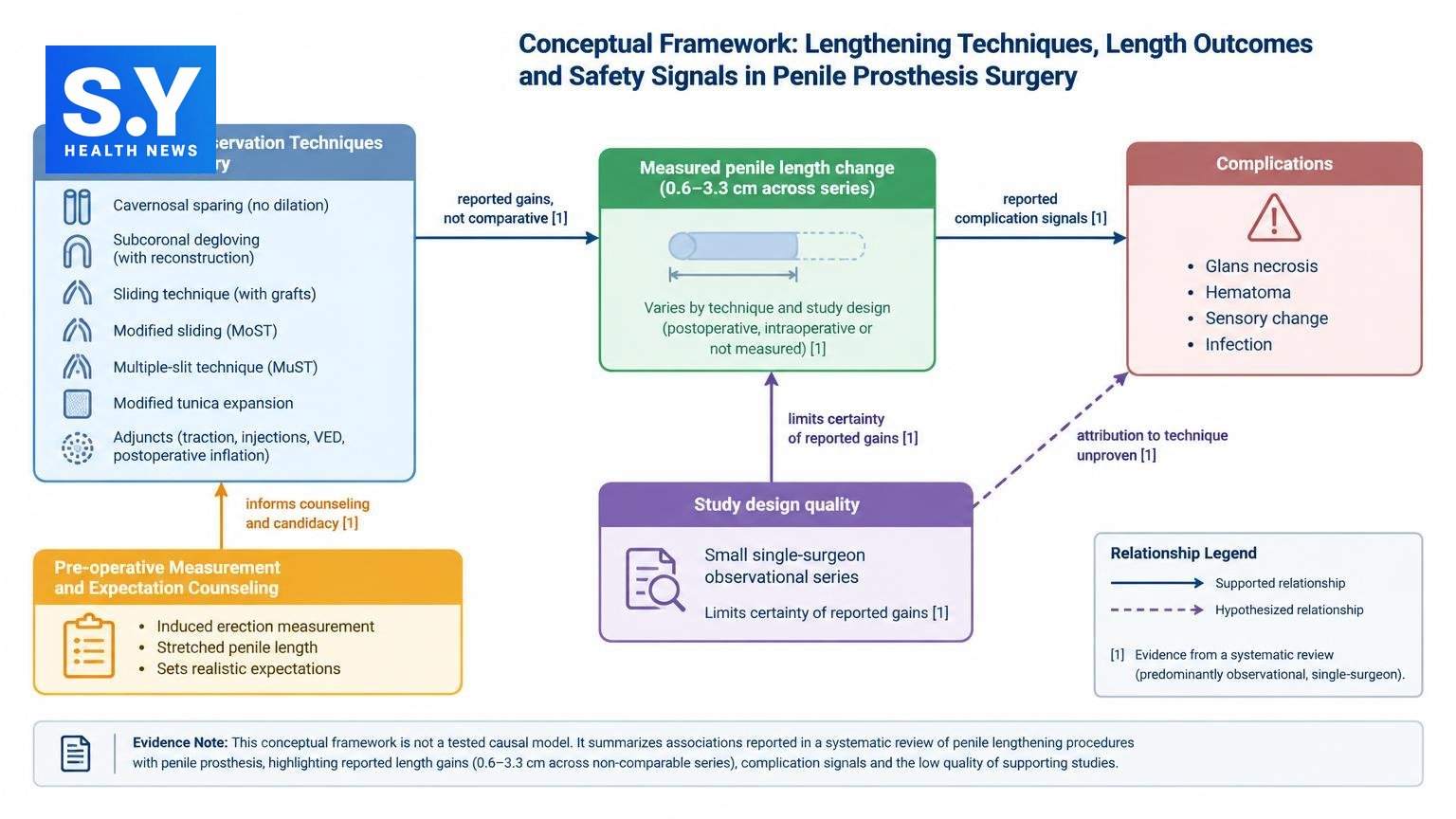
Conceptual framework: Conceptual framework, not a tested causal model. It shows how lengthening and preservation techniques used around penile prosthesis implantation relate to reported length changes (roughly 0.6 to 3.3 cm across non-comparable single-group series) and to complication signals, with study-design quality limiting certainty and pre-operative measurement informing counseling. Evidence is predominantly observational and single-surgeon.
Academic References & Evidence
SANYUN Science Center explains published research on men's reproductive and sexual health, connecting scientific evidence with everyday questions while making sources and limitations clear.
Disclaimer: This article is for scientific education and research communication only. It does not provide medical advice, diagnosis, or individualized treatment recommendations, and does not endorse any medication, supplement, device, penile enlargement procedure, or other intervention. Decisions about sexual and reproductive health should be made in consultation with a qualified healthcare professional. Do not delay seeking professional care because of information in this article.
Original Content & Copyright Notice
- This article is prepared for SANYUN Science Center, drawing on published research and publicly available academic literature on men’s sexual and reproductive health. Its editorial explanations and presentation are developed for this platform.
- Copyright in the original editorial content, selection, and arrangement is reserved by SANYUN Science Center to the extent protected by applicable law. Referenced research, quotations, and third-party materials remain subject to the rights of their respective owners. This notice does not claim ownership of scientific facts or third-party research.
- Except where permitted by applicable law or an applicable license, prior written permission is required to reproduce, republish, translate, adapt, redistribute, or commercially reuse protected content. Attribution alone does not grant permission for such reuse.
- For permitted quotation or authorized reuse, clearly identify the source and retain a link to the original article.
- Source: SANYUN Science Center
- Original URL: Retain the original article URL on science.san-yun.com.
- Copyright Holder: SANYUN Science Center, for its own protected editorial content.
- Quotation, excerpts, or authorized reuse must not distort the scientific meaning, omit material limitations or disclaimers, or imply unverified medical claims, product efficacy, or endorsement by SANYUN Science Center.



