




Category: Penis Enlargement
Core Research Direction: Evidence quality and outcomes of suspensory ligament release and combined reconstructive techniques (monsplasty, scrotoplasty) for penile length enhancement in adults with acquired buried penis, contrasted with commercial clinic claims of added flaccid length
Search Intent: For a man considering penile-lengthening surgery, what does actual published evidence show about measured length gains, the specific surgical techniques used, and how reliable the marketing claims about added centimeters really are?
Platform: SANYUN Science Center
Evidence reviewed through: 2026-11-09
Executive Summary
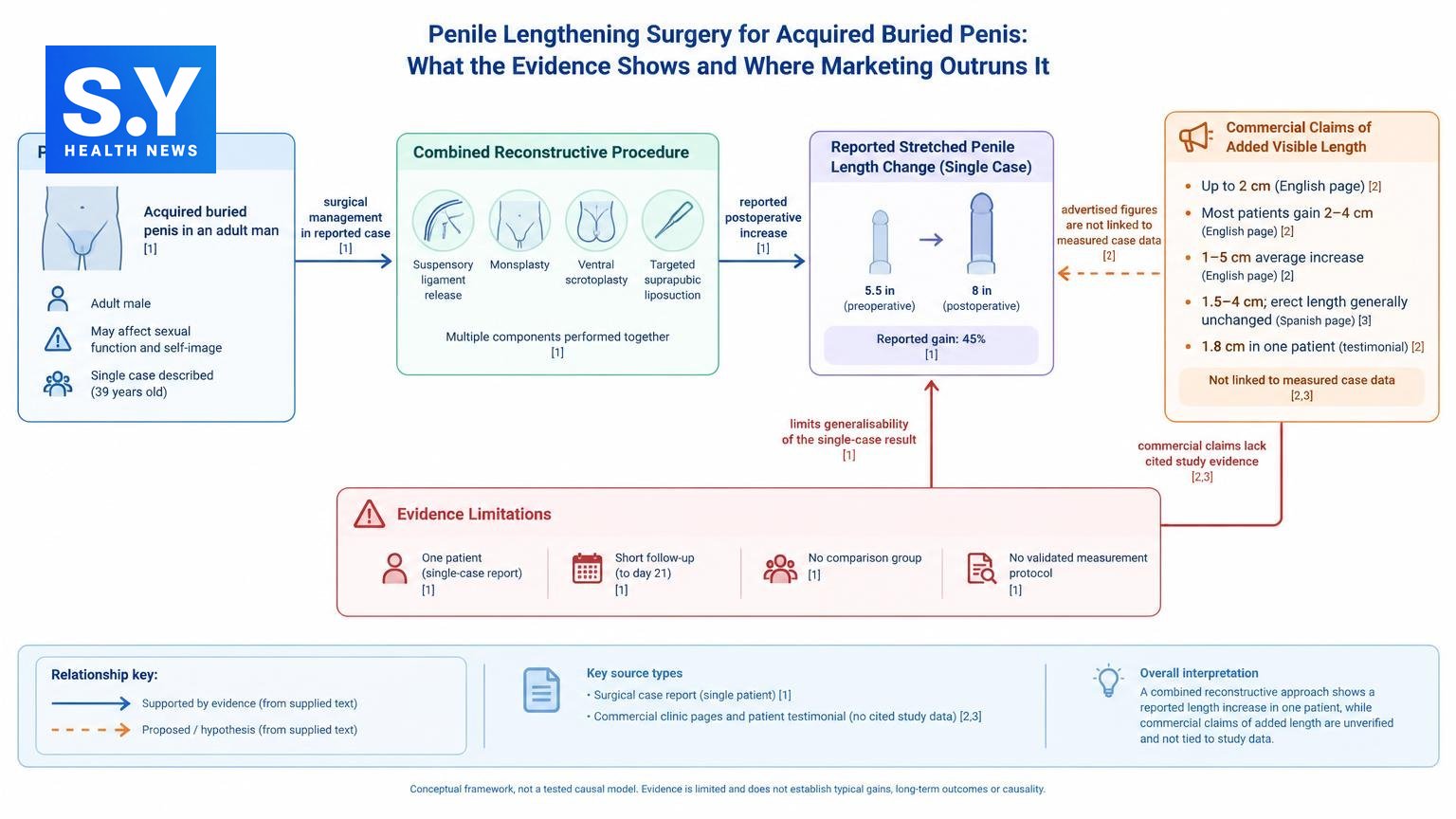
Men considering penile-lengthening surgery are often shown confident centimetre figures. The published record supplied here is far thinner. The only peer-reviewed-type surgical report available is a conference video abstract describing a single 39-year-old man with acquired buried penis whose stretched penile length was reported to rise from 5.5 inches to 8 inches after a combined procedure involving suspensory ligament release, monsplasty, ventral scrotoplasty and targeted suprapubic liposuction. That is one patient, with no comparison group and no described measurement protocol, so it cannot establish a typical gain or a causal effect of any single component.[1]
Commercial clinic pages describe suspensory ligament release as increasing visible length by allowing more of the internal shaft to extend outward. One English-language page advertises up to 2 cm of added visible length, then states most patients gain 2-4 cm of visible flaccid length, and elsewhere describes a 1-5 cm average increase. A Spanish-language version of the same provider states 1.5-4 cm and says erect length generally does not change, while the English page says erect length may improve modestly. None of these figures is tied to a cited study or patient series.[2][3]
The central problem is not that surgery for acquired buried penis is unproven in principle; it is that the evidence supplied is a single-case technique demonstration and a set of marketing pages. That combination cannot tell a man his expected gain, whether the added length is erect or only apparent when flaccid, how long it lasts, or what the complication rate is. Those questions require comparative or prospective series that are not in this packet.
Why This Matters
Acquired buried penis in adult men can significantly impair erectile and sexual function, according to background framing in the surgical abstract. When a condition affects sexual function and self-image, demand for a surgical fix is understandable, and the language around it becomes commercially valuable. That makes the gap between a one-patient video report and advertised centimetre ranges clinically relevant, because the man reading the advertisement has no way to see that the numbers behind the two statements are not comparable.
There is also a conceptual mismatch. The surgical case describes a reconstructive operation for a concealment problem: the phallus was reported to be fully exteriorized and the penopubic and penoscrotal angles re-established. The clinic pages describe a lengthening operation marketed for mild hidden penis or aesthetic enhancement. Applying outcome language from a deformity-correction case to an aesthetic consumer procedure assumes the two populations respond similarly, which the supplied evidence does not demonstrate.
Biological and Clinical Mechanism
The suspensory ligament attaches the penile shaft to the pubic bone. The proposed mechanism in the commercial description is straightforward: cutting the suspensory ligament allows a greater portion of the internal shaft to extend outward, increasing visible length. This is a plausible anatomical rationale, but it is a mechanism description from a commercial page rather than an independently evidenced finding in the supplied text. It also does not specify how much of the visible change reflects true shaft exteriorization versus skin and fat repositioning.
In the reported case, the operation was not ligament release alone. The patient underwent preoperative markings, targeted suprapubic liposuction, monsplasty, suspensory ligament release and ventral scrotoplasty. Key technical steps included identifying the fundiform and true suspensory ligaments, dissecting carefully to preserve the dorsal neurovascular bundle, and redefining the penopubic and penoscrotal junctions. Because several components were performed together, the reported length change cannot be attributed to ligament release specifically.
The abstract notes that suspensory ligament release or monsplasty have been used for length enhancement, and suggests a comprehensive combined approach may yield superior functional and aesthetic outcomes. That statement is framed as a possibility, not a tested comparison. It is a reasonable hypothesis for a reconstructive surgeon facing a buried penis with multiple contributing features, but it remains a hypothesis in this packet.
What the Evidence Shows
The surgical evidence consists of one 39-year-old man with acquired buried penis and concern over reduced penile length affecting sexual function. Postoperatively, his stretched penile length was reported to increase from 5.5 inches to 8 inches, described as a 45% gain. The phallus was reported fully exteriorized with re-established penopubic and penoscrotal angles. The Foley catheter was removed on postoperative day 1 and he was discharged on day 2. Partial staple removal occurred on day 14, with complete removal by day 21. No wound complications were observed, and the patient was satisfied with cosmetic and functional outcomes.
Those are encouraging single-case observations. They are not a measured average, a complication rate, or a durability estimate. The follow-up described extends only to staple removal at day 21, so longer-term stability of the length change is not reported. The measurement timepoint is described only as 'postoperatively,' and no validated measurement protocol is specified. The authors themselves state the report is not a clinical trial, involved human subjects with Helsinki ethics approval and informed consent; those disclosures support the report's conduct but do not convert one case into comparative evidence.
| Source type | Reported length figure | Population or basis | Key limitation |
|---|---|---|---|
| Single-case surgical video abstract | Stretched penile length from 5.5 to 8 inches, a reported 45% gain | One 39-year-old man with acquired buried penis after combined ligament release, monsplasty and scrotoplasty | Single patient; no comparison group; no validated measurement protocol or long follow-up |
| Commercial clinic page, English | Up to 2 cm of added visible length | Advertised claim; no study or dataset cited | Marketing statement without cited evidence |
| Commercial clinic page, English | Most patients gain 2-4 cm of visible flaccid length | Advertised claim; no study or dataset cited | Conflicts with the same page's up to 2 cm and 1-5 cm figures |
| Commercial clinic page, English | 1-5 cm average penile length increase | Advertised claim; no study or dataset cited | Conflicts with two other gain figures on the same page |
| Commercial clinic page, Spanish | 1.5-4 cm flaccid length gain; erect length generally unchanged | Advertised claim; no study or dataset cited | Differs from English version on gain range and on erect length |
| Commercial clinic page, patient testimonial | 1.8 cm visible gain in one quoted patient | One unnamed 38-year-old man; anecdote on a commercial site | Unverified; no measurement method or follow-up stated |
The table makes the evidential asymmetry visible. The only measured figure tied to a described patient comes from a reconstructive case with multiple simultaneous procedures. Every centimetre range in the commercial material is an assertion about an unspecified population. Two of those assertions appear on the same page and disagree with each other, and the Spanish version disagrees with the English version on both the flaccid range and whether erect length changes. That internal inconsistency is itself a warning about how much weight the figures can bear.
Interpretation and Limitations
The most defensible reading is that a combined reconstructive approach can produce a substantial reported stretched-length increase in a man whose penis is concealed by acquired buried penis anatomy. The case report explicitly concludes that the combination of suspensory ligament release, monsplasty and ventral scrotoplasty provides an effective surgical solution for patients with acquired buried penis. That conclusion is stated broadly, yet it rests on one patient and no comparative data; it should be read as the authors' impression from a technique demonstration, not as an established generalizable effect.
Several limitations matter for interpretation. Stretched penile length is a clinical measurement, and the report does not describe who measured, with what technique, at what timepoint, or whether measurement was repeated. The absence of a comparison group means regression to the mean, concurrent liposuction and monsplasty, and postoperative tissue changes cannot be separated from any ligament-release effect. The short reported follow-up to day 21 leaves durability, scar contracture, sensory change and later complications unaddressed. The abstract reports no wound complications, but a single patient cannot yield a meaningful complication rate.
The commercial material has a different problem: it is not a study at all. It advertises up to 2 cm of added visible length through suspensory ligament release combined with V-Y skin plasty, and reports a 90-minute procedure time for standard lengthening with V-Y plasty. Those operational details may be accurate for that provider, but they are provider-reported service information, not research findings. The claim that modern techniques do not significantly affect erection angle, while older procedures sometimes caused a downward angle, is asserted without cited supporting data and sits awkwardly with the basic premise of cutting a ligament that supports the shaft.
The claim that results are permanent provided the patient consistently uses a penile extender during the first three months of recovery is also unsourced. It introduces an adjunct device as a condition of durability without presenting data on either the device or the surgery. For a reader trying to weigh a surgical decision, the practical consequence is that the commercial pages cannot answer the questions that matter most: expected erect and flaccid change, persistence over years, effect on sensation and erection quality, and reoperation or complication rates.
Research Outlook
What the field needs is not another technique video but prospective series with standardized stretched and erect length measurement, defined follow-up intervals, validated sexual function and satisfaction instruments, and transparent complication reporting. Comparative designs would help separate the contributions of ligament release, monsplasty, liposuction and scrotoplasty, and would clarify whether outcomes in acquired buried penis generalize to men seeking aesthetic enhancement. Until such data exist, the honest position is that the combined reconstructive approach is plausible and supported by a favorable single case, while advertised centimetre gains for aesthetic lengthening remain unverified marketing claims.
Key Takeaways
- The only measured surgical outcome in this packet is a single case: stretched penile length rose from 5.5 to 8 inches after combined ligament release, monsplasty, liposuction and scrotoplasty in a 39-year-old man with acquired buried penis.
- That case cannot establish a typical gain, a causal effect of ligament release alone, or long-term durability; reported follow-up extended only to day 21 and no measurement protocol was described.
- Commercial clinic pages advertise up to 2 cm, 2-4 cm, 1-5 cm and 1.5-4 cm depending on the page and language, with no cited study; the figures conflict with each other.
- Claims about preserved erection angle and permanence contingent on three months of extender use are unsourced marketing assertions, not evidence-backed outcomes.
- Men considering surgery should treat advertised centimetre gains as unverified and ask for measured, time-defined outcomes and complication data rather than testimonials.
Questions and Answers
What is suspensory ligament release in penile lengthening surgery?
It is a surgical step in which the suspensory ligament attaching the penile shaft to the pubic bone is cut, with the proposed aim of allowing more of the internal shaft to extend outward. The rationale is described on a commercial clinic page rather than demonstrated in a controlled study, and in the reported case it was combined with monsplasty, scrotoplasty and liposuction.
What length gain was reported after combined surgery for acquired buried penis?
In a single 39-year-old man with acquired buried penis, stretched penile length was reported to increase from 5.5 inches to 8 inches postoperatively, described as a 45% gain. This is one patient in a technique video abstract, with no comparison group and no detailed measurement protocol, so it is not a typical or expected result.
How strong is the evidence for penile lengthening surgery?
The supplied evidence is weak for estimating outcomes. It consists of a single-case surgical video abstract and commercial clinic webpages. There is no comparative trial, no prospective series and no cited dataset behind the advertised centimetre ranges. The case report itself states it is not a clinical trial, which limits any generalisation from its favorable result.
Do the advertised centimetre gains for penile lengthening apply to all men?
No. The advertised figures come from commercial pages without a defined population, and they disagree with each other: up to 2 cm, 2-4 cm, 1-5 cm and 1.5-4 cm appear across the provider's pages and languages. The single reported case involved a man with acquired buried penis and multiple combined procedures, so neither the case nor the advertisements establish a gain applicable to men generally.
What are the limitations and risks of the evidence on ligament release for length?
Key limitations are the single patient, short reported follow-up to day 21, unspecified measurement timing and technique, and multiple simultaneous procedures that prevent attribution to ligament release alone. Commercial claims about unchanged erection angle and permanence with three months of extender use are unsourced. A single case cannot provide a complication rate or durability estimate.
What should a man ask before considering penile lengthening surgery?
He should ask for measured outcomes with defined timepoints, whether gains are erect or flaccid, complication and reoperation rates, and evidence beyond testimonials. Advertised centimetre ranges that conflict across pages should be treated as unverified. The published case supports a combined reconstructive approach for acquired buried penis in principle, but it cannot predict an individual's result.
Conceptual framework: Conceptual framework, not a tested causal model. It shows the single reported case linking combined reconstructive surgery to a measured stretched-length change, alongside commercial claims of added visible length that are not tied to cited study data. Population context is one adult with acquired buried penis; commercial figures describe no defined population. Relations marked as proposed indicate unverified marketing associations. Key limitation: one patient, short follow-up and no comparison group.
Academic References & Evidence
- Almidani O; Al Homsi A; Rowaiee R; Cherubino M; Raheem O. Double Plasty for Penile Length Enhancement: Suspensory Ligament Release, Monsplasty, and Scrotoplasty in a Patient with Acquired Buried Penis. 2026
- Noppon Arunkajohnsak. Penile Lengthening Surgery Bangkok – Menscape Clinic.
- Noppon Arunkajohnsak. Cirugía de Alargamiento de Pene en Bangkok | Menscape Clinic.
SANYUN Science Center explains published research on men's reproductive and sexual health, connecting scientific evidence with everyday questions while making sources and limitations clear.
Disclaimer: This article is for scientific education and research communication only. It does not provide medical advice, diagnosis, or individualized treatment recommendations, and does not endorse any medication, supplement, device, penile enlargement procedure, or other intervention. Decisions about sexual and reproductive health should be made in consultation with a qualified healthcare professional. Do not delay seeking professional care because of information in this article.
Original Content & Copyright Notice
- This article is prepared for SANYUN Science Center, drawing on published research and publicly available academic literature on men’s sexual and reproductive health. Its editorial explanations and presentation are developed for this platform.
- Copyright in the original editorial content, selection, and arrangement is reserved by SANYUN Science Center to the extent protected by applicable law. Referenced research, quotations, and third-party materials remain subject to the rights of their respective owners. This notice does not claim ownership of scientific facts or third-party research.
- Except where permitted by applicable law or an applicable license, prior written permission is required to reproduce, republish, translate, adapt, redistribute, or commercially reuse protected content. Attribution alone does not grant permission for such reuse.
- For permitted quotation or authorized reuse, clearly identify the source and retain a link to the original article.
- Source: SANYUN Science Center
- Original URL: Retain the original article URL on science.san-yun.com.
- Copyright Holder: SANYUN Science Center, for its own protected editorial content.
- Quotation, excerpts, or authorized reuse must not distort the scientific meaning, omit material limitations or disclaimers, or imply unverified medical claims, product efficacy, or endorsement by SANYUN Science Center.



