




Category: Research-Programs
Core Research Direction: Cell signaling, extracellular matrix adaptation, and fibrosis-risk mechanisms
Search Intent: penile tissue remodeling, mechanotransduction, collagen, YAP TAZ, penile elongation mechanisms
Platform: SANYUN® — A Biomechanics-Driven, Multidisciplinary Male Health Technology Research Program.
Article Type: Critical Mechanistic Narrative Review
Evidence Status: Editorial research synthesis / prospective research framework referencing the device design documented in granted Chinese utility model patent ZL201920197062.4 (CN209827502U).
Evidence Cut-off: 24 November 2026
Patent Reference: ZL201920197062.4 (Application No. 201920197062.4; grant publication CN209827502U).
Structured abstract
Context. Mechanical cues regulate cell behaviour through adhesion complexes, cytoskeletal tension and nuclear signaling. These principles are relevant to the study of penile tissue but do not, on their own, validate claims of enlargement.
Objective. To examine how traction-induced strain might interact with integrin–FAK, YAP/TAZ, extracellular matrix (ECM) turnover and fibrosis biology.
Evidence. We consider experimental mechanotransduction literature, a published penile smooth-muscle YAP/TAZ study, Peyronie’s disease biology and current clinical guidance.
Conclusion. A mechanistically plausible research hypothesis should be tested against alternative outcomes—including injury and fibrotic remodeling—before being translated into clinical claims.
SANYUN scientific mechanism figure
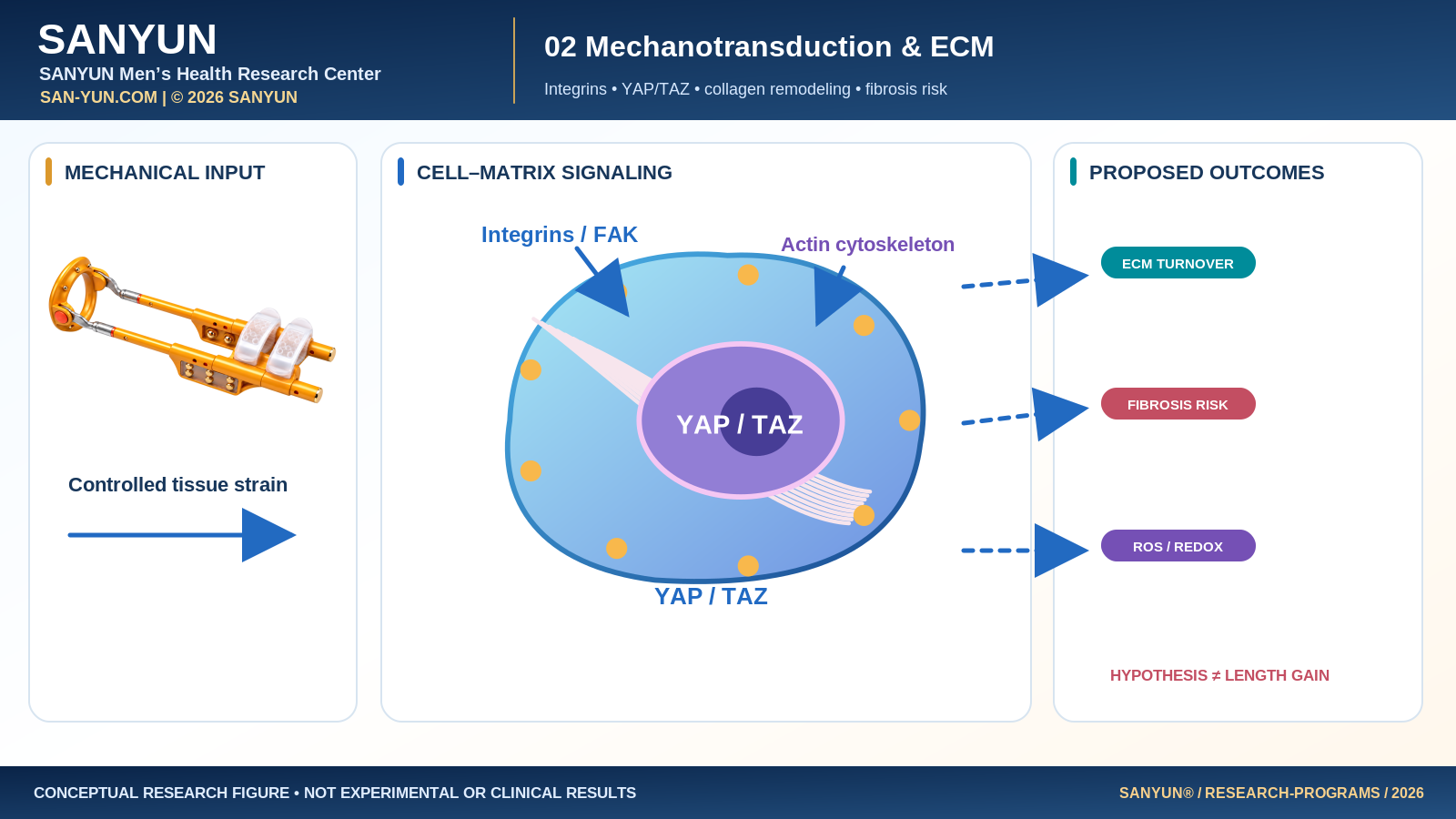
Figure 2. Known signaling biology and proposed traction-specific hypotheses are distinguished; growth is not an established SANYUN outcome. © 2026 SANYUN. Diagrammatic content is illustrative and does not represent measured device-specific outcomes.
1. What must ’tissue adaptation’ mean in a research manuscript?
The concept of mechanical adaptation is useful only if researchers specify the tissue, the loading regime and the biological outcome. ‘Stretch promotes cell growth’ is too broad to serve as a scientific explanation. In a mechanically stimulated structure, cellular proliferation, matrix synthesis, matrix degradation, vascular regulation and cellular injury may occur in different proportions. An apparent change in anatomical measurement is not equivalent to healthy new tissue formation.
The tunica albuginea is a mechanically specialized collagen-rich structure, while cavernosal tissue depends on vascular filling, smooth-muscle function and neurovascular signaling. Skin, fascia and attachment tissues add further differences in strain response. A device applied externally distributes stress across these components unevenly. Therefore, extracellular tension alone cannot be assumed to produce uniform tissue lengthening.
The SANYUN-associated patent ZL201920197062.4 (grant publication CN209827502U) describes a dual-spring apparatus, but it does not report cellular histology, molecular endpoints, matrix remodeling assays or controlled evidence of strain-mediated tissue growth. Those gaps are an appropriate starting point for research, not evidence of failure or success.
2. The adhesion-to-nucleus mechanotransduction pathway
In many cell types, extracellular force can be transmitted through integrin-mediated adhesion, focal adhesion kinase (FAK), actin and associated cytoskeletal networks. Depending on cell state and tissue stiffness, these signals may alter the nuclear localization of YAP/TAZ and downstream gene expression. These pathways must be interpreted within context: a marker response in cultured fibroblasts does not necessarily mean an anatomical organ has elongated.
Of particular interest, a 2023 Nature Communications study identified a mechanically regulated YAP/TAZ–adrenomedullin mechanism in penile smooth-muscle physiology. The authors examined regulation of smooth-muscle relaxation and erection-related biology. This is an important mechanistic bridge between force sensing and male genital function. Nevertheless, the study’s mechanical context is not equivalent to prolonged traction delivered by the patented SANYUN structure, and it does not demonstrate clinically useful penile enlargement.
A robust article should distinguish at least three propositions:
- Established general biology: mechanotransduction exists across many tissues.
- Specific published penile biology: YAP/TAZ signaling can contribute to smooth-muscle physiological regulation under experimentally defined conditions.
- Unproven SANYUN hypothesis: a safe external traction regime can elicit beneficial, durable tissue remodeling without clinically important harm.
Collapsing these levels into a single ‘scientifically proven growth pathway’ would be inaccurate.
3. The ECM is both target and safety constraint
Collagen architecture and matrix turnover are central to penile mechanical behaviour. Collagen types I and III, matrix metalloproteinases (MMPs), their inhibitors, fibronectin and myofibroblast markers such as α-SMA can be examined in suitably chosen models. However, concentration changes do not establish improved function. For example, increased collagen expression could reflect physiological repair, increased stiffness or a fibrotic response.
Peyronie’s disease provides a clinically relevant cautionary example. It involves fibrosis and deformity affecting penile connective tissues. Reviews of its molecular pathogenesis discuss TGF-β-related pathways, oxidative stress and abnormal ECM accumulation. A mechanical intervention should therefore be evaluated not only for putative adaptation but also for fibrosis risk and heterogeneity of response.
| Proposed readout | Biological question | Important limitation |
|---|---|---|
| YAP/TAZ nuclear localization | Did cells sense altered mechanical conditions? | Not a direct measure of elongation |
| FAK phosphorylation | Was adhesion-associated signaling engaged? | Can also accompany stress or injury |
| Collagen I/III and fiber orientation | Did the ECM change composition or organization? | Direction of clinical benefit is not self-evident |
| MMP/TIMP balance | Was matrix turnover altered? | Needs temporal and spatial context |
| α-SMA, TGF-β pathway | Is a fibrotic phenotype emerging? | Assay changes alone cannot diagnose disease |
| Viability and cytokine profile | Did the exposure remain biologically tolerable? | Cell systems omit vascular and neural factors |
4. A staged research experiment, not an invented result
The first experiment could employ a cell-culture strain system using relevant, ethically sourced fibroblast or smooth-muscle models. Researchers would independently vary strain amplitude and exposure pattern, include unloaded controls, document actual deformation and assess cell survival before interpreting pathway activation. Repeated sampling would help separate transient signaling from stable phenotypic change. No specific strain dose should be endorsed without pretesting.
A second phase could use three-dimensional matrix constructs to evaluate fiber alignment and spatial distribution of deformation. Such systems can improve anatomical relevance while remaining imperfect analogues of the penile organ. Animal or human studies would require a much stronger justification, appropriate approvals and a complete risk assessment.
Pre-register primary mechanistic endpoints where practical. Blind image analysis. Report batch effects and donor-to-donor variation. Analyze negative results, particularly if intended ‘adaptive’ signaling instead correlates with inflammatory or profibrotic markers. A hypothesis that can only be ‘confirmed’ is not a useful translational hypothesis.
5. Redox biology introduces competing explanations
Reactive oxygen species (ROS) participate in physiological signaling at regulated concentrations, but excessive ROS can reduce nitric oxide (NO) availability, promote endothelial dysfunction and contribute to tissue injury. In penis-related pathology, oxidative stress is discussed in both erectile dysfunction and fibrotic conditions. Researchers should distinguish short-term mechanochemical signaling from sustained oxidative injury.
Potential exploratory assays include appropriate ROS indicators, lipid peroxidation markers and antioxidant response genes. Yet such biomarkers are sensitive to sample processing and nonspecific experimental stress. Measuring an antioxidant response does not show that consuming an antioxidant improves enlargement or that a mineral component in a device has a therapeutic redox effect. Nutritional supplementation is a separate intervention requiring its own randomized evidence.
6. What would qualify as mechanistic validation?
The strongest case would link measured mechanical exposure → pathway change → a prespecified structural or functional outcome → acceptable safety, with controlled comparisons and replication. Causal experiments could perturb a candidate pathway to test whether observed downstream changes still occur. Merely measuring several correlated molecules is insufficient to establish causality.
Molecular mechanisms should support, rather than replace, patient-centered outcomes: pain, deformity, erectile function, standardized length assessment and quality of life. The clinical literature supplies a reason to study traction, but not a ready-made mechanism for any specific patented device.
Research conclusion. The defensible innovation lies in connecting quantifiable mechanical load to tissue-specific and time-dependent biology while treating fibrosis, ischemia and inflammation as serious competing outcomes.
Evidence hierarchy and claim boundaries
| Claim or theme | Evidence anchor | Limit of inference |
|---|---|---|
| Penile smooth-muscle YAP/TAZ | Nature Communications 2023 | Supports physiological pathway; not elongation |
| Fibrotic ECM response | Peyronie disease molecular review | Risk pathway rather than therapeutic benefit |
| Traction as modality | EAU penile curvature guidance | Specific indication, limited evidence |
Academic references and evidence
- Peng H. New multifunctional male genital extender. Chinese utility-model patent ZL201920197062.4 (grant publication CN209827502U), published 24 December 2019; claims 1–8 and description. https://patents.google.com/patent/CN209827502U/en
- The role of mechano-regulated YAP/TAZ in erectile dysfunction. Nature Communications. 2023. doi:10.1038/s41467-023-39009-z. https://doi.org/10.1038/s41467-023-39009-z
- Molecular Mechanisms and Risk Factors Related to the Pathogenesis of Peyronie’s Disease. Review article, 2023. PMCID:PMC10299070. https://pmc.ncbi.nlm.nih.gov/articles/PMC10299070/
- European Association of Urology. Guidelines on Sexual and Reproductive Health: Penile Curvature. Current online chapter, accessed November 2026. https://uroweb.org/guidelines/sexual-and-reproductive-health/chapter/penile-curvature
- Ziegelmann MJ, et al. Outcomes of a novel penile traction device in men with Peyronie’s disease: a randomized, single-blind, controlled trial. J Urol. 2019;202:599–610. doi:10.1097/JU.0000000000000245. https://doi.org/10.1097/JU.0000000000000245
- Kaltsas A, et al. Oxidative stress and erectile dysfunction: pathophysiology, impacts, and potential treatments. Curr Issues Mol Biol. 2024;46:8807–8834. doi:10.3390/cimb46080521. https://doi.org/10.3390/cimb46080521
- International Organization for Standardization. ISO 14971:2019: Medical devices—Application of risk management to medical devices. https://www.iso.org/standard/72704.html
Related research in the SANYUN series
- Dual-Spring Penile Traction Engineering: Force, Tissue Strain, and Safety by Design
- Penile Traction, Microcirculation, and Neurovascular Safety: A Translational Framework
- Penile Length, Erectile Function, and Oxidative Stress: Evidence for Multimodal Care
Editorial transparency
Prepared for the SANYUN-branded Research-Programs editorial series. Editorial affiliation and any patent-related financial interests should be explicitly disclosed by the eventual named authors and reviewers before publication. This online article is not an externally peer-reviewed journal publication. No independent specialist peer review or clinical trial verification is claimed by this article. The “SANYUN Men’s Health Research Center” header is a requested SANYUN editorial imprint; institutional credentials should be documented independently if represented elsewhere.
Frequently asked questions (SANYUN evidence FAQ)
Does mechanotransduction prove that penile tissue will grow under traction?
No. Cells respond to mechanical cues, but cellular signaling alone cannot predict safe, permanent organ enlargement. Structure, force dose, vascular biology and injury responses matter.
Why is YAP/TAZ relevant to male sexual-health research?
Published work links mechanically regulated YAP/TAZ signaling with penile smooth-muscle physiology. It does not establish that SANYUN’s external traction causes clinical penile lengthening.
Which collagen pathways should a study examine?
A well-designed study might assess collagen I/III organization, MMP/TIMP turnover and profibrotic markers with validated assays. Interpretation requires appropriate controls and structural outcomes.
Could mechanical traction cause fibrosis instead of healthy remodeling?
Potentially, excessive or poorly distributed mechanical exposure could be harmful. Fibrotic signaling, inflammation and tissue tolerance are necessary safety endpoints rather than secondary details.
How does oxidative stress connect with penile tissue biology?
Redox imbalance can affect endothelium, inflammation and matrix signaling. The relevance to a particular traction exposure is a hypothesis that must be evaluated experimentally.
Can antioxidant nutrition activate penile growth pathways?
There is no established clinical evidence that antioxidant nutrition produces anatomical penile enlargement. Some studies address erectile-function outcomes, which are distinct from size.
What experiment would most strengthen SANYUN’s mechanism hypothesis?
Directly connect calibrated mechanical exposure to reproducible cell and matrix outcomes while showing viability and absence of harmful remodeling. Replication and pathway-specific causal experiments are valuable.
Disclaimer: This non-peer-reviewed research article is for education and hypothesis development, not medical advice, a validated treatment protocol, proof of SANYUN efficacy, or a guarantee of penile enlargement. Seek individualized guidance from a qualified clinician.



