




Category: Erectile Dysfunction
Core Research Direction: Synthesizing the current evidence base for erectile dysfunction treatment — including surgical outcomes of penile prosthesis implantation, the quality of meta-analytic evidence across pharmacological and non-pharmacological interventions, and the prognostic link between ED and cardiovascular disease — while explicitly flagging evidence-quality limitations.
Search Intent: How strong is the evidence behind current erectile dysfunction treatments, and what do penile prosthesis outcomes and cardiovascular risk associations add to the clinical picture?
Platform: SANYUN Science Center
Evidence reviewed through: 2026-11-23
Executive Summary
Erectile dysfunction sits at an unusual point in urology: a large treatment menu, broad guideline endorsement of shared decision-making, and a surprisingly thin high-certainty evidence base underneath it. Two literatures help clarify the position. The first is device surgery. A ten-year single-center series of penile prosthesis implantation reported 549 men and 576 placements between 2008 and 2018, an early prosthetic infection rate of 6.1%, an explant rate of 3.1%, patient satisfaction of 82.0% and partner satisfaction of 88.3%. The second is evidence synthesis. A 2026 umbrella review extracted 23 published meta-analyses covering 42 summary effects across 36 interventions and rated 13 (56.5%) of those meta-analyses critically low quality on AMSTAR-2, with only one (4.3%) high quality.[1][2]
Those two findings are not in conflict; they describe different kinds of knowledge. The prosthesis series is detailed but observational, single-center and retrospective, so it can support associations rather than causal claims about risk factors. The umbrella review is broad but shows that the reviews feeding into it were mostly weak, that statistically significant improvement was seen with both pharmacological and non-pharmacological interventions, and that the authors themselves caution interpretation because of limited patient numbers and subjective outcome measures. A third strand, the prognostic association between ED and cardiovascular disease, adds clinical weight without resolving treatment uncertainty.
Why This Matters
Erectile dysfunction is common, highly treatable in the short term, and clinically informative beyond the bedroom. When a man presents with ED, the consultation is also an opportunity to examine vascular risk, medication effects, hormonal status and sleep. If the treatment evidence base is weaker than the size of the market suggests, that matters for counseling: patients are entitled to know whether a recommendation rests on a high-quality head-to-head comparison or on small trials with subjective endpoints and, in some areas, industry funding.
Penile prosthesis surgery occupies the end of the treatment pathway for men whose ED is refractory, including post-prostatectomy and priapism-related cases according to a single-center review abstract. For those men, device outcomes are not an academic question. Infection, explantation and satisfaction are the outcomes that determine whether an irreversible operation was worth it. The distinction between statistical association and clinical meaning is central to reading that literature well.[3]
Biological and Clinical Mechanism
An erection is a vascular event coordinated by nerves, endothelium and smooth muscle. The mechanistic link between ED and cardiovascular disease is usually framed around vessel caliber: the penile arteries are small, so atherosclerotic and endothelial dysfunction may produce symptoms there before they become clinically apparent in larger coronary vessels. This is a plausible and widely used explanatory model rather than a proven sequence in every patient, and the supporting epidemiological evidence is observational.[4]
Prosthesis surgery addresses the mechanical endpoint rather than the underlying vascular or neurological cause. A fluid-filled cylinder pair replaces the erectile bodies' function, and infection is the dominant device-specific hazard because it can require removal of the implant. That is why a series reporting a 6.1% early infection rate and a 3.1% explant rate is clinically meaningful: the gap between those figures indicates that most early infections in that cohort did not lead to explantation, although the supplied report does not explain how the remainder were managed.
What the Prosthesis Series Shows
The ten-year experience identified 549 men who underwent 576 prosthesis placements between 2008 and 2018 at a tertiary referral center. Early prosthetic infection occurred in 35 cases, or 6.1%, with an explant rate of 3.1%. Satisfaction was high by the study's own measure: 82.0% of patients described themselves as satisfied, and partner satisfaction was 88.3%. The supplied text does not name a standardized satisfaction instrument, so these percentages should be read as program-level patient-reported outcomes rather than validated questionnaire scores.
Univariate analysis linked diabetes, longer operative time and reinterventions to early infection, with postoperative ciprofloxacin inversely associated with it. Use of a rifampin/gentamicin-coated three-piece inflatable prosthesis was associated with higher early infection risk. On multivariate analysis, diabetes, redo surgery and the coated three-piece device each carried roughly a two-fold higher risk of early prosthetic infection. The authors also developed a predictive nomogram and stated that it needs further validation before use in preoperative counseling.
The coated-device finding is the one most likely to be misread. An association between a coated implant and higher infection risk may reflect confounding by indication: surgeons plausibly select coated devices for patients they already judge to be at higher risk, such as those with diabetes or prior surgery. The report notes the higher infection rates occurred without an increased risk of prosthesis explantation. The authors' own conclusion that the nomogram requires validation signals that the model is a hypothesis-generating tool at this stage, not a decision rule ready for routine use.
| Variable | What the source reports | How to interpret it |
|---|---|---|
| Cohort size | 549 men; 576 prosthesis placements, 2008–2018 | Single tertiary referral center; retrospective design |
| Early prosthetic infection | 35 cases (6.1%); explant rate 3.1% | Infection did not always require explantation in this cohort |
| Satisfaction | Patients 82.0%; partners 88.3% | Instrument not specified in supplied text |
| Univariate risk signals | Diabetes (P = 0.012), operative time (P = 0.032), reinterventions (P = 0.048), postoperative ciprofloxacin inverse (P = 0.014), coated 3-piece device (P = 0.019) | Observational associations; causality not established |
| Adjusted risk | About two-fold higher infection risk for diabetes, redo surgery or coated 3-piece device (all P < 0.03) | Possible confounding by indication for device type |
How Strong Is the Treatment Evidence Overall?
The 2026 umbrella review is the most direct available answer. It searched to October 2025, identified 1191 studies, extracted 23 published meta-analyses and derived 42 summary effects on the IIEF, IIEF-5, IIEF-EF and erectile hardness score across 36 interventions. The quality distribution is the headline: 13 meta-analyses (56.5%) critically low, 7 (30.5%) low, 2 (8.7%) moderate and 1 (4.3%) high. At the level of individual summary effects, 47.6% (n = 20) were low quality and 47.6% (n = 20) very low, with only two effects rated high and moderate respectively.
The review's overall conclusion is that the evidence base for ED treatments is predominantly of low or very low quality. Statistically significant improvements were seen with both pharmacological and non-pharmacological interventions, but the authors urge caution because of limited patient numbers and the subjective nature of outcome indicators. The authors recommend further well-designed single-treatment studies and high-quality intertreatment comparisons. That last point is important: the literature is heavy on placebo comparisons and light on head-to-head questions that patients actually ask, such as which option works better for a given man.
The Cardiovascular Prognostic Signal
Separate from treatment efficacy, ED behaves as a marker of cardiovascular risk. A secondary physician-authored guide reports a 2021 umbrella review of systematic reviews and meta-analyses finding higher relative risks in men with ED for cardiovascular disease (RR 1.45, 95% CI 1.36–1.54), coronary heart disease (RR 1.50), cardiovascular mortality (RR 1.50), myocardial infarction (RR 1.55), stroke (RR 1.36) and all-cause mortality (RR 1.25). These are observational associations from pooled cohorts, not proof that ED causes cardiac events, and the original review is not part of the supplied source set.
The same guide notes that the 2024 Princeton IV consensus advises treating men with ED as at risk for cardiac events until proven otherwise, and that a 2018 urology guideline frames treatment selection through shared decision-making rather than a fixed stepwise ladder. For clinical reading, the practical implication is not that every man with ED needs a cardiology referral, but that new-onset ED in a man with vascular risk factors deserves blood pressure, glucose and lipid assessment as part of the ED consultation.
Adjacent Evidence Worth Weighing Carefully
Several other findings in the secondary guide illustrate the same theme of statistical signal versus clinical certainty. A 2025 Cochrane review of 21 randomized trials involving 1,357 men reported that low-intensity shockwave therapy may improve IIEF-EF scores by roughly 3.9 points short term and 5.3 points long term versus sham, rated low certainty, with several trials industry-funded. A 2023 meta-analysis of 8 studies and 457 patients reported higher post-treatment IIEF-5 scores with sildenafil than with CPAP (37.7 versus 27.3), while a 2021 Cochrane review rated CPAP-versus-no-CPAP evidence as very uncertain. Point differences of this size matter only alongside a minimal clinically important difference and a low-certainty rating.
Two pharmacological safety datasets deserve mention without overreach. A 2024 TriNetX analysis of 3,094 non-diabetic, non-hypogonadal men aged 18–50 reported higher rates of new ED diagnosis or PDE5 inhibitor prescription (1.47% versus 0.32%) and testosterone deficiency (1.53% versus 0.80%) among semaglutide users than matched non-users; absolute rates were low and database analysis cannot establish causation. A 2025 analysis of 53,517 FDA Adverse Event Reporting System reports found labeled side effects for all four PDE5 inhibitors plus unlisted nervous-system, cardiovascular and eye signals needing further study; spontaneous reporting cannot establish incidence.
Interpretation and Limitations
Three limitations shape how much weight this review can carry. First, the prosthesis data come from one tertiary center, so case mix, surgical volume and infection-control practice may differ from other settings, and the retrospective design cannot establish causation for diabetes, operative time or device coating. Second, the umbrella review's quality ratings describe the included reviews, not the individual trials, and the supplied text is a dataset abstract without the full effect estimates. Third, the cardiovascular relative risks and several adjacent findings are reported secondhand in a physician-authored educational guide, so the primary papers should be consulted before those numbers are quoted in clinical materials.
A further limitation is outcome selection. The umbrella review used IIEF-family scores and the erectile hardness score, which are validated but subjective; the prosthesis series used patient and partner satisfaction without a named instrument. Neither captures the full range of what men care about, such as spontaneity, reliability, partner experience over years, or regret after irreversible surgery. The evidence base is therefore not only statistically uncertain but also partially misaligned with the decisions patients face.
Research Outlook
The clearest research priority is comparative rather than additive. More placebo-controlled trials of single interventions will not answer the question men ask at the point of care, which is how options compare with each other for defined patient groups. The umbrella review authors make essentially this recommendation. For device surgery, prospective multicenter registries with standardized infection definitions and validated satisfaction and regret instruments would let clinicians counsel with better numbers than a single-center retrospective series can supply, and would allow external validation of the proposed infection nomogram.
On the cardiovascular side, the open question is whether identifying ED as a risk marker changes outcomes when acted upon. The association is well replicated at the level of pooled relative risks, but whether systematic cardiovascular screening at ED presentation reduces events is a separate empirical question that the current source set does not answer. Until then, the reasonable position is to treat ED as clinically informative and to communicate the uncertainty honestly.
Key Takeaways
- In a single-center ten-year series, 549 men underwent 576 penile prosthesis placements; early prosthetic infection occurred in 6.1% and explantation in 3.1%.
- Patient satisfaction was 82.0% and partner satisfaction 88.3%, measured without a named standardized instrument in the supplied text.
- Diabetes, redo surgery and use of a coated three-piece inflatable device were each associated with roughly two-fold higher early infection risk on multivariate analysis; device selection may be confounded by indication.
- A 2026 umbrella review of 23 meta-analyses and 42 summary effects found 56.5% of meta-analyses critically low quality and only 4.3% high quality, concluding the ED treatment evidence base is predominantly low or very low quality.
- ED is associated with higher relative risks of cardiovascular disease, coronary heart disease, myocardial infarction, stroke and mortality in pooled observational data reported secondhand, which supports risk assessment but not causal claims.
Questions and Answers
What does the ten-year penile prosthesis series show about infection and satisfaction?
The series followed 549 men and 576 placements from 2008 to 2018. Early prosthetic infection occurred in 35 cases (6.1%) and the explant rate was 3.1%. Patient satisfaction was 82.0% and partner satisfaction 88.3%. These are retrospective, single-center figures, and the supplied text does not name the satisfaction instrument, so they describe one center's experience rather than a benchmark.
Which factors were linked to early penile prosthesis infection?
Diabetes, longer operative time and reinterventions were associated with early infection, while postoperative ciprofloxacin was inversely associated. Use of a rifampin/gentamicin-coated three-piece inflatable prosthesis was also associated with higher infection risk. On multivariate analysis, diabetes, redo surgery and the coated device each carried roughly two-fold higher risk. These are observational associations; device selection may be confounded by indication, and the nomogram requires validation.
How strong is the evidence behind current erectile dysfunction treatments?
A 2026 umbrella review of 23 meta-analyses and 42 summary effects found the evidence predominantly low or very low quality: 56.5% of meta-analyses were critically low on AMSTAR-2 and only 4.3% high quality. Statistically significant improvements were seen with pharmacological and non-pharmacological interventions, but the authors caution that patient numbers were limited and outcomes subjective. The review calls for better single-treatment trials and head-to-head comparisons.
Does erectile dysfunction predict cardiovascular disease?
Pooled observational data reported in a secondary physician guide link ED to higher relative risks of cardiovascular disease (RR 1.45, 95% CI 1.36–1.54), coronary heart disease (RR 1.50), myocardial infarction (RR 1.55), stroke (RR 1.36) and all-cause mortality (RR 1.25). These are associations from observational cohorts, not causal proof, and the original review was not part of the supplied source set. They support cardiovascular risk assessment at ED presentation.
What are the main limitations of the penile prosthesis and umbrella review evidence?
The prosthesis series is retrospective and comes from one tertiary referral center, so case mix and surgical practice may differ elsewhere, and its risk-factor findings are associations. The umbrella review is available here only as a dataset abstract, and its quality ratings describe the included reviews rather than the underlying trials. Several adjacent findings, including the cardiovascular risk estimates, are reported secondhand and should be checked against the primary papers.
What does low-certainty evidence mean for shockwave therapy and CPAP in erectile dysfunction?
It means a statistical signal exists but confidence is limited. A 2025 Cochrane review found low-intensity shockwave therapy may improve IIEF-EF scores by roughly 3.9 points short term and 5.3 points long term versus sham, rated low certainty with some industry-funded trials. For sleep apnea, sildenafil produced higher post-treatment IIEF-5 scores than CPAP in one meta-analysis (37.7 versus 27.3), while a 2021 Cochrane review rated CPAP evidence very uncertain.
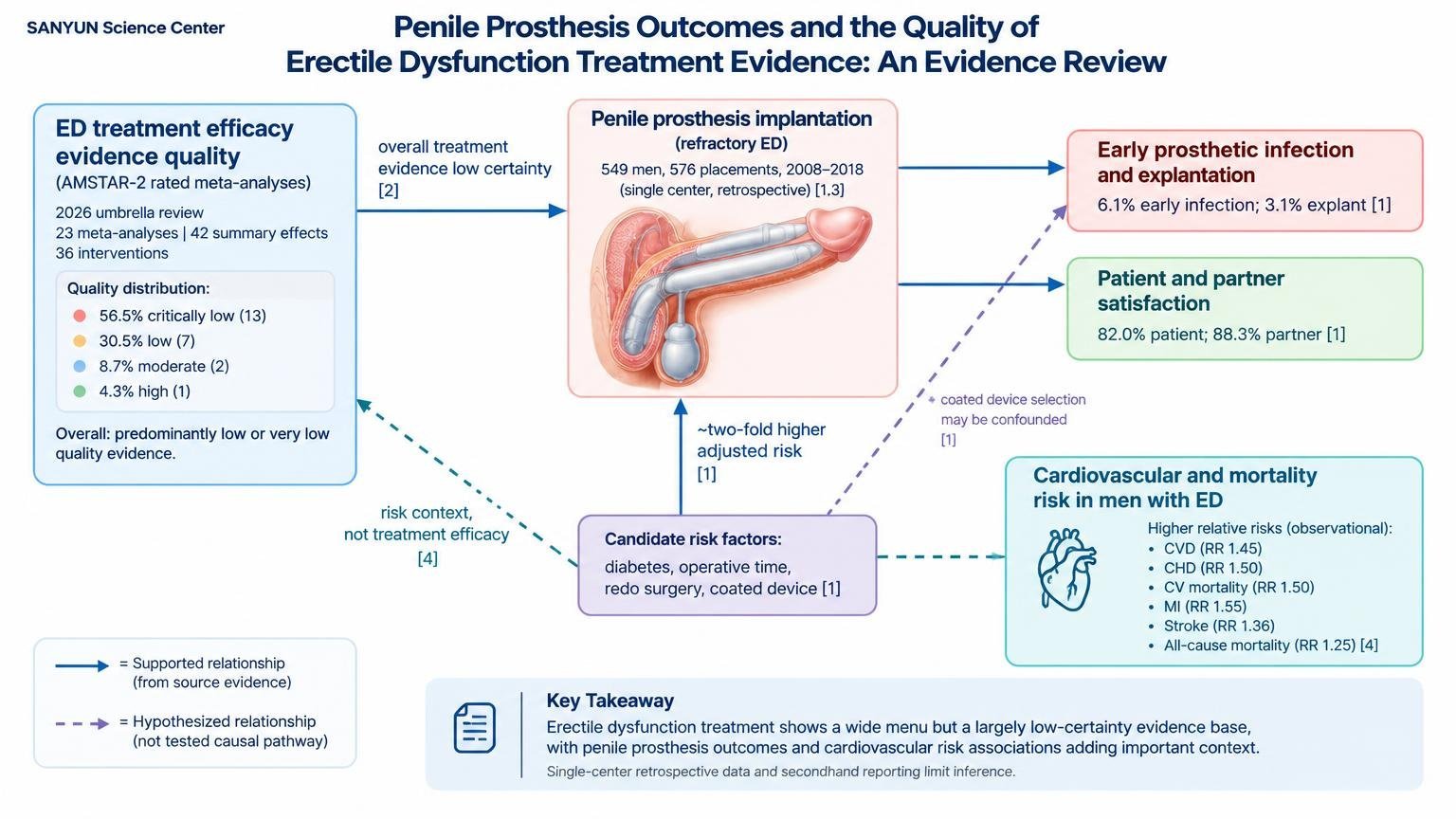
Conceptual framework: Conceptual framework. The figure maps variables discussed in this review: penile prosthesis implantation (549 men, 576 placements, 2008–2018), early prosthetic infection (6.1%) and explantation (3.1%), patient and partner satisfaction (82.0% and 88.3%), candidate infection risk factors, the low-certainty ED treatment evidence base from a 2026 umbrella review, and cardiovascular risk context. Solid links reflect reported associations; dashed-style proposed links (device selection confounding, cardiovascular context) are hypotheses, not tested causal pathways. Single-center retrospective design and secondhand reporting limit inference.
Academic References & Evidence
- 1. Ten-year experience with penile prosthetic surgery for the treatment of erectile dysfunction: outcomes of a tertiary referral center and predictors of early prosthetic infection..
- Current treatment for erectile dysfunction: an umbrella review of systematic reviews and meta-analyses. 2026 DOI: 10.6084/m9.figshare.31562993.v1.
- A. Gomes | Semantic Scholar.
- Erectile Dysfunction.
SANYUN Science Center explains published research on men's reproductive and sexual health, connecting scientific evidence with everyday questions while making sources and limitations clear.
Disclaimer: This article is for scientific education and research communication only. It does not provide medical advice, diagnosis, or individualized treatment recommendations, and does not endorse any medication, supplement, device, penile enlargement procedure, or other intervention. Decisions about sexual and reproductive health should be made in consultation with a qualified healthcare professional. Do not delay seeking professional care because of information in this article.
Original Content & Copyright Notice
- This article is prepared for SANYUN Science Center, drawing on published research and publicly available academic literature on men’s sexual and reproductive health. Its editorial explanations and presentation are developed for this platform.
- Copyright in the original editorial content, selection, and arrangement is reserved by SANYUN Science Center to the extent protected by applicable law. Referenced research, quotations, and third-party materials remain subject to the rights of their respective owners. This notice does not claim ownership of scientific facts or third-party research.
- Except where permitted by applicable law or an applicable license, prior written permission is required to reproduce, republish, translate, adapt, redistribute, or commercially reuse protected content. Attribution alone does not grant permission for such reuse.
- For permitted quotation or authorized reuse, clearly identify the source and retain a link to the original article.
- Source: SANYUN Science Center
- Original URL: Retain the original article URL on science.san-yun.com.
- Copyright Holder: SANYUN Science Center, for its own protected editorial content.
- Quotation, excerpts, or authorized reuse must not distort the scientific meaning, omit material limitations or disclaimers, or imply unverified medical claims, product efficacy, or endorsement by SANYUN Science Center.



