




Category: Erectile Dysfunction
Core Research Direction: Penile prosthesis implantation for refractory erectile dysfunction: long-term single-center outcomes, early prosthetic infection predictors, and the quality of the broader evidence base for ED treatments
Search Intent: What do long-term single-center outcomes and infection predictors show for penile prosthesis surgery in men with refractory erectile dysfunction, and how reliable is the wider evidence for ED treatments?
Platform: SANYUN Science Center
Evidence reviewed through: 2026-11-23
Executive Summary
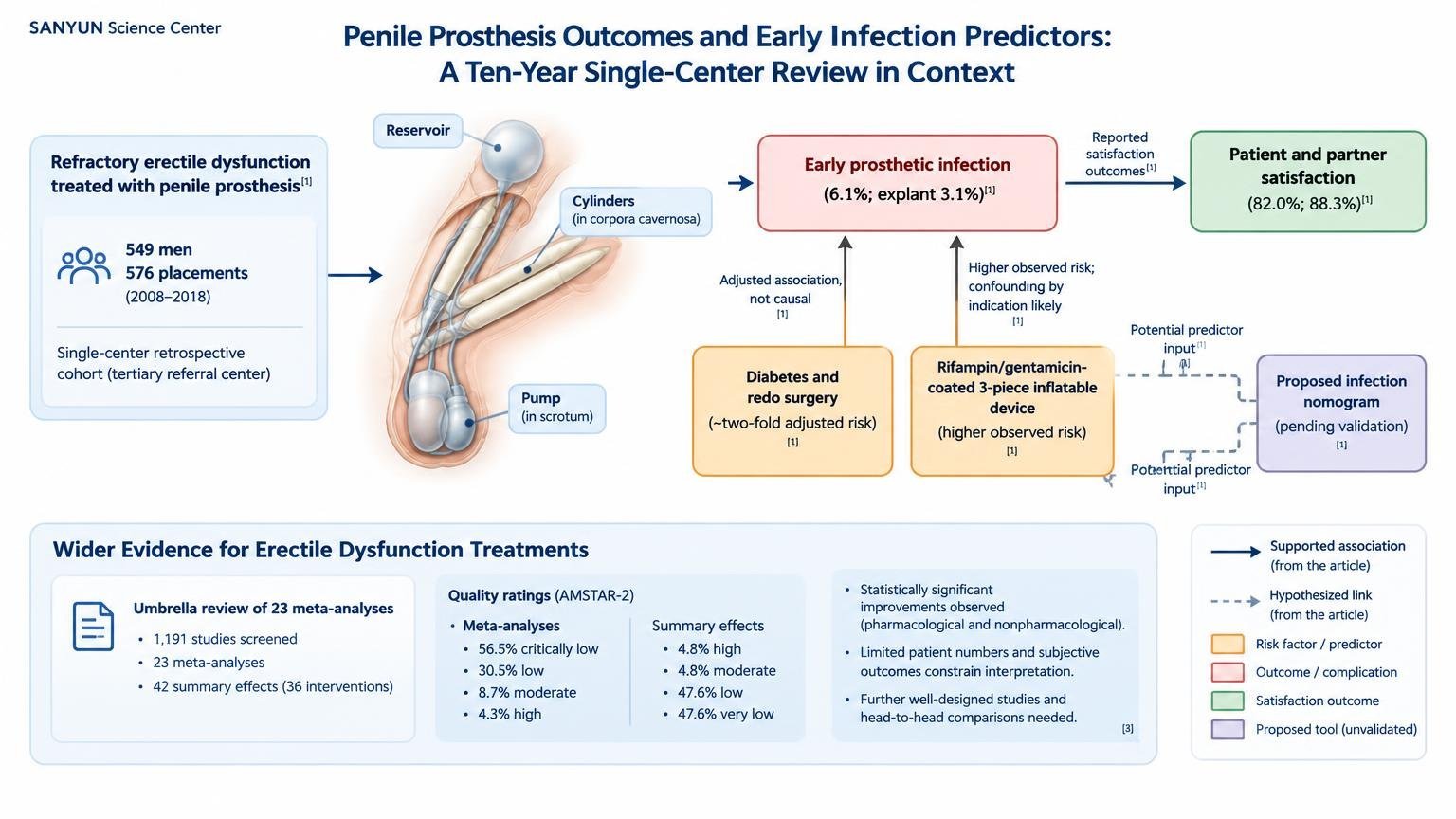
Penile prosthesis implantation is the definitive surgical option for men whose erectile dysfunction has not responded to less invasive treatment, and for selected men after prostate cancer surgery or priapism. A ten-year retrospective review from a tertiary referral center followed 549 men who received 576 prosthesis placements between 2008 and 2018, and it adds granular outcome and risk-factor data to a surgical literature that is still largely built from single-center series.[1][2]
Early prosthetic infection occurred in 35 cases, or 6.1%, with an explant rate of 3.1%. Patient-reported satisfaction was 82.0%, and partner satisfaction was 88.3%. On univariate analysis, diabetes, longer operative time and reinterventions were associated with infection risk, while postoperative ciprofloxacin was inversely associated with it. After adjustment, diabetes, redo surgery and use of a rifampin/gentamicin-coated three-piece inflatable prosthesis were each associated with approximately two-fold higher infection risk.
These are observational associations from one center, not causal estimates, and the exact adjusted effect sizes and confidence intervals are not reported in the available text. The wider evidence base for erectile dysfunction treatments is a separate problem: an umbrella review of 23 meta-analyses rated most included reviews as critically low or low quality and most summary effects as low or very low quality, so statistically significant improvements in questionnaire scores should not be equated with strong certainty.[3]
Why This Matters
Men who reach the point of considering a penile prosthesis have usually exhausted oral drugs, injections, vacuum devices or shockwave therapy, and many have had pelvic cancer surgery that removed or damaged the erectile nerves. For them, the prosthesis is not one option among many equivalent choices but the remaining route to reliable rigidity. That raises the stakes on two questions: how well the device performs and satisfies users over years, and who is at elevated risk of the complication that most threatens the device, infection.[4]
Infection matters because it can require device removal and a period without a prosthesis before reimplantation is considered, and because redo surgery itself appears to carry higher infection risk. A preoperative risk model that could identify men at higher risk would change counseling rather than the operation itself, and the authors frame their nomogram in exactly those terms: a proposed tool for preoperative discussion, pending further validation.
The broader ED evidence base matters for a different reason. Patients and clinicians frequently encounter confident claims about many treatments, yet the umbrella review covering 36 interventions found that reliability across that landscape was poor. A rigorous prosthesis series and a low-certainty meta-analytic literature can coexist, and distinguishing the two is part of honest clinical communication.
Surgical Context and Clinical Mechanism
An erection depends on coordinated nerve signaling, nitric oxide release and blood flow into the corpora cavernosa, with smooth muscle relaxation allowing the penis to become rigid. When that chain is irreversibly broken by radical prostatectomy, radiation, priapism-related fibrosis or severe vascular disease, a prosthesis replaces the hydraulic mechanism with a mechanical one. The device does not restore nerve or vascular function; it provides rigidity on demand, which is why satisfaction depends heavily on device reliability, surgical technique and informed expectations rather than on underlying biology alone.
A three-piece inflatable prosthesis consists of paired cylinders in the corpora, a pump in the scrotum and a fluid reservoir, allowing inflation and flaccidity. Infection is the central prosthetic failure mode because bacteria colonizing the device can form a biofilm that antibiotics cannot reliably clear, and coating implants with rifampin and gentamicin is one strategy intended to reduce that risk. In the reviewed series, however, the coated three-piece inflatable device was associated with higher infection rates, a finding that likely reflects how such devices were selected for particular patients rather than a demonstrated harmful effect of the coating itself.
What the Evidence Shows
The single-center review is a retrospective cohort covering 549 men and 576 placements from 2008 to 2018, meaning some men received more than one device. The early infection rate of 6.1% is consistent with the range commonly reported for contemporary implant surgery, and the explant rate of 3.1% indicates that nearly half of early infections were managed without device removal in this series. Satisfaction figures of 82.0% for patients and 88.3% for partners describe a largely satisfied population, although the quoted text does not specify how satisfaction was measured or what the responder denominators were.
Risk-factor findings split into univariate signals and adjusted associations. Diabetes, longer operative time and reinterventions were each associated with early infection on univariate testing. Postoperative ciprofloxacin was inversely associated with infection, which is a plausible prophylactic signal but also vulnerable to confounding by prescribing practice. On multivariate analysis, diabetes, redo surgery and the coated inflatable device each carried approximately two-fold higher risk, with all reported P values below 0.03.
The authors concluded that diabetes, longer operative time and secondary surgeries were risk factors, that postoperative ciprofloxacin was associated with reduced risk, and that the coated device showed higher infection rates without increased explant risk. That last distinction is clinically interesting: a higher infection rate that did not translate into more device removals may indicate milder or medically managed infections in that group, but the available text does not provide the data needed to test that interpretation.
| Outcome or Predictor | Reported Finding | Interpretation and Caveat |
|---|---|---|
| Population and placements | 549 men; 576 placements; 2008–2018 | Counts differ, so some men underwent more than one placement; single tertiary center. |
| Early prosthetic infection | 35 cases (6.1%) | Observed crude rate in one retrospective series; denominator not restated in the source sentence. |
| Device explantation | 3.1% | Fewer explants than infections, suggesting some infections were managed without removal. |
| Patient and partner satisfaction | 82.0% patients; 88.3% partners | Ascertainment method and responder denominators not specified in the available text. |
| Diabetes, operative time, reinterventions | Univariate associations; P = 0.012, 0.032 and 0.048 | Univariate signals; observational design cannot establish causation. |
| Postoperative ciprofloxacin | Inverse univariate association; P = 0.014 | Possible prophylactic signal, but vulnerable to confounding by prescribing practice. |
| Coated three-piece inflatable device | Higher risk univariate (P = 0.019); ~two-fold adjusted risk | Likely reflects device selection and case mix; no increased explant risk was reported. |
| Diabetes and redo surgery | ~two-fold higher adjusted risk, all P < 0.03 | Adjusted associations; exact effect sizes and confidence intervals not given in available text. |
How Reliable Is the Wider ED Treatment Evidence?
A separate umbrella review approached erectile dysfunction treatment from the top down, screening 1191 studies, extracting 23 published meta-analyses and deriving 42 summary effects on the International Index of Erectile Function, its short forms and the erectile hardness score across 36 interventions. The design is useful for mapping a crowded field, but its conclusions are only as strong as the reviews it aggregates.
Quality appraisal was sobering. Thirteen of the 23 meta-analyses, or 56.5%, were rated critically low by AMSTAR-2, seven (30.5%) low, two (8.7%) moderate and one (4.3%) high. At the level of summary effects, only two were rated high and moderate quality respectively, while 20 (47.6%) were low and 20 (47.6%) very low. The authors concluded that the current evidence base for ED treatments is predominantly of low or very low quality.
That conclusion is not a claim that treatments do not work. Statistically significant improvements were observed with both pharmacological and nonpharmacological interventions, but the review authors caution that limited patient numbers and subjective outcome indicators constrain interpretation. Erectile function questionnaires capture a patient's reported experience, which is clinically meaningful, yet they are vulnerable to expectancy effects and inconsistent reporting across trials.
The review's recommendations point toward the structural gap: further well-designed single-treatment studies and high-quality meta-analyses comparing treatments head-to-head are urgently needed. Existing meta-analyses largely pool heterogeneous studies of individual interventions rather than directly comparing one treatment against another, which limits what patients and clinicians can conclude about choosing between options.
Interpretation and Limitations
The prosthesis review and the umbrella review answer different questions and carry different limitations. The surgical series is a retrospective, single-center cohort from a tertiary referral center, which means its case mix likely skews toward complex or refractory patients, and its complication rates may not transfer directly to lower-volume or community settings. Retrospective designs also depend on the quality of recorded data, and the available text does not report adjusted effect sizes with confidence intervals, so the precision of the two-fold risk estimates is unknown.
Several findings invite overinterpretation and should not be read causally. The inverse association between postoperative ciprofloxacin and infection could reflect prophylaxis, but it could equally reflect which patients received it, when it was given, or unmeasured differences in surgical era and technique. The higher infection rate with the coated inflatable device most plausibly reflects confounding by indication, since coated implants may have been chosen for patients perceived as higher risk; a device registry or randomized comparison would be needed to separate coating effects from patient selection. The predictive nomogram is explicitly proposed pending validation, not an established tool.
The umbrella review carries its own nested limitations. Its quality ratings depend on how AMSTAR-2 was applied, and the quoted text uses "studies" loosely when describing summary effects. More fundamentally, an umbrella review can only summarize the reviews that exist, so the predominance of low-quality evidence is partly a statement about the field's design choices rather than about any individual treatment. Its call for better primary studies and head-to-head comparisons is a research agenda, not a clinical result.
The conference abstract on prosthesis indications adds only a broad directional statement that post-surgical and priapism-related erectile dysfunction were leading indications at that center, without sample size or effect estimates. The 2025 European Urology Open Science citation is provided only as bibliographic metadata in the available material, so it should not be cited for outcomes. These gaps are worth naming rather than filling by inference.[5]
Research Outlook
The most direct next step for prosthesis research is external validation of the proposed infection nomogram in independent, ideally multicenter, cohorts with complete reporting of adjusted effect estimates and confidence intervals. Prospective registries would allow device-level comparisons, including coated versus uncoated implants, while controlling for case mix and surgical era. Standardized definitions and timing windows for early infection would make rates comparable across centers, and standardized satisfaction instruments would clarify what the 82.0% and 88.3% figures actually capture.
On the broader treatment side, the umbrella review's agenda is clear: well-designed single-treatment trials and high-quality head-to-head meta-analyses. Until those exist, evidence summaries should present statistically significant questionnaire improvements alongside explicit certainty ratings, and clinicians should be candid that the strength of evidence differs substantially between a mature surgical procedure with registry-level outcome data and many adjunctive therapies whose meta-analytic support remains low certainty.
Key Takeaways
- A ten-year single-center review of 549 men and 576 prosthesis placements reported a 6.1% early infection rate and a 3.1% explant rate, with 82.0% patient and 88.3% partner satisfaction.
- Diabetes, redo surgery and use of a rifampin/gentamicin-coated three-piece inflatable prosthesis were each associated with approximately two-fold higher adjusted early infection risk, but these are observational associations from one center.
- Postoperative ciprofloxacin was inversely associated with infection, a hypothesis-generating signal rather than proof of prophylactic benefit.
- The proposed infection nomogram is a counseling concept pending external validation, not a validated prediction tool.
- An umbrella review of 23 meta-analyses found that 56.5% were critically low quality and 47.6% of summary effects were very low quality, so the wider ED treatment evidence base is predominantly weak.
- Statistically significant improvements with many ED interventions should be interpreted cautiously because of limited patient numbers and subjective outcome measures.
Questions and Answers
What is a penile prosthesis and when is it considered for erectile dysfunction?
A penile prosthesis is a surgically implanted device that provides mechanical rigidity when the penis cannot achieve or sustain an erection. It is generally reserved for refractory erectile dysfunction after other options fail, and it is also used in selected men after prostate cancer surgery or priapism. It restores rigidity but does not restore natural nerve or vascular function, and implantation is irreversible.
What did the ten-year penile prosthesis review find about infection and satisfaction?
Among 549 men and 576 placements, early prosthetic infection occurred in 35 cases (6.1%) with an explant rate of 3.1%. Patient satisfaction was 82.0% and partner satisfaction 88.3%. These figures come from one retrospective tertiary-center series, and the available text does not specify how satisfaction was measured or the responder denominators.
Which factors were associated with early prosthetic infection after penile implant surgery?
On univariate analysis, diabetes, longer operative time and reinterventions were associated with higher early infection risk, while postoperative ciprofloxacin was inversely associated. After adjustment, diabetes, redo surgery and a rifampin/gentamicin-coated three-piece inflatable prosthesis were each associated with approximately two-fold higher risk. These are observational associations, and exact adjusted estimates and confidence intervals are not given in the available text.
How strong is the overall evidence base for erectile dysfunction treatments?
An umbrella review of 23 meta-analyses found that 56.5% were critically low quality by AMSTAR-2 and 47.6% of the 42 summary effects were very low quality. The authors concluded that the ED treatment evidence base is predominantly low or very low quality and recommended better-designed single-treatment studies and head-to-head comparisons.
Do these findings prove that coated implants or missing ciprofloxacin cause infection?
No. The coated-device finding most plausibly reflects confounding by indication, since higher-risk patients may have received coated implants, and the ciprofloxacin association could reflect prescribing patterns rather than a protective effect. The review is retrospective and single-center, so it cannot establish causation for either finding.
Can the proposed infection nomogram be used to predict individual patient risk today?
Not yet. The authors describe the nomogram as a tool that could aid preoperative counseling after further validation, so it remains a proposed model rather than a validated calculator. Men considering a penile prosthesis should discuss their individual risk factors, including diabetes and prior implant surgery, with their surgeon rather than relying on an unvalidated prediction.
Conceptual framework: Conceptual framework, not a tested causal model. A single-center ten-year retrospective review (549 men, 576 placements) reported a 6.1% early infection rate and 3.1% explant rate, with adjusted associations for diabetes, redo surgery and coated implants and high reported satisfaction. The nomogram is proposed pending validation.
Academic References & Evidence
- 1. Ten-year experience with penile prosthetic surgery for the treatment of erectile dysfunction: outcomes of a tertiary referral center and predictors of early prosthetic infection..
- A. Gomes | Semantic Scholar.
- Current treatment for erectile dysfunction: an umbrella review of systematic reviews and meta-analyses. 2026
- Erectile Dysfunction.
- P. Pereira; V. Andrade; Ana Carolina Freitas Meireles; Aléxia Gomes; Luis Severo; L. Campos Pinheiro. Penile prosthesis implantation: a 10-year retrospective review from a single urology center | Semantic Scholar. European Urology Open Science. 2025
SANYUN Science Center explains published research on men's reproductive and sexual health, connecting scientific evidence with everyday questions while making sources and limitations clear.
Disclaimer: This article is for scientific education and research communication only. It does not provide medical advice, diagnosis, or individualized treatment recommendations, and does not endorse any medication, supplement, device, penile enlargement procedure, or other intervention. Decisions about sexual and reproductive health should be made in consultation with a qualified healthcare professional. Do not delay seeking professional care because of information in this article.
Original Content & Copyright Notice
- This article is prepared for SANYUN Science Center, drawing on published research and publicly available academic literature on men’s sexual and reproductive health. Its editorial explanations and presentation are developed for this platform.
- Copyright in the original editorial content, selection, and arrangement is reserved by SANYUN Science Center to the extent protected by applicable law. Referenced research, quotations, and third-party materials remain subject to the rights of their respective owners. This notice does not claim ownership of scientific facts or third-party research.
- Except where permitted by applicable law or an applicable license, prior written permission is required to reproduce, republish, translate, adapt, redistribute, or commercially reuse protected content. Attribution alone does not grant permission for such reuse.
- For permitted quotation or authorized reuse, clearly identify the source and retain a link to the original article.
- Source: SANYUN Science Center
- Original URL: Retain the original article URL on science.san-yun.com.
- Copyright Holder: SANYUN Science Center, for its own protected editorial content.
- Quotation, excerpts, or authorized reuse must not distort the scientific meaning, omit material limitations or disclaimers, or imply unverified medical claims, product efficacy, or endorsement by SANYUN Science Center.



