




Category: Health Academy
Core Research Direction: Adult men's erectile dysfunction treatment options: how PDE5 inhibitors and non-oral alternatives work, comparative durations and success rates, and what early-stage LIB-01 data do and do not establish
Search Intent: What treatments exist for erectile dysfunction, how do they differ in mechanism, onset, duration and success rates, and how strong is the evidence behind newer options like LIB-01?
Platform: SANYUN Science Center
Evidence reviewed through: 2026-11-23
Executive Summary
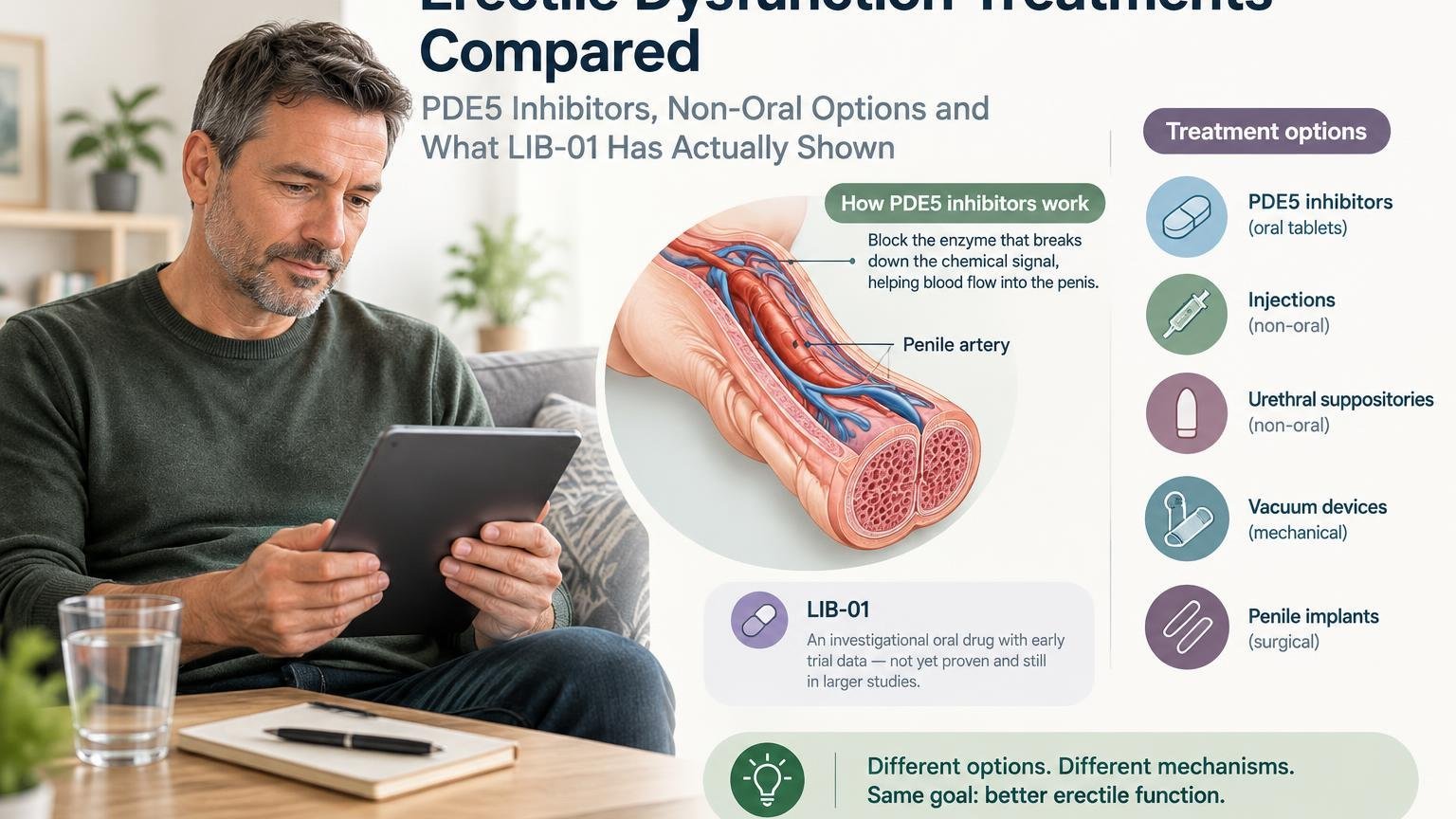
Erectile dysfunction treatment is usually presented as a menu of escalating options: oral drugs first, then injections, suppositories, devices or surgery. The most widely used medicines are phosphodiesterase type 5 (PDE5) inhibitors, which work by blocking an enzyme that breaks down the chemical signal allowing penile arteries to dilate and blood to flow in. This explainer looks at how the main options differ in mechanism, speed, duration and reported success, and separates those established categories from LIB-01, an investigational oral drug that has completed an early randomised trial and has now entered a larger phase 2b study.[1][2]
The central honesty point is about evidence quality. Reported success figures for marketed treatments in this source are broad descriptive statements without cited studies, sample sizes or definitions of success, so they should be read as orientation rather than precise probabilities. Early LIB-01 findings come from a conference abstract reported in the trade press: they include a clinically meaningful within-group improvement that did not reach statistical significance against placebo on the primary comparison, alongside significant pooled and responder results that need confirmation.
Why This Matters
Erectile dysfunction is common enough that most adult men, or their partners, will encounter the question of treatment at some point, and the choice is rarely only about potency. Onset time shapes spontaneity, duration shapes planning, and route of administration shapes acceptability. A tablet taken 30 minutes before sex and lasting up to about 4 hours supports a different pattern of intimacy from one with a window of up to 36 hours, or from an injection, a urethral suppository, a vacuum device or an implant.
There is also a safety dimension. Some options are unsuitable for men with particular cardiovascular conditions or medications, alprostadil carries a risk of priapism, and devices and surgery carry their own constraints. For readers trying to make sense of marketing claims and headlines about a new drug class, understanding what the evidence actually measured is as important as the headline percentage.
How Oral PDE5 Inhibitors Work
During sexual arousal, a chemical signal relaxes the smooth muscle of the penile arteries, increasing blood inflow and producing an erection. PDE5 is the enzyme that degrades that signal, so inhibiting it prolongs the signal and supports a stronger, more sustained erection when arousal occurs. The mechanism description in this source is simplified: PDE5 inhibitors do not merely suppress enzyme production, they inhibit enzyme activity. They also do not create arousal by themselves; sexual stimulation remains part of the picture.
The three familiar oral drugs described are sildenafil (Viagra), tadalafil (Cialis) and vardenafil (Levitra). They are presented as the same drug family, with similar effectiveness but different practical profiles. Sildenafil is described as normally starting to work in around 30 minutes and lasting up to 4 hours, with 50 mg as the usual starting dose from 25, 50 and 100 mg options. Fatty food and a full stomach are said to inhibit its absorption.
Tadalafil is described as having a longer duration of effect, with a window of opportunity demonstrated to be as long as 36 hours, and absorption not inhibited by fats. It is available as 10 mg and 20 mg, with 10 mg the usual starting dose. The source says it can appear to act more rapidly than sildenafil in some patients, achieving an erection within 15 minutes of administration, but this is a descriptive statement rather than a trial result and should not be read as a reliable onset guarantee.
Vardenafil is offered in 5, 10 and 20 mg, with 10 mg as the normal starting dose and 5 mg advised for elderly men because clearance of the active drug is lower with age. The page also repeats clinic anecdote that vardenafil may help some men for whom sildenafil did nothing, while explicitly stating no scientific data were found to confirm this. Anecdote of that kind is a hypothesis, not an established difference between drugs.
Onset, Duration and Reported Success: What the Numbers Mean
The most quoted figure in this source is that the oral medications have effectiveness rates of around 75%. That single number conceals a great deal: there is no cited study, no stated population, no definition of what counts as success (an erection sufficient for intercourse, a positive response on a questionnaire, or simply continuing the drug) and no distinction between doses. It is reasonable to say that a substantial share of men respond to PDE5 inhibitors; it is not reasonable to promise an individual a 75% chance.
Side-effect patterns are described as similar across the oral drugs: headache, facial flushing, dizziness, vision disorders and indigestion are the most common listed effects, without incidence figures. Tadalafil is also associated with back pain in around 6% of people, according to the page, again without a study or denominator. A practical implication the source highlights is that the longer the drug's duration, the longer any troublesome effect may persist, which is why it suggests not jumping to a higher dose before trying a lower one.
This is a good place to distinguish statistical reporting from clinical meaning. Even a well-run trial showing a mean improvement on a symptom score does not guarantee that a given man will notice a difference, and a reported percentage of responders depends heavily on how response is defined. The figures below come from a commercial patient-education page and should be treated as approximate orientation to relative patterns, not as validated comparative effectiveness data.
| Option | How it is used and how it works | Reported onset or duration | Reported success |
|---|---|---|---|
| Sildenafil (Viagra) | Oral PDE5 inhibitor; absorption reduced by fatty food; 50 mg usual starting dose | About 30 minutes onset; lasts up to 4 hours | Around 75% for oral drugs as a group |
| Tadalafil (Cialis) | Oral PDE5 inhibitor; absorption not inhibited by fats; 10 mg usual starting dose | Window of opportunity demonstrated up to 36 hours; some erections within 15 minutes | Around 75% for oral drugs as a group |
| Vardenafil (Levitra) | Oral PDE5 inhibitor; 10 mg usual starting dose, 5 mg in elderly men | Not specified in source | Around 75% for oral drugs as a group; clinic anecdote for sildenafil non-responders unconfirmed |
| Alprostadil injection (Caverject) | Injected into the penis; causes blood vessels to expand; usually reserved after oral treatment failure | Not specified in source | Around 80% of men with ED |
| Alprostadil urethral suppository (MUSE) | Inserted into the urethra; usually reserved after oral treatment failure | Not specified in source | 30–40% achieve an erection |
| Vacuum constriction device | Cylinder plus pump draws blood in; band retains it; band left on about 30 minutes | Erection forms during use with sexual stimulation | 50–80% in cited studies, not individually referenced |
| Penile implant | Inflatable cylinders in the corpora cavernosa with a groin pump; erection of about 20–30 minutes | On demand by pumping | Around 90%, with similarly high satisfaction reported |
| Vascular reconstructive surgery | Bypass linking penile arteries to an abdominal artery; limited eligibility | Not specified in source | About 5% overall; higher in young men with artery injury |
Non-Oral and Procedural Options
Alprostadil is a different kind of drug: rather than modulating the PDE5 pathway, it directly causes penile blood vessels to expand. It is normally described as reserved for men for whom oral PDE5 inhibitors have not worked, and it is given either as an injection into the penis (Caverject) or as a small suppository into the urethra (MUSE). The source reports roughly 80% success for the injection and only 30–40% for the suppository, a substantial gap that matters when discussing which route to try first.
The safety warning attached to alprostadil is the clearest in the source: it must not be used by men who do not have erectile dysfunction, because it can cause priapism, an erection lasting 4 hours or more that may permanently damage the penis and destroy future erectile function. Anyone in that situation should seek urgent medical attention.
Mechanical and surgical options sit further along the pathway. A vacuum constriction device draws blood into the penis and a band retains it, with the band safe to leave on for around 30 minutes; reported success is 50–80%, but the source notes preparation burden and reduced ejaculatory force. A penile implant is described as around 90% successful with high satisfaction, while removal of the tubes is said to make future natural erections highly unlikely. Vascular reconstructive surgery is described as expensive with very low overall success of about 5%, used mainly in young men with a specific arterial injury, where results are described as significantly higher.
Other contributors round out the picture. Low testosterone is described as a very rare cause of erectile dysfunction, identified by blood test, and testosterone replacement is suggested only after considering PDE5 inhibitors first. Sex therapy is presented as more successful when the partner takes part. Smoking cessation is said not to improve erectile function immediately but to help over time, consistent with smoking-related arterial disease being a slow process.
What the Early LIB-01 Data Actually Show
LIB-01 is not an approved treatment. It is an investigational oral drug being developed around a proposed mechanism that could produce more sustained effects after intermittent dosing, unlike PDE5 inhibitors taken on demand or daily. That framing is a hypothesis and a development strategy, not a demonstrated clinical advantage. The company has initiated an adaptive phase 2b study planned to enrol at least 200 men across US and European sites, with a primary efficacy endpoint of change from baseline in the erectile function domain of the International Index of Erectile Function (IIEF-EF) at week 12. Planned facts like these describe what will be measured, not what has been found.
The rationale comes from a randomised, placebo-controlled phase 2a study (NCT06703840) that enrolled 156 men with mild to moderate erectile dysfunction, defined by IIEF-EF scores from 11 to 25. Participants received LIB-01 10, 25 or 50 mg, or placebo, once daily for 3 days, then were observed for 8 weeks. The primary endpoint was change in IIEF-EF at week 4. These design details matter because a 3-day course with 8 weeks of follow-up is a very different proposition from a long-term treatment study.
The headline result is more nuanced than the phrase '8.5-point improvement' suggests. At week 4, the 50 mg group improved by 8.5 points from baseline, which exceeded the conventional 5-point threshold for clinical significance, but the comparison against placebo did not reach statistical significance (P = .11). In other words, a change that looks clinically meaningful within the treated group was not, in that individual-dose analysis, clearly separable from placebo fluctuation at the conventional statistical threshold.
Two other results point in a more supportive direction. At week 4, 31% of patients in the 50 mg cohort reached IIEF-EF above 25, described as normal erectile function, versus 0% with placebo (P = .04). And a prespecified pooled analysis of the 25 mg and 50 mg groups showed a 6.5-point improvement from baseline versus placebo (P = .03). Among participants with moderate erectile dysfunction, the 50 mg group improved by 7.5 points, with P = .06 versus placebo, falling just short of conventional significance.
Those numbers should be read with care. A 0% placebo response is unusual in erectile dysfunction trials and can inflate the apparent contrast; subgroup and pooled analyses multiply comparisons and raise the risk of chance findings; and the details come from a conference abstract reported in a trade publication, not a peer-reviewed full paper with confidence intervals. Reported tolerability, with generally mild and transient adverse events mostly during initial dosing and mild gastrointestinal symptoms most common, is reassuring but equally awaits full publication.
Interpretation and Limitations
The marketed-treatment numbers and the LIB-01 numbers are not comparable. Established oral drugs come with a very large, decades-long clinical literature behind them, even though the specific figures quoted here are uncited summaries. LIB-01 rests on one early randomised trial of 156 men with mild to moderate dysfunction, a short dosing schedule and results presented at a conference. Prior probability therefore strongly favours the established options, while the investigational drug's real test is the ongoing phase 2b study in a broader severity range.
Several gaps run through the whole topic. Success rates vary by how success is defined, which men were included and whether treatment was taken correctly; none of the percentages in the commercial source carry that detail. Safety data for the oral drugs here are listed without frequencies. And the comparative claims that patients most want, such as which drug works best for whom, are generally not answered by the material available. These are limitations of the source base, not findings that the treatments are equivalent or ineffective.
Another limitation is context: treatment choice is shaped by cardiovascular health, other medications, partner involvement, cost and personal preference, none of which a success-rate table captures. Any decision about a specific medicine, dose or procedure belongs with a clinician who knows the individual's history.
Research Outlook
The immediate research question is whether LIB-01's intermittent dosing can produce durable benefit without the on-demand timing of PDE5 inhibitors, and whether that holds across all severities of erectile dysfunction rather than the mild to moderate group studied so far. The phase 2b design is adaptive, with Part I intended to identify a higher dose for Part II, and the company expected Part I to conclude in the first quarter of 2027. Until results are reported and peer reviewed, LIB-01 remains a hypothesis under test rather than an option to compare with existing care.
Key Takeaways
- PDE5 inhibitors such as sildenafil, tadalafil and vardenafil work by inhibiting the enzyme that breaks down the erection-promoting signal, supporting erection when arousal occurs.
- Practical differences matter: sildenafil is described as starting in about 30 minutes and lasting up to 4 hours, while tadalafil's window of opportunity has been reported as up to 36 hours with absorption not inhibited by fats.
- The often-quoted figure that oral drugs are around 75% effective comes without a cited study, population or definition, so treat it as rough orientation rather than a personal probability.
- Injectable alprostadil is reported at around 80% success versus 30–40% for the urethral suppository, and alprostadil carries a priapism warning requiring urgent care for erections of 4 hours or more.
- Early LIB-01 phase 2a data show a clinically meaningful within-group improvement that was not statistically significant against placebo on the main comparison, plus significant responder and pooled analyses awaiting confirmation in a larger phase 2b trial.
Questions and Answers
How do PDE5 inhibitors like sildenafil and tadalafil actually work for erectile dysfunction?
They inhibit PDE5, the enzyme that breaks down the chemical signal relaxing penile arteries. Blocking it prolongs that signal so more blood flows in and an erection is easier to achieve and sustain when arousal occurs. The source's wording implies enzyme production is inhibited, but the accurate description is inhibition of enzyme activity. Sexual stimulation is still required.
How long do Viagra and Cialis last, and what is the difference in onset?
This source describes sildenafil as starting in around 30 minutes and lasting up to 4 hours, while tadalafil has a reported window of opportunity as long as 36 hours and is not affected by fatty food. Tadalafil is described as acting within 15 minutes in some patients, but that is a general statement rather than a trial result, so individual onset varies.
What success rates are reported for erectile dysfunction injections, suppositories and devices?
The source reports around 80% success for injectable alprostadil (Caverject), 30–40% for the urethral suppository (MUSE), 50–80% for vacuum devices, around 90% for penile implants and about 5% overall for vascular reconstructive surgery. These are uncited descriptive figures with undefined success criteria, so they indicate rough relative patterns rather than precise probabilities for an individual man.
How strong is the evidence that LIB-01 improves erectile function?
It is early-stage. A randomised placebo-controlled phase 2a trial in 156 men with mild to moderate ED produced an 8.5-point IIEF-EF improvement at week 4 in the 50 mg group that was clinically meaningful but not statistically significant versus placebo. Significant responder and pooled results need confirmation in the planned phase 2b trial, and the findings so far come from a conference abstract, not a peer-reviewed paper.
Is LIB-01 an approved erectile dysfunction treatment yet?
No. LIB-01 is an investigational oral drug, not an approved option. It is being developed around a proposed mechanism that might produce sustained effects after intermittent dosing, rather than on-demand or daily use. A phase 2b adaptive study is planned to enrol at least 200 men, with a week-12 IIEF-EF endpoint; those are planned methods, not reported outcomes, and approval would require much more evidence.
What are the main safety warnings for non-oral erectile dysfunction treatments?
Alprostadil must not be used by men without erectile dysfunction because it can cause priapism, an erection of 4 hours or more that may permanently damage the penis, so prolonged erections need urgent medical attention. Vacuum device bands are described as safe to leave on for around 30 minutes, and implant surgery is said to make later natural erections highly unlikely if the tubes are removed.
Sources and References
- Dr Loraine Studley. Erectile Dysfunction Treatments.
- Rosen RC; Giuliano F; Padma-Nathan H; Gauffin C. LIB-01 enters phase 2b development for erectile dysfunction | Urology Times.
SANYUN Science Center explains published research on men's reproductive and sexual health, connecting scientific evidence with everyday questions while making sources and limitations clear.
Disclaimer: This article is for scientific education and research communication only. It does not provide medical advice, diagnosis, or individualized treatment recommendations, and does not endorse any medication, supplement, device, penile enlargement procedure, or other intervention. Decisions about sexual and reproductive health should be made in consultation with a qualified healthcare professional. Do not delay seeking professional care because of information in this article.
Original Content & Copyright Notice
- This article is prepared for SANYUN Science Center, drawing on published research and publicly available academic literature on men’s sexual and reproductive health. Its editorial explanations and presentation are developed for this platform.
- Copyright in the original editorial content, selection, and arrangement is reserved by SANYUN Science Center to the extent protected by applicable law. Referenced research, quotations, and third-party materials remain subject to the rights of their respective owners. This notice does not claim ownership of scientific facts or third-party research.
- Except where permitted by applicable law or an applicable license, prior written permission is required to reproduce, republish, translate, adapt, redistribute, or commercially reuse protected content. Attribution alone does not grant permission for such reuse.
- For permitted quotation or authorized reuse, clearly identify the source and retain a link to the original article.
- Source: SANYUN Science Center
- Original URL: Retain the original article URL on science.san-yun.com.
- Copyright Holder: SANYUN Science Center, for its own protected editorial content.
- Quotation, excerpts, or authorized reuse must not distort the scientific meaning, omit material limitations or disclaimers, or imply unverified medical claims, product efficacy, or endorsement by SANYUN Science Center.



