




Category: Penis Enlargement
Core Research Direction: Patient-reported sexual health outcomes after penile lengthening (skin graft or tissue expansion) and phalloplasty in adult males with bladder exstrophy-epispadias complex, plus psychosexual outcomes of genital gender-confirming surgery (phalloplasty/metoidioplasty) in transmen, used to frame what reconstructive penile surgery can and cannot establish
Search Intent: In adults seeking penile reconstruction or lengthening, what do small longitudinal and retrospective studies actually show about changes in penile appearance perception, sexual activity and satisfaction, and what are their major limitations?
Platform: SANYUN Science Center
Evidence reviewed through: 2026-11-10
Executive Summary
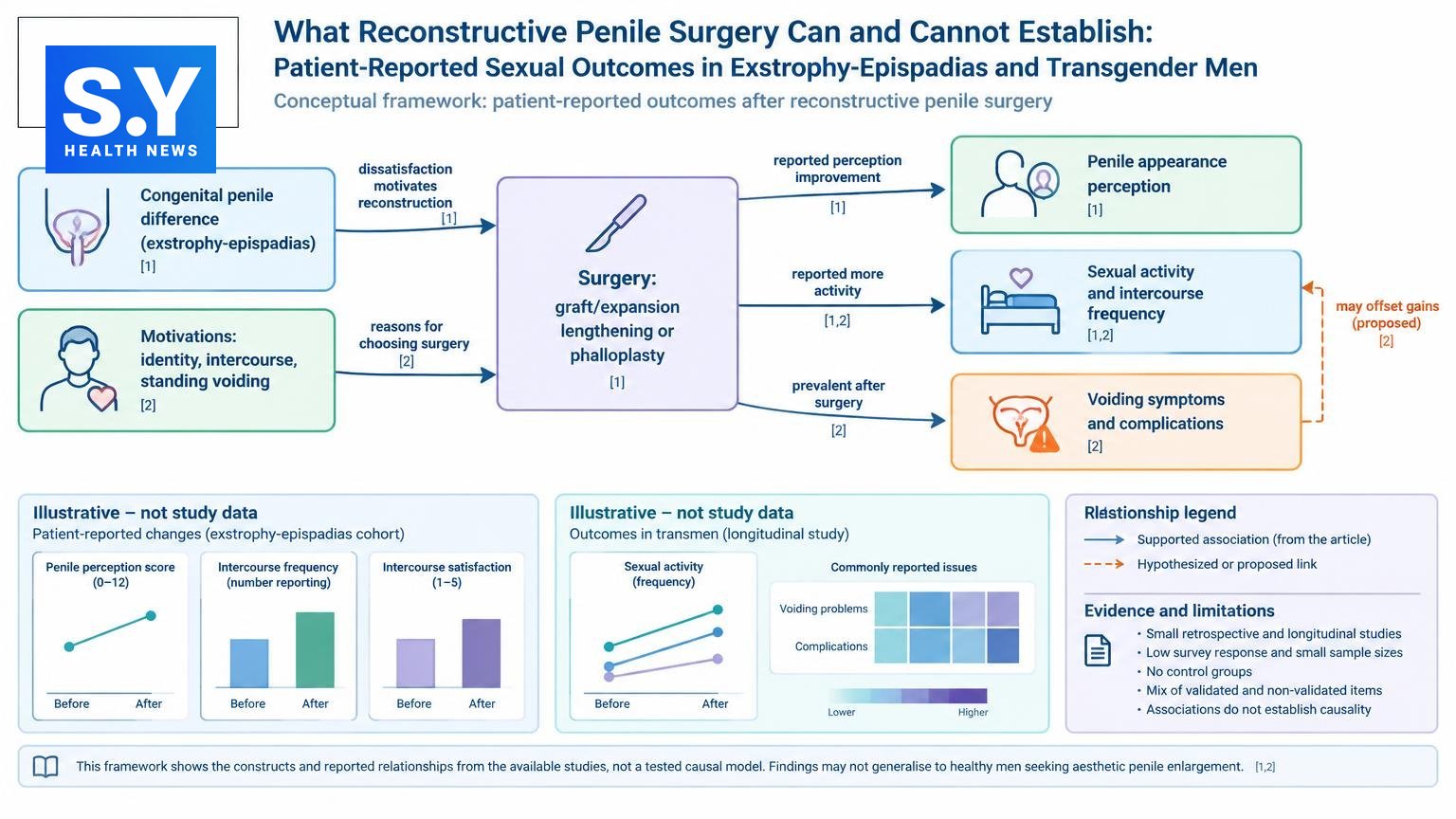
Reconstructive penile surgery is performed for two very different reasons that the published literature often discusses side by side: to rebuild a congenitally small penis in males with bladder exstrophy-epispadias complex, and to construct or enlarge a phallus as part of genital gender-confirming surgery for transmen. In exstrophy-epispadias, the penis is described as small, patients are often dissatisfied with its appearance, and psychosexual dysfunction risk is described as increased, motivating a desire for reconstruction.[1]
The two supplied studies are small and methodologically modest. A retrospective review of an institutional database identified 68 eligible men who had undergone skin-graft- or tissue-expansion-assisted penile lengthening or phalloplasty; only 28 responded to a survey (41.2%). Among respondents, the median penile perception score rose from 4.5 to 7.5 on a 0–12 scale (p=0.0034), the number reporting intercourse increased from 9 to 17, and median intercourse satisfaction moved from 3 to 4 on a five-point scale. A separate longitudinal study of 21 transmen found more sexual activity and more frequent genital use during sex after surgery, alongside prevalent voiding problems and complications.[2]
- These are patient-reported, uncontrolled observations; neither study can attribute change to surgery rather than recall, selection or time.
- Neither study reports a validated, adequately powered head-to-head comparison of lengthening versus phalloplasty techniques.
- The published abstracts do not quantify complications or voiding symptoms in the exstrophy cohort, and the transgender cohort's complication rates are not given in the supplied text.
Questions and Answers
What is penile reconstruction for exstrophy-epispadias and what techniques are used?
In males with bladder exstrophy-epispadias complex the penis is described as small, and dissatisfaction with appearance is common. Described options are skin-graft- or tissue-expansion-assisted penile lengthening, in which graft or expansion provides skin coverage for gained corporal length, or phalloplasty using a radial forearm free flap or a pedicled anterolateral thigh flap.
Did penile perception scores improve after penile lengthening or phalloplasty in the exstrophy study?
Yes, among the 28 survey respondents the median penile perception score on a 0–12 scale improved significantly from 4.5 before to 7.5 after reconstruction (p=0.0034). This was a self-reported, uncontrolled comparison with low survey response, so it indicates perceived improvement in this responding group rather than a proven average effect.
How strong is the evidence that reconstructive penile surgery improves sexual function?
Moderate at best for perception, weak for function. The exstrophy data come from a retrospective survey with a 41.2% response rate and a mix of validated and non-validated items; the transmen study was prospective and longitudinal but included only 21 participants recruited through their surgeon. Neither had a control group, so improvements cannot be confidently attributed to surgery alone.
Are the findings on sexual activity after surgery applicable to all men seeking penile enlargement?
No. The exstrophy cohort had a congenital penile difference and the transgender cohort sought gender-confirming genital surgery; both differ from healthy adult men requesting cosmetic lengthening. Motivation, baseline anatomy and psychosocial context differ substantially, so these results should not be generalised to aesthetic penile enlargement in the general population.
What risks and limitations accompany these reconstructive procedures?
Problematic voiding symptoms and complications were described as prevalent after genital gender-confirming surgery, and some psychological distress can persist despite improved sexual activity. The exstrophy abstract does not report complication rates. Small samples, surgeon-recruited participants and non-validated survey items further limit certainty about benefit and harm.
What should patients understand before considering penile lengthening or phalloplasty?
Patients should understand that published outcome data are encouraging but come from small, mostly uncontrolled studies measuring perception and self-reported activity rather than verified anatomical gain or function. Counseling should be personalised and interdisciplinary, decisions should weigh prevalent voiding problems and complications, and realistic expectations about what surgery can and cannot change are essential.
Conceptual framework: Conceptual framework. Small retrospective and longitudinal studies in males with exstrophy-epispadias and in transmen report improved penile perception and more sexual activity after lengthening or phalloplasty, while voiding symptoms and complications remain common. Arrows show reported associations and one proposed relationship; the framework is not a tested causal model.
Academic References & Evidence
- Thomas Harris; Preeya Khandge; Wayland Wu; Angelo Leto Barone; Roni Manyevitch; Trinity Bivalacqua; Arthur Burnett; Richard Redett III; John Gearhart. SPU – Sexual Health Outcomes Following Penile Lengthening and Phalloplasty For Adult Male Bladder Exstrophy Patients. 2021
- Tim C. van de Grift; Garry L.S. Pigot; Siham Boudhan; Lian Elfering; Baudewijntje P.C. Kreukels; Luk A.C.L. Gijs; Marlon E. Buncamper; Müjde Özer; Wouter van der Sluis; Eric J.H. Meuleman; Mark Bram Bouman; Margriet G. Mullender. A Longitudinal Study of Motivations Before and Psychosexual Outcomes After Genital Gender-Confirming Surgery in Transmen. journal of sexual medicine. 2017 14(12):1621-1628 DOI: 10.1016/j.jsxm.2017.10.064.
SANYUN Science Center explains published research on men's reproductive and sexual health, connecting scientific evidence with everyday questions while making sources and limitations clear.
Disclaimer: This article is for scientific education and research communication only. It does not provide medical advice, diagnosis, or individualized treatment recommendations, and does not endorse any medication, supplement, device, penile enlargement procedure, or other intervention. Decisions about sexual and reproductive health should be made in consultation with a qualified healthcare professional. Do not delay seeking professional care because of information in this article.
Original Content & Copyright Notice
- This article is prepared for SANYUN Science Center, drawing on published research and publicly available academic literature on men’s sexual and reproductive health. Its editorial explanations and presentation are developed for this platform.
- Copyright in the original editorial content, selection, and arrangement is reserved by SANYUN Science Center to the extent protected by applicable law. Referenced research, quotations, and third-party materials remain subject to the rights of their respective owners. This notice does not claim ownership of scientific facts or third-party research.
- Except where permitted by applicable law or an applicable license, prior written permission is required to reproduce, republish, translate, adapt, redistribute, or commercially reuse protected content. Attribution alone does not grant permission for such reuse.
- For permitted quotation or authorized reuse, clearly identify the source and retain a link to the original article.
- Source: SANYUN Science Center
- Original URL: Retain the original article URL on science.san-yun.com.
- Copyright Holder: SANYUN Science Center, for its own protected editorial content.
- Quotation, excerpts, or authorized reuse must not distort the scientific meaning, omit material limitations or disclaimers, or imply unverified medical claims, product efficacy, or endorsement by SANYUN Science Center.



