




Category: Erectile Dysfunction
Core Research Direction: Penile rehabilitation strategies after nerve-sparing radical prostatectomy for erectile dysfunction recovery: what randomized evidence and evidence-quality assessments can and cannot establish
Search Intent: After nerve-sparing radical prostatectomy, which penile rehabilitation strategies have randomized evidence for restoring unassisted erections, and how reliable is the broader erectile-dysfunction treatment evidence base?
Platform: SANYUN Science Center
Evidence reviewed through: 2026-11-14
Executive Summary
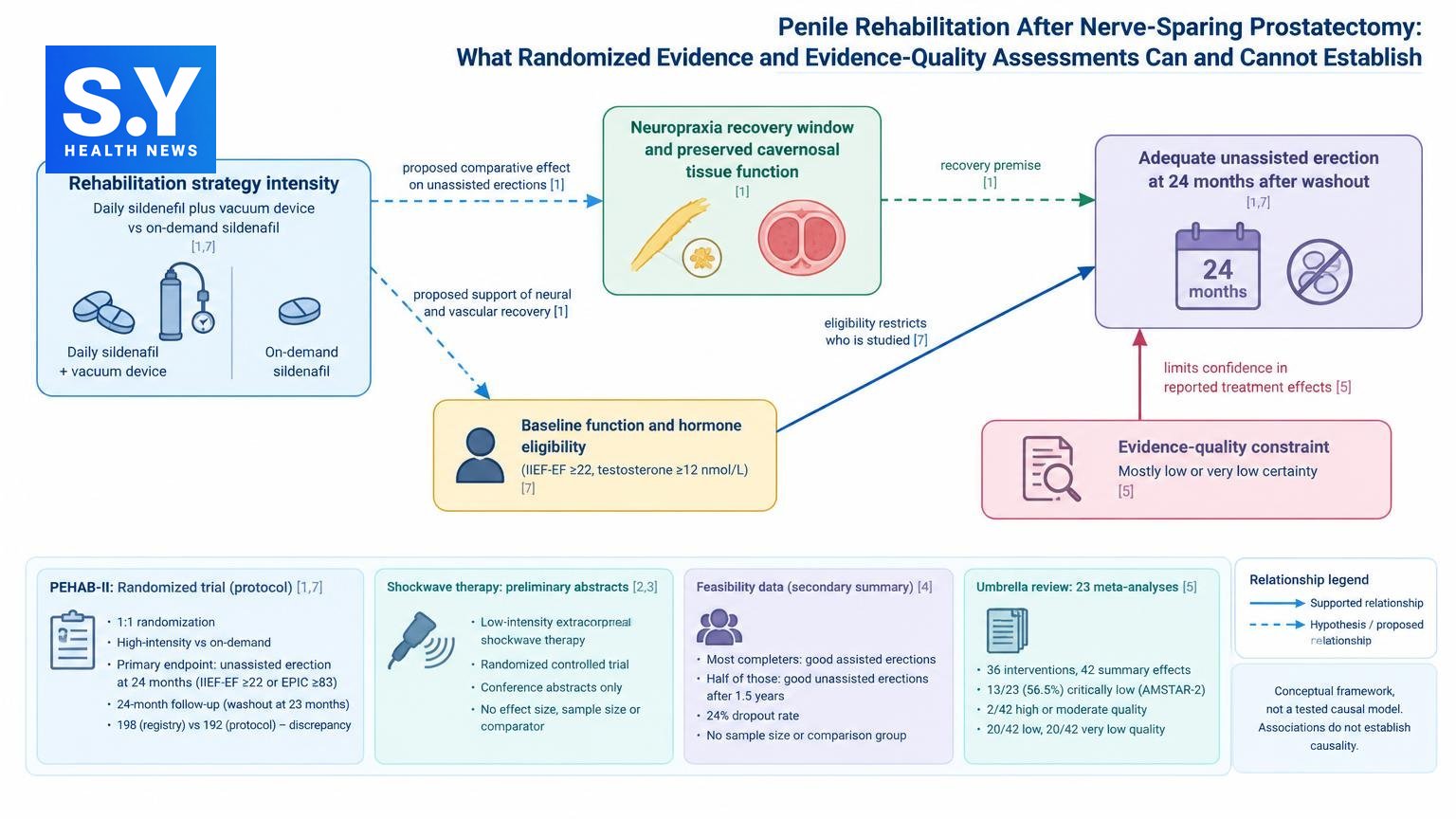
Erectile dysfunction remains common after nerve-sparing radical prostatectomy, yet the protocol rationale for the principal ongoing randomized trial states that the best penile rehabilitation strategy remains unclear because well-designed randomized studies are lacking. That trial, PEHAB-II, is designed to compare 12 months of daily sildenafil plus vacuum device therapy with on-demand sildenafil alone, with the primary endpoint defined as an adequate, unassisted erection at 24 months after surgery. No results from that comparison appear in the available material.[1]
Two other strands of evidence are visible but thin. A randomized trial of low-intensity extracorporeal shockwave therapy for rehabilitation after nerve-sparing robot-assisted radical prostatectomy exists only as preliminary conference abstracts in the supplied material, with no effect size, sample size or comparator reported. A secondary summary of a prospective feasibility study reports that most completers had good assisted erections and half of those reported good unassisted erections after 1.5 years, against a 24% dropout rate.[2][3][4]
Zooming out, an umbrella review of 23 meta-analyses covering 36 interventions found the erectile-dysfunction evidence base predominantly low or very low quality: 13 of 23 meta-analyses (56.5%) were rated critically low on AMSTAR-2, and only two of 42 summary effects were rated high or moderate quality. The practical message is that rehabilitation choices currently rest on a mixture of biological rationale, partially reported trials and low-certainty pooled evidence, not on established comparative effectiveness.[5]
Why This Matters
Prostate cancer surgery injures the erectile mechanism at a point where nerve and vascular function converge. The PEHAB-II rationale describes postoperative erectile dysfunction as arising mainly not from complete transection of the neurovascular bundle but from crushing or overstretching of its fibers, a neuropraxia-type injury that may permit recovery over time. If recovery depends on preserving tissue oxygenation and neural input during that window, then the intensity, timing and duration of rehabilitation could plausibly matter.
This matters to patients because the stakes are quality of life, not survival: the protocol describes postoperative erectile dysfunction as a widely observed side effect of surgery for clinically localized prostate cancer with a substantial impact on quality of life, and notes that rates remain high even after well-performed nerve-sparing surgery. It also matters scientifically, because a plausible mechanism does not establish that a more intensive regimen produces better unassisted erections—only a randomized comparison with an appropriate endpoint can test that.
Biological and Clinical Mechanism
The rationale distinguishes two injury types. Neurotmesis—complete nerve transection—offers little prospect of spontaneous recovery, whereas neuropraxia from neuronal crushing or overstretching leaves the nerve anatomically continuous and potentially recoverable. On that reasoning, penile rehabilitation is proposed to serve two purposes: activating neural recovery and retaining the vasculogenic function of the penile corpora cavernosa during the recovery period.
Pharmacologically, phosphodiesterase type 5 inhibitors such as sildenafil enhance cyclic GMP–mediated smooth-muscle relaxation, and a vacuum device draws blood into the corpora cavernosa mechanically. The proposed logic of combining them is to provide regular erectile tissue engorgement and oxygen delivery while the cavernous nerves recover. This remains a mechanistic hypothesis in the supplied material rather than a demonstrated pathway, and the protocol itself frames the optimal strategy as unresolved.[6]
What the Randomized Evidence Shows—and Does Not Yet Show
PEHAB-II is described as a multicentre, randomized, controlled clinical trial sponsored by the Netherlands Cancer Institute, listed as active and recruiting, with a start date of January 15, 2024 and an estimated completion date of January 1, 2027. The registry lists 198 total participants, while the protocol text states that 192 patients will be included—an internal inconsistency worth noting when interpreting the eventual sample.
The planned comparison randomizes participants 1:1 to a high-intensity arm (daily sildenafil plus vacuum device therapy for 10 minutes a day, five times a week, for 12 months) versus a less intensive arm (on-demand sildenafil before sexual activity). The primary endpoint is an adequate, unassisted erection at 24 months, defined as sufficient for successful intercourse without medication or devices, measured by IIEF-EF of at least 22 after a one-month drug washout, or by a composite EPIC erection score of at least 83 for men not engaging in penetrative sex. Planned follow-up is 24 months with washout at 23 months.[7]
These design features matter for interpretation. The washout protects the unassisted-erection endpoint from being inflated by residual drug effect, and the 24-month horizon aligns with the assumed neuropraxia recovery window. But because the supplied material is a registry protocol, it reports no randomized result: we cannot say whether intensive rehabilitation improves, worsens or leaves unchanged the proportion of men with unassisted erections. Anyone citing PEHAB-II as evidence of benefit would be citing a plan, not a finding.
Shockwave Therapy and Feasibility Data: Preliminary and Fragmented
A second randomized strand concerns low-intensity extracorporeal shockwave therapy delivered for penile rehabilitation after nerve-sparing robot-assisted radical prostatectomy. The supplied records are a conference abstract in a journal supplement (Volume 89, Supplement 1, pages S1–S2, March 2026) and a bibliographic listing of the same work, both titled as preliminary results from a randomized controlled trial. No sample size, comparator, effect estimate, confidence interval or adverse-event data appear in the available text.
This is a meaningful evidence gap rather than a neutral one. Preliminary abstracts can signal that a question is being tested, but they cannot establish efficacy: randomization protects against bias only if the analysis is complete and reported. Conference abstracts are also frequently superseded by full publications with different results. Until full data appear, shockwave therapy for post-prostatectomy rehabilitation should be described as under randomized investigation, not as an established option.
The feasibility summary is even more limited. According to a secondary summary, most patients who completed a rehabilitation program reported good assisted erections, and half of these reported good unassisted erections after 1.5 years of follow-up, with a 24% dropout rate. The same summary asserts that structured rehabilitation significantly reduces erectile dysfunction risk at 24 months while age over 70 increases it. However, no sample size, comparison group, effect size or study design is given, and the results are reported among completers—so the 24% attrition could bias them in either direction.
How Strong Is the Wider Evidence Base?
The umbrella review offers the clearest available answer to the evidence-quality question. Screening 1,191 studies, it extracted 23 published meta-analyses yielding 42 summary effects across 36 interventions, measured with IIEF, IIEF-5, IIEF-EF and the Erection Hardness Score. On AMSTAR-2, 13 meta-analyses (56.5%) were critically low quality, seven (30.5%) low, two (8.7%) moderate and one (4.3%) high. Of the 42 summary effects, only two were rated high and moderate quality respectively, while 20 (47.6%) were low and 20 (47.6%) very low.
The review's conclusion is that the evidence base for erectile dysfunction treatments is predominantly low or very low quality. Statistically significant improvements were observed with both pharmacological and nonpharmacological interventions, but the authors caution that limited patient numbers and the subjective nature of outcome indicators—questionnaire-based erectile function scores—constrain interpretation. They call for further well-designed single-treatment studies and high-quality meta-analyses comparing treatments.
| Variable or construct | Definition in the source | Interpretation |
|---|---|---|
| High-intensity rehabilitation arm | Planned daily sildenafil plus vacuum device therapy for 10 minutes a day, five times a week, for 12 months | An intervention whose comparative effect on unassisted erections is not yet reported |
| Primary endpoint | Adequate unassisted erection at 24 months, IIEF-EF of at least 22 after a one-month drug washout, or EPIC erection score of at least 83 for men not having penetrative sex | A patient-relevant functional outcome designed to avoid counting drug-assisted erections |
| Planned enrollment | 198 participants listed in the registry versus 192 patients stated in the protocol text | Planned figures only; the discrepancy should temper precision assumptions |
| AMSTAR-2 quality of included meta-analyses | 13 of 23 (56.5%) critically low; 7 (30.5%) low; 2 (8.7%) moderate; 1 (4.3%) high | Most pooled reviews underlying erectile-dysfunction treatment claims are methodologically weak |
| Quality of summary effects | Only two of 42 rated high or moderate; 20 (47.6%) low and 20 (47.6%) very low | Statistically significant pooled effects often rest on low-certainty evidence |
| Feasibility program completion | Half of completers reported good unassisted erections after 1.5 years, with 24% dropout | Completer-only result in a feasibility study; attrition limits inference |
Interpretation and Limitations
Several distinctions are essential here. First, statistical significance is not clinical significance: a pooled IIEF-EF improvement that reaches significance may still be smaller than the difference a patient would notice, and the umbrella review's caution about subjective outcome indicators applies directly to penile rehabilitation, where the endpoint is a questionnaire score or a reported ability to have intercourse. Second, association is not causation: the feasibility summary's claim that structured rehabilitation reduces erectile dysfunction risk is a secondary summary without a described design, so it cannot separate rehabilitation effects from selection, surgeon skill, nerve-sparing quality or spontaneous recovery.
Third, these studies enroll a narrow population. PEHAB-II eligibility requires age 18–70, non-metastatic disease, at least unilateral nerve-sparing, good preoperative erections, a pre-diagnostic IIEF-EF of at least 22, and testosterone of at least 12 nmol/L. Men with poor baseline function, low testosterone, more advanced pathology or adjuvant therapy are excluded. Results from such a selected group may not generalize to the broader post-prostatectomy population, and the protocol's own safety exclusions—cardiovascular contraindications to sildenafil, nitrate use, previous pelvic radiation—define a medically screened group.
Fourth, the evidence-quality picture itself has limits. The umbrella review is a repository-deposited synthesis covering studies published up to October 2025; it evaluates reviews, not individual patients, and its counts of critically low ratings describe the meta-analytic literature rather than proving that any specific intervention fails. Low certainty means we are uncertain about the size of an effect, not that an effect is absent.
Finally, safety information in the supplied material is descriptive rather than quantified: sildenafil may cause dyspepsia, dizziness and headache, and vacuum devices cold feeling, pain, hematoma or oedema. These considerations belong in shared decision-making about any rehabilitation regimen and are not a reason to self-direct therapy.
Research Outlook
The field's central need is comparative randomized evidence with patient-relevant, washout-protected endpoints. PEHAB-II is designed to provide exactly that for daily sildenafil plus vacuum device versus on-demand sildenafil, but its estimated completion date of January 1, 2027 means results are not yet available, and the eventual analysis must be judged on its reported sample, adherence, attrition and prespecified endpoint handling.
For shockwave therapy, the priority is full publication of the randomized trial currently visible only as preliminary abstracts, including effect sizes, confidence intervals and adverse events. More broadly, the umbrella review's call for well-designed single-treatment trials and high-quality head-to-head meta-analyses describes the path from a diverse but unreliable treatment landscape to one in which clinicians and patients can compare strategies with confidence.
Key Takeaways
- The optimal penile rehabilitation strategy after nerve-sparing prostatectomy remains unresolved, according to the rationale of the principal ongoing randomized trial; the common problem is real, but comparative effectiveness is not established.
- PEHAB-II plans to compare 12 months of daily sildenafil plus vacuum device therapy with on-demand sildenafil alone, using unassisted erection at 24 months after a drug washout as the primary endpoint; no outcomes are available yet.
- Randomized shockwave-therapy evidence for this setting exists only as preliminary abstracts without reported effect sizes, and a feasibility summary reports completer-only results with 24% dropout.
- An umbrella review of 23 meta-analyses found the erectile-dysfunction evidence base predominantly low or very low quality, with only two of 42 summary effects rated high or moderate.
- Statistically significant questionnaire-score improvements should be read cautiously; they do not by themselves establish a clinically meaningful benefit for individual patients.
Questions and Answers
What is penile rehabilitation after nerve-sparing prostatectomy and what is it intended to do?
It is a structured postoperative program intended to support recovery of erectile function after surgery that stretches or crushes the cavernous nerves. The PEHAB-II rationale proposes two aims: activating neural recovery and preserving the vasculogenic function of the penile corpora cavernosa. Components in the evidence include daily or on-demand sildenafil and vacuum device therapy, but the optimal strategy remains unclear.
What is the PEHAB-II trial comparing in penile rehabilitation after prostatectomy?
PEHAB-II plans to randomize men 1:1 to 12 months of daily sildenafil plus vacuum device therapy (10 minutes a day, five times a week) versus on-demand sildenafil alone. The primary endpoint is an adequate unassisted erection at 24 months, assessed after a one-month drug washout. The trial is listed as recruiting with an estimated completion date of January 1, 2027, so no comparative results are yet available.
Does low-intensity shockwave therapy improve erectile function after nerve-sparing prostatectomy?
That cannot be determined from the available evidence. A randomized trial of low-intensity extracorporeal shockwave therapy for rehabilitation after nerve-sparing robot-assisted radical prostatectomy is described only in preliminary conference abstracts, and the supplied material reports no effect size, sample size, comparator or adverse-event data. Until full results are published, shockwave therapy should be regarded as under randomized investigation rather than established.
How strong is the overall evidence base for erectile dysfunction treatments?
An umbrella review of 23 meta-analyses covering 36 interventions concluded the evidence is predominantly low or very low quality. On AMSTAR-2, 13 of 23 meta-analyses (56.5%) were rated critically low, and only two of 42 summary effects were rated high or moderate quality, with 20 low and 20 very low. Statistically significant improvements were seen, but subjective outcomes and limited patient numbers limit confidence.
What are the limitations of penile rehabilitation studies after radical prostatectomy?
Key limitations include selection of men with good baseline function—PEHAB-II requires a preoperative IIEF-EF of at least 22 and testosterone of at least 12 nmol/L—and questionnaire-based, partly subjective endpoints. Attrition matters: one feasibility summary reported a 24% dropout rate with results among completers only. Much of the wider treatment literature also carries critically low or low methodological quality ratings.
Why does an unassisted erection endpoint with a drug washout matter in rehabilitation trials?
An unassisted erection at 24 months, measured after a one-month washout, tests whether function recovered rather than whether medication can temporarily produce an erection. PEHAB-II defines this endpoint as an erection sufficient for intercourse without medication or devices, using IIEF-EF of at least 22 or an EPIC score of at least 83 for men not having penetrative sex.
Conceptual framework: Conceptual framework, not a tested causal model. Built from the PEHAB-II protocol and an umbrella review, it shows the proposed link between rehabilitation strategy intensity and unassisted erections at 24 months, modified by the neuropraxia recovery premise and restricted by baseline eligibility; a separate constraint node reflects predominantly low or very low certainty across the treatment evidence base.
Academic References & Evidence
- PEnile ReHABilitation After Nerve Sparing Robot-assisted Radical Prostatectomy for Prostate Cancer 2.0 (PEHAB-II). (protocol)
- Mastroianni, Riccardo; Bologna, Eugenio; Chiacchio, Giuseppe; Anceschi, Umberto. LOW-INTENSITY EXTRACORPOREAL SHOCKWAVE THERAPY ON PENILE REHABILITATION AFTER NERVE SPARING ROBOT-ASSISTED RADICAL PROSTATECTOMY: PRELIMINARY RESULTS FROM A RANDOMIZED CONTROLLED TRIAL-学者服务. The Journal of Urology
- R. Mastroianni; E. Bologna; G. Chiacchio; U. Anceschi; A.M. Bove; A. Brassetti; S. D'Annunzio; M. Ferriero; R.S. Flammia; S. Guaglianone; M.R. Barletta; G. Spadaro; G. Atzu; L.C. Licari; L. Misuraca; F. Proietti; G. Tuderti; C. Leonardo; O. Simone; G. Simone. A0717 Low-intensity extracorporeal shockwave therapy on penile rehabilitation after nerve sparing robot-assisted radical prostatectomy: Preliminary results from a randomized controlled trial. 2026 89(Supplement 1):S1-S2 PMID: 10.1097/01.JU.0001191396.05243.57.17.
- I. Cox | Semantic Scholar.
- Current treatment for erectile dysfunction: an umbrella review of systematic reviews and meta-analyses.
- Erectile Dysfunction.
- PEnile ReHABilitation After Nerve Sparing Robot-assisted Radical Prostatectomy for Prostate Cancer 2.0 (PEHAB-II). (protocol)
SANYUN Science Center explains published research on men's reproductive and sexual health, connecting scientific evidence with everyday questions while making sources and limitations clear.
Disclaimer: This article is for scientific education and research communication only. It does not provide medical advice, diagnosis, or individualized treatment recommendations, and does not endorse any medication, supplement, device, penile enlargement procedure, or other intervention. Decisions about sexual and reproductive health should be made in consultation with a qualified healthcare professional. Do not delay seeking professional care because of information in this article.
Original Content & Copyright Notice
- This article is prepared for SANYUN Science Center, drawing on published research and publicly available academic literature on men’s sexual and reproductive health. Its editorial explanations and presentation are developed for this platform.
- Copyright in the original editorial content, selection, and arrangement is reserved by SANYUN Science Center to the extent protected by applicable law. Referenced research, quotations, and third-party materials remain subject to the rights of their respective owners. This notice does not claim ownership of scientific facts or third-party research.
- Except where permitted by applicable law or an applicable license, prior written permission is required to reproduce, republish, translate, adapt, redistribute, or commercially reuse protected content. Attribution alone does not grant permission for such reuse.
- For permitted quotation or authorized reuse, clearly identify the source and retain a link to the original article.
- Source: SANYUN Science Center
- Original URL: Retain the original article URL on science.san-yun.com.
- Copyright Holder: SANYUN Science Center, for its own protected editorial content.
- Quotation, excerpts, or authorized reuse must not distort the scientific meaning, omit material limitations or disclaimers, or imply unverified medical claims, product efficacy, or endorsement by SANYUN Science Center.



