




Category: Erectile Dysfunction
Core Research Direction: Ongoing randomized trial (PEHAB-II) testing whether intensive penile rehabilitation (daily sildenafil plus vacuum device) versus on-demand sildenafil improves recovery of unassisted erectile function at 24 months after nerve-sparing radical prostatectomy, framed by the neuropraxia mechanism and the post-prostatectomy ED burden.
Search Intent: After nerve-sparing radical prostatectomy, does intensive penile rehabilitation with daily sildenafil plus a vacuum device produce more unassisted erections at 24 months than on-demand sildenafil alone, and what does the ongoing randomized evidence actually establish so far?
Platform: SANYUN Science Center
Evidence reviewed through: 2026-10-30
Executive Summary
Men who undergo nerve-sparing radical prostatectomy for localised prostate cancer often retain the anatomical nerves but still lose reliable erections. The PEHAB-II trial was designed around a specific claim: that this postoperative erectile dysfunction is driven mainly by neuronal crushing or overstretching, rather than by complete nerve transection, and that early, structured penile rehabilitation may therefore protect both neural recovery and the vascular tissue of the corpora cavernosa. The trial randomises participants to 12 months of daily sildenafil combined with vacuum device therapy, or to on-demand sildenafil as standard of care.[1]
The primary endpoint is a genuinely demanding one: an adequate, unassisted erection at 24 months after surgery, defined as sufficient for intercourse without medication or devices, and measured by IIEF-EF ≥22 after a one-month drug washout or by an EPIC erectile score ≥83 among men not engaging in penetrative sex. The importance of this endpoint is that it separates durable recovery from treatment-assisted function. As of the available registry records, the trial is ongoing and no comparative outcome data have been posted. Its registrations disagree on several design details, including planned enrollment and sildenafil dose, and the design is open-label.[2]
Why Post-Prostatectomy Erectile Function Matters
Postoperative erectile dysfunction is described in the trial background as a widely observed consequence of prostate cancer surgery for clinically localised disease, with a substantial impact on quality of life. Nerve-sparing technique has improved erectile outcomes, yet the same background states that dysfunction rates remain high even after well-performed nerve-sparing surgery. One Dutch-language registry background goes further, stating that full erectile recovery after nerve-sparing prostate surgery occurs in fewer than half of patients. That statement is presented without a cited denominator or study, so it should be read as context rather than as a precise benchmark.[3]
The practical stakes are not limited to intercourse. The trial's secondary endpoints include assisted and unassisted erectile function, time to recovery, penile length, broader sexual functions, climacturia, feelings of masculinity, health-related quality of life for patients and partners, adherence, side effects, and comparison of two sexual function questionnaires. This breadth acknowledges that surgical recovery affects couples and self-image, not just a single physiological measurement. It also reflects a design question that has troubled the field: which instrument best captures meaningful erectile recovery after pelvic surgery.
The Neuropraxia Rationale
The mechanistic case for rehabilitation rests on a distinction between nerve injury types. The trial background argues that erectile dysfunction after nerve-sparing prostatectomy is not primarily caused by complete transection, or neurotmesis, but rather by neuronal crushing and/or overstretching, termed neuropraxia, of the neurovascular bundle running alongside the prostate toward the erectile tissue. Neuropraxia implies preserved nerve continuity with temporary functional impairment, which in principle creates a window for recovery. This is a rationale, not a demonstrated trial finding.
From that premise, the background proposes that postoperative care may be insufficient to consolidate the effects of nerve-sparing surgery, because penile rehabilitation is needed to activate neural recovery and to retain the vasculogenic function of the corpora cavernosa. The Dutch registry background adds a related claim: that the interval during which nerves cannot properly transmit signals to the penis may last 2 to as long as 4 years, during which infrequent erections may cause the erectile bodies to lose elasticity. These are explicitly framed as suggestions and background estimates, and the 24-month trial horizon is therefore a practical compromise rather than a guarantee that recovery is complete by then.
What the Trial Actually Tests
PEHAB-II is described as a prospective, multicentre, randomized, controlled trial designed to assess the effect of two rehabilitation strategies on recovery of erectile function in nerve-sparing prostatectomy patients. The comparison is between intensity levels rather than between rehabilitation and no treatment: both arms receive a phosphodiesterase type 5 inhibitor, and the active comparator is described as standard of care. This matters for interpretation, because a null result would not show that sildenafil is ineffective; it would speak only to whether daily dosing plus mechanical therapy adds benefit over on-demand dosing.
| Measure / finding | Result | Population / follow-up | Limitations |
|---|---|---|---|
| The two trial arms are: 12 months of daily sildenafil 100 mg plus vacuum device therapy 10 minutes a day five times a week, versus on-demand sildenafil 100 mg monotherapy as standard of care. | nerve-sparing prostatectomy patients; 12 months of therapy | Planned intervention; doses differ slightly from other registry records (75/100 mg). | |
| Patients are randomized 1:1 to daily sildenafil 75/100 mg for 12 months plus vacuum device 10 min/day five times weekly, versus on-demand sildenafil 75/100 mg before sexual activity. | nerve-sparing prostatectomy patients; 12 months | Planned intervention; sildenafil dose range differs from the 100 mg in the sponsor listing. | |
| adequate unassisted erection at 24 months | nerve-sparing prostatectomy patients; 24 months after surgery | Planned endpoint; no observed results. | |
| IIEF-EF >=22; EPIC erectile score >=83 | nerve-sparing prostatectomy patients; after a one-month drug washout (at 23–24 months) | Planned measurement definition. | |
| Each patient is followed for 24 months. | 24 months per patient | 24 months | Follow-up duration planned. |
| The trial is open-label (no masking). | Open-label design may introduce bias in patient-reported outcomes. |
The intensive arm is planned as 12 months of daily sildenafil 100 mg plus vacuum device therapy for 10 minutes a day, five times a week; the comparator is on-demand sildenafil 100 mg monotherapy. The Dutch registry describes the same contrast using a 75/100 mg sildenafil dose range, and describes vacuum pump use as 5×2 minutes per day, five times weekly. The dose range and device-duration wording differ between records, which is a reminder that registry summaries are not the final protocol. After the first 12 months, treatment intensity can be adjusted for the next 12 months up to the full 24-month neuropraxia recovery window, with intracavernosal injection therapy available as an optional intensification rather than as part of the rehabilitation programme itself.
The Endpoint Is Unassisted Recovery, Not Assisted Function
The primary endpoint is an adequate, unassisted erection at 24 months after surgery, defined as an erection sufficient for successful intercourse without medication or devices. Operationally, this requires IIEF-EF ≥22 after a one-month drug washout, or an EPIC erectile score summing Q8b, Q9 and Q10 of ≥83 for men who did not participate in penetrative sex. The washout is the critical design feature: it prevents an on-treatment measurement from being mistaken for recovered spontaneous function. The EPIC alternative acknowledges that men without a partner or without penetrative activity would otherwise be unmeasurable.
Eligibility further shapes what the result will mean. Participants needed a pre-diagnostic IIEF-EF ≥22, with or without PDE5 inhibitor use, alongside a history of erections good enough for intercourse and at least unilateral nerve-sparing. Men with poor baseline function, previous pelvic radiotherapy, androgen deprivation therapy, or adjuvant radiotherapy or hormonal therapy were excluded. A trial enrolling only men with good preoperative erections and partial nerve preservation cannot be generalised to all men undergoing radical prostatectomy, particularly those with bilateral non-nerve-sparing surgery.
Where the Evidence Currently Stands
No comparative efficacy result is available. The registry records state that recruitment has stopped, and the sponsor listing describes the study as active and recruiting at one site, with an estimated completion date of January 1, 2027 after a start date of January 15, 2024. Each participant is followed for 24 months. Given that endpoints are assessed at 24 months, mature primary outcome data should not be expected before the follow-up window closes for the last enrolled participant. Until a results publication or posting appears, any claim that intensive rehabilitation does or does not improve unassisted erections remains a hypothesis under test.
The background itself concedes the evidence gap that motivated the trial: the best penile rehabilitation strategy to reduce postoperative erectile dysfunction remains unclear because well-designed randomized studies are lacking. That concession is important for readers encountering promotional claims. The existence of a large randomised trial does not itself establish benefit; it establishes that the question is being asked with a design capable of answering it. Earlier, smaller or non-randomised rehabilitation studies are not summarised in the available records and should not be treated as confirming the PEHAB-II hypothesis.
Interpretation and Limitations
The most consequential limitation is the open-label design: masking is not used. Erectile function is measured by self-report questionnaires, and participants who devote 12 months to daily medication and five weekly vacuum sessions may report differently from those taking a tablet before sex, independently of physiological change. Men who tolerate and adhere to an intensive regimen may also differ from those who do not. Randomisation protects against measured and unmeasured confounding at baseline, but it does not blind participants or clinicians to assignment, and adherence and side-effect endpoints may themselves be reported differently between arms.
The protocol also permits treatment intensification after 12 months in both arms, with on-demand PDE5 inhibitors, vacuum device use and injection therapy allowed during the second year according to patient preference and need. This is clinically sensible, since withholding effective treatment for a year would be difficult to justify, but it dilutes the contrast between arms over the period in which the primary endpoint is measured. A difference at 24 months would therefore reflect the initial 12-month strategy plus whatever subsequent care each participant chose, not a pure comparison of 12 months of daily therapy against on-demand therapy.[4]
Registry records are also inconsistent. Planned enrollment appears as 198 participants in one listing, 242 in the Dutch registry, and 192 in the sponsor's trial-population description. The intensive-arm sildenafil dose is stated as 100 mg in one record and as a 75/100 mg range in another, and vacuum device duration appears as 10 minutes daily in some records and as 5×2 minutes daily in the Dutch version. These discrepancies may reflect amendments, translation differences, or aggregator error, but they mean the exact protocol should be confirmed from the final methods publication rather than from any single listing.
Finally, the 24-month horizon rests on a background estimate that nerve recovery may take 2 to as long as 4 years. If that estimate is correct, a 24-month primary endpoint could classify some men as failures who would have recovered later, potentially understating the benefit of a strategy that protects tissue during a longer recovery window. Conversely, a strategy that merely accelerates recovery without changing the final proportion of men with unassisted erections would look positive at earlier time points but neutral at 24 months. The choice of endpoint timing is therefore an interpretive commitment, not a neutral technical detail.
Research Outlook
The trial's secondary analyses may be as informative as the primary comparison. Time to recovery, assisted versus unassisted function, penile length, partner-reported outcomes, and the head-to-head comparison of two sexual function questionnaires could clarify whether intensive rehabilitation mainly speeds recovery, preserves tissue, or changes neither. The inclusion of gay and bisexual men and the separate analysis of men not engaging in penetrative sex also address a longstanding measurement gap, since most erectile function instruments were validated in heterosexual penetrative contexts. These are exploratory questions, and their results should be reported with the same caution as the primary endpoint.
For clinicians and patients, the appropriate posture until results are available is genuine equipoise. Daily sildenafil plus a vacuum device is a burdensome regimen with recognised side effects including dyspepsia, dizziness, headache, and device-related cold sensation, pain, haematoma or oedema, described as temporary and resolving within 25 hours. Whether that burden is justified for a better chance of unassisted erection at 24 months is precisely what PEHAB-II was built to answer. It is not a question that registry summaries, mechanistic reasoning, or the existence of an ongoing trial can settle in advance.
Key Takeaways
- PEHAB-II is an ongoing, open-label, multicentre randomized trial comparing 12 months of daily sildenafil plus vacuum device therapy with on-demand sildenafil after nerve-sparing radical prostatectomy.
- The primary endpoint is an unassisted erection sufficient for intercourse at 24 months, measured by IIEF-EF ≥22 after a one-month drug washout or EPIC erectile score ≥83 for men not engaging in penetrative sex.
- The mechanistic rationale is neuropraxia rather than neurotmesis, with rehabilitation proposed to support neural recovery and preserve corpora cavernosa vasculogenic function; this remains a stated hypothesis, not a demonstrated result.
- No comparative outcome data have been posted; recruitment status and enrollment figures differ across registry records, and the trial is not expected to complete until January 1, 2027 on the sponsor listing.
- Eligibility required good preoperative erectile function (IIEF-EF ≥22) and at least unilateral nerve-sparing, so results will not automatically generalise to men with poorer baseline function or more extensive nerve sacrifice.
Questions and Answers
What is penile rehabilitation after nerve-sparing prostatectomy?
It is a structured postoperative programme intended to maintain penile tissue and support nerve recovery while erectile function is impaired. In PEHAB-II, the intensive version is planned as 12 months of daily sildenafil plus vacuum device therapy 10 minutes a day, five times a week. The comparator is on-demand sildenafil, so the trial tests intensity, not rehabilitation versus nothing.
Why does the trial focus on neuropraxia?
The background argues that post-prostatectomy erectile dysfunction is caused mainly by crushing or overstretching of the neurovascular bundle rather than complete nerve transection. Because neuropraxia implies preserved nerve continuity, the investigators propose that early rehabilitation may activate neural recovery and preserve the vasculogenic function of the corpora cavernosa. This is an explicit rationale, not a demonstrated trial finding.
What is the primary outcome and why does the washout matter?
The primary endpoint is an adequate, unassisted erection at 24 months, sufficient for intercourse without medication or devices, defined as IIEF-EF ≥22 after a one-month drug washout, or EPIC erectile score ≥83 for men not engaging in penetrative sex. The washout prevents an on-treatment erection from being counted as recovered spontaneous function, which is the clinically meaningful distinction.
Has the trial reported whether intensive rehabilitation works better?
No comparative efficacy result is available in the registry records reviewed. Recruitment has been listed as stopped, and the sponsor listing gives an estimated completion date of January 1, 2027 with 24-month per-patient follow-up. Until results are published or posted, the comparative benefit of daily sildenafil plus a vacuum device over on-demand sildenafil remains unknown.
How strong is the evidence, and what are the main design limits?
The design is a randomised controlled trial, which is appropriate for the question, but it is open-label, so self-reported erectile outcomes may be influenced by expectations. Treatment can be intensified after 12 months in both arms, diluting the contrast, and registry records disagree on enrollment and dosing. These are protocol and reporting limitations, not evidence of ineffectiveness.
Who will the results apply to?
Eligible men were aged 18 to 70 with non-metastatic disease, good preoperative erections (IIEF-EF ≥22), and at least unilateral nerve-sparing, and they were motivated to complete a rehabilitation programme. Men with poor baseline function, prior pelvic radiotherapy, androgen deprivation, or adjuvant therapy were excluded. Results therefore apply best to men with favourable baseline function and partial nerve preservation, not to all prostatectomy patients.
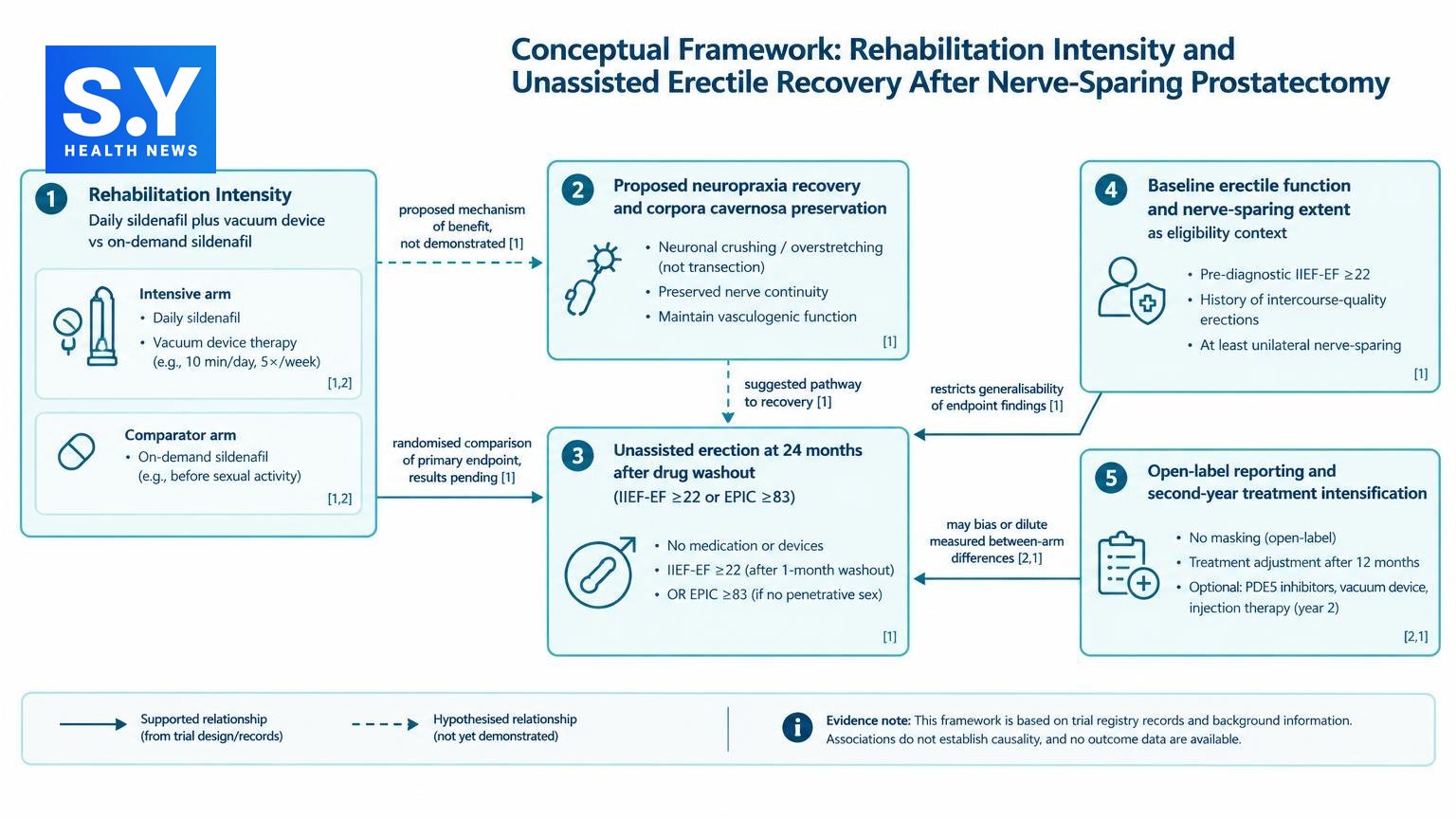
Conceptual framework: Conceptual framework of the PEHAB-II research question. The figure links the randomised comparison of daily sildenafil plus vacuum device versus on-demand sildenafil to the planned 24-month unassisted-erection endpoint, with the neuropraxia rationale shown as a proposed rather than established pathway. Eligibility context and open-label or treatment-intensification factors are included as interpretive limits. This framework is an editorial synthesis of trial registry records, not a tested causal model, and no outcome data are implied.
Academic References & Evidence
- PEnile ReHABilitation After Nerve Sparing Robot-assisted Radical Prostatectomy for Prostate Cancer 2.0 (PEHAB-II).
- M. P. J. Nicolai. PEnile ReHAbilitation After Nerve Sparing Robot-assisted Radical Prostatectomy for Prostate Cancer 2.0, a Multicenter, Randomized Clinical Trial.
- M. P. J. Nicolai. Peniele rehabilitatie na zenuwsparende robot-geassisteerde prostatectomie voor gelokaliseerd prostaatkanker 2.0, een multicenter, gerandomiseerde studie.
- PEHAB-II Phase 4 — 3 sites, 4 sponsors, updated Mar 2025 | DataLookout.
SANYUN Science Center explains published research on men's reproductive and sexual health, connecting scientific evidence with everyday questions while making sources and limitations clear.
Disclaimer: This article is for scientific education and research communication only. It does not provide medical advice, diagnosis, or individualized treatment recommendations, and does not endorse any medication, supplement, device, penile enlargement procedure, or other intervention. Decisions about sexual and reproductive health should be made in consultation with a qualified healthcare professional. Do not delay seeking professional care because of information in this article.
Original Content & Copyright Notice
- This article is prepared for SANYUN Science Center, drawing on published research and publicly available academic literature on men’s sexual and reproductive health. Its editorial explanations and presentation are developed for this platform.
- Copyright in the original editorial content, selection, and arrangement is reserved by SANYUN Science Center to the extent protected by applicable law. Referenced research, quotations, and third-party materials remain subject to the rights of their respective owners. This notice does not claim ownership of scientific facts or third-party research.
- Except where permitted by applicable law or an applicable license, prior written permission is required to reproduce, republish, translate, adapt, redistribute, or commercially reuse protected content. Attribution alone does not grant permission for such reuse.
- For permitted quotation or authorized reuse, clearly identify the source and retain a link to the original article.
- Source: SANYUN Science Center
- Original URL: Retain the original article URL on science.san-yun.com.
- Copyright Holder: SANYUN Science Center, for its own protected editorial content.
- Quotation, excerpts, or authorized reuse must not distort the scientific meaning, omit material limitations or disclaimers, or imply unverified medical claims, product efficacy, or endorsement by SANYUN Science Center.



