




Category: Latest Research
Core Research Direction: Comparing an intensive 12-month penile rehabilitation regimen (daily sildenafil plus vacuum erection device) versus on-demand sildenafil alone for recovery of unassisted erectile function after nerve-sparing robot-assisted radical prostatectomy (PEHAB-II protocol)
Search Intent: Does intensive daily sildenafil plus vacuum device therapy during the first year after nerve-sparing radical prostatectomy improve unassisted erectile function at 24 months compared with on-demand sildenafil alone?
Platform: SANYUN Science Center
Evidence reviewed through: 2026-11-23
Executive Summary
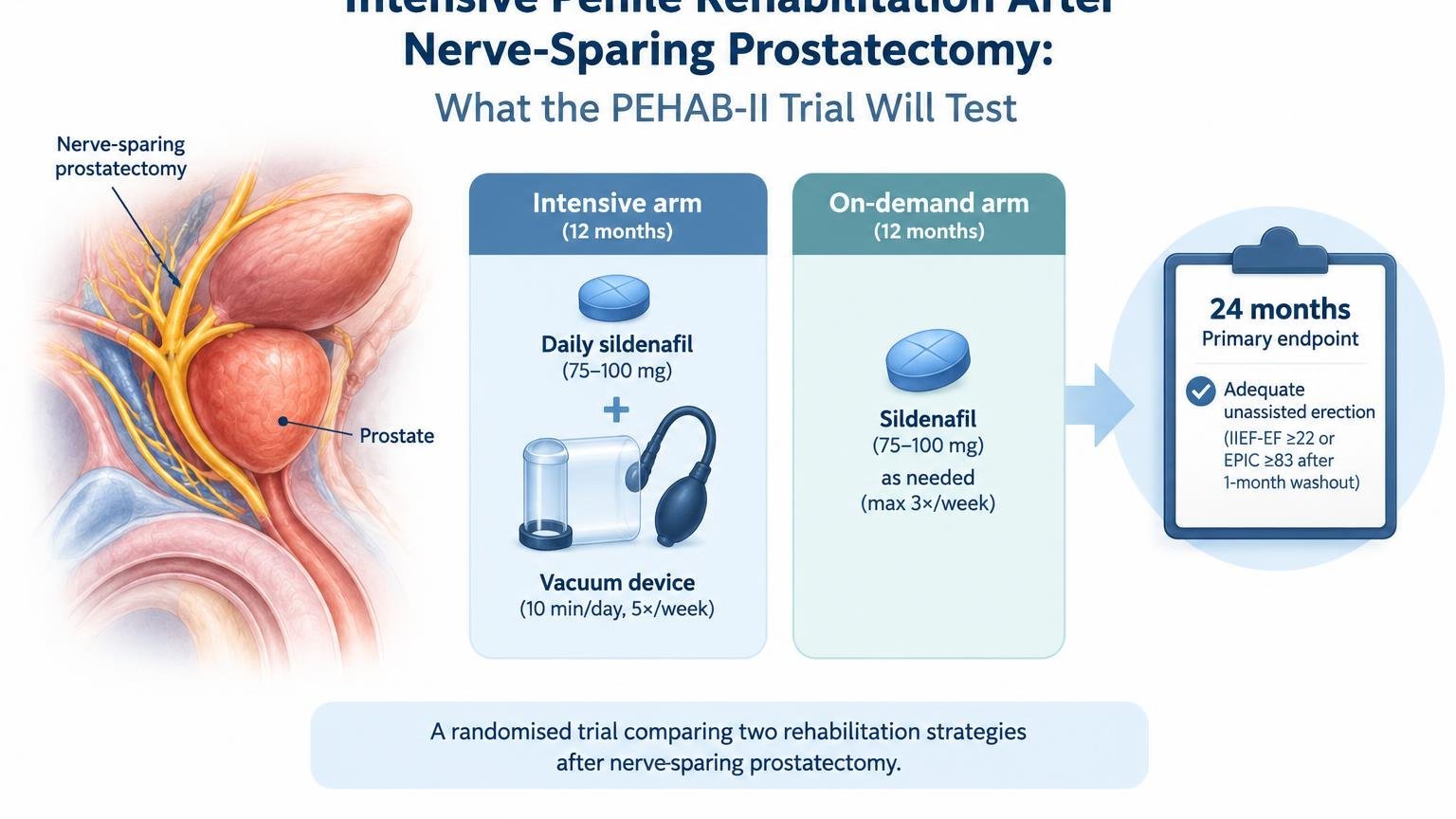
PEHAB-II is a prospective, randomised, multicentre trial in the Netherlands comparing two penile rehabilitation strategies in men who have undergone nerve-sparing radical prostatectomy for localised prostate cancer. One arm receives 12 months of daily sildenafil combined with a vacuum erection device used 10 minutes a day, five times a week; the other receives on-demand sildenafil as standard of care.[1]
The primary endpoint is an adequate unassisted erection at 24 months after surgery — that is, an erection sufficient for intercourse without medication or devices, measured after a one-month drug washout. As of this evidence review, the trial is still recruiting and no comparative results have been published. Everything below describes the design and its rationale, not an answer.[2]
This matters because postoperative erectile dysfunction remains common even after well-performed nerve-sparing surgery, and the protocol's authors state that the best rehabilitation strategy is unclear due to a lack of well-designed randomised studies. PEHAB-II is an attempt to fill that specific gap.
Why This Matters
Erectile dysfunction after prostate cancer surgery has a substantial impact on quality of life, and nerve-sparing technique has improved outcomes without eliminating the problem. Men considering surgery are often told that recovery takes time and that rehabilitation may help, but the evidence base behind specific regimens has been thin. A trial that directly compares an intensive daily programme with standard on-demand dosing addresses a practical question men and clinicians actually face.
The trial also reflects a shift in how postoperative sexual recovery is framed: not as waiting for nerves to heal, but as an active period in which tissue oxygenation and nerve signalling might be supported. Whether that framing is correct is precisely what the trial is designed to test rather than assume.
The Biological Rationale Being Tested
The protocol's mechanistic argument is specific. Erectile dysfunction after nerve-sparing prostatectomy is described as arising mainly from neuropraxia — crushing or overstretching of the neurovascular bundle that runs alongside the prostate toward the erectile tissue — rather than from complete transection of those nerves. Neuropraxia is potentially recoverable, which is why a time-limited window of intensive support is biologically plausible.
From that premise, the authors suggest that penile rehabilitation may help activate neural recovery and preserve the vasculogenic function of the corpora cavernosa. Daily PDE5 inhibition is proposed to maintain perfusion and tissue health during the recovery period, while vacuum therapy is proposed to draw oxygenated blood into the penis and prevent structural changes associated with disuse. These are hypotheses motivating the trial, not established effects.
The 24-month horizon is consistent with this model: if recovery depends on nerve repair over many months, an endpoint assessed only weeks or a few months after surgery could miss the effect or misattribute it. The protocol explicitly links the 24-month window to full neuropraxia recovery time.
How the Two Arms Compare
Participants are randomised 1:1. The intensive arm receives daily sildenafil at 75–100 mg for 12 months plus vacuum device therapy for 10 minutes a day, five times a week. The comparator arm receives sildenafil 75/100 mg on demand before sexual activity, capped at a maximum of three times a week, which the protocol characterises as standard of care.
After the first 12 months, treatment intensity can be adjusted for a further 12 months until the 24-month recovery window is reached. Intracavernosal injection therapy with papaverine/phentolamine is available as an optional auxiliary option for men who do not want to wait for spontaneous erections; it is not a mandatory part of the programme and is not randomised.
That design choice is honest to clinical practice but complicates interpretation. If men in one arm use injection therapy more often than the other, differences at 24 months could reflect adjunct use as well as the randomised regimen. Readers should expect the eventual publication to report adjunct uptake by arm.
| Feature | Intensive arm | On-demand arm | Why it matters for interpretation |
|---|---|---|---|
| Active therapy duration | 12 months of daily sildenafil plus vacuum device 10 minutes/day, five times weekly | 12 months of sildenafil on demand, maximum three times weekly | The comparison tests schedule intensity, not the drug itself |
| Primary endpoint | Adequate unassisted erection at 24 months | Adequate unassisted erection at 24 months | Both arms judged on the same unassisted standard |
| Endpoint measurement | IIEF-EF >=22 after one-month washout, or EPIC erection score >=83 if no penetrative sex | Same thresholds | Washout separates drug-assisted from recovered function |
| Post-12-month flexibility | Intensity may be adjusted; optional injection therapy | Intensity may be adjusted; optional injection therapy | Optional adjuncts can dilute the randomised contrast |
| Masking | Open label | Open label | Subjective questionnaire outcomes are susceptible to expectation effects |
Who Is Being Studied
The planned population is men aged 18 to 70 with non-metastatic, localised prostate cancer treated with nerve-sparing radical prostatectomy as primary therapy. Eligibility requires at least unilateral nerve sparing or a favourable fascia preservation score, preoperative erections adequate for intercourse, a preoperative IIEF-EF of at least 22 with or without PDE5 inhibitors (or an EPIC erection score of at least 83 for men without a partner or not engaging in penetrative sex), and testosterone of at least 12 nmol/L.
These criteria define a comparatively favourable group: men who had good erections before surgery, have adequate testosterone, and retain at least partial nerve preservation. Findings will therefore not automatically generalise to men with poor preoperative function, bilateral non-nerve-sparing surgery, low testosterone, or those requiring adjuvant radiotherapy or hormonal therapy, all of which are excluded.
Enrolment figures in the supplied listings are not fully consistent: one location states a planned 192 patients, while the registry summary reports an estimated 198 participants. Both are targets rather than observed recruitment, and the discrepancy should be resolved in the final report.
What the Evidence Shows So Far
At the time of this review, there are no comparative efficacy results. The trial started on 15 January 2024 according to the registry, is listed as active and recruiting, and has an estimated completion date of 1 January 2027. The sponsor is the Netherlands Cancer Institute. Until publication, any claim that daily sildenafil plus vacuum therapy restores erections better than on-demand sildenafil is a prediction, not a finding.
What the protocol does establish is a set of measurement decisions. The primary endpoint is deliberately strict: an unassisted erection sufficient for intercourse, assessed after a one-month washout during month 23. This avoids counting drug-assisted erections as recovery, which is a common source of inflated success rates in rehabilitation literature.
Secondary endpoints broaden the picture beyond the single primary question. They include assisted and unassisted erectile function, time to recovery, penile length, other sexual functions, climacturia, feelings of masculinity, health-related quality of life, differences between heterosexual and gay or bisexual participants, adherence, side effects, and a head-to-head comparison of two sexual function questionnaires.
Interpretation and Limitations
Several design features will shape how the eventual results should be read. The trial is open label, with no masking, and the primary outcome is derived from self-reported questionnaires. Men assigned to a demanding daily regimen may report differently because they have invested more effort, and clinicians delivering care are aware of allocation. This does not invalidate the trial, but it means effect sizes should be interpreted with expectation bias in mind.
Adherence is another uncertainty. Daily sildenafil for 12 months plus vacuum device use five times a week is burdensome, and the protocol lists adherence and side effects as secondary endpoints. Sildenafil may cause dyspepsia, dizziness and headache, while vacuum therapy may cause cold sensation, pain, haematoma or oedema; the protocol describes these as temporary and subsiding within 25 hours. Real-world tolerability could narrow any benefit observed under trial conditions.
The post-12-month flexibility is a further interpretive caveat. Because treatment intensity can be adjusted and injection therapy is optional, the 24-month comparison reflects the randomised first year plus whatever each man subsequently chose, rather than a pure contrast of two fixed regimens. That mirrors real care but blurs the causal question.
Finally, the trial is sited in the Netherlands and requires Dutch literacy, which limits extrapolation to other health systems and languages. Its results will be most directly applicable to men resembling the eligibility profile: good preoperative function, preserved testosterone, and at least unilateral nerve sparing.
Research Outlook
The key readout will be the proportion of men in each arm achieving an adequate unassisted erection at 24 months, with time-to-recovery curves and penile length as supporting signals. If the intensive regimen shows a clinically meaningful advantage, the next questions will concern cost, burden and which patients benefit most. If it does not, that would be a genuinely useful negative result, because it would argue against imposing a demanding daily schedule on all men after nerve-sparing surgery.
Until then, the honest position is that penile rehabilitation after prostatectomy remains an area of active uncertainty. The trial's own authors frame the current state as a lack of well-designed randomised evidence, and PEHAB-II is a direct response to that gap rather than confirmation of a settled practice.
Key Takeaways
- PEHAB-II is a randomised, open-label, multicentre Dutch trial comparing 12 months of daily sildenafil plus vacuum device therapy with on-demand sildenafil in men after nerve-sparing prostatectomy.
- The primary endpoint is an adequate unassisted erection at 24 months, defined as IIEF-EF of at least 22 after a one-month washout, or EPIC erection score of at least 83 for men not engaging in penetrative sex.
- No outcome data are available yet; the registry lists active recruitment, a January 2024 start and an estimated completion date of 1 January 2027.
- Eligibility requires good preoperative erections, at least unilateral nerve sparing and testosterone of at least 12 nmol/L, so results will apply mainly to a favourable-risk surgical population.
- Open-label design, optional injection therapy after 12 months and inconsistent enrolment targets of 192 versus 198 are caveats to keep in mind when results appear.
Questions and Answers
What is penile rehabilitation after nerve-sparing prostatectomy and what does PEHAB-II test?
Penile rehabilitation is a structured postoperative programme intended to support recovery of erectile function after prostate cancer surgery. PEHAB-II randomises men to 12 months of daily sildenafil plus a vacuum erection device used 10 minutes a day, five times a week, versus on-demand sildenafil alone. The primary question is whether the intensive regimen produces more unassisted erections at 24 months.
Does daily sildenafil plus a vacuum device improve erections 24 months after prostatectomy?
That is not yet known. PEHAB-II was designed to answer this question, but as of this review no comparative results have been published; the trial is listed as active and recruiting with an estimated completion date of 1 January 2027. Any current claim of superiority for the intensive regimen is a hypothesis rather than an established finding.
How is an adequate unassisted erection defined in the PEHAB-II trial?
It is an erection sufficient for successful intercourse without medication or devices. Operationally, that means an IIEF-EF score of at least 22 after a one-month drug washout, or an EPIC erection score of at least 83 for men who do not engage in penetrative sex. The washout prevents drug-assisted erections from being counted as recovery.
Why does the PEHAB-II protocol focus on neuropraxia rather than nerve transection?
The protocol's rationale holds that post-prostatectomy erectile dysfunction mainly reflects crushing or overstretching of the neurovascular bundle — neuropraxia — rather than complete transection. Because neuropraxia is potentially reversible over months, the authors suggest that rehabilitation might support neural recovery and preserve corpora cavernosa function. These remain motivating hypotheses, not demonstrated effects.
Who is eligible for the PEHAB-II penile rehabilitation trial?
Eligible men are 18 to 70 years old with non-metastatic localised prostate cancer treated by nerve-sparing prostatectomy, with at least unilateral nerve sparing, good preoperative erections (IIEF-EF at least 22 or EPIC score at least 83), and testosterone of at least 12 nmol/L. Men needing adjuvant radiotherapy or hormonal therapy, or with prior pelvic radiation, are excluded.
What are the main limitations of the PEHAB-II trial design?
The trial is open label, so self-reported erectile outcomes may be influenced by expectation. After 12 months, treatment can be adjusted and optional injection therapy may be used, which blurs the randomised comparison. Enrolment is listed inconsistently as 192 and 198 patients, and results will apply mainly to men with favourable preoperative function and preserved testosterone.
Sources and References
- Inge Cox; Melianthe Nicolai. PEnile ReHABilitation After Nerve Sparing Robot-assisted Radical Prostatectomy for Prostate Cancer 2.0 (PEHAB-II). (protocol)
- PEnile ReHABilitation After Nerve Sparing Robot-assisted Radical Prostatectomy for Prostate Cancer 2.0 (PEHAB-II). (protocol)
SANYUN Science Center explains published research on men's reproductive and sexual health, connecting scientific evidence with everyday questions while making sources and limitations clear.
Disclaimer: This article is for scientific education and research communication only. It does not provide medical advice, diagnosis, or individualized treatment recommendations, and does not endorse any medication, supplement, device, penile enlargement procedure, or other intervention. Decisions about sexual and reproductive health should be made in consultation with a qualified healthcare professional. Do not delay seeking professional care because of information in this article.
Original Content & Copyright Notice
- This article is prepared for SANYUN Science Center, drawing on published research and publicly available academic literature on men’s sexual and reproductive health. Its editorial explanations and presentation are developed for this platform.
- Copyright in the original editorial content, selection, and arrangement is reserved by SANYUN Science Center to the extent protected by applicable law. Referenced research, quotations, and third-party materials remain subject to the rights of their respective owners. This notice does not claim ownership of scientific facts or third-party research.
- Except where permitted by applicable law or an applicable license, prior written permission is required to reproduce, republish, translate, adapt, redistribute, or commercially reuse protected content. Attribution alone does not grant permission for such reuse.
- For permitted quotation or authorized reuse, clearly identify the source and retain a link to the original article.
- Source: SANYUN Science Center
- Original URL: Retain the original article URL on science.san-yun.com.
- Copyright Holder: SANYUN Science Center, for its own protected editorial content.
- Quotation, excerpts, or authorized reuse must not distort the scientific meaning, omit material limitations or disclaimers, or imply unverified medical claims, product efficacy, or endorsement by SANYUN Science Center.



